Of the five rollup-as-a-service providers compared here, only one publishes a mainnet price, and it is a formula: Conduit charges a quoted monthly fee plus 5% of sequencer profit, with a $250 a month trial testnet. Caldera, Gelato, AltLayer and Gateway.fm all quote mainnet chains through sales. What the vendors do publish is which rollup stacks they run, which data availability layers they post to, what they bundle (sequencer, bridge, explorer, RPC) and how many chains they operate. That is enough to shortlist two or three.
The second half covers what a RaaS contract does not: the RPC a chain needs once it has users. Every vendor bundles an endpoint, provisioned for the chain operator. The indexers, wallets, explorers and trading desks that make a chain worth running need archive state, debug_trace* methods, WebSocket subscriptions, rate limits that fit their traffic and a second provider for failover. Four chains in Dwellir's catalog were launched through the vendors below, so the post ends with how that works.
Every figure was checked against the provider's own site or documentation on 9 November 2026. Where a page said nothing, the table says "not published".
Rollup-as-a-Service Providers Compared (2026)
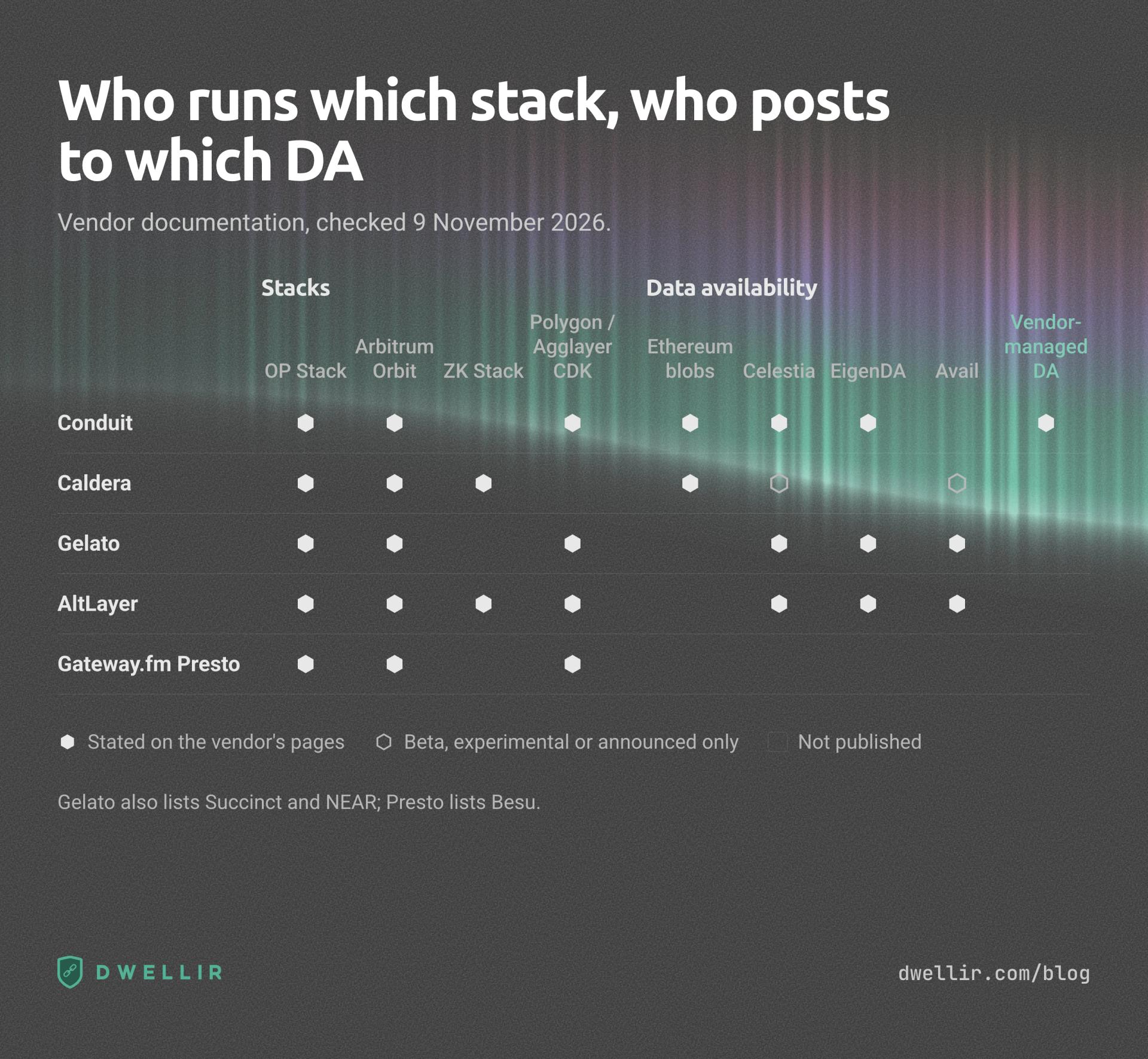
| # | Provider | Stacks | DA options | Published price | Sequencer | Bridge and explorer | Chains launched (vendor claim) | SLA |
|---|---|---|---|---|---|---|---|---|
| 1 | Conduit | OP Stack, Arbitrum Orbit, Agglayer CDK (OP Succinct) | Ethereum blobs, Celestia, EigenDA, Conduit DA, Private DA; AnyTrust on Orbit | Testnet $250/mo; mainnet quoted + 5% sequencer profit; RPC Pro $50/mo included | Conduit G1, G2, G3 by plan | Superbridge or open-source bridge UI; explorer included | 60+ mainnets, $4B TVL, 3B transactions | Per-customer SLA |
| 2 | Caldera | Arbitrum Nitro, OP Bedrock, ZK Stack | Ethereum, Arbitrum AnyTrust, Avail, Celestia (NEAR in docs, beta) | Not published; testnet self-serve, mainnet via call | Single by default; Espresso decentralized sequencing (beta) | Bridge UI, explorer, hub page, faucet; Metalayer bridge aggregation across 50+ networks | 75+ chains, $1B+ peak TVL | 99.99% uptime for all mainnets |
| 3 | Gelato | Arbitrum, OP, Polygon, Succinct, custom | Celestia, EigenDA, Avail, NEAR | Not published | Gelato Turbo: up to 1 Gigagas/s, 5 ms blocks (vendor figures) | Bridge UI, explorer, faucet, indexer, paymaster and bundler | 50+ rollups (Oct 2024), including Ink and Lisk | 99.99% uptime |
| 4 | AltLayer | OP Stack, Arbitrum Orbit, Polygon CDK, ZK Stack | Celestia, EigenDA, Avail | Not published; "two service packages" | Restaked: SQUAD (sequencing), VITAL (verification), MACH (fast finality) on EigenLayer | Via dashboard and partners (Hyperlane) | Not published on docs pages checked | Not published |
| 5 | Gateway.fm Presto | Besu, Arbitrum, OP Stack, Polygon CDK (CDK Erigon), Gateway Stack | Not published | Testnet free in beta; mainnet via sales@gateway.fm | Managed | Blockscout explorer, bridge, faucet; WebSocket on all rollups | Not published | Not published |
Rollkit appears in none of these vendors' documentation; Celestia-based chains are served through the Celestia DA option on OP Stack and Orbit instead. Four names were checked and left out: NodeKit's site states it is shutting down, Vistara has pivoted to agent payments, Lumoz returned HTTP 403 on every fetch, and Instanodes' rollup page returned 404. Syndicate ships an appchain stack with programmable onchain sequencers and is a framework rather than a managed service.
How the Providers Are Ranked
Five criteria, weighted in this order:
- Production footprint the vendor publishes. Named mainnets, TVL, transaction counts. Conduit (60+ mainnets, $4B TVL) and Caldera (75+ chains) lead; AltLayer and Gateway.fm publish no chain count.
- Stack and DA breadth. How many of OP Stack, Arbitrum Orbit, ZK Stack and Polygon CDK the vendor runs, and how many DA layers it posts to. Conduit's five DA options and Gelato's five frameworks score well; Gateway.fm publishes no DA option.
- Pricing transparency. Conduit is the only vendor with figures on its price page.
- A documented reliability commitment. A written SLA figure, failover design, status page. Caldera's reliability page is the most complete.
- Bundled tooling. Bridge UI, explorer, faucet, indexer, account abstraction. Gelato's bundle is the widest.
Gateway.fm Presto sits last because its pages publish no DA option, no chain count and no SLA figure.
1. Conduit
Conduit is the only vendor with numbers on its pricing page. Chain plans come in three tiers, Growth, Pro and Enterprise, each "contact for pricing + 5% sequencer profit", and a Trial Testnet is $250 a month with a 15-minute deploy. Billing is a monthly fee per deployment, cancelled by deleting the chain.
- Stacks: OP Stack (
op-reth), Arbitrum Orbit with Stylus on by default, and Agglayer CDK run as an OP Stack chain with ZK validity proofs via OP Succinct. Conduit operates the CDK stack for Katana and Phala - DA on OP Stack: Ethereum blobs, Celestia, EigenDA, Conduit DA (managed, cloud object storage, publicly verifiable) and Private DA (encrypted, HSM-held keys). Orbit chains need AnyTrust for a custom gas token. Celestia and EigenDA on OP Succinct are marked experimental
- Sequencer tiers G1 (Growth), G2 (Pro, autoscaling and external nodes) and G3 (Enterprise)
- Every chain includes autoscaling RPCs, a block explorer and a metrics dashboard. Mainnet customers get the Conduit Nodes Pro RPC plan free: 1B compute units a month, 250,000 CU per second, $0.10 per additional 1M CU
- The FAQ states Conduit sends the chain keys to a wallet you specify if you want to leave
Chains: 60+ mainnets, $4B TVL, 3B transactions. Named customers include Zora, Mode, Aevo, Plume, Ethena, Katana and Blackbird.
Considerations: The 5% sequencer-profit share rises with your chain's revenue. The RPC bundle is metered in compute units, so trace-heavy explorer and indexer traffic consumes it faster than the headline suggests. Public and free RPC tiers dropped to 25 and 250 requests per second on 4 August 2026.
Best for: Teams that want a price formula before the first call, a managed DA option that avoids blob-market volatility, and a documented exit.
2. Caldera
Caldera runs the Rollup Engine, a one-click deployer for Arbitrum Nitro, OP Bedrock and ZK Stack chains, and the Metalayer, a Hyperlane-based bridge aggregator across 50+ networks. Testnets are self-serve; mainnets start with a booked call.
- DA: Ethereum, Arbitrum AnyTrust, Avail and Celestia on the product page; the docs list Celestia, NEAR and AnyTrust as beta
- Decentralized sequencing through Espresso, in beta. Settlement on Ethereum, Polygon, Cronos, Optimism or Arbitrum
- Bridge UI, block explorer, hub page, faucet and white-label docs
- Reliability page: 99.99% uptime SLA for all mainnets, AWS multi-region Kubernetes, sequencer auto-failover, an L1 RPC fallback proxy that aggregates several RPC providers, and a status page per chain
Chains: 75+ chains on the home page, $1B+ peak TVL. The rollups page gives 360M transactions and 30M wallets, the home page 550M and 17M, so the two are not reconciled. ApeChain runs as an Arbitrum Orbit chain on Caldera. Manta Pacific launched on Caldera's OP Stack with Celestia DA; its later stack is disputed between sources.
Considerations: No price is published for any tier. Alt-DA and Espresso sequencing are both labelled beta.
Best for: Chains that want a written SLA and a choice of DA layers, and ecosystems that value day-one bridging to other Caldera chains.
3. Gelato
Gelato pairs rollup hosting with the account-abstraction tooling it already sells: paymaster, bundler, embedded wallets and an indexer come with the chain.
- Frameworks: Arbitrum, OP, Polygon, Succinct and custom. Settlement on Ethereum, Base or Arbitrum. DA: Celestia, EigenDA, Avail, NEAR
- Gelato Turbo sequencer, rated by the site at up to 1 Gigagas per second and 5 ms blocks. Reya reports sub-100 ms blocks and over 400 Mgas/s peak on it
- 99.99% uptime, high-availability sequencers across availability zones, automated upgrades
- Block explorer, faucet, bridge UI (Across intent bridging is documented), indexer, 4337 and 7702 wallet tooling
Chains: "Over 50 rollups" as of October 2024, including Ink (Kraken), Verify (Fox) and Lisk, launched on the OP Stack in December 2023.
Considerations: The docs host returned an expired certificate and a missing deployment on 9 November 2026, so stack details come from the marketing site. /pricing returns 404. The Turbo figures are vendor benchmarks without published conditions.
Best for: Consumer and trading chains that want gasless UX and sequencer throughput from one vendor.
4. AltLayer
AltLayer sells restaked rollups: three EigenLayer AVSes created per chain, SQUAD for decentralized sequencing, VITAL for state verification and MACH for fast finality. It supports OP Stack, Arbitrum Orbit, Polygon CDK and ZK Stack, with Celestia, EigenDA and Avail as DA, and a no-code dashboard that claims a five-minute deploy.
Considerations: The pricing page says only that there are two service packages. The implementation-status page returned 404 and the ecosystem page defers to an external map, so no chain list could be verified from AltLayer's own documentation.
Best for: Teams whose requirement is decentralized sequencing or fast finality from day one.
5. Gateway.fm Presto
Gateway.fm runs Presto for Besu, Arbitrum, OP Stack, Polygon CDK (CDK Erigon) and its own Gateway Stack. Testnets are free during beta; mainnet is not available in the UI and goes through sales. WebSocket is on for every rollup and the explorer is Blockscout.
Best for: Polygon CDK chains, where Gateway.fm's Erigon work is the deepest documented.
What Your Rollup Still Needs After Launch
A RaaS contract gives you a sequencer, a bridge, an explorer and an RPC endpoint sized for you, the operator. Once an explorer is indexing every block, a wallet is polling balances, a DEX is streaming swaps and a market maker is tracing reverts, someone has to serve that traffic, and the bundled endpoint was not sized for it. Five things decide who does.
Archive state and trace. Explorers, indexers and analytics need every historical block and debug_traceTransaction on it. Whether the bundled RPC exposes archive and debug namespaces, and at what rate, is not published by any vendor here. The cost of running archive nodes yourself is in the hidden cost of archive nodes.
WebSocket. Wallets and bots subscribe to newHeads and logs. Presto states WebSocket on all rollups; Conduit's Pro plan allows 5,000 concurrent connections. Check the cap against your client count; WebSockets for blockchain developers covers the reconnection patterns a launch tests.
Rate limits and units. Conduit meters in compute units, so a trace-heavy mix burns the 1B CU allowance faster than a balance poller would. Per-response metering avoids the conversion. See RPC provider rate limits and RPS compared and best RPC providers for high-throughput workloads.
Multi-region. Caldera hosts in AWS across regions. The RPC your users hit should be in their regions, which may differ from where the sequencer runs.
A second provider. Caldera's reliability page describes an L1 RPC fallback proxy that aggregates multiple providers because the rollup's link to Ethereum is a weak point. Apply the same logic to your own chain: one vendor for the sequencer, at least one independent provider for public and partner traffic. The trade-offs are in self-hosted vs managed RPC nodes.
How a RaaS-launched chain gets onto Dwellir
Dwellir runs its own nodes and sells access three ways, with trace and debug included at 1 response = 1 credit:
- Shared plans on the pricing page: Developer $49 a month for 25M responses at 100 RPS, Growth $299 for 150M at 500 RPS, Scale $999 for 500M at 5,000 RPS with 10,000 burst, Free at 20 RPS and 100,000 responses a day. One key covers 170+ networks (testnets included) across the 110 chains in the catalog
- Unlimited Nodes: one endpoint with the meter off, 25 to 1,000 RPS, $119 to $4,799 a month
- Dedicated node clusters: isolated, redundant archive nodes in the regions you choose, no rate limit, no request counting, 99.99% uptime SLA, HTTP, WebSocket, trace and debug. Archive clusters start at $2,400 a month; full-node clusters are quoted separately and usually lower
The catalog behind the /networks pages listed 110 chains on 9 November 2026, 48 of them EVM, 107 with a dedicated cluster at a published list price. Four were launched through vendors in this post:
| Chain | Launched through | Stack | Dedicated archive cluster list price |
|---|---|---|---|
| Ink | Gelato | OP Stack | $2,400/mo |
| Zora | Conduit | OP Stack | $3,412/mo |
| Manta Pacific | Caldera | OP Stack at launch | $3,600/mo |
| Lisk | Gelato | OP Stack | $4,080/mo |
For a chain in the catalog, the dedicated cluster page describes three steps: pick the chain for its list price, a 30-minute call to agree throughput, regions and node mode, then a fixed quote and the same invoice every month. Shared endpoints for the same chains run from the free tier up. A per-chain guide exists for Ink, and guides for the parent stacks cover Optimism and Arbitrum.
For a chain not yet in the catalog, the dedicated cluster page lists "priority chain launches" as a benefit and routes new networks through contact. The site does not publish lead times or a process for adding a network, so ask before you fix a launch date around it.
Conclusion
Conduit is the vendor to shortlist first for most teams: the only price formula on a page, three stacks with five DA options including a managed DA that sidesteps blob pricing, and a documented way to take your keys and leave. Caldera is the alternative when a written 99.99% SLA and failover design matter more than DA choice, at the cost of a sales call for every price. Gelato is the pick when the product depends on gasless UX and sequencer throughput, once its documentation host is back.
Whichever vendor runs the sequencer, budget the RPC separately. The bundled endpoint is one plan from one provider, metered in that provider's units. Ink, Zora, Lisk and Manta Pacific all ended up with independent providers serving public traffic, and a dedicated archive cluster from $2,400 a month is a number you can put in the launch budget today.
Planning a chain launch? Talk to the Dwellir team about shared endpoints or a dedicated cluster for your network, or create a free account to test against the chains already in the catalog.
Frequently Asked Questions
Which rollup-as-a-service provider is the most reliable?
Judge reliability by what the vendor commits to in writing. Conduit publishes a per-customer SLA and reports 60+ mainnets; Caldera documents a 99.99% uptime SLA for all mainnet deployments, multi-region AWS hosting, sequencer auto-failover and a public status page per chain; Gelato states 99.99% uptime. AltLayer and Gateway.fm Presto publish no rollup-specific SLA figure. Whatever the vendor promises, your chain's RPC is a single-provider dependency at launch, so plan a second RPC provider before mainnet.
How much does rollup-as-a-service cost in 2026?
Only Conduit publishes a figure: a trial testnet is $250 a month, and every mainnet chain plan is quoted on request plus 5% of sequencer profit. Caldera, Gelato, AltLayer and Gateway.fm all price mainnet chains through sales. Older reports of $50 testnets and $3,000 mainnets for Conduit are from 2024 and no longer match its pricing page. On top of the vendor fee, budget for L1 or alt-DA posting costs, which the vendor passes through, and for production RPC.
Which RaaS supports the most rollup stacks?
AltLayer lists four: OP Stack, Arbitrum Orbit, ZK Stack and Polygon (Agglayer) CDK. Gelato lists Arbitrum, OP, Polygon, Succinct and custom frameworks. Gateway.fm Presto lists Besu, Arbitrum, OP Stack, Polygon CDK and its own Gateway Stack. Conduit and Caldera each run three. Nobody in this list documents Rollkit.
Does a RaaS provider include RPC for my chain?
Yes, every provider here bundles RPC endpoints, a block explorer and a bridge UI. The bundled RPC is sized for the chain operator, not for every team that will build on the chain. Conduit's bundled plan is its Pro RPC tier: 1B compute units a month, 250,000 CU per second, then $0.10 per million CU. Explorers, indexers, wallets and trading desks on a live chain also need archive state, trace and debug methods, WebSocket subscriptions and a second provider for failover.
How does a RaaS-launched chain get onto Dwellir?
Dwellir's catalog lists 110 chains as of 9 November 2026, 107 of them with a dedicated archive cluster at a published monthly list price from $2,400. Four were launched through RaaS vendors in this post: Ink and Lisk through Gelato, Zora through Conduit, Manta Pacific through Caldera. For a chain in the catalog, the dedicated cluster page describes three steps: pick the chain, a 30-minute call to agree throughput, regions and node mode, then a fixed monthly price. For a chain not yet listed, contact the Dwellir team; the pages do not publish an onboarding process for new networks.
Sources
All vendor figures checked on 9 November 2026.
- Conduit pricing, RPC pricing and throughput, OP Stack, Arbitrum Orbit, Agglayer CDK, Conduit DA, FAQ, chains overview
- Caldera rollups, quickstart, alternative DA, decentralized sequencing, reliability, Metalayer
- Gelato Rollups, Series A+ and Ink announcement, 28 October 2024
- AltLayer RaaS offering, pricing model
- Gateway.fm, Presto docs, how to deploy mainnet, Presto FAQ
- NodeKit, Vistara, Instanodes, Syndicate docs
- Dwellir pricing, dedicated clusters, Unlimited Nodes, network catalog API