Six providers serve Elysium today, and they differ on most of the features a trading chain needs. The provider Kinetiq recommends has no debug API. The operator's free public endpoint has no WebSocket without a key. Only some keep archive state, and the cost of an eth_getLogs call ranges from about $2 to $31.50 per million depending on whose meter you are on.
Elysium is Kinetiq's Arbitrum Orbit L2 for the Hyperliquid ecosystem: it settles to HyperEVM, pays gas in HYPE, and produces a block roughly every 130 ms. Only the testnet (chain ID 99801) is live. Kinetiq has not published a mainnet chain ID; its X account has teased November 9. Every provider below serves the testnet, and this comparison covers what each one offers as of October 22, 2026.
If you need background on the chain itself first, start with What Is Elysium?.
What Makes Elysium Different for RPC
Elysium runs stock Arbitrum Nitro (ArbOS 61 on testnet), so the JSON-RPC surface is familiar. The workload is not.
Blocks arrive 7 to 8 times per second. At ~130 ms per block, Elysium produces about 670,000 blocks a day. Polling eth_blockNumber misses heads and wastes requests. WebSocket newHeads subscriptions are the practical way to follow the chain, and the one free endpoint that offers WebSocket publishes no rate limits or SLA.
Log queries hit range caps fast. The public RPC caps unfiltered eth_getLogs at 2,000 blocks, about four minutes of history. Indexing a single day takes more than 300 calls. Range limits and per-call log pricing decide what a backfill costs.
There is no mempool. A single sequencer orders transactions by priority fee, and pending-transaction filters never deliver anything. Trading systems react to blocks, which makes head latency and WebSocket stability the metrics that count.
Debug traces are the only trace option. Nitro does not implement Parity-style trace_*, and arbtrace_* only covers pre-Nitro Arbitrum One history. On Elysium, debug_traceTransaction with callTracer or flatCallTracer is the only way to see inside a reverted transaction. Whether your provider offers it, and what it charges, is a first-order question.
Bad chain configs are common. viem's built-in elysiumTestnet export is an unrelated Vulcan Forged chain (ID 1338, gas token LAVA). Confirm eth_chainId returns 0x185d9 on any endpoint you test.
What to Look for in an Elysium RPC Provider
- WebSocket support for
newHeadsand log subscriptions at sub-second block times. - Debug API access, and whether debug calls cost more than standard reads.
- Archive state for backtesting quote logic, reconciling fills and querying positions at past blocks.
eth_getLogsrange and pricing, since indexers live on this method.- Normalized pricing. Compute units, credits and request units are not comparable until you convert them to dollars per million calls.
- Mainnet commitment. All six serve testnet only. Check which providers have said they will serve mainnet.
How to Compare Elysium Pricing
Three billing models are in play.
Per-response or per-request billing. Dwellir counts one API credit per response for every method. Chainstack counts one request unit per call at the chain tip and two for archive calls (anything older than 127 blocks, plus debug).
Compute units and credits. Alchemy weights each method: eth_call is 26 CU, eth_getLogs 60 CU, eth_blockNumber 10 CU, at $0.525 per million CU on pay-as-you-go. QuickNode and Conduit also bill in weighted units, but neither publishes per-method weights for Elysium.
Free public endpoints. Kinetiq's endpoint (run by Conduit) and Hypedexer's cost nothing, publish no rate limits and offer no SLA.
The fair comparison is dollars per million calls for the methods you actually use. On Elysium that usually means eth_call for quoting, eth_getLogs for indexing, and debug traces for diagnosing reverts.
1. Dwellir
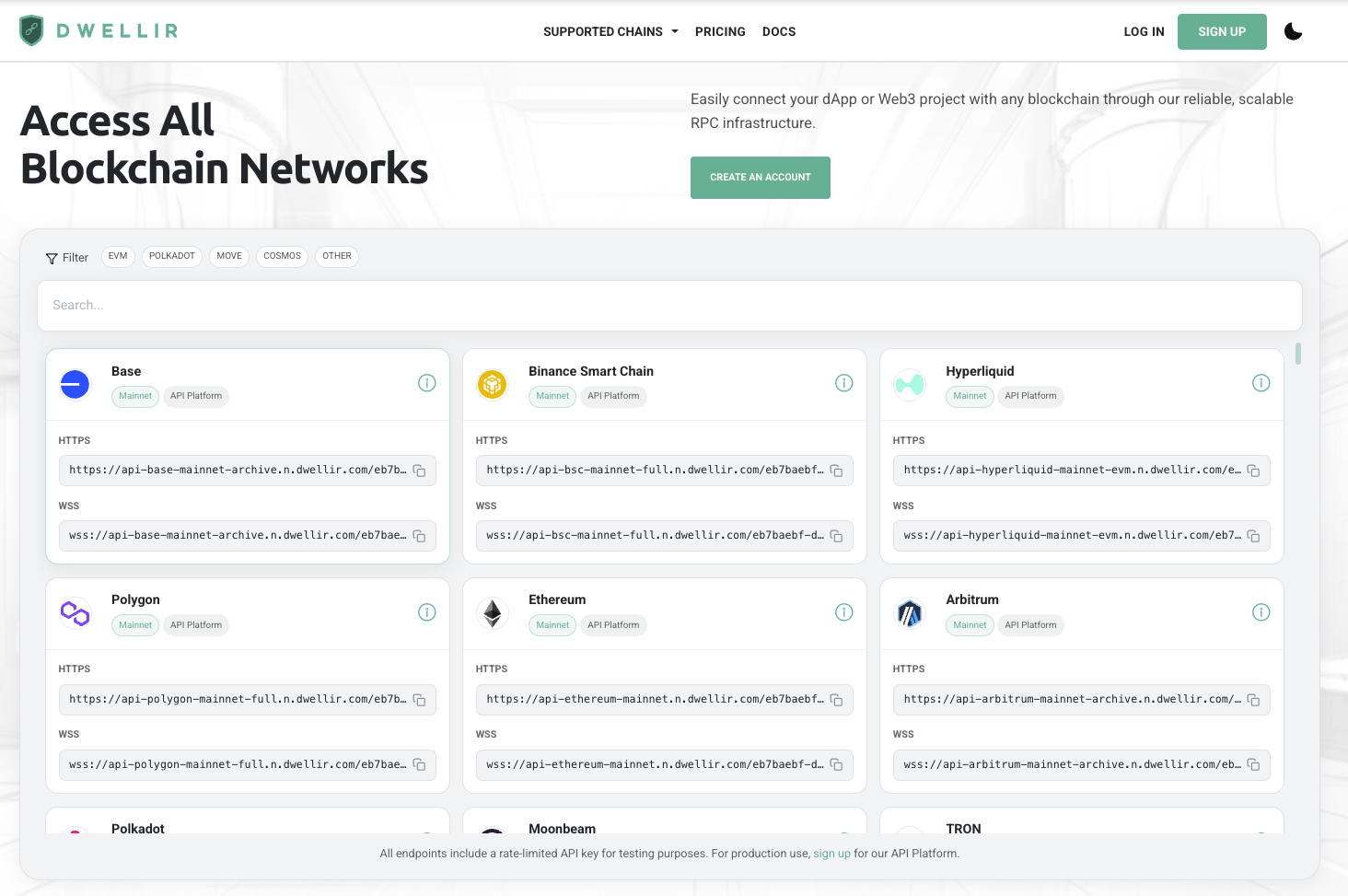
Dwellir serves Elysium testnet at api-elysium-testnet-archive.n.dwellir.com from an archive Nitro node in Singapore, with the eth, net, web3, debug and arb namespaces over HTTPS and WebSocket. The node syncs from Dwellir's own HyperEVM testnet node rather than the public HyperEVM RPC, which times out on the inbox log queries Nitro needs. Launch details are in Dwellir Adds Elysium RPC Support.
Pricing is 1:1: one response is one API credit, whether the call is eth_blockNumber, a wide eth_getLogs or debug_traceTransaction.
Key features:
- Archive state from genesis
debug_*tracing at the standard credit price- WebSocket subscriptions
- HyperEVM and HyperCore infrastructure on the same platform, including Tokyo gRPC streaming for Hyperliquid
- 150+ networks on one API key
- Served from Singapore
Pricing:
| Plan | Monthly cost | Responses included | RPS | Overage |
|---|---|---|---|---|
| Free | $0 | 100,000/day | 20 | - |
| Developer | $49 | 25M | 100 | $5/M |
| Growth | $299 | 150M | 500 | $3/M |
| Scale | $999 | 500M | 5,000 | $2/M |
The flat model helps on Elysium in two ways. Indexers spend most of their budget on eth_getLogs, the method that compute-unit providers weight most heavily. And debug traces, which Elysium's lack of trace_* makes your only diagnostic tool, cost the same $1.96 per million as a block number lookup.
Best for: Trading and indexing workloads that need archive state, debug traces and WebSocket on one endpoint at a predictable per-call price.
2. Conduit
Conduit runs Elysium's sequencer. Conduit is a rollup-as-a-service company whose customers include Base, Polygon and Tempo, and Kinetiq's public RPC at testnet-rpc.elysium.kinetiq.xyz is Conduit infrastructure. The same backend answers at rpc-elysium-testnet.t.conduit.xyz. Keyed access through Conduit Nodes gives you the operator's own endpoint, with WebSocket, debug and trace methods unlocked.
Key features:
- Endpoints from the team that runs the Elysium sequencer
- Free public RPC, no key required
debug_*,trace_*and WebSocket with a Conduit Nodes key (401 without one)- A generous free keyed tier: 100M CU per month on Nodes Starter
- Public RPC:
eth_getLogscapped at 2,000 blocks without an address filter, 10,000 results with one; batches of 100 or more calls are rejected
Pricing:
| Plan | Monthly cost | Included | Overage |
|---|---|---|---|
| Public RPC | $0 | Rate-limited, unpublished | - |
| Nodes Starter | $0 | 100M CU | - |
| Nodes Pro | $50 | 1B CU | $0.10/1M CU |
Conduit does not publish per-method CU weights, so the Pro rate of $0.05 per million CU cannot be converted to a per-call price. The keyless public endpoint rate-limited our probes after about a dozen rapid calls, which is fine for a wallet connection and not for a bot; use a Nodes key for anything automated.
Best for: Teams that want keys from the operator that runs the sequencer, and anyone getting started with zero setup.
3. Chainstack
Chainstack was the first commercial provider to announce Elysium support, on October 2, 2026. It offers both shared Global Nodes and Dedicated Nodes, which makes it the only provider here selling single-tenant Elysium infrastructure today.
Key features:
- Global Nodes (shared, geo-balanced) and Dedicated Nodes in Full or Archive mode
- HTTPS and WebSocket
debug_*withcallTracer,prestateTracer,flatCallTracer,muxTracer,erc7562TracerandstylusTracer, back to genesiseth_getProofonly within 127 blocks of the tip- Unlimited Node option with flat RPS-based billing
Pricing:
| Plan | Monthly cost | Request units | RPS |
|---|---|---|---|
| Developer | $0 | 3M RU | 25 |
| Growth | $49 | 20M RU | 250 |
| Pro | $199 | 80M RU | 400 |
Chainstack bills 1 RU per call at the chain tip and 2 RU for archive and debug calls, so Growth works out to $2.45 per million recent calls and $4.90 per million archive or debug calls. Overage on Growth is $15 per million RU. Chainstack's launch post says debug needs Growth or above, while its methods page lists debug on Global Nodes generally, so test with your own plan before you depend on it.
Best for: Teams that want a dedicated Elysium node today, or broad tracer support on a shared endpoint.
4. Hypedexer
Hypedexer, run by Enigma Validator, offers a free public Elysium RPC with no key, plus an indexed REST data API. On our probes it was the most capable free endpoint.
Key features:
- Free, keyless HTTPS and WebSocket at
elysium-testnet-rpc.hypedexer.com - Archive state:
eth_getProofat block 4,096 returned a valid proof - 10,000-block
eth_getLogsqueries succeeded - No
debug_*ortrace_* - Open-source Docker setup for self-hosting an Elysium node
- Data API with 5,000 free credits per month
Pricing: The RPC is free. Rate limits and uptime commitments are not published.
Best for: Prototyping, archive queries and backfills during development, and teams evaluating self-hosting.
5. Alchemy
Alchemy is the provider Kinetiq's connection docs name as its "recommended infrastructure provider", and the only one Kinetiq lists as live on mainnet from day one. Kinetiq's docs already print Alchemy mainnet URLs. If you want the provider the chain team is coordinating with, this is it.
Key features:
- HTTPS and WebSocket endpoints at
elysium-testnet.g.alchemy.com - Kinetiq's recommended provider, with mainnet planned from launch
- Archival data listed on all plans in Alchemy's general pricing
- No Debug API or Trace API on Elysium; both are listed as not currently supported
Pricing:
| Plan | Monthly cost | Included | Throughput |
|---|---|---|---|
| Free | $0 | 30M CU/month | 15 RPS |
| Pay as You Go | $0.525/1M CU | Usage-based | From 300 RPS |
| Enterprise | Custom | Custom | Custom |
Alchemy's headline rate is low and its method weights are high. At 26 CU, eth_call costs $13.65 per million calls. At 60 CU, eth_getLogs costs $31.50 per million. The bigger gap for trading teams is the missing debug API: if a quote update reverts on Elysium, you need a second provider to trace it.
Best for: Teams that want the chain team's recommended provider and guaranteed day-one mainnet access, and can trace reverts elsewhere.
6. QuickNode
QuickNode published Elysium documentation on October 15, 2026, and serves the testnet on shared endpoints over HTTPS and WebSocket.
Key features:
debug_*methods and thearb_*namespace- No
trace_*orarbtrace_* - Routing to the nearest available location
- Dedicated Clusters on Enterprise
- Add-on marketplace and Streams on the wider platform
Pricing:
| Plan | Monthly cost | API credits | RPS |
|---|---|---|---|
| Free trial | $0 (1 month) | 10M | 15 |
| Build | $49 | 80M | 50 |
| Accelerate | $249 | See pricing page | 125 |
| Scale | $499 | See pricing page | 250 |
Build works out to about $0.61 per million credits, but QuickNode does not publish Elysium's per-method credit weights, and debug calls carry a 2x chain multiplier. Until the weights are public, you cannot compute a per-call price without running your own traffic and reading the dashboard.
Best for: Teams already on QuickNode who want Elysium on the same account, with debug access.
Provider Comparison
| Provider | Free tier | Entry paid | Archive | WSS | Debug | Pricing model |
|---|---|---|---|---|---|---|
| Dwellir | 100K/day, 20 RPS | $49/mo | Yes | Yes | Yes, 1 credit | 1 response = 1 credit |
| Conduit | Public RPC + 100M CU | $50/mo | Yes (public RPC) | Key only | Key only | Compute units |
| Chainstack | 3M RU/mo, 25 RPS | $49/mo | Yes | Yes | Yes, 2 RU | Request units |
| Hypedexer | Free public RPC | n/a | Yes | Yes | No | Free |
| Alchemy | 30M CU/mo, 15 RPS | PAYG $0.525/1M CU | Not stated for Elysium | Yes | No | Compute units |
| QuickNode | 10M credits (trial) | $49/mo | Not stated for Elysium | Yes | Yes, 2x multiplier | API credits |
None of the six exposes trace_* or arbtrace_* on Elysium. InfraSingularity is listed by Kinetiq as "exploring" Elysium and has nothing live. We also checked dRPC, Ankr, GetBlock, Tenderly, thirdweb, BlockPI, Validation Cloud, Allnodes, OnFinality and NOWNodes, and found no Elysium support.
Cost Per Million Calls
Only three providers publish enough to compute a per-call price. Rates use each provider's cheapest paid plan.
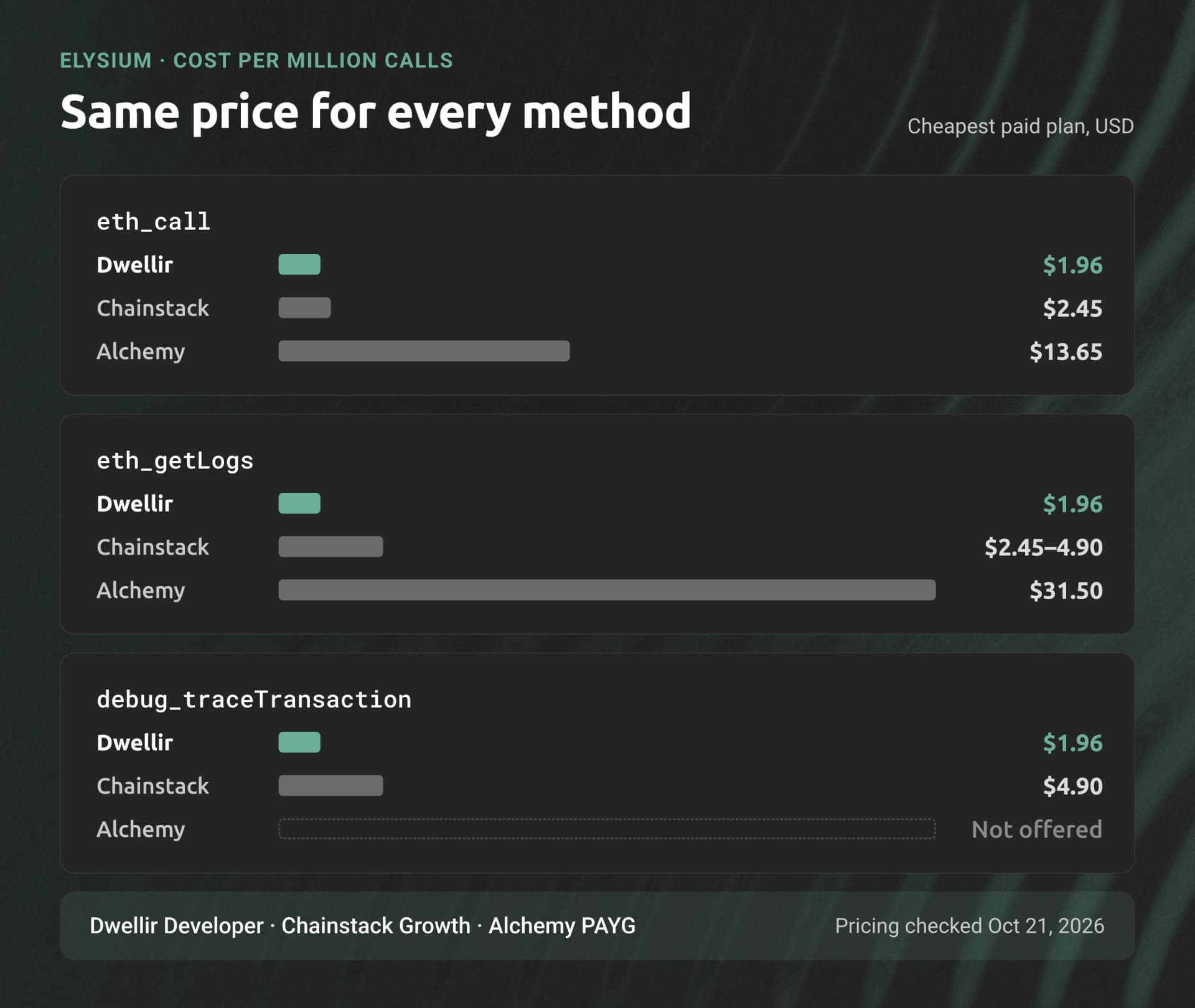
| Method | Dwellir (Developer) | Chainstack (Growth) | Alchemy (PAYG) |
|---|---|---|---|
eth_blockNumber | $1.96 | $2.45 | $5.25 |
eth_call (latest) | $1.96 | $2.45 | $13.65 |
eth_call (historical) | $1.96 | $4.90 | $13.65 |
eth_getLogs | $1.96 | $2.45 to $4.90 | $31.50 |
debug_traceTransaction | $1.96 | $4.90 | Not available |
QuickNode and Conduit are left out because neither publishes Elysium per-method weights.
What That Costs at Volume
Take a market-making and indexing workload of 100M calls a month: 50% eth_call, 30% eth_getLogs, 20% eth_blockNumber.
- Dwellir: Growth at $299 covers 150M responses. $299/month.
- Chainstack: 100M RU at the chain tip needs a plan above Pro's 80M, plus 2 RU for any historical calls. Check Chainstack's pricing page for current tiers.
- Alchemy: 50M × 26 + 30M × 60 + 20M × 10 = 3.3B CU, at $0.525 per million CU. $1,732.50/month, about 5.8x Dwellir's price.
Add debug traces for revert analysis and the gap widens, since Alchemy cannot serve them at all and Chainstack charges double for them.
Which Elysium Provider to Choose
Best all-round choice: Dwellir. Archive state, WebSocket and debug traces on one endpoint, with every method at the same $1.96 per million. On a chain where eth_getLogs drives indexing costs and debug traces are the only way to inspect a revert, flat pricing removes the two biggest cost surprises.
Best for operator-run endpoints: Conduit. It runs the Elysium sequencer, and a free Nodes key unlocks WebSocket, debug and trace methods on the same backend that serves Kinetiq's public RPC.
Best for dedicated infrastructure today: Chainstack. It is the only provider selling single-tenant Elysium nodes right now, in Full or Archive mode with a wide set of tracers.
Best free option for development: Hypedexer. It is keyless, keeps archive state, offers WebSocket and handles 10,000-block log queries. Move to a paid endpoint before anything touches real funds.
Best for day-one mainnet certainty: Alchemy. Kinetiq recommends it and already publishes its mainnet URLs. Pair it with a debug-capable provider for revert analysis.
Getting Started
Before you commit, run three checks against each candidate endpoint with your own workload:
eth_chainIdreturns0x185d9, which rules out stale Vulcan Forged configs.- Count how many
newHeadsevents arrive over WebSocket in 10 seconds. At ~130 ms blocks you should see 75 or more. - Run
debug_traceTransactionwithcallTraceron a recent transaction from the testnet explorer.
All three are cheap to run on a free tier, and together they show whether a provider can handle a trading workload on Elysium.
Ready to build? Create a Dwellir account and follow the Elysium quickstart, or talk to the Dwellir team about dedicated Elysium nodes and high-RPS quote infrastructure.
For more comparisons, see Hyperliquid RPC Providers and Top Arc RPC Providers.