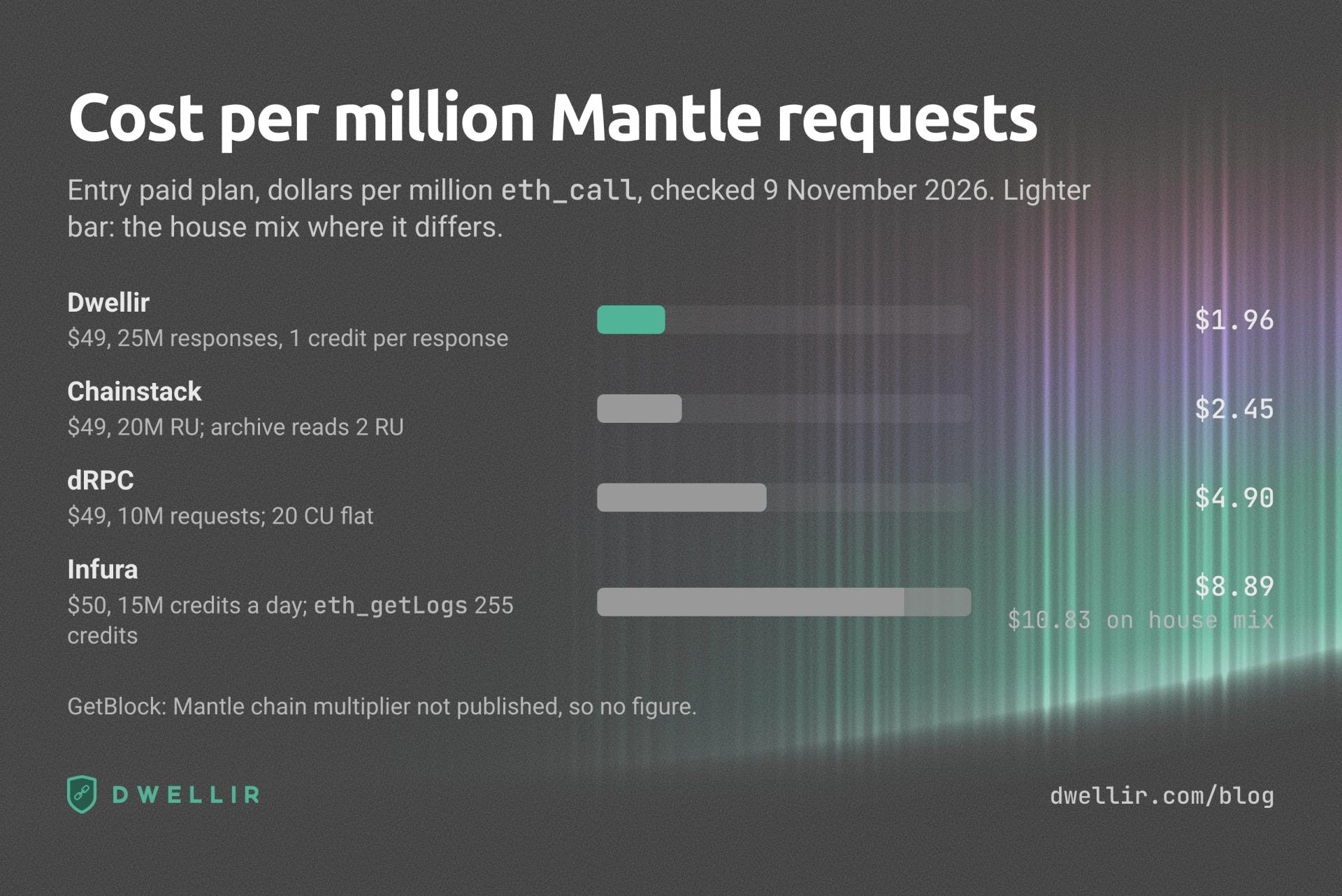
For most teams building on Mantle, Dwellir is the lowest-cost provider that includes archive state, WebSocket and debug tracing on a shared plan: $1.96 per million responses on the $49 Developer plan, the same price for every method, verified today on an endpoint that answered eth_call at block 10,000,000 and traced a block with debug_traceBlockByNumber. Chainstack is next at $2.45 per million with archive reads at double, dRPC charges $4.90 on flat compute units, and Infura's credit table comes to $8.89 on eth_call and $10.83 on a realistic method mix.
Mantle is an unusual L2 to pick a provider for, because the chain under the endpoint has changed three times since launch. It went live in July 2023 as an OVM rollup, moved to an OP Stack Bedrock base on 15 March 2024 (the v2 Tectonic upgrade), swapped its data availability layer twice, and added ZK validity proofs in September 2025. Each change left something an RPC consumer notices: a pre-Bedrock history boundary that full nodes cannot cross, a gas token that is not ETH, and a fee model with its own RPC method. The public endpoint at rpc.mantle.xyz is fine for a wallet, but it rejected more than half of a 600-request burst in our test and does not expose debug_*.
This post compares 5 commercial providers and 2 free public endpoints on Mantle mainnet (chain ID 5000). Every price and limit was read from the provider's own pricing page or docs on 9 November 2026, and the Dwellir, dRPC and both public endpoints were tested live. Dwellir publishes this post and is in the list; the methodology shows the working.
Mantle in 2026: What an RPC Consumer Needs to Know
- Chain ID 5000 (
0x1388), confirmed witheth_chainIdon four endpoints. Sepolia testnet is 5003. - Gas is paid in MNT. Since Tectonic, MNT is the rollup's native asset rather than a bridged ERC-20, and EIP-1559 transactions are supported.
eth_gasPriceandeth_estimateGasreturn MNT-denominated values. - Blocks arrive every 2 seconds. We measured six blocks in 12 seconds on 9 November and the chain passed block 103,040,000 the same day. Dwellir's docs page says "sub-second", which is stale.
- OP Stack fork with ZK validity proofs. Mantle upgraded to OP Succinct on 16 September 2025, so state roots are proven with SP1 instead of waiting out a 7-day fault-proof window. L2BEAT classifies it as a Stage 0 ZK rollup with $1.18 billion secured.
- Data availability is Ethereum blobs. MantleDA was switched off for EigenDA on 19 March 2025, Mantle announced the move to blobs on 22 January 2026, and the Arsia upgrade in April 2026 removed the EigenDA code path. GetBlock still describes EigenDA on its Mantle page.
- Arsia changed the fee model. Fees are
L2ExecutionFee + L1DataFee + OperatorFee, with a dynamic EIP-1559 base fee and a neweth_estimateTotalFeemethod that returns the total. - The pre-Bedrock boundary matters for archive work. A full node returns "no historical RPC is available for this historical (pre-bedrock) execution request" for state before the Tectonic block, so a provider that answers
eth_callat block 10,000,000 is routing to legacy history as well as running an archive node. Official endpoints also rejecteth_sendTransactionand return an emptyeth_accounts.
Top Pick by Use Case
- Lowest cost per request with archive, WSS and debug included: Dwellir, $1.96 per million on the $49 Developer plan.
- Per-request pricing with SOC 2 Type II: Chainstack Growth, $2.45 per million.
- Free tier for a prototype: dRPC, 210M compute units a month (about 10M requests) at 100 RPS with archive and WebSocket. Dwellir's Free plan is 100,000 responses a day at 20 RPS.
- Highest published shared rate limit: Dwellir Scale, 5,000 responses per second with bursts to 10,000, for $999. The next highest is GetBlock at 800 RPS for $499.
- Fixed monthly price: a Dwellir Unlimited Node from $119 (25 RPS) to $4,799 (1,000 RPS), or a Mantle dedicated cluster at $3,006 list.
The Numbers: Price per Million, Unit, Free Tier, Archive, WSS and RPS
Entry-tier cost per million eth_call, cost per million on the house mix in the methodology, the billing unit, and the highest rate limit sold without a sales call. Archive and WSS refer to Mantle mainnet on shared plans. Sorted by eth_call cost.
| Provider | $ per 1M eth_call (entry plan) | $ per 1M on house mix | Unit | Free tier | Archive | WSS | RPS cap (top self-serve plan) |
|---|---|---|---|---|---|---|---|
| Dwellir | $1.96 ($49, 25M responses) | $1.96 | 1 credit per response, every method | 100K/day, 20 RPS | Yes (verified) | Yes (verified) | 5,000, bursts to 10,000 ($999) |
| Chainstack | $2.45 ($49, 20M RU) | $2.45 | 1 RU; 2 RU for archive, debug, trace | 3M RU/month, 25 RPS | Yes (2 RU) | Yes | 600 ($499) |
| dRPC | $4.90 ($49, 10M requests) | $4.90 | 20 CU flat; $6 per 1M overage | 210M CU/month (~10M requests), 100 RPS | Yes (verified) | Yes | 600 ($199) |
| GetBlock | Not published for Mantle ($49, 90M CU; Mantle absent from the chain-multiplier table) | Not published | CU = chain x method multiplier, x2 on archive endpoints | 50K CU/day, 20 RPS | Shared: not published. Dedicated archive nodes | Yes | 800 ($499) |
| Infura | $8.89 ($50, 15M credits/day) | $10.83 | Credits: eth_call 80, eth_getLogs 255, debug_traceTransaction 1,000 | 3M credits/day | Not published for Mantle | Not published for Mantle | 40,000 credits/s, ~500 eth_call/s ($225) |
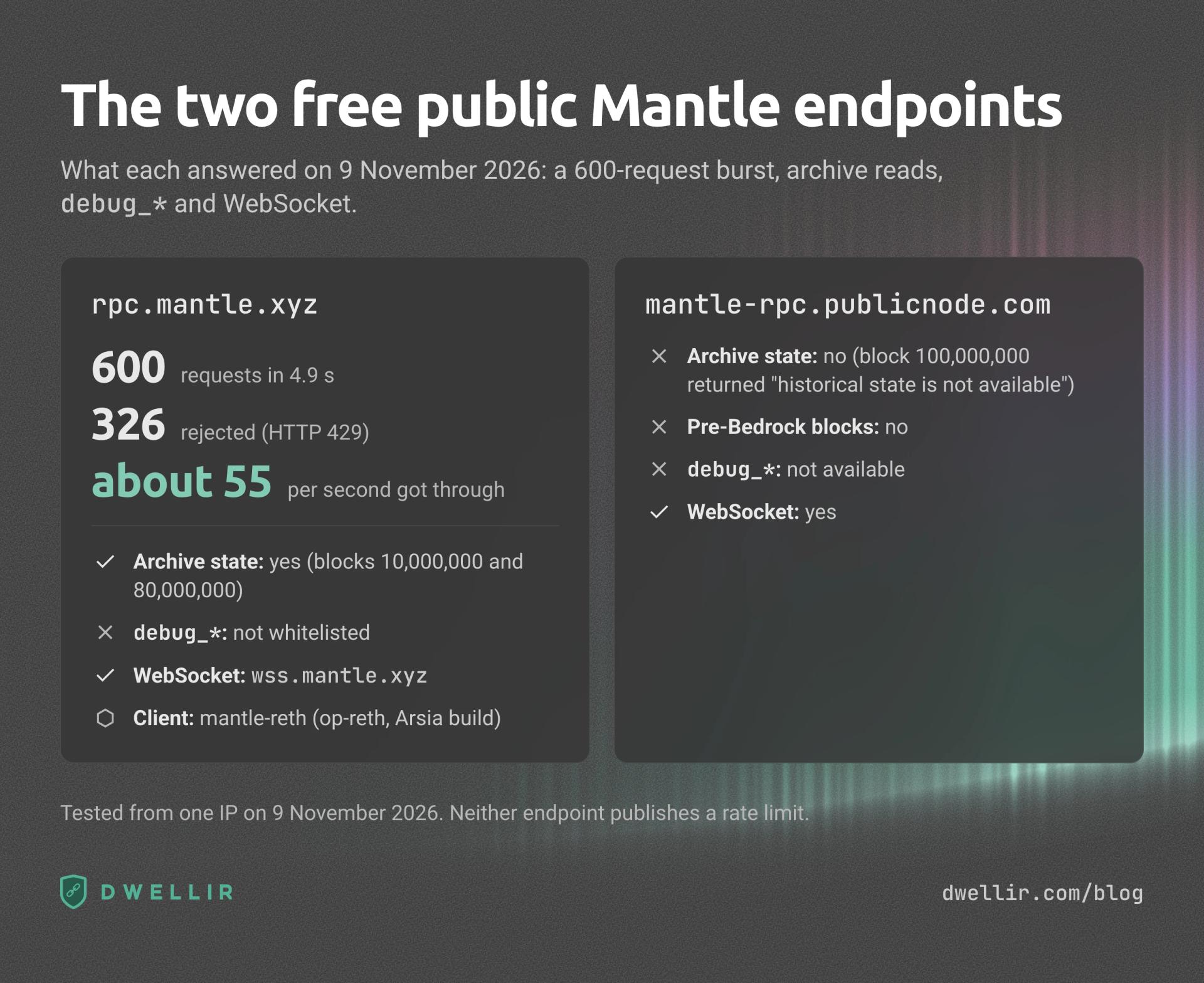
Two free public endpoints sit outside the table. Mantle's https://rpc.mantle.xyz and wss://wss.mantle.xyz run mantle-reth (an op-reth build tagged arsia), serve archive state back into the pre-Bedrock era, reject debug_* with "rpc method is not whitelisted" and publish no rate limit; in our burst test 326 of 600 requests came back 429 in 4.9 seconds. PublicNode's https://mantle-rpc.publicnode.com and its WSS twin are full nodes: eth_call at block 100,000,000, about 3 million blocks behind the head, returned "historical state is not available", and debug is not exposed.
1. Dwellir
Dwellir serves Mantle mainnet and Sepolia on archive nodes at one credit per response for every method. The Mantle network page lists the HTTPS and WSS endpoints at api-mantle-mainnet.n.dwellir.com; the Mantle docs cover 54 methods.
Verified on 9 November 2026: eth_chainId returns 0x1388; eth_call against WMNT at block 10,000,000 returns the historical total supply, so the endpoint reaches across the pre-Bedrock boundary; debug_traceBlockByNumber with callTracer returns traces; the WebSocket upgrade answers 101 Switching Protocols.
Plans: Free at 20 responses per second and 100,000 a day without eth_getLogs; Developer $49 for 25M responses at 100 RPS (500 burst) with $5 per million overage; Growth $299 for 150M at 500 RPS (2,500 burst), $3 overage; Scale $999 for 500M at 5,000 RPS (10,000 burst), $2 overage. Limits apply per account on a token bucket. An Unlimited Node turns the meter off for one endpoint at $119 (25 RPS) to $4,799 (1,000 RPS) a month, and a Mantle dedicated cluster lists at $3,006.
Considerations: no MEV-protected routing (dRPC has it), no SOC 2 report, and log-driven prototypes start at $49 because Free excludes eth_getLogs.
Best for: indexers, analytics backends and DeFi protocols that mix traces, logs and reads and want the invoice to track call count.
2. Chainstack
Chainstack lists Mantle for Global Nodes and Dedicated Nodes in full and archive modes. Billing is 1 request unit for a recent-state call and 2 for archive, debug or trace. Developer is free with 3M RU at 25 RPS; Growth $49 for 20M at 250 RPS ($2.45 per million); Business $499 for 200M at 600 RPS; Enterprise $990 with no RPS cap. An Unlimited Node add-on starts at $149 for 25 RPS, dedicated nodes bill from $0.50 per node-hour, and Chainstack holds SOC 2 Type II and ISO 27001.
Considerations: archive reads cost $4.90 per million on Growth, and overage runs $5 to $20 per million by plan.
Best for: regulated teams that need audit documentation with per-request pricing, or a dedicated Mantle node billed by the hour.
3. dRPC
dRPC tags its Mantle endpoint as archive, with WebSocket at wss://mantle.drpc.org, and charges 20 compute units for every method. The free tier is the largest here: 210M CU a month, about 10M requests, at 100 RPS on public nodes with archive, debug, trace and WebSocket. Pro is $49 for 10M requests at 300 RPS ($4.90 per million), Scale $199 for 47M at 600 RPS, overage $6 per million, with front-running protection on paid plans. The public https://mantle.drpc.org returned archive state at block 10,000,000 in our test.
Considerations: the free tier limits per IP, which catches Kubernetes pods behind one NAT address, and the paid rate is 2.5x Dwellir's.
Best for: MEV-sensitive submission on Mantle, and a free tier you can build on before paying.
4. GetBlock
GetBlock added Mantle on 17 September 2025 with shared JSON-RPC and WebSocket endpoints plus dedicated full and archive nodes. Shared plans run from Starter at $49 for 90M CU and 250 RPS to Pro at $499 for 1B CU and 800 RPS. Cost per call is chain multiplier x method multiplier, doubled on archive endpoints, but the chain-multiplier table does not name Mantle: at the "others" default of 10, eth_call would be $5.44 per million on Starter; at Ethereum's 20, $10.89. We left the cell unpublished rather than pick one. GetBlock holds SOC 2 Type II.
Considerations: archive mode on shared Mantle endpoints is not stated, and the Mantle page still lists EigenDA.
Best for: a dedicated Mantle archive node from a provider with endpoints in New York, Frankfurt and Singapore.
5. Infura
Infura lists Mantle and mantle-mainnet.infura.io is live. Quotas are daily: Core is free with 3M credits a day, Developer $50 for 15M at 4,000 credits per second, Team $225 for 75M at 40,000 per second. eth_call is 80 credits, eth_getLogs 255 and debug_traceTransaction 1,000, so Developer comes to $8.89 per million eth_call and $10.83 on the mix.
Considerations: Infura publishes no Mantle reference page, so archive depth, WebSocket and debug on Mantle are unconfirmed, and exhausting the daily quota returns HTTP 402.
Best for: teams in the MetaMask developer ecosystem with light, predictable Mantle traffic.
Which Provider for Which Mantle Workload
Indexer or analytics backfill across Mantle's full history. You need archive state on both sides of the Tectonic boundary and a unit that does not punish eth_getLogs. Dwellir (1 credit, 10,000-block ranges on Growth) or Chainstack (2 RU on archive reads). Avoid PublicNode, which has no history.
Trading bot or liquidator. Submissions and traces dominate. Dwellir charges one credit for eth_sendRawTransaction and debug_traceTransaction, Chainstack bills a trace at 2 request units, and Infura at 1,000 credits. For private transaction routing, dRPC's paid plans include it.
Wallet or consumer app. Light reads at modest rate. dRPC's free tier covers about 10M calls a month, Chainstack's 3M request units, Dwellir's 100,000 responses a day. Once you pay, Dwellir's $49 buys 25M responses against 20M on Chainstack Growth and 10M on dRPC Pro.
Bridge or withdrawal proving. The output roots you verify against L1 live in the OPSuccinctL2OutputOracle on Ethereum, so read that contract directly.
Conclusion
For most Mantle workloads Dwellir is the best all-round choice: the lowest metered rate at $1.96 per million with no method weighting, archive state that reaches pre-Bedrock blocks, debug tracing on every paid plan, and the highest published shared ceiling at 5,000 responses per second. Chainstack is the pick for teams that must show SOC 2 Type II paperwork, and dRPC for MEV-sensitive submission or the largest free tier. Run your own method mix through the unit tables before signing. On Mantle the gap between $1.96 and $10.83 per million is the unit, not the node.
Ready to build on Mantle? Create a free Dwellir account, read the Mantle RPC docs, or compare rate ceilings in best RPC providers for high-throughput workloads and the wider market in best RPC node providers.
Frequently Asked Questions
Which RPC providers support Mantle mainnet?
As of 9 November 2026, Dwellir, Chainstack, dRPC, GetBlock and Infura serve Mantle mainnet (chain ID 5000) on shared plans. NOWNodes does not list Mantle. Mantle runs a free public endpoint at rpc.mantle.xyz (WebSocket at wss.mantle.xyz) and PublicNode runs a free full-node endpoint.
What is the rate limit on the public Mantle RPC?
Mantle does not publish one; its docs say the endpoint is rate limited and returns HTTP 429. In our test on 9 November 2026, 600 eth_blockNumber calls from one IP at 40 concurrent connections took 4.9 seconds and 326 were rejected, so about 55 requests per second got through. The endpoint serves historical state but rejects debug_* methods.
Is Mantle still using EigenDA?
No. Mantle moved from MantleDA to EigenDA in March 2025, announced a switch to Ethereum blobs in January 2026, and the Arsia upgrade in April 2026 removed the EigenDA code path. L2BEAT lists Mantle as a Stage 0 ZK rollup with Ethereum-only data availability and OP Succinct validity proofs. Several provider pages still say EigenDA.
Which Mantle RPC provider is cheapest per million requests?
On the entry paid plan Dwellir is $1.96 per million eth_call ($49 for 25 million responses), and the figure is the same on any method mix because every response is one credit. Chainstack is $2.45 (archive reads $4.90), dRPC $4.90 and Infura $8.89 ($10.83 on a realistic mix). GetBlock does not publish a Mantle chain multiplier.
Do I need an archive node for Mantle?
Yes if you read state older than a full node's retained window, about 128 blocks or 4 minutes on Mantle's 2-second blocks. Mantle also has a pre-Bedrock boundary from the March 2024 Tectonic upgrade; full nodes answer older requests with "no historical RPC is available". Dwellir, Chainstack and dRPC serve archive state on shared plans. PublicNode does not.
Methodology
Cost per million is the entry paid plan's price divided by the calls its included volume buys after applying the provider's own weight per method. The house mix is 40% eth_call, 25% eth_getTransactionReceipt, 15% eth_blockNumber, 10% eth_getLogs over small ranges, 5% eth_getBalance and 5% eth_sendRawTransaction, on recent blocks. The RPS column is the ceiling of the highest shared plan with a published price, converted to eth_call per second where the provider meters in units per second. "Verified" means we called the endpoint on 9 November 2026 with eth_chainId, eth_call against WMNT (0x78c1b0C915c4FAA5FffA6CAbf0219DA63d7f4cb8) at blocks 10,000,000, 80,000,000 and 100,000,000, debug_traceBlockByNumber, web3_clientVersion, a WebSocket upgrade and a 600-request burst. Not measured: latency, error rates and data freshness.
Sources
All provider figures checked on 9 November 2026 unless noted.
- Dwellir Mantle network page, Mantle docs, pricing, rate limits
- Mantle docs: node endpoints and providers, what's new in Arsia, differences from OP Stack and Ethereum, Mantle API
- L2BEAT: Mantle, Mantle on Ethereum blobs, 22 January 2026, Tectonic upgrade, 15 March 2024
- Chainstack pricing, request units, RPS plan limits, protocols and networks
- dRPC pricing, Mantle chainlist
- GetBlock CU and rate limits, what counts as a CU, Mantle page, Mantle launch post, 17 September 2025
- Infura pricing, credit costs, networks
- PublicNode Mantle, Chainlist: Mantle