On July 1, 2026, Robinhood launched its own Ethereum Layer 2, and within two weeks it was a top-five chain by DEX volume, with roughly $3.1 billion in seven-day DEX volume and 65,000+ active users. Tokenized stocks, the Arcus DEX, Uniswap, and on-chain lending all settle on Robinhood Chain, and every one of those trades is an event log that applications read back. That read load is the infrastructure problem.
The public Robinhood Chain endpoint caps you with rate limits and carries no archive guarantee. A whale tracker subscribing to Stock Token transfers, an indexer reconstructing a wallet's trade history, or a dashboard serving live positions will exhaust it quickly. At that point you need a production RPC provider.
Robinhood Chain is a standard EVM L2 built on Arbitrum Orbit (chain ID 4663, ETH gas), so any Ethereum-compatible provider can serve it. This comparison covers six providers selling managed Robinhood Chain RPC, plus two more, across archive, WebSocket, debug and trace support and cost per million calls. Prices are a list-price snapshot from 2026-10-07.
What to Look for in a Robinhood Chain RPC Provider
Because Robinhood Chain is a standard EVM L2, the evaluation criteria match Ethereum and Arbitrum, with a few chain-specific notes driven by its tokenized-asset and trading workload.
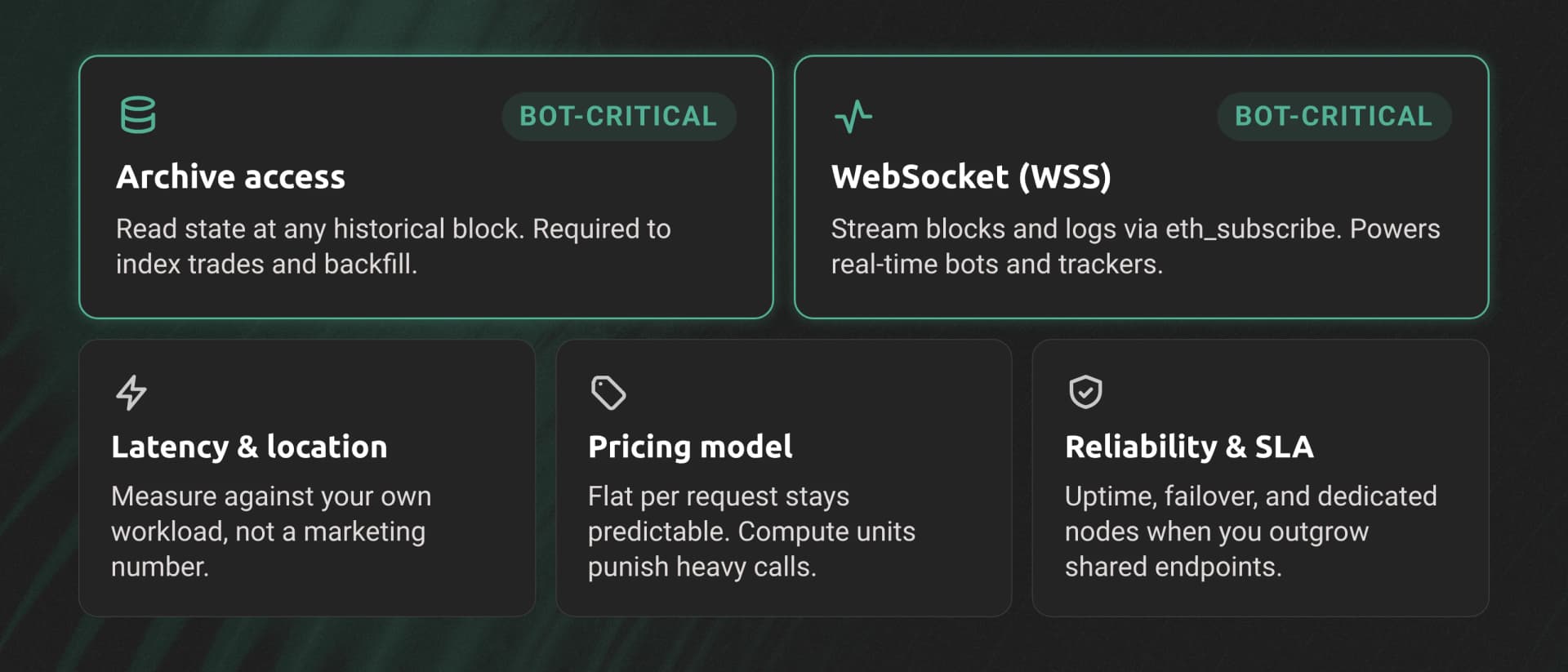
Archive access: Robinhood Chain's whole point is tokenized real-world assets trading across multiple venues. Reconstructing balances, positions, or a wallet's DEX history requires reading state at historical blocks, and a full (pruned) node cannot serve eth_getBalance or eth_call against old blocks. For any indexer, analytics platform, or backtest, archive access is required.
WebSocket support: Whale trackers, liquidation monitors, and copy-trading bots stream new blocks and logs through eth_subscribe. Robinhood Chain runs roughly 100ms preconfirmations, so a stable WebSocket (WSS) endpoint turns that speed into sub-second alerts. Not every provider states WSS support for every chain, so confirm it for Robinhood Chain specifically.
Pricing model: Most providers price in compute units or credits, and those units are not standardized. A single eth_call costs 1 credit on Dwellir, 1 request unit on Chainstack, 20 credits on QuickNode, 26 CU on Alchemy and 40 CU on Validation Cloud. eth_getLogs costs more again on the weighted providers, and indexing tokenized-stock trades is exactly that log-heavy pattern. The only reliable comparison is cost per actual API call, worked out below.
Latency and location: Trading-adjacent workloads care about round-trip time. A provider with infrastructure near your bot delivers tighter latency, but measure it against your own workload rather than trusting a marketing figure.
Multi-chain coverage and reliability: Most teams building on Robinhood Chain also run Ethereum or other L2s. A provider that covers Robinhood Chain alongside those under one API key and billing account reduces operational overhead, and uptime, failover, and dedicated-node options matter more as your usage grows.
Robinhood Chain RPC Providers: At-a-Glance
| Provider | Free Tier | Entry Price | Effective $/1M Calls | Pricing Model | Ideal Use Case |
|---|---|---|---|---|---|
| Dwellir | 100K/day (no eth_getLogs) | $49/mo (eth_getLogs + WSS) | $1.96 | 1:1 per response | Archive indexing, bots |
| dRPC | 210M CU/mo (public nodes) | $6 per 1M req | $6.00 | Flat 20 CU per call | Flat pricing, redundancy |
| Chainstack | 3M RU/mo | $49/mo | $2.45 | 1 RU (2 for archive, debug, trace) | Archive and trace with SOC 2 |
| Validation Cloud | 50M CU/mo | $0.50 per 1M CU | $21.50 | Compute units | Enterprise and staking |
| QuickNode | 10M credits (1-month trial) | $49/mo | $12.25 | 20 credits per call | Streams and webhooks |
| Alchemy | 30M CU/mo | $0.525 per 1M CU | $13.60 | Compute units | Enhanced APIs, simulation |
| Public RPC | Rate-limited | Free | - | N/A | Testing, wallets |
Top pick by use case
Short answers. The provider comparison and the methodology show the working.
- Lowest cost per request: Dwellir, $1.96 per million calls on the $49 Developer plan. One credit per response for every method, debug included.
- Archive and trace on a shared endpoint, with SOC 2: Chainstack, $2.45 per million on Growth, with debug and trace at 2 request units per call.
- One price for every method: dRPC, a flat $6.00 per million calls whether the call is a balance check, an archive read or a trace.
- Largest free tier: dRPC, 210M compute units a month (about 10.5M calls on public nodes). Dwellir's Free plan allows 100,000 responses a day at 20 RPS, without
eth_getLogs. - Highest self-serve rate limit: Dwellir Scale, 5,000 responses per second with bursts to 10,000, at $999 per month. dRPC Growth also advertises 5,000 RPS.
- Enterprise and staking under one vendor: Validation Cloud, with a 50M CU monthly free tier (about 1.16M calls) and SOC 2 Type II.
- Streams and webhooks: QuickNode, at $12.25 per million calls on Build.
- Enhanced APIs and simulation: Alchemy, if you use its token APIs and simulation enough to justify $13.60 per million calls.
Cheapest Tier with eth_getLogs and WebSocket on Robinhood Chain (Chain ID 4663)
A free tier is not always the cheapest way to get eth_getLogs and WSS, because some free tiers leave one of them out. The table lists what each provider's public pricing or docs page says, checked between 28 September and 7 October 2026. "Not stated" means the page does not say either way, so confirm with the provider before you depend on it.
| Provider | Lowest published tier | eth_getLogs on that tier | WSS on that tier | Cheapest tier with both |
|---|---|---|---|---|
| Dwellir | Free: $0, 20 RPS, 100K responses/day | No | Yes | Developer, $49/month, 500 blocks per eth_getLogs request (Growth, $299/month: 10,000) |
| dRPC | Free: $0, 210M CU/month, public nodes only, 100 RPS | Not stated | Not stated | Not stated; Growth is $6 per 1M requests |
| Chainstack | Developer: $0, 3M RU/month, 25 RPS | Not stated | Yes | Not stated for Developer; archive, debug and trace start on Growth at $49/month |
| Validation Cloud | Free: $0, 50M CU/month | Listed in the Robinhood Chain method table (80 CU) | Listed in the Robinhood Chain docs | Free, per the docs; Scale is $0.50 per 1M CU after 50M |
| QuickNode | Free trial: $0 for 1 month, 10M credits, 15 RPS | Not stated | Not stated | Not stated; Build is $49/month |
| Alchemy | Free: $0, 30M CU/month, 25 req/s | Node API listed on Free; range caps not on the pricing page | WebSockets listed on Free | Free, per the pricing page |
Sources: Dwellir pricing and rate limits, dRPC pricing, Chainstack pricing, Validation Cloud Robinhood Chain docs and billing, QuickNode pricing, Alchemy pricing.
On Dwellir, every endpoint needs an API key; there is no keyless Robinhood Chain endpoint. The endpoints, chain facts and method list are in the Robinhood Chain docs.
How to Compare Robinhood Chain Pricing Across Unit Systems
Every headline rate in this comparison is quoted in a different unit. The only way to compare them is to convert each one to dollars per million calls for the methods your application actually makes, using the weight each provider assigns to the method.
Per-request billing. One response is one unit, whatever the method. Dwellir bills this way, and Chainstack does too on recent state (1 request unit per call, 2 for reads 127 or more blocks behind the tip and for every debug or trace call). Dwellir's Developer plan works out to $1.96 per 1M calls included, with overage at $5.00 per 1M ($2-5 across plans). Chainstack Growth is $2.45 per 1M included, $15 per 1M overage.
Compute units and credits. The provider charges per million units and gives each method a weight, so the cost of a call depends on the method.
- Alchemy charges $0.525 per 1M CU. On Robinhood Chain that is $13.65 per 1M
eth_call, $31.50 per 1Meth_getLogs, $21.00 per 1Meth_sendRawTransaction, $10.50 per 1Meth_getTransactionReceiptoreth_getBalance, and $21.00 per 1Mdebug_traceTransaction. - QuickNode assigns a flat 20 credits to every Robinhood Chain call, which is $10.00 per 1M calls at Business's overage rate and $12.40 at Build's. Debug and trace calls carry a 2x multiplier, $20.00 per 1M at the Business overage rate.
- dRPC assigns 20 CU to every method, a flat $6.00 per 1M calls, trace and archive included.
- Validation Cloud weights
eth_blockNumberat 20 CU,eth_call,eth_getBalanceandeth_getTransactionReceiptat 40, andeth_getLogs,eth_sendRawTransactionanddebug_*at 80, at $0.50 per 1M CU on the first Scale tier.
Method by method, in dollars per 1M calls at each plan's included rate:
| Method | Dwellir (Developer) | Chainstack (Growth) | dRPC | QuickNode (Business) | Alchemy (PAYG) | Validation Cloud (Scale, first tier) |
|---|---|---|---|---|---|---|
eth_call | $1.96 | $2.45 | $6.00 | $9.99 | $13.65 | $20.00 |
eth_getTransactionReceipt | $1.96 | $2.45 | $6.00 | $9.99 | $10.50 | $20.00 |
eth_getLogs | $1.96 | $2.45 | $6.00 | $9.99 | $31.50 | $40.00 |
eth_sendRawTransaction | $1.96 | $2.45 | $6.00 | $9.99 | $21.00 | $40.00 |
debug_traceTransaction | $1.96 | $4.90 | $6.00 | $19.98 | $21.00 | $40.00 |
Dwellir and Chainstack overage runs $2-5 and $15 per 1M respectively, and Chainstack doubles the unit for reads 127 or more blocks behind the tip and for debug and trace calls.
The monthly totals later in this post use a mostly-reads mix: 40% eth_call, 25% receipts, 15% eth_blockNumber, 10% eth_getLogs over small ranges, 5% eth_getBalance and 5% eth_sendRawTransaction, all on recent blocks. On that mix a Robinhood Chain call averages 25.9 CU on Alchemy (eth_blockNumber is 10 CU), so 1M calls cost $13.60 and the free 30M CU covers about 1.16M calls. On Validation Cloud a call averages 43 CU, $21.50 per 1M at the first Scale tier and $15.05 above 1B CU. On QuickNode every call is 20 credits, so Build's 80M credits cover 4M calls and Business's 2B credits cover 100M calls at $999. An indexer that leans harder on eth_getLogs widens the gap, because eth_getLogs is the heaviest standard read on Alchemy and Validation Cloud and one unit on Dwellir and Chainstack.
1. Dwellir - Archive and WebSocket on Transparent 1:1 Pricing
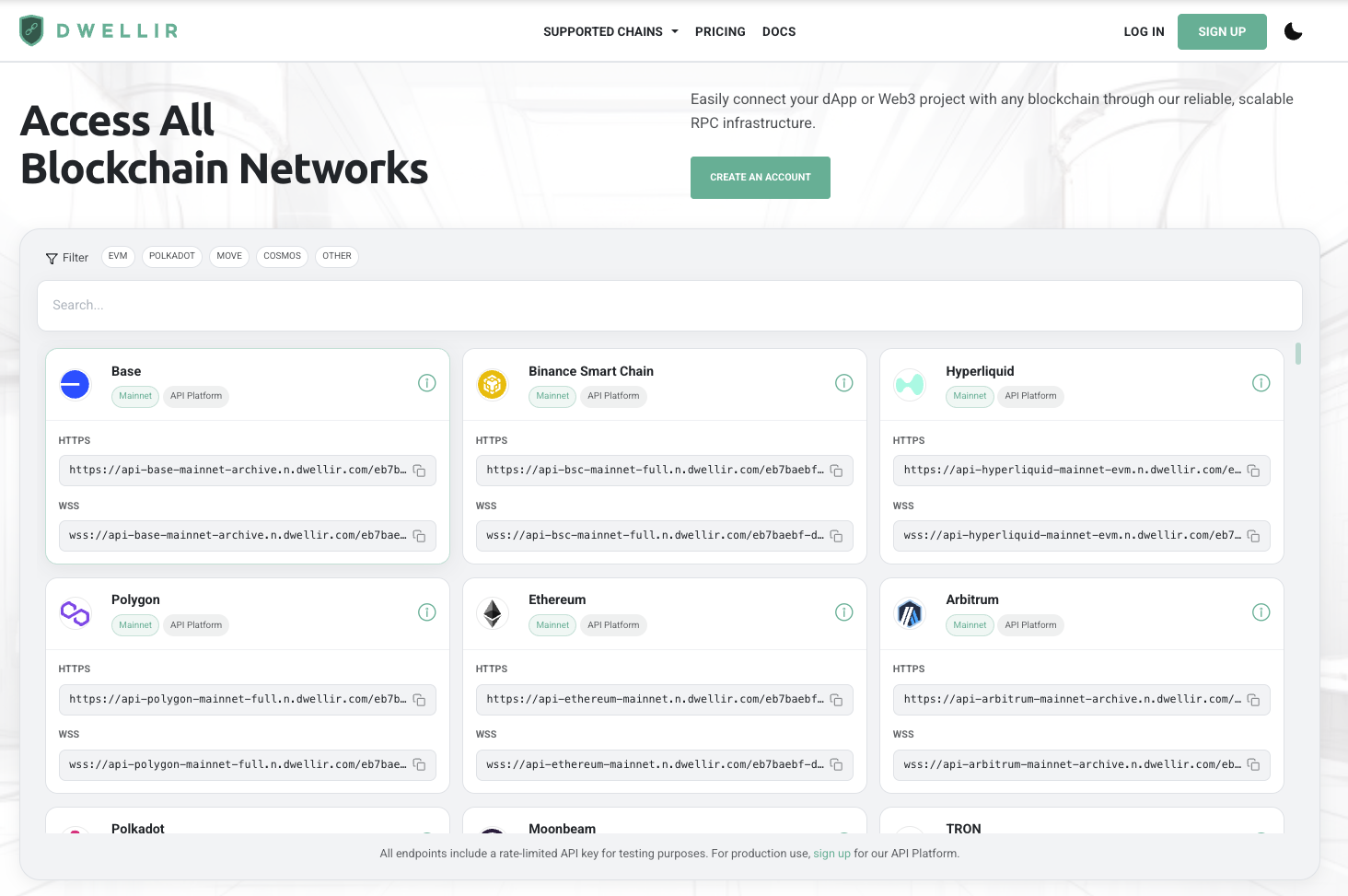
Dwellir runs an archive Robinhood Chain node over both HTTPS and WebSocket. A live endpoint returns chain ID 4663, serves state from the genesis block, and reports as fully synced. Every RPC response costs 1 credit regardless of method, so an eth_getLogs-heavy indexer reconstructing Stock Token trades costs the same per call as a simple balance check.
The same API key spans Ethereum, Arbitrum, and 150+ other networks, which matters for teams running Robinhood Chain alongside the L1 and L2s their users bridge from.
Key Features
- Archive plus WebSocket in one endpoint: The combination indexers and real-time bots need, over HTTPS and WSS.
- 1:1 credit system: Every method (standard, debug, archive) costs 1 credit. No compute-unit multipliers.
- 150+ network coverage: A single API key spans Robinhood Chain, Ethereum, Arbitrum, and more.
- Burst protection: Sustained RPS from 20 to 5,000 with burst capacity for traffic spikes.
- Debug APIs: Nitro
debug_*methods are included at no premium on paid plans. Parity-styletrace_*is not enabled on Robinhood Chain. - Unlimited Node: Flat, unmetered billing by RPS tier on the same endpoint URL and API key.
- Crypto payments: Pay in crypto on every paid plan, from Developer to Enterprise.
Pricing Structure
| Plan | Monthly Cost | Responses Included | RPS (Burst) | Effective $/1M Calls | Overage $/1M Calls |
|---|---|---|---|---|---|
| Free | $0 | 100,000/day | 20 | $0 | - |
| Developer | $49 | 25M | 100 (500) | $1.96 | $5.00 |
| Growth | $299 | 150M | 500 (2,500) | $1.99 | $3.00 |
| Scale | $999 | 500M | 5,000 (10,000) | $2.00 | $2.00 |
| Unlimited Node | Monthly Cost | Calls Covered at Full RPS | Effective $/1M Calls |
|---|---|---|---|
| 25 RPS | $119 | 65M | $1.83 |
| 100 RPS | $479 | 260M | $1.84 |
| 250 RPS | $1,199 | 650M | $1.84 |
| 500 RPS | $2,399 | 1.3B | $1.85 |
| 1,000 RPS | $4,799 | 2.6B | $1.85 |
A dedicated Robinhood Chain node cluster lists at $4,200 per month, with unlimited RPS and responses, debug APIs, and regions of your choice. Dwellir's network page also lists trace APIs for clusters, but the shared endpoint uses debug_trace* in place of trace_*, so confirm trace_* support before you rely on it, for latency-sensitive strategies.
Pros and Cons
Advantages:
- Archive and WebSocket together, which is what whale trackers, indexers, and copy-trading bots on Robinhood Chain depend on.
- Predictable billing regardless of method mix. Log-heavy indexing does not inflate the bill.
- Debug endpoints included at no premium on paid plans.
- Multi-chain footprint for unified Robinhood Chain plus L1/L2 infrastructure.
Considerations:
- No
trace_*on the shared Robinhood Chain endpoint; Chainstack, QuickNode and dRPC offer it. - The Free plan excludes
eth_getLogs, and Developer caps eacheth_getLogsrequest at 500 blocks, so large backfills need Growth (10,000 blocks) or chunked windows. - Enhanced APIs (NFT indexing, token metadata) are less extensive than larger platform providers.
Best For
Teams building indexers, whale trackers, or copy-trading bots on Robinhood Chain that need archive reads and stable WebSocket streaming on cost-predictable pricing, especially workloads dominated by eth_getLogs and eth_call.
2. dRPC - One Flat Price for Every Method
dRPC aggregates infrastructure from independent node operators across geo-distributed clusters. Traffic routes automatically based on latency, availability, and geography, with failover between operators, so if one has downtime, requests reroute.
Every method costs a flat 20 CU at $0.30 per 1M CU, so archive, debug and trace calls cost the same $6.00 per 1M as a balance check. dRPC's chainlist marks Robinhood Chain with archive. The keyless public endpoint answered with chain ID 4663 on 28 September 2026.
Key Features
- Flat pricing: $6.00 per 1M calls on every method, archive and trace included.
- Large free tier: 210M CU a month on public nodes, about 10.5M calls.
- Decentralized routing: Automatic failover across independent node operators.
- High throughput: Up to 5,000 RPS on Growth.
- Debug and trace APIs: On Growth, at the same flat 20 CU.
Pricing Structure
| Plan | Monthly Cost | Included | RPS | Effective $/1M Calls | Overage $/1M Calls |
|---|---|---|---|---|---|
| Free | $0 | 210M CU (public nodes, ~10.5M calls) | 100 | $0 | - |
| Growth | $6/1M requests | Pay as you go | 5,000 | $6.00 | $6.00 |
| Enterprise | Custom, from 300M req/mo | Volume discounts | Unlimited | Custom | Custom |
Growth advertises 99.99% uptime, with the formal SLA on Enterprise.
Pros and Cons
Advantages:
- The same price for every method, so a trace-heavy or archive-heavy workload costs what a balance-check workload costs.
- No monthly commitment and no overage step on Growth.
- The largest free tier in this comparison.
- 5,000 RPS ceiling for high-throughput workloads.
Considerations:
- $6.00 per 1M is about three times Dwellir's and 2.4 times Chainstack's per-call rate on recent-block traffic.
- WebSocket on Robinhood Chain is not stated on dRPC's chain page; confirm before you depend on it.
- Latency can vary depending on the operator serving your request.
Best For
Teams that want one price per call regardless of method, projects that need a high-throughput secondary provider for redundancy, and prototyping on the free tier.
3. Chainstack - Archive, Debug and Trace with SOC 2
Chainstack serves Robinhood Chain mainnet and testnet as Global Nodes, with full and archive data and both the Debug and Trace APIs. It bills request units with no method weights on recent state, which puts it closest to Dwellir on unit design.
Key Features
- Archive on Robinhood Chain: Global Node and dedicated deployments, mainnet and testnet.
- Debug and Trace APIs: Both documented for Robinhood Chain, at 2 request units per call.
- WebSocket: Available on Global Nodes.
- Unlimited Node add-on: From $149/month at 25 RPS, on top of Growth or higher.
- Dedicated Robinhood bundle: Testnet plus mainnet dedicated nodes advertised at $749/month ($674/month promotional).
- Compliance: SOC 2 Type II and ISO 27001; 70+ chains.
Pricing Structure
| Plan | Monthly Cost | Request Units Included | RPS | Effective $/1M Calls | Overage $/1M Calls |
|---|---|---|---|---|---|
| Developer | $0 | 3M | 25 | $0 | $20.00 |
| Growth | $49 | 20M | 250 | $2.45 | $15.00 |
| Pro | $199 | 80M | 400 | $2.49 | $12.50 |
| Business | $499 | 200M | 600 | $2.50 | $10.00 |
| Enterprise | $990 | 400M | Unlimited | $2.48 | $5.00 |
A request under 127 blocks behind the tip costs 1 RU; 127 or more blocks behind costs 2 RU as an archive read, and debug and trace calls cost 2 RU regardless of block age. Debug, trace and archive data start on Growth. Annual billing lowers Growth to $40, Pro to $166, Business to $416 and Enterprise to $825 per month.
Pros and Cons
Advantages:
- Archive, debug and trace documented on Robinhood Chain, with SOC 2 Type II and ISO 27001.
- Near 1:1 pricing on recent state: $2.45 per 1M on Growth for every standard method.
- Dedicated Robinhood Chain nodes at a published price.
Considerations:
- Overage is $10-20 per 1M below Enterprise, four to ten times the included rate.
- Archive reads and every debug or trace call cost 2 RU, so a backfill-heavy indexer pays double per call.
- The Unlimited Node add-on costs more than Dwellir's at the entry tier ($149 vs $119 at 25 RPS) and needs a Growth subscription underneath.
Best For
Teams that need archive and trace on a shared Robinhood Chain endpoint with SOC 2 documentation and predictable per-request billing.
4. Validation Cloud - Enterprise and Staking Infrastructure
Validation Cloud targets enterprise and institutional teams, pairing node infrastructure with staking and data services. It has a self-serve compute-unit plan alongside custom Private pricing.
For a regulated real-world-asset chain like Robinhood Chain, that enterprise posture fits teams whose compliance or reliability requirements exceed what a shared endpoint provides.
Key Features
- Archive and WebSocket: Its Robinhood Chain docs list full history (archive), HTTPS and WSS on mainnet and testnet.
- Debug API:
debug_traceTransaction,debug_traceCalland the block trace methods are documented for Robinhood Chain at 80 CU each. - Monthly free tier: 50M CU a month, about 1.2M calls on this article's mix.
- Staking services: Node and staking infrastructure under one platform.
- SOC 2 Type 2: Compliance report available for regulated teams.
Pricing Structure
| Plan | Monthly Cost | Included | RPS | Effective $/1M Calls | Overage $/1M Calls |
|---|---|---|---|---|---|
| Free | $0 | 50M CU (~1.2M calls) | Not published | $0 | - |
| Scale (50M-150M CU) | $0.50/1M CU | Pay as you go | Not published | $21.50 | $21.50 |
| Scale (150M-500M CU) | $0.45/1M CU | Pay as you go | Not published | $19.35 | $19.35 |
| Scale (500M-1B CU) | $0.40/1M CU | Pay as you go | Not published | $17.20 | $17.20 |
| Scale (over 1B CU) | $0.35/1M CU | Pay as you go | Not published | $15.05 | $15.05 |
| Private | Custom | Custom | Custom | Custom | Custom |
The Scale bracket prices were last read on Validation Cloud's billing page on 28 September 2026. Its Robinhood Chain method weights were rechecked on 7 October 2026 and had not changed. The Private plan adds volume discounts and more chains on a custom quote.
Pros and Cons
Advantages:
- Archive, WebSocket,
eth_getLogsand debug methods all documented for Robinhood Chain. - A 50M CU monthly free tier, about 1.16M calls on the mix, the same as Alchemy's 30M CU and ongoing rather than a one-month trial.
- Combined node and staking infrastructure for institutional teams.
Considerations:
- The heaviest method weights in this comparison: an
eth_callis 40 CU andeth_getLogsis 80 CU, which puts the entry Scale rate at $21.50 per 1M calls under this article's mix. - No published RPS limits.
- Better suited to larger teams than solo developers prototyping.
Best For
Enterprise and institutional teams building on Robinhood Chain that need managed infrastructure and dedicated support, where compliance and reliability guarantees matter more than per-call price.
5. QuickNode - Global Edge Network with Streams
QuickNode lists Robinhood Chain mainnet with HTTP, WSS and archive (no pruning), and routes requests through a global edge network. The platform pairs standard RPC with Streams for real-time event streaming, webhooks, and dedicated node options.
It bills API credits, and its credit table charges 20 credits for every Robinhood Chain method, with trace and debug calls at a 2x multiplier (40 credits). Trace and debug are available from Build upward, not on the free trial.
Key Features
- Global edge network: Automatic routing to the nearest region.
- Streams and webhooks: Real-time event streaming for on-chain activity.
- Dedicated nodes: Isolated infrastructure for deterministic performance.
- Observability dashboard: Response times, error rates, and credit tracking.
- Compliance: SOC 1 Type 2, SOC 2 Type 2 and ISO 27001.
Pricing Structure
| Plan | Monthly Cost | API Credits | Robinhood Calls Covered | RPS | Effective $/1M Calls | Overage $/1M Calls |
|---|---|---|---|---|---|---|
| Free trial | $0 (1 month) | 10M | ~500K | 15 | $0 | - |
| Build | $49 | 80M | ~4M | 50 | $12.25 | $12.40 |
| Accelerate | $249 | 450M | ~22.5M | 125 | $11.07 | $11.20 |
| Scale | $499 | 950M | ~47.5M | 250 | $10.51 | $10.60 |
| Business | $999 | 2B | ~100M | 500 | $9.99 | $10.00 |
| Enterprise | Custom | Custom | Custom | Custom | Custom | Custom |
Effective price is the plan cost spread over the Robinhood Chain calls its credits cover. At 20 credits per call, the credit totals overstate Robinhood Chain request capacity by 20 times. Annual billing takes about 30% off. Streams, Functions, and dedicated node clusters cost extra.
Pros and Cons
Advantages:
- Global edge routing for latency-sensitive workloads.
- Streams and webhooks simplify event-driven Robinhood Chain architectures.
- Archive, debug and trace on paid plans.
Considerations:
- $12.25 per 1M calls on Build, about six times Dwellir's $1.96, and Build caps throughput at 50 RPS.
- Debug and trace cost 40 credits per call and are not on the free trial, which lasts one month.
- Add-ons for Streams, Functions, and dedicated infrastructure increase total spend.
Best For
Robinhood Chain applications built around Streams and webhooks, for teams comfortable managing credit-based billing.
6. Alchemy - Developer Platform with Enhanced APIs
Alchemy serves Robinhood Chain over HTTPS and WebSocket and is the recommended provider in Robinhood's own docs. Its feature-support table lists the full Debug API on Robinhood Chain mainnet; the Trace API is not available on the chain. Beyond raw RPC, it offers enhanced APIs for tokens and wallet activity, transaction simulation, and an analytics dashboard that tracks per-method compute-unit consumption.
Key Features
- Enhanced APIs: Token and wallet APIs reduce custom indexing work.
- Transaction simulation: Validate transactions before submitting them on-chain.
- Debug API: All 16 debug methods listed for Robinhood Chain mainnet.
- Analytics dashboard: Per-method compute-unit tracking and latency breakdowns.
- SDK coverage: TypeScript and Python SDKs.
Pricing Structure
| Plan | Monthly Cost | Included | Throughput | Effective $/1M Calls | Overage $/1M Calls |
|---|---|---|---|---|---|
| Free | $0 | 30M CU (~1.16M calls) | 500 CU/s (25 req/s) | $0 | - |
| Pay as you go | $0.525/1M CU | Usage-based | 10,000 CU/s (300 req/s) included | $13.60 | $13.60 |
| Enterprise | Custom | Custom | Custom | Custom | Custom |
Compute-unit weights vary by method: eth_blockNumber is 10 CU, eth_getBalance and eth_getTransactionReceipt 20, eth_call 26, eth_sendRawTransaction 40 and eth_getLogs 60. That puts 1M eth_getLogs calls at $31.50 against $13.65 for 1M eth_call. Throughput above the included 10,000 CU/s costs $160 per month for each extra 5,000 CU/s, up to 30,000 CU/s self-serve, so the full self-serve ceiling adds $640 a month.
Pros and Cons
Advantages:
- Enhanced APIs and transaction simulation reduce custom development.
- Strong developer experience with SDKs, webhooks, and analytics.
- Full Debug API on Robinhood Chain.
Considerations:
- $13.60 per 1M calls on the mix, above QuickNode Build's $12.25, and $31.50 per 1M for
eth_getLogs, the method Robinhood Chain indexers use most. - No Trace API on Robinhood Chain.
- Extra throughput is a separate monthly fee on top of compute units.
Best For
Teams that want enhanced APIs, transaction simulation, and analytics around their Robinhood Chain integration, where developer productivity justifies the compute-unit premium.
Also Serving Robinhood Chain
GetBlock offers its flat-rate Limitless Node on Robinhood Chain from $150 per month. The RPS tiers are only shown in its dashboard, so it is not in the tables below.
Blockdaemon also supports Robinhood Chain, an enterprise option suited to teams that already run staking or custody infrastructure with it.
Provider Comparison
| Provider | Free Tier | Entry Paid | Effective $/1M Calls | Archive on Robinhood Chain | WSS | Debug | Trace | getLogs Cap | Pricing Unit | Networks |
|---|---|---|---|---|---|---|---|---|---|---|
| Dwellir | 100K/day (no eth_getLogs) | $49/mo | $1.96 | Yes | Yes | Yes | No | 500 blocks (Developer), 10,000 (Growth+) | 1 response | 150+ |
| dRPC | 210M CU/mo | $6/1M req | $6.00 | Yes | Not stated | Growth | Growth | Not stated | 20 CU flat | 130+ |
| Chainstack | 3M RU/mo | $49/mo | $2.45 | Yes (2 RU) | Yes | Yes (2 RU) | Yes (2 RU) | Not stated | 1 RU (2 archive) | 70+ |
| Validation Cloud | 50M CU/mo | $0.50/1M CU | $21.50 | Yes | Yes | Yes (80 CU) | Not stated | Not stated | CU (~43/req) | 80+ |
| QuickNode | 10M credits, 1 month | $49/mo | $12.25 | Yes | Yes | Paid only | Paid only | Not stated | 20 credits/call | 75+ |
| Alchemy | 30M CU/mo | $0.525/1M CU | $13.60 | Yes | Yes | Paid only | No | Not stated | CU (~25.9/req) | 100+ |
For reference, the official public endpoint rpc.mainnet.chain.robinhood.com is rate-limited and carries no archive guarantee or SLA. It suits testing and wallet connections, not production.
Effective Price per Million Calls
One denominator for every provider: dollars per 1M Robinhood Chain calls under the mix, at the entry paid plan and at the best self-serve rate, with overage alongside.
| Provider | Entry Paid Plan | Effective $/1M Calls | Best Self-Serve Rate | Overage $/1M Calls |
|---|---|---|---|---|
| Dwellir | Developer $49 | $1.96 | $1.83 (Unlimited Node, 25 RPS) | $2.00-5.00 |
| Chainstack | Growth $49 | $2.45 | $2.45 (Growth) | $5.00-20.00 |
| dRPC | Growth, pay as you go | $6.00 | $6.00 | $6.00 |
| QuickNode | Build $49 | $12.25 | $9.99 (Business) | $10.00-12.40 |
| Alchemy | Pay as you go | $13.60 | $13.60 | $13.60 |
| Validation Cloud | Scale, pay as you go | $21.50 | $15.05 (over 1B CU) | $15.05-21.50 |
What That Costs at Volume
Plans step at fixed tiers, so monthly bills differ from the per-million rates. Same mix, list prices.
| Provider | 10M req/mo | 50M req/mo | 100M req/mo |
|---|---|---|---|
| Dwellir (metered) | $49 | $174 | $299 |
| Chainstack | $49 | $199 | $449 |
| Dwellir (Unlimited Node) | $119 | $119-479 | $479 |
| dRPC | $60 | $300 | $600 |
| QuickNode | ~$123 | ~$526 | $999 |
| Alchemy | ~$136 | ~$680 | ~$1,360 |
| Validation Cloud | ~$176 | ~$810 | ~$1,563 |
At 10M requests, Dwellir's $49 ties Chainstack, and dRPC's free tier covers the same workload at $0 on public nodes. At 50M and 100M, Dwellir's metered plans are the lowest list price of the six providers here. The Unlimited Node at 50M is $119 if average traffic stays under 25 RPS and $479 for the 100 RPS tier. Validation Cloud figures assume its CU tiers are billed by bracket after the free 50M CU.
Methodology
How the ranking and the numbers in this post were produced, so you can reproduce or dispute them.
Ranking: this is an editorial ranking by Dwellir, the publisher of this post, and Dwellir is one of the providers in it. It weighs three things: the effective cost per million calls on the house mix, how predictable the bill is when your method mix, block age or volume changes, and what the plans include (free tier, archive, debug and trace, MEV protection or compliance). No single criterion sorts the list, so a provider can sit above a cheaper one. dRPC ranks above the cheaper Chainstack because one flat price covers every method, with no overage step and the largest free tier here. Validation Cloud ranks above QuickNode and Alchemy despite the highest per-call rate ($21.50 per 1M on the mix): its free tier is ongoing rather than QuickNode's one-month trial, it covers about the same number of calls as Alchemy's (about 1.16M each), and it documents archive, WSS, eth_getLogs and debug on Robinhood Chain alongside staking and SOC 2 Type II under one contract. That is the most judgement-heavy placement in this list.
Cost per million is each plan's monthly price divided by the number of calls its included units buy on the mix: 40% eth_call, 25% eth_getTransactionReceipt, 15% eth_blockNumber, 10% eth_getLogs over small ranges, 5% eth_getBalance and 5% eth_sendRawTransaction, all on recent blocks. Metered plans with no fixed bundle (Alchemy, dRPC, Validation Cloud) use their per-unit rate. Annual discounts and add-ons are excluded.
Unit weights come from each provider's published method-cost table: Alchemy compute unit costs (25.9 CU average on the mix), QuickNode's Robinhood Chain credit table (20 per call), dRPC's flat 20 CU, Validation Cloud's Robinhood Chain method table (43 CU average) and Chainstack's request-unit rules (1 per recent-block call). Dwellir counts one credit per response.
Archive, WSS, debug and trace mean the provider documents that capability on Robinhood Chain mainnet. "Not stated" means its chain page does not say either way.
Not measured here: latency, error rates and data freshness. Those depend on your region and method mix. Run a short benchmark from your own infrastructure against the two or three providers this comparison narrows you to before committing.
Verification dates: plan prices, method weights and chain support were checked on each provider's pricing page and Robinhood Chain docs on 2026-10-07, except Validation Cloud's Scale bracket prices (2026-09-28). The modified date at the top of this post moves whenever a figure is rechecked.
Recommendations by Use Case
For indexers, whale trackers, and copy-trading bots: Dwellir. It pairs archive depth with WebSocket streaming in one endpoint, and one credit per response keeps an eth_getLogs-heavy indexer at $1.96 per 1M calls.
For one flat price across every method, or a redundant second provider: dRPC, at $6.00 per 1M with archive and trace included and a 210M CU free tier.
For archive and trace with SOC 2 documentation: Chainstack, at $2.45 per 1M on recent-block calls and 2 RU for archive reads and traces.
For enterprise and regulated teams: Validation Cloud provides managed infrastructure and dedicated support for institutions whose compliance needs exceed self-serve endpoints.
For Streams and webhooks: QuickNode, if you budget for 20 credits per call.
For enhanced APIs and simulation: Alchemy, if you model compute-unit cost for your method mix.
Conclusion
Robinhood Chain arrives with real order flow: tokenized stocks, the Arcus DEX, and read load for the apps built on top. For indexers, whale trackers, and copy-trading bots, Dwellir combines archive access, WebSocket streaming, and 1:1 pricing that does not penalize the log-heavy method mix these applications generate.
dRPC charges one flat price for every method, Chainstack adds trace and SOC 2 at near 1:1 pricing, Validation Cloud fits enterprise teams, QuickNode brings Streams, and Alchemy brings the richest tooling at a higher per-call price than every provider here except Validation Cloud. Whichever you choose, check the two capabilities Robinhood Chain workloads depend on: archive reads and a stable WebSocket.
Frequently Asked Questions
Which RPC providers support Robinhood Chain?
Robinhood Chain is served by Dwellir, dRPC, Chainstack, Validation Cloud, QuickNode and Alchemy, plus GetBlock and Blockdaemon, alongside the rate-limited public endpoint. Because Robinhood Chain is a standard EVM L2 (chain ID 4663), any Ethereum-compatible provider can serve it.
Does Robinhood Chain have a public RPC endpoint?
Yes, at rpc.mainnet.chain.robinhood.com. It is rate-limited and offers no archive guarantee or SLA, so it suits testing and wallet connections but not indexing, bots, or production traffic.
What is the Robinhood Chain chain ID?
Mainnet is 4663 (0x1237). The public testnet is 46630. Gas is paid in ETH, and standard Ethereum and Arbitrum tooling works without modification.
Why does archive access matter for Robinhood Chain?
Robinhood Chain hosts tokenized stocks and multiple DEXes, so indexers, whale trackers, and analytics need to read historical state and event logs. A pruned or rate-limited endpoint cannot serve those reliably. Archive nodes can.
How do compute units affect Robinhood Chain RPC pricing?
Alchemy and Validation Cloud weight each method differently, so a log-heavy indexer costs more than the headline rate suggests: eth_getLogs is 60 CU on Alchemy and 80 CU on Validation Cloud. QuickNode charges 20 credits for every Robinhood Chain call. Dwellir charges 1 credit per response and Chainstack 1 request unit per recent-block call. On a mostly-reads mix that works out to $1.96 per million calls on Dwellir, $2.45 on Chainstack, $12.25 on QuickNode Build and $13.60 on Alchemy.
Which providers offer debug and trace on Robinhood Chain?
Chainstack documents both debug and trace on Robinhood Chain at 2 request units per call, from Growth. QuickNode has both on paid plans at 40 credits, not on its free trial. Dwellir and Alchemy serve debug_* but not trace_*. dRPC includes both on Growth at its flat 20 CU, and Validation Cloud documents debug methods at 80 CU.
What is the cheapest Dwellir plan with eth_getLogs and WebSocket on Robinhood Chain?
Developer at $49/month. It includes HTTPS, WebSocket and eth_getLogs with a 500-block range per request. Growth at $299/month raises the range to 10,000 blocks. The Free plan (20 responses per second, 100,000 a day) includes HTTPS and WebSocket but not eth_getLogs. Every Dwellir endpoint needs an API key.
Related Resources
- Robinhood Chain docs - Endpoints, chain ID 4663, block time, and supported methods
- How to Get Robinhood Chain Data for DeFi Strategies - Swaps, pool state, and chunked
eth_getLogsbackfills - What Is Robinhood Chain? - Architecture, Stock Tokens, the Arcus DEX, and how to connect
- Build a Real-Time Robinhood Chain Whale Tracker - Stream large Stock Token trades over WebSocket
- Best Ethereum RPC Providers 2026 - Full pricing and feature comparison for Ethereum L1
- Best Arbitrum RPC Providers 2026 - Compare providers for the Arbitrum ecosystem Robinhood Chain is built on
Ready to build on Robinhood Chain? Start with Dwellir's Free plan to test HTTPS and WebSocket access, move to Developer at $49/month when you need eth_getLogs, or contact the Dwellir team to discuss archive access, WebSocket streaming, or dedicated node clusters for your production deployment.