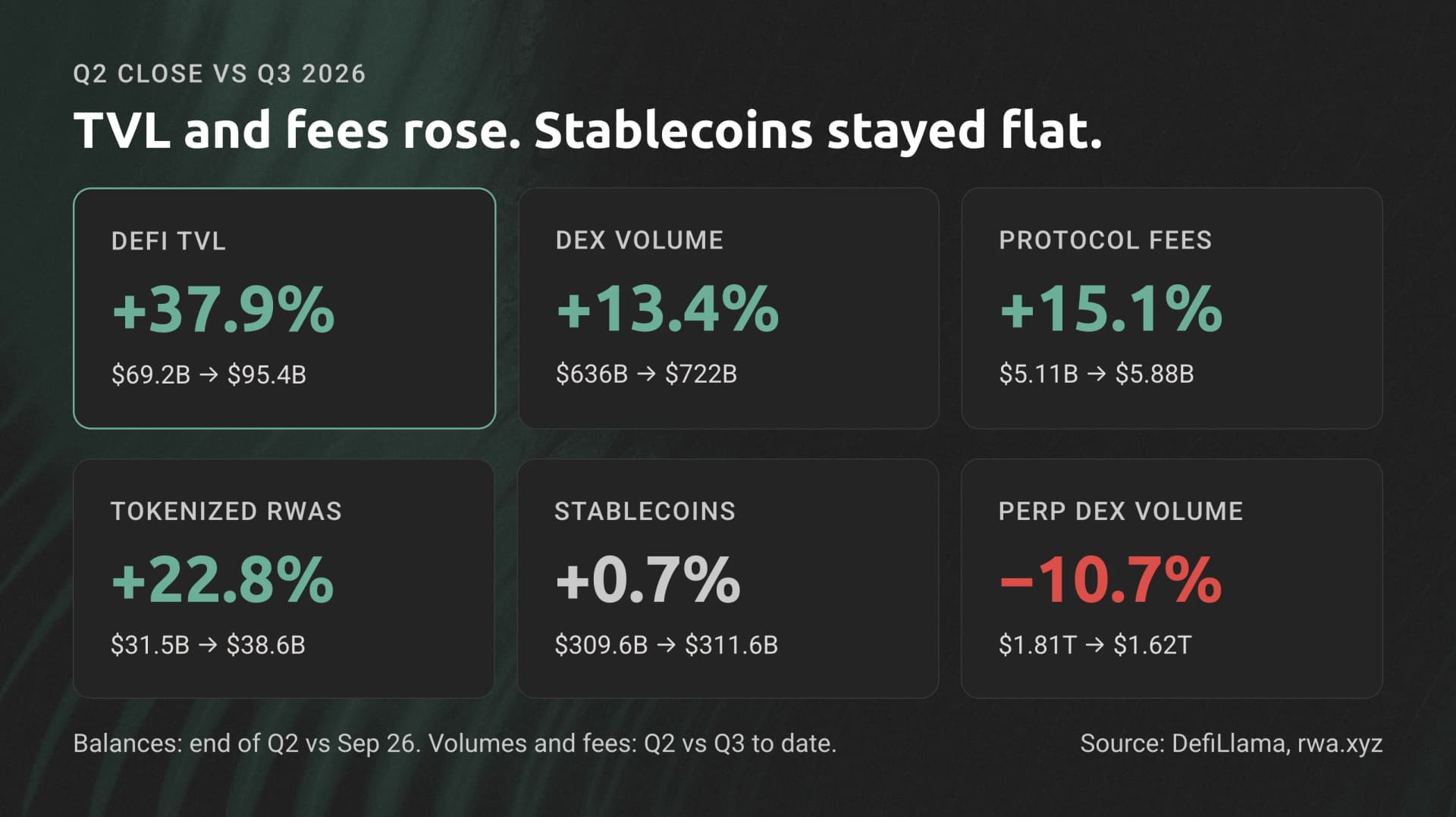
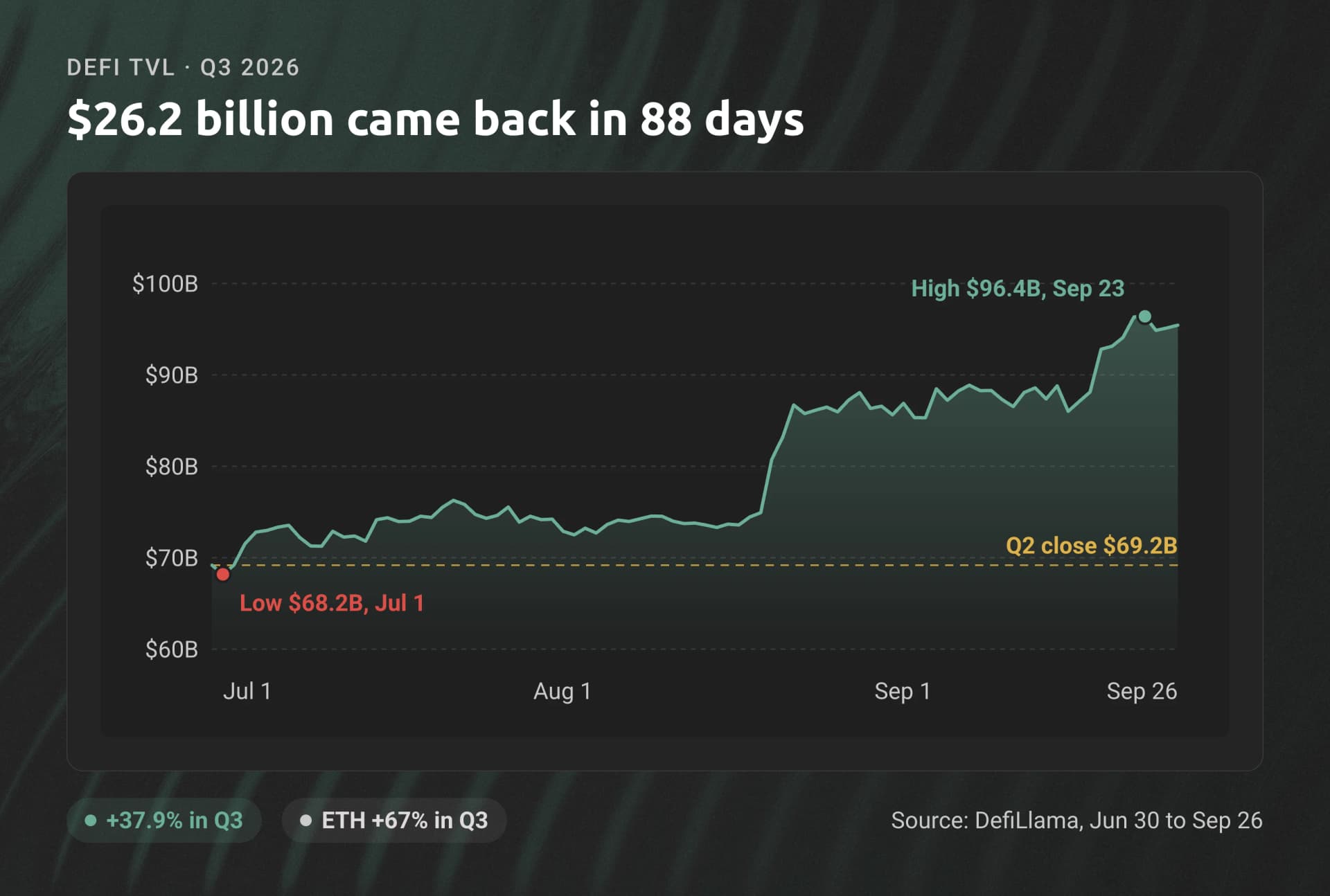
DeFi total value locked reached $95.4 billion on September 26, 2026, up from $69.2 billion on June 30. That is a $26.2 billion gain, or 37.9%, in 88 days. It puts TVL back within 2% of the April 17 level from before the KelpDAO exploit, $96.7 billion on DefiLlama's current series. The April post quoted $99.5 billion for that date from an earlier snapshot of the same series. Stablecoin supply barely moved, from $309.6 billion to $311.6 billion. DEX volume rose 13% to $721.7 billion and protocol fees rose 15% to $5.88 billion. Robinhood Chain and Monad, two chains missing from the April snapshot, each passed $1 billion in TVL.
The recovery was uneven. ETH rose 67% in the quarter, and that price move explains most of the TVL gain. Hackers took $1.25 billion across 116 incidents, the worst quarter of 2026. One centralized exchange and one Bitcoin sidechain accounted for $707 million of that. In the EU, MiCA moved from deadline to enforcement on July 1. In the US, regulators missed the GENIUS Act's July 18 rulemaking date.
This post is the Q3 2026 update to The State of DeFi in 2026, the February guide. It also updates The State of DeFi in April 2026, the last monthly snapshot. Every figure comes from DefiLlama UTC daily closes or a named source, with its date next to it. We wrote this with four days left in the quarter, so "latest" means September 25 or 26. Where a Q3 number contradicts the February or April posts, this article says so and uses the current series.
Q3 2026 in numbers
| Metric | Jun 30, 2026 (Q2 close) | Latest (Q3) | Change | Source |
|---|---|---|---|---|
| DeFi TVL | $69.18B | $95.42B (Sep 26) | +$26.24B (+37.9%) | DefiLlama |
| Q3 TVL low / high | Low $68.18B (Jul 1) | High $96.43B (Sep 23) | +41% low to high | DefiLlama |
| Stablecoin supply (peggedUSD) | $309.58B | $311.60B (Sep 26) | +0.7% | DefiLlama stablecoins |
| DEX volume, quarter | Q2: $636.3B | Q3: $721.7B (to Sep 26) | +13.4% | DefiLlama DEXs |
| Best DEX month of Q3 | Jun: $229.2B | Sep: $275.3B (to Sep 26) | Best month since Feb | DefiLlama DEXs |
| Perp DEX volume, quarter | Q2: $1,813.0B | Q3: $1,619.7B (to Sep 25) | -10.7% | DefiLlama perps |
| Hyperliquid share of perp DEX volume | Q2: 34.2% | Q3: 37.3% | +3.1 pts | DefiLlama perps |
| Protocol fees, quarter | Q2: $5.11B | Q3: $5.88B (to Sep 26) | +15.1% | DefiLlama fees |
| Stolen in hacks, quarter | Q2: $820.1M | Q3: $1,247.8M (to Sep 24) | +52% | DefiLlama hacks |
| Hack incidents | Q2: 114 | Q3: 116 | +2 | DefiLlama hacks |
| US spot BTC ETF net flows | Q2: -$4.97B | Q3: +$6.39B (to Sep 25) | Reversal | SoSoValue |
| US spot ETH ETF net flows | Q2: -$0.71B | Q3: +$3.09B (to Sep 25) | Reversal | SoSoValue |
| Tokenized RWAs (distributed) | $31.46B (Jun 26) | $38.62B (Sep 26) | +22.8% | rwa.xyz |
| Uniswap v4 vs v3 volume | Q2: v4 $69.4B, v3 $58.7B | Q3: v3 $99.5B, v4 $88.8B | v3 led again | DefiLlama DEXs |
We fetched all DefiLlama rows on September 26, 2026 at about 06:00 UTC, so the Sep 26 values are provisional daily points.
Activity rose too, but by less than TVL. TVL rose every month: +7.3% in July, +15.4% in August and +11.4% in September to the 26th. DEX volume rose 13% and fees rose 15%. September's $2.16 billion in fees over 26 days is already the highest monthly total of 2026. Spot ETF flows swung from $5.7 billion of combined Q2 outflows to $9.5 billion of Q3 inflows.
The dollar-denominated categories did not follow. Stablecoins grew under 1%, RWA protocols tracked inside DeFi fell 2%, and basis-trading protocols such as Ethena grew 4%. The categories that grew fastest hold ETH, and ETH went from $1,610 to $2,688. Q3 was a price-led recovery with a smaller amount of new money on top.
The $26 billion recovery
Where did the capital come back?
Most of Q3's TVL gain came from ETH-denominated collateral, and most of that was price. Ethereum-chain TVL rose 43%, from $37.35 billion to $53.54 billion, while ETH rose 67%. Ethereum's share of all DeFi TVL moved from 54.0% to 56.1%. The February guide's "68% Ethereum dominance" figure does not match DefiLlama's current series. That series stayed between 54% and 57% through Q3.
| Category (DefiLlama, double-counted) | Jun 30 | Sep 26 | Change |
|---|---|---|---|
| Liquid staking | $32.72B | $60.35B | +84% (+74% excluding a new JustLend listing) |
| Lending | $35.66B | $53.88B | +51% |
| Restaking | $7.66B | $10.71B | +40% |
| CDP | $7.27B | $7.99B | +10% |
| Basis trading | $7.00B | $7.31B | +4% |
| RWA | $4.16B | $4.07B | -2% |
Category sums double-count. Staked ETH deposited into lending appears in both categories, for example, so the rows do not sum to the $95 billion headline. Even so, staking and restaking grew roughly in line with ETH. Lending grew 51% on a mixed collateral base, and borrowed balances rose with it, which points to real demand. The dollar categories were flat.
Two DefiLlama listing changes also flatter the category table. DefiLlama added JustLend's staked TRX ($3.32 billion) on September 23 and Bittensor's dTAO ($557 million) on September 19. Neither is a Q3 inflow. Liquid staking also sits outside DefiLlama's default $95 billion headline, so the staking rows here move without moving the headline.
Why did stablecoin supply go flat?
Stablecoin supply rose about $2 billion in Q3, under 1%. The two largest issuers moved in opposite directions and several yield-bearing tokens shrank. The DefiLlama peggedUSD series, which this article uses throughout, bottomed at $305.16 billion on August 11 and closed at $311.60 billion on September 26. The all-time high in this series is $320.87 billion on May 17. The April post's "$321 billion on April 21" came from a different series. peggedUSD shows $318.20 billion for that date.
| Stablecoin | Jun 30 | Sep 26 | Q3 change |
|---|---|---|---|
| USDT | $184.96B | $183.79B | -$1.17B (-0.6%) |
| USDC | $73.78B | $75.47B | +$1.70B (+2.3%) |
| USDS | $7.91B | $6.57B | -$1.34B (-17.0%) |
| USDe | $4.46B | $4.93B | +$0.47B (+10.6%) |
| RLUSD | $1.56B | $2.49B | +$0.93B (+59.3%) |
| USYC (Circle yield token) | $2.75B | $2.11B | -$0.64B (-23.2%) |
USDT's share fell from 59.7% to 59.0% and USDC's rose from 23.8% to 24.2%. The timing matches MiCA. Licensed EU venues removed USDT on July 1 because Tether did not seek authorisation, and Revolut finished its USDT delisting on August 31. GENIUS is not a factor yet. Its issuer rules take effect no later than January 18, 2027, and we could trace no Q3 change in DeFi stablecoin yields to it. For what the licensing rules mean for issuers and integrators, see Enterprise Stablecoin Adoption in 2026.
USDS is the largest decliner in the table. Sky's own Q2 report puts USDS supply at $10.04 billion on June 30, against DefiLlama's $7.91 billion, so the two use different methods.
Stablecoins also moved between chains. Ethereum lost $7.13 billion while Tron gained $4.97 billion, Hyperliquid $1.75 billion, Solana $1.58 billion and Robinhood Chain $1.07 billion.
Which protocols gained and lost in Q3
Which lending protocols grew the most?
Aave V3 grew most in dollars and Morpho grew fastest. Between June 30 and September 26, Aave V3 went from $11.91 billion to $18.21 billion, up 53%. Morpho Blue went from $6.60 billion to $11.01 billion, up 67%. Aave V3 borrowing rose from $9.76 billion to $12.57 billion, so users added positions as well as collateral value.
| Protocol | Jun 30 | Sep 26 | Change |
|---|---|---|---|
| Aave V3 | $11.91B | $18.21B | +53% |
| Morpho Blue | $6.60B | $11.01B | +67% |
| Sky Lending | $5.32B | $5.87B | +10% |
| SparkLend | $3.45B | $5.60B | +63% |
| Maple | $2.31B | $3.00B | +30% |
| Compound V3 | $1.04B | $1.51B | +45% |
| Fluid Lending | $0.60B | $0.73B | +22% |
| Aave V4 | $0.15B | $0.64B | +318% |
Source: DefiLlama /protocol/{slug}, default TVL, which excludes borrowed funds, fetched Sep 26.
Aave V3 is still 29% below its pre-exploit level of $25.67 billion on April 17. Aave V3 fees fell from $154.7 million in Q2 to $92.5 million in Q3, because Q2 included the April liquidations.
Aave V4 launched on Avalanche on July 15 and on Circle's Arc on September 16. A Snapshot vote to deploy on Base passed between September 22 and 25. Aave counts about $1.16 billion supplied to V4 as of September 16 to 17, against DefiLlama's $0.64 billion. The two differ because Aave includes borrowed funds and a dedicated ether.fi instance on OP Mainnet, and DefiLlama excludes both.
Morpho announced Midnight, its fixed-rate lending product, on April 14, the date the April post gave as its launch. It launched on Base on July 21 and holds only $4.83 million of TVL. Coinbase began to offer fixed-rate BTC-backed USDC loans through it on September 22 and 23. Those add to more than $1.4 billion in variable-rate Morpho loans.
Did Uniswap v4 overtake v3 in Q3?
No. Uniswap v4 led v3 in April, May and Q2 as a whole, and v3 led again in every month of Q3. Uniswap v3 did $99.5 billion in Q3 against $88.8 billion for v4. v4 led on 29 of the 88 days, and in 3 full weeks.
| Month | Uniswap v3 | Uniswap v4 | v4 as % of v3 |
|---|---|---|---|
| Apr 2026 | $16.62B | $22.56B | 136% |
| May 2026 | $16.74B | $22.58B | 135% |
| Jun 2026 | $25.38B | $24.21B | 95% |
| Jul 2026 | $27.36B | $24.20B | 88% |
| Aug 2026 | $28.74B | $26.32B | 92% |
| Sep 1-26, 2026 | $43.38B | $38.24B | 88% |
Source: DefiLlama /summary/dexs/uniswap-v3 and /uniswap-v4, fetched Sep 26.
The shift comes mostly from Robinhood Chain, which launched on July 1 with Uniswap v2, v3, v4 and UniswapX live. Over the 30 days to September 26, Robinhood Chain was 51% of Uniswap v3 volume and 45% of v4 volume. Uniswap's total volume across versions rose 48%, from $130.0 billion in Q2 to $192.9 billion in Q3.
The v4 fee switch passed. Uniswap governance executed proposals #99 and #100 with a timelock date of July 27. They enabled protocol fees for selected v4 pools and for Robinhood Chain. Fees routed to the UNI burn rose from $13.5 million in Q2 to $28.0 million in Q3. September 4 set a record burn of about 184,000 UNI, or about $1.15 million. About 81% of that day's burn came from Robinhood Chain.
The hooks ecosystem kept growing in developer terms. By early September, the count of initialized hook addresses passed 90,000, and the hooks directory listed more than 500 registered hooks on September 24. Permissioned Pools for tokenized securities launched on July 23. Token launchpads also run on v4 hooks. Doppler, for example, launches tokens through price-discovery auctions on locked v4 pools.
Uniswap v4's total TVL on DefiLlama was $0.71 billion on April 30 and $1.25 billion on September 26. We cannot reconcile either figure with the April post's "$3.4 billion first-day TVL" for the Hooks Marketplace, and we found no Q3 source for it.
Outside Uniswap, the Q3 DEX table was stable. PancakeSwap did $69.7 billion against $70.8 billion in Q2, PumpSwap $50.9 billion against $48.2 billion, and Aerodrome $36.3 billion against $44.3 billion. Raydium rose to $14.7 billion after a launchpad integration lifted its September volume to $8.5 billion. BisonFi, a proprietary AMM on Solana, did $20.0 billion on only $22 million of TVL.
What happened to liquid staking and restaking?
Staking TVL rose with ETH and barely grew in ETH terms. Lido went from $14.50 billion to $26.37 billion, up 82%, but its stETH balance grew only 7.7%, from 9.10 million to 9.80 million ETH. Lido's share of staked ETH moved from 21.2% to 21.8% on Lido's own method, which includes the entry queue.
| Protocol | Jun 30 | Sep 26 | Dollar change | ETH-terms change |
|---|---|---|---|---|
| Lido | $14.50B | $26.37B | +82% | +7.7% |
| SSV Network | $7.93B | $14.11B | +78% | +6.8% |
| Binance staked ETH | $5.90B | $10.02B | +70% | +0.6% |
| EigenCloud | $4.38B | $7.05B | +61% | about -4% |
| ether.fi Stake | $2.64B | $5.18B | +96% | +16.5% |
Source: DefiLlama /protocol/{slug} TVL and token series, fetched Sep 26.
ether.fi had the only large real inflow, with 272,000 more ETH staked by the end of the quarter. EigenCloud, formerly EigenLayer, lost about 4% in ETH terms. The February post's "$25 billion" for EigenLayer never appeared in DefiLlama's series. Its peak was $22.06 billion on August 14, 2025, and it was $9.54 billion on February 11, 2026.
SSV Network's $14.11 billion is distributed validator infrastructure. It is 5.25 million ETH run by operators who split validator keys. Lido and ether.fi already count much of that stake, and neither SSV nor the liquid staking protocols above are part of DefiLlama's $95.4 billion headline.
Did fee switches and buybacks pay holders one quarter later?
Uniswap, Sky, PancakeSwap and Raydium paid more to token holders in Q3 than in Q2. Aave paid nothing.
| Protocol | Q3 fees | Q3 to holders | Q2 to holders | Mechanism and status |
|---|---|---|---|---|
| Uniswap | $401.5M | $28.0M | $13.5M | UNI burn, with v4 and Robinhood Chain fees live from Jul 27 |
| PancakeSwap | $44.9M | $10.0M | $7.0M | Weekly CAKE burns |
| Jupiter | $46.7M | $7.9M | $7.1M | 50% of revenue buys JUP into the Litterbox Trust |
| Sky | $80.6M | $7.7M | $3.4M | SKY buybacks from surplus |
| Raydium | $52.8M | $5.8M | $2.1M | 12% of swap fees buy RAY |
| Pendle | $1.8M | $1.4M | $3.0M | Up to 80% of revenue to buybacks |
| Aave | $94.2M | $0 | $0.7M | Buybacks paused since the April exploit |
| Ethena | $53.5M | $0 | $0 | Fee switch passed Sep 2, inactive until USDe tops $7.5B |
Source: DefiLlama fees, revenue and holders-revenue series, Jul 1 to Sep 26.
Aave's "Aave Will Win" vote in April sent branded-product revenue to the DAO, but the $1 million-per-week buyback stopped on April 22 and remains paused. DefiLlama's last recorded Aave buyback is June 24. On September 18, Stani Kulechov described "Aavenomics 3.0", an automated buyback funded by protocol and GHO revenue. Details are due at the next quarterly call. Kulechov puts Aave's DAO revenue at about $134 million a year. DefiLlama's reserve-factor-only figure annualizes to about $52 million.
Hyperliquid's Assistance Fund kept buying. Between September 3 and 26 it bought 539,945 HYPE for $46.63 million, and it held 47,504,295 HYPE on September 26. Hyperliquid's Q3 revenue, which all goes to the fund, was $138.6 million to September 25.
Perps and prediction markets
What is Hyperliquid's perp DEX market share in September 2026?
On DefiLlama's perps data, Hyperliquid had 34.2% of perp DEX volume from September 1 to 25, and 37.3% for Q3. Its Q3 volume was $604.0 billion, slightly below Q2's $620.1 billion. The monthly split was $208.89 billion in July, $212.65 billion in August and $182.51 billion in September to the 25th. The sector fell faster, from $1,813.0 billion to $1,619.7 billion, so Hyperliquid's share rose.
Share figures depend on the denominator. DefiLlama tracks about 209 perp venues. Artemis tracks a smaller set and put Hyperliquid at 63.1% in July, and a CryptoRank top-8 view gives about 54%. On DefiLlama's own series Hyperliquid was 33.2% in April, so the April post's 44% came from a narrower set of venues than this article uses.
Hyperliquid's open interest nearly doubled on DefiLlama, from $4.68 billion on June 30 to $8.39 billion on September 25. That is 58% of all perp DEX open interest. Fees fell, from $201.8 million in Q2 to $185.2 million in Q3. By our count from Hyperliquid's candle data, builder-deployed HIP-3 markets were about half of Hyperliquid volume in July and about a quarter in September. Most of that HIP-3 volume was trade.xyz equity and commodity perps.
HyperEVM TVL fell 13%, from $1.44 billion to $1.25 billion, even though HYPE rose 38%. Dollar-stablecoin lending on HyperEVM shrank after the USDH wind-down finished in June. Capital moved to HyperCore instead. The Hyperliquid Bridge grew from $5.54 billion to $7.35 billion.
How big is HIP-4 after five months?
HIP-4, Hyperliquid's outcome-market standard, has $303.2 million in all-time volume since its May 2 mainnet launch, by Liquidiction's count. It did $46.8 million in the 30 days to September 26, under 0.1% of prediction-market volume. The April post dated the launch to April 30. The mainnet date was May 2.
HIP-4 outcomes are fully collateralized contracts that settle between 0 and 1, with no leverage, funding or liquidation. Each market has Yes and No side tokens on a merged order book. Buying Yes at a price p is the same as selling No at 1 minus p. Price markets settle automatically to HyperCore mark prices. All live outcomes used USDC as the quote asset on September 26.
Deployment became permissionless on August 29. Any builder who stakes 500,000 HYPE, locked for at least 183 days and slashable for bad settlement, can list markets from validator-approved templates. On September 26 there were 231 active outcomes. Liquidiction counted 4,609 markets deployed since launch and 19,727 unique traders. Daily volume rose from an August average of $545,000 to about $2.75 million in the first days after the upgrade, and a rebate program drove most of it. It then eased, and the 30-day total to September 26 works out to about $1.6 million a day. For the launch mechanics, see HIP-4 Mainnet: What Hyperliquid Actually Shipped.
| Platform (notional volume) | Jul | Aug | Sep 1-25 | Q3 | Q2 |
|---|---|---|---|---|---|
| Kalshi | $41.24B | $39.84B | $47.46B | $128.5B | $64.6B |
| Polymarket (all) | $12.83B | $8.49B | $10.09B | $31.4B | $34.3B |
| of which Polymarket US | $4.79B | $3.82B | $6.44B | $15.05B | $7.46B |
| Hyperliquid HIP-4 | n/a | n/a | $46.8M (30d) | n/a | n/a |
Source: DefiLlama notional volume series, fetched Sep 26. HIP-4 from Liquidiction.
Kalshi had its record month in September. It also appears in DefiLlama's DEX ranking with $13.0 billion of 30-day volume. That ranking uses cash volume, price times contracts, rather than the $1-per-contract notional above. Kalshi is an off-chain, CFTC-regulated exchange, so treat its presence in DEX rankings as a data artefact. Polymarket US passed Polymarket International in September.
Which challengers gained perp share?
Variational gained the most share after Hyperliquid, and Grvt lost the most.
| Venue | Q3 volume | Q3 share | Q2 share | Change |
|---|---|---|---|---|
| Hyperliquid | $604.0B | 37.3% | 34.2% | +3.1 pts |
| Aster | $154.8B | 9.6% | 9.2% | +0.4 pts |
| Lighter | $126.9B | 7.8% | 7.1% | +0.8 pts |
| Variational | $104.0B | 6.4% | 3.5% | +3.0 pts |
| ApeX | $97.4B | 6.0% | 6.9% | -0.9 pts |
| edgeX | $87.7B | 5.4% | 7.1% | -1.6 pts |
| GMX | $64.5B | 4.0% | 5.5% | -1.5 pts |
| Grvt | $60.7B | 3.7% | 6.5% | -2.8 pts |
| dYdX | $3.6B | 0.2% | 0.6% | -0.4 pts |
Source: DefiLlama perps, Q3 to Sep 25.
Sources disagree on edgeX. Artemis reports $2.1 billion for July against DefiLlama's $20.54 billion.
Drift missed its Q2 relaunch target. It announced a rebrand to Velocity DEX on July 1 and merged an OtterSec audit with no critical findings on September 16. DefiLlama recorded no volume for it from May through September 25.
How much was stolen in DeFi hacks in Q3 2026?
DefiLlama records $1.25 billion stolen across 116 incidents between July 1 and September 24, 2026. That is 52% more than Q2's $820.1 million and 3.9 times Q3 2025's $321.0 million. Without centralized exchanges, custodial platforms and self-custody wallets, Q3 losses were $700.9 million, 13% below Q2's $803.8 million on the same basis. Net of funds returned within the quarter, the DeFi-side figure falls to roughly $314 million by our calculation.
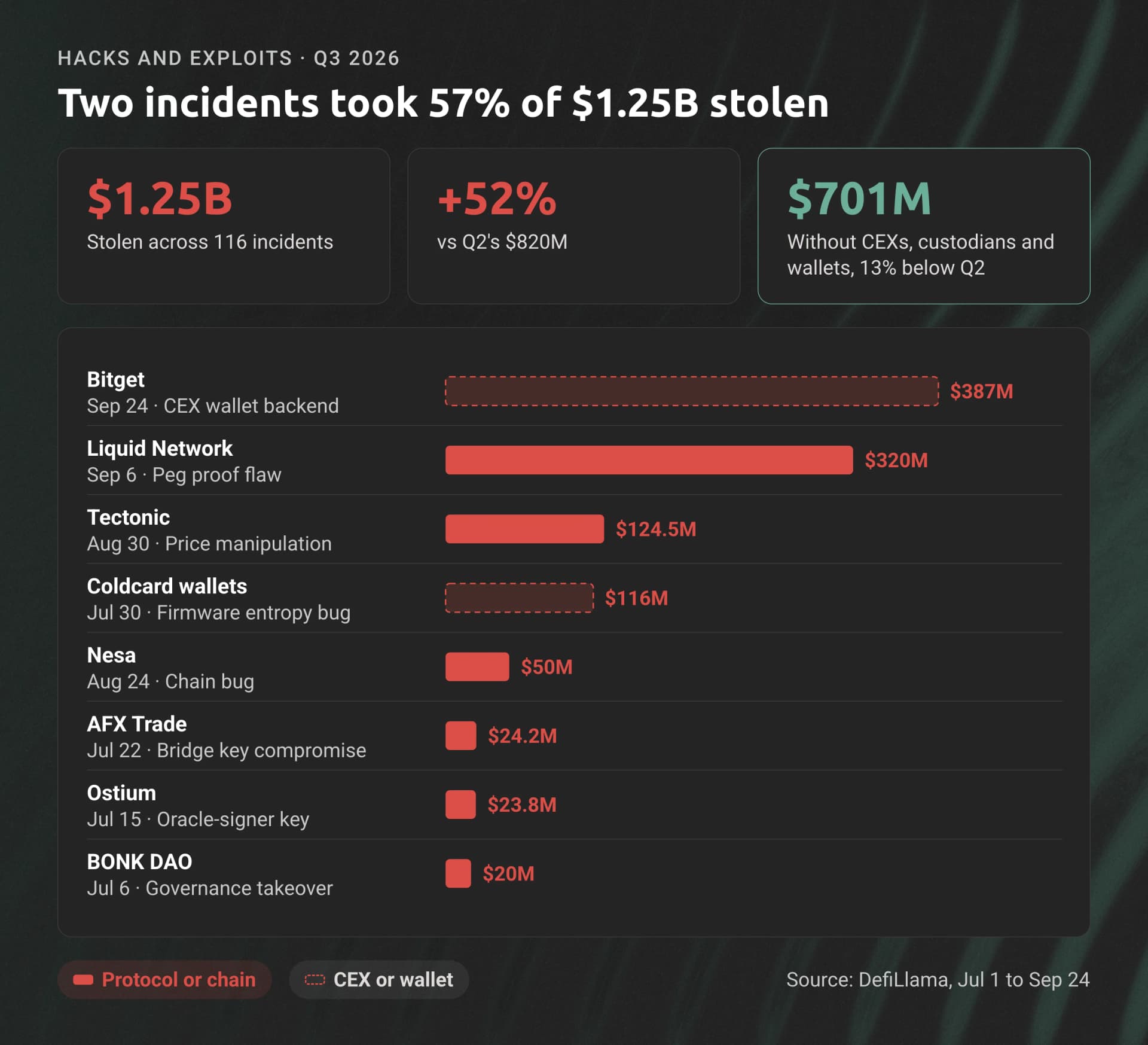
| Date (2026) | Protocol | Chain | Loss | Cause |
|---|---|---|---|---|
| Sep 24 | Bitget | Multiple | $387.0M | Compromise of CEX wallet backend |
| Sep 6 | Liquid Network | Liquid / Bitcoin | $320.0M | Peg proof-verification flaw |
| Aug 30 | Tectonic | Cronos | $124.5M | Price manipulation of TONIC collateral |
| Jul 30 to Aug 4 | Coldcard hardware wallets | Bitcoin | $116.0M | Firmware entropy bug, self-custody |
| Aug 24 | Nesa | Nesa | $50.0M nominal | Bug in Cosmos EVM chain |
| Jul 22 | AFX Trade | Arbitrum | $24.15M | Compromise of bridge validator key |
| Jul 15 | Ostium | Arbitrum | $23.75M | Oracle-signer key compromise |
| Jul 6 | BONK DAO | Solana | $20.0M | Governance takeover |
| Jul 21 | Wanchain Cardano-BNB bridge | Cardano / BNB | $10.0M | Bridge signature verification |
| Jul 24 | Triple-A | Ethereum / Tron / Arbitrum | $9.7M | Custodial hot-wallet key |
| Aug 22 | KiiChain | KiiChain | $9.7M | Bug in Cosmos EVM chain |
| Sep 22 | Astroport and Drop | Neutron | $9.3M | Governance takeover |
| Jul 11 | Bonzo Lend | Hedera | $9.05M | Third-party oracle flaw |
Source: DefiLlama hacks API, fetched Sep 26. The table lists every incident DefiLlama records at $9 million or more, with one exception. It omits KITE Foundation, $13.34 million in DefiLlama on Aug 5, because the foundation says no tokens were lost. Ostium and Wanchain figures vary by source. Halborn puts Ostium at $18 million, and Wanchain ranges from $9 million to $13 million.
Three events were 67% of the total, and most of the money from two of them came back. Liquid Network's attackers returned 3,400 of about 4,000 BTC within two days. Cronos validators reverted 1 hour 54 minutes of chain history to undo $111.2 million of Tectonic's loss. That rollback also removed unrelated transactions. Bitget covered its loss from a user protection fund, and its CEO called North Korean involvement "very likely".
On the DeFi side, bridge and peg verification failures caused 48.9% of losses. Oracle and price manipulation of illiquid collateral caused 21.7%, and smart-contract logic bugs 16.2%. Logic bugs were the most common incident type, 57 of 105, but averaged about $2 million each.
The same pattern hit Tectonic's TONIC and Bonzo's oracle failure. It also hit Moonwell's MAMO on Base for $8.7 million on Aug 27, and Nostra's NSTR on Starknet for $3.5 million on Sep 17. The attacker pumps a thinly traded token, borrows against it at the inflated price, and keeps the loan. If your protocol prices collateral from a spot feed, What Is a Blockchain Oracle? explains how these manipulations work.
No report tied any Q3 incident to an RPC-node compromise, though Across's relayer did accept forged off-chain deposit events on July 17. DefiLlama recorded no Q3 hacks on Hyperliquid L1, Monad, Robinhood Chain or Plasma.
On the April incidents, recovery is mostly complete and still costing money. rsETH backing returned to 100.01% on May 25. The "DeFi United" pledges of more than $303 million settled into 14,570 ETH of donations and 25,000 ETH from the Aave DAO treasury. Mantle added a credit line of up to 30,000 ETH, which is still outstanding. Arbitrum sent the frozen 30,765.6 ETH to Aave LLC on June 15 under a US court order. The court did not issue a final ruling by September 26. On September 24, KelpDAO's developer sued LayerZero Labs and its CEO in British Columbia over the April exploit. DefiLlama now puts April's losses at $648.1 million, higher than the $629 million in the April post.
Regulation after the MiCA and GENIUS deadlines
Did MiCA take full effect on July 1, 2026?
Yes. Every MiCA transitional period expired on July 1, 2026, so unlicensed crypto-asset service providers, or CASPs, can no longer serve EU clients. France's AMF counted 283 authorised CASPs across the EU on July 6. ESMA's interim register listed 354 authorisations effective by September 24, including Coinbase, Kraken, OKX, Bybit and Robinhood Europe. Binance, Bitget, MEXC and HTX were not on it.
Enforcement began at small scale. Austria's FMA published the first reported MiCA fine on August 14. The fine was EUR 70,000 against Bitpanda for a late white paper and marketing before publication. USDT left licensed EU venues on July 1.
DeFi comes next. The European Parliament asked for a review of DeFi, staking and lending under MiCA on July 7. On September 24 the EBA proposed to bring crypto lending and access to DeFi lending into scope, with certification for DeFi lending protocols. The Commission's MiCA review consultation closes September 30.
What happened to the GENIUS Act after July 18?
The July 18, 2026 rulemaking deadline passed with no final implementing rules. The OCC's Comptroller said on August 19 that a final rule would be out "by November". Treasury published its issuer proposal on August 18, with comments due October 17. The Federal Reserve proposed its rules for Board-supervised issuers on September 24. The statute takes effect on January 18, 2027 at the latest. Circle received final OCC approval for a national trust bank on July 10.
What about the SEC, the CLARITY Act and the rest?
The CLARITY Act, the US market structure bill, failed a Senate cloture vote 49 to 50 on September 15. Its developer protections are therefore not law. The agencies moved instead. The SEC proposed "Regulation Crypto Assets", a token offering exemption, on August 18. On September 17 it issued an Innovation Exemption for tokenized stocks on permissioned AMM venues. The CFTC extended no-action relief to wallet front-ends that route users to regulated venues. The SEC's April Covered User Interface guidance remains the main US rule for DeFi front-ends.
Elsewhere, the UK's FCA opens its crypto application gateway on September 30, 2026, ahead of an October 2027 start. Japan's Diet reclassified 105 crypto assets as financial products on July 15. The flat 20% tax is scheduled for 2028, not April 2026 as the April post said.
Multi-chain snapshot, Q2 close to September 26
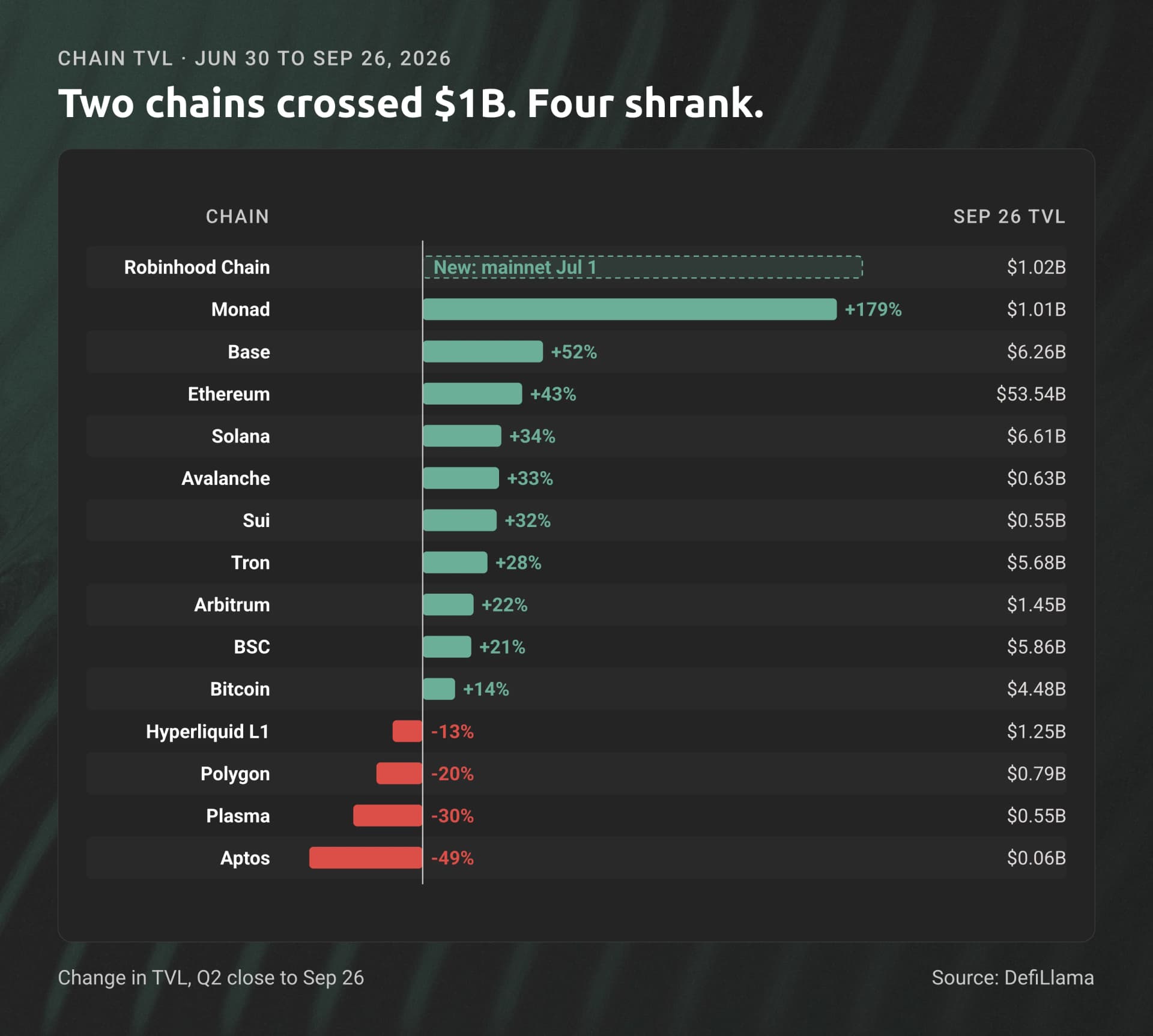
| Chain | Jun 30 | Sep 26 | Change | What drove it |
|---|---|---|---|---|
| Ethereum | $37.35B | $53.54B | +43% | Mostly ETH price (+67%) |
| Solana | $4.92B | $6.61B | +34% | SOL +61% |
| Base | $4.13B | $6.26B | +52% | All-time high in the series |
| BSC | $4.84B | $5.86B | +21% | BNB +38% |
| Tron | $4.43B | $5.68B | +28% | JustLend +$0.95B |
| Bitcoin | $3.94B | $4.48B | +14% | BTC +40%, plus Babylon |
| Arbitrum | $1.19B | $1.45B | +22% | Rebound from a year-long decline |
| Hyperliquid L1 | $1.44B | $1.25B | -13% | Stablecoin lending shrank |
| Robinhood Chain | $0.00B | $1.02B | New | Mainnet Jul 1, led by Morpho and Uniswap v4 |
| Monad | $0.36B | $1.01B | +179% | Aave V3, Euler V2, Pendle |
| Polygon | $0.98B | $0.79B | -20% | Declined every month |
| Avalanche | $0.47B | $0.63B | +33% | Aave V3 $0.34B, Aave V4 live Jul 15 |
| Plasma | $0.79B | $0.55B | -30% | Aave V3 is 86% of chain TVL |
| Sui | $0.41B | $0.55B | +32% | NAVI $172M, Suilend $168M |
| Aptos | $0.11B | $0.06B | -49% | Continued decline |
Source: DefiLlama chain TVL, fetched Sep 26. Excludes CEX and bridge-category TVL.
Which chains crossed $1 billion in Q3?
Robinhood Chain and Monad both crossed $1 billion in Q3. Robinhood Chain went from zero at its July 1 mainnet to $1.02 billion on September 26, its all-time high. Morpho Blue, at $570 million, and Uniswap v4, at $204 million, led it. Its trading activity is far larger than its TVL. It did $85.2 billion of DEX volume in Q3, 11.8% of the headline total. Its $50.5 billion in September was almost all of the headline total's increase from August to September. Much of that flow runs through token launchpads such as Pons V2 and trading apps such as GMGN. Pons V2 earned $141.2 million in fees over 30 days, third behind Tether and Circle.
Monad rose from $363 million to $1.01 billion after Aave V3 and GHO launched there in early July. Users deposited more than $100 million in 48 hours. Euler V2 at $264 million, Pendle at $199 million and Morpho Blue at $192 million followed. Its Q3 DEX volume doubled to $8.71 billion.
Arc, Circle's stablecoin chain, reached $0.49 billion within ten days of its September 16 mainnet, mostly Morpho and Aave V4. See Top 8 Arc RPC Providers 2026 for the endpoints available there.
What happened to Plasma and Sui?
Plasma kept falling and Sui recovered. Plasma lost most of its TVL inside April, from $2.19 billion on April 17 to $0.61 billion on April 30. It lost another 30% in Q3, to $0.55 billion. Stablecoins held on Plasma rose from $1.10 billion to $1.45 billion over the same quarter, so the chain kept deposits but not DeFi activity.
Sui grew 32% in Q3. The April post listed Sui at $2 billion and Aptos above $1 billion. DefiLlama's default series shows Sui at $0.61 billion and Aptos at $0.28 billion on April 17. Sui's peak was $2.64 billion in October 2025.
Why is Arbitrum's TVL so far behind Base?
Arbitrum's DeFi TVL is $1.45 billion against Base's $6.26 billion for two reasons. DefiLlama's default chain figure excludes bridges and CEX wallets, and Arbitrum's DeFi TVL declined over the past year. The series shows $4.20 billion on October 7, 2025, $2.89 billion at the end of 2025 and $1.19 billion on June 30. On L2BEAT's total value secured, which counts all bridged and native assets, the gap is smaller. Arbitrum had $11.55 billion and Base $16.43 billion on September 26.
AI agents and x402, one quarter on
x402 transactions grew faster than x402 dollar volume. x402scan counted 232.4 million all-time transactions and $54.82 million in volume on September 25. The April post had 165 million transactions and $50 million. In the 30 days to September 26, x402scan recorded 18.8 million transactions and $1.02 million. The x402.org homepage still shows "75.41M transactions, $24.24M" for the last 30 days. That figure is unchanged since at least June 24, so do not cite it as current.
The Linux Foundation completed the x402 Foundation launch on July 14 with 40 members, and the list had 52 on September 26. Block joined on September 24 and added Lightning support. Microsoft was not on either list, although the April post named it as a backer. For how x402 compares with the other machine-payment standard, see x402 vs MPP.
ERC-8004 agent registrations reached 538,724 on September 26, four times the April post's projection of 130,000 by year-end. BNB Chain holds 61% of them, which suggests low-cost bulk registration. On Ethereum mainnet the count went from about 24,000 in early May to 31,883.
What Q3 means for builders in Q4
Size capacity for September, not July. Daily DEX volume averaged $10.66 billion in September against $6.69 billion in July, a ratio of 1.59. If you sized your indexer, bot or API backend in early summer, re-test it at 1.6 times July load. Robinhood Chain produces about 10 blocks per second, so a 500-block eth_getLogs window covers under a minute of chain time. The Robinhood Chain DeFi data guide covers chunking and backfill.
On Hyperliquid, the Foundation announced in June that public WebSocket order-book pushes would slow to 2-second intervals, or 0.5 seconds with fast: true. It told automated traders to run a non-validating node instead. Do not size a market-making bot on the old feed cadence.
Decide on the new chains this quarter. Two chains went from under $400 million to $1 billion in 88 days, and Arc reached $0.49 billion in ten days. If your product is multi-chain, check which of Robinhood Chain, Monad and Arc your users are already bridging to.
Treat thin collateral and off-chain inputs as attack targets. Q3's DeFi-specific losses came from price manipulation of illiquid tokens, bridge verifiers and signer keys. No report tied any of them to a compromised RPC node. The defensive pattern from April still applies. Read the same state from multiple independent RPC providers and pause automated actions when they disagree. The April post's monitoring sample shows the code.
Treat MiCA and GENIUS as current obligations. If you serve EU users through a front-end or API and are not fully decentralized, you need a CASP licence or a licensed partner now. If you issue or integrate a US stablecoin, the GENIUS rules are in proposal with a January 18, 2027 backstop date.
Dwellir runs RPC infrastructure for 150+ networks, including Robinhood Chain, Monad, Arc and Hyperliquid, through a single API key. Paid plans start at $49 a month for 100 requests per second and bill 1 API credit per RPC response, with no compute units. Unlimited Nodes remove per-request metering at 25 to 1,000 requests per second from $119 a month. Dedicated clusters of archive nodes start at $2,400 a month. Dwellir does not offer Solana RPC, so Solana teams need a different provider for that chain.
What to watch in Q4 2026
- DeFi TVL needs another $17.9 billion, or 19%, to reach the $113.34 billion of December 31, 2025. If ETH holds, the rest has to come from new deposits.
- Stablecoin supply stayed between $305.16 billion and $312.32 billion throughout Q3. A close above the May 17 high of $320.87 billion would mean new dollars are entering.
- Uniswap v4 ran at 88% of v3's volume in September, so it needs about 14% more relative volume to lead again. Robinhood Chain's routing will decide it.
- Hyperliquid's DefiLlama share fell from 39.1% in July to 34.2% in September while Variational and Aster gained.
- Regulatory dates fall through the quarter. The MiCA review consultation closes September 30. Treasury's GENIUS comments close October 17. The OCC says its final rule will be out by November. The Senate's target adjournment is December 18.
To build on any of the chains above, see Dwellir's supported networks or contact the Dwellir team.
Sources
All fetched September 26, 2026 unless stated.
- DefiLlama TVL: historicalChainTvl, per-chain
/v2/historicalChainTvl/{chain}, per-protocol/protocol/{slug} - DefiLlama stablecoins: stablecoincharts/all (peggedUSD series),
/stablecoin/{id} - DefiLlama DEX volume and fees: overview/dexs, overview/fees,
/summary/dexs/{slug},/summary/fees/{slug} - DefiLlama perps: defillama.com/perps (the
api.llama.fi/overview/derivativesroute returns HTTP 402). Open interest from/summary/open-interest/hyperliquid-perps - DefiLlama hacks: api.llama.fi/hacks (latest record Sep 24)
- ETF flows: SoSoValue historical inflow API, US spot BTC and ETH (data to Sep 25)
- Tokenized RWAs: rwa.xyz (Sep 26) and Wayback snapshot of Jun 26
- L2BEAT total value secured: Arbitrum
- Hyperliquid info API (
outcomeMeta,spotClearinghouseState,candleSnapshot), HIP-4 documentation, Liquidiction HIP-4 stats, QuickNode on the WebSocket changes (Jun 12) - x402: x402scan (Sep 25), x402 Foundation launch (Jul 14)
- ERC-8004: 8004scan (Sep 26)
- MiCA: ESMA MiCA page, ESMA CASP register (updated Sep 24), AMF release (Jul 6)
- GENIUS Act: The Block on the missed deadline (Jul 18), OCC release (Aug 19), Federal Reserve proposals (Sep 24)
- SEC: Regulation Crypto Assets proposal (Aug 18), Innovation Exemption (Sep 17)
- CLARITY Act cloture vote: JD Supra (Sep 15)
- Uniswap fee switch: Uniswap governance forum, GovernorBravo proposals #99 and #100 read on-chain
- Aave V4 and Kelp recovery: Aave governance, Cointelegraph on Aave V4 Avalanche (Jul 15)
- Morpho Midnight: Cointelegraph (Jul 21)
- Security incidents: Halborn on Liquid Network, CoinDesk on the Cronos rollback (Sep 8), CoinDesk on the Bitget freeze (Sep 25), The Block on the KelpDAO lawsuit (Sep 25), Arbitrum forum on the frozen ETH