You hold a long ETH perpetual on Hyperliquid and want to hedge with a prediction market position on the next Fed rate decision. Today, that means a separate Polymarket account, separate USDC collateral on Polygon, and zero cross-margining between the two.
Prediction markets generated $63.5 billion in trading volume during 2025 (a 302.7% increase year-over-year) and hit 8.58 million monthly active users by January 2026. The growth is real, but every major platform operates in isolation from the rest of DeFi.
HIP-4 (Hyperliquid Improvement Proposal 4) changes this. It introduces outcome contracts directly into Hyperliquid's trading engine: fully collateralized binary instruments that settle between 0 and 1 based on whether a real-world event occurs. They share the same order book infrastructure, margin system, and USDH settlement as Hyperliquid's perpetual and spot markets. For the first time, a trader can hold perps, spot positions, and prediction market contracts in a single margin account with automatic offsetting.
This guide covers how outcome contracts work, the full market lifecycle, why perpetuals cannot handle binary events, and what developers need to know to build on this new primitive.
What Is HIP-4?
HIP-4 introduces outcome contracts to Hyperliquid - fully collateralized binary financial instruments that settle between 0 and 1 based on whether a specific real-world event occurs. The contract price represents the market's implied probability of that event happening.
Outcome contracts execute natively within HyperCore, sharing the trading engine, order book infrastructure, and unified margin system with Hyperliquid's existing spot and perpetual markets. If a contract trades at 0.65, the market implies a 65% probability the event will occur. Buying YES at 0.65 profits 0.35 per contract if the event occurs and loses 0.65 if it does not. All settlement happens in USDH, Hyperliquid's native stablecoin.
The key distinction from standalone prediction market platforms is composability. HIP-4 outcome contracts sit alongside perps and spot in the same trading ecosystem, enabling cross-product strategies that are impossible when prediction markets exist on isolated platforms.
How Outcome Contracts Work
Binary Mechanics
An outcome contract is a binary instrument tied to a discrete event. The mechanics are straightforward:
- Price range: Contracts trade between 0.001 and 0.999, representing the market's implied probability
- Buying YES at price P: You profit (1 - P) if the event occurs and lose P if it does not
- Buying NO at price P: You profit P if the event does not occur and lose (1 - P) if it does
- Settlement: The contract resolves to exactly 0 or 1 based on the oracle's final binary outcome
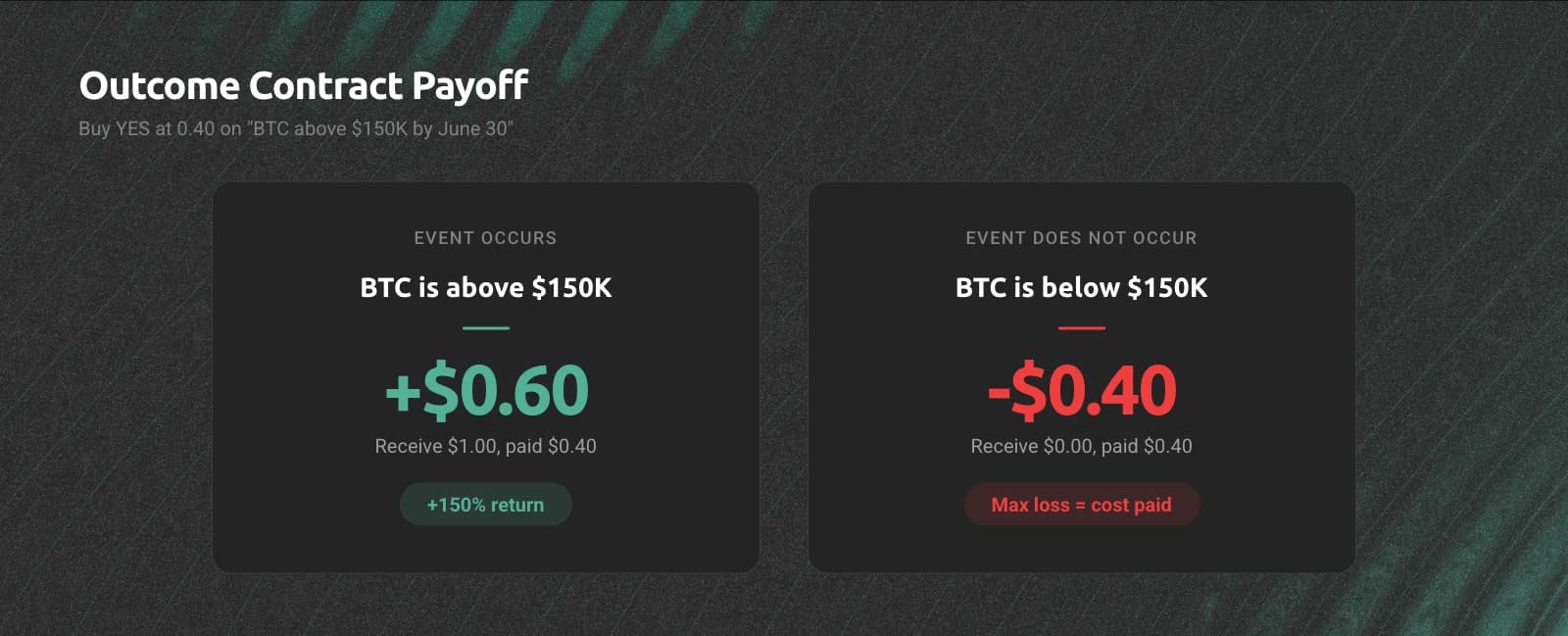
For example, if you buy a YES contract on "BTC above $150K by June 30" at 0.40, you pay $0.40 per contract. If BTC is above $150K at expiry, you receive $1.00 (profit of $0.60). If not, you lose your $0.40.
Full Collateralization
Every HIP-4 position uses 1x isolated margin only. There is no leverage. This design choice eliminates liquidation risk entirely. When you buy a contract at 0.40, you post $0.40 in USDH. Your maximum loss is capped at exactly what you paid.
This is a deliberate departure from Hyperliquid's perpetual futures, which support up to 50x leverage. Binary events do not lend themselves to leveraged positions - the outcome is all-or-nothing, making full collateralization the natural fit.
Central Limit Order Book
Each outcome market gets its own order book on HyperCore, using the same CLOB (central limit order book) infrastructure that powers Hyperliquid's perp and spot markets. Orders match using price-time priority with the same low-latency characteristics as other Hyperliquid markets - around 200,000 orders per second across the platform.
The Market Lifecycle
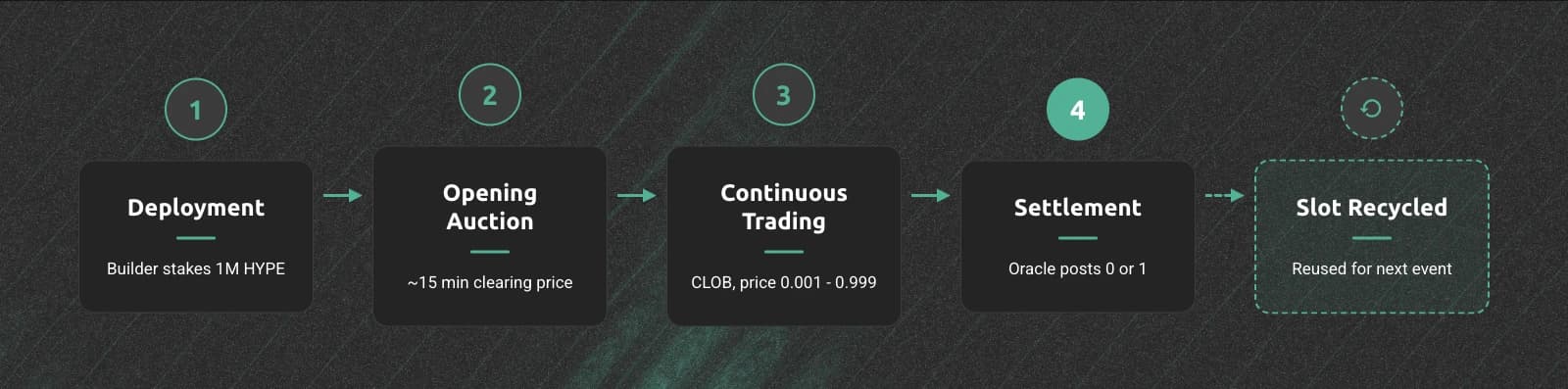
Every HIP-4 outcome market moves through four phases: deployment, opening auction, continuous trading, and settlement.
1. Deployment
A builder deploys an outcome market into a slot within their event DEX. Builders must stake 1,000,000 HYPE to participate. This stake is slashable, creating economic accountability for market quality and accurate event definitions.
The builder defines the event schema - the specific conditions that determine whether the contract settles at 0 or 1. For example: "ETH spot price above $5,000 at 00:00 UTC on July 1, 2026, as reported by the designated oracle." Builders receive up to 50% of trading fees above the base rate, creating a direct incentive to deploy popular markets. For more on builder economics and staking, see the linked guide.
2. Opening Auction (Approximately 15 Minutes)
Once deployed, a market enters an opening auction lasting roughly 15 minutes. During this phase:
- Participants submit orders, but no matching occurs
- The system calculates a clearing price that maximizes matched volume
- At auction close, all orders that cross the clearing price execute simultaneously
The opening auction prevents early-mover advantages and establishes a fair initial price based on aggregated market sentiment, similar to how traditional equity exchanges handle opening crosses.
3. Continuous Trading
After the auction, the market transitions to continuous trading on the CLOB. Orders follow price-time priority. Traders place limit orders, market orders, and manage positions the same way they would on any Hyperliquid perp or spot market.
During this phase, the contract price fluctuates between 0.001 and 0.999 based on supply and demand. As new information about the underlying event emerges, the price adjusts to reflect the market's updated probability assessment.
4. Settlement
When the event reaches its resolution criteria:
- An authorized oracle posts the final binary outcome (0 or 1)
- Trading halts immediately
- All open positions auto-settle in USDH at the posted outcome price
- An optional challenge window allows disputes before settlement finalizes
After settlement, the market slot is recycled and can be reused by the builder for a new event. This slot recycling mechanism enables recurring markets - weekly, monthly, or event-driven series - without requiring new contract deployments each time.
The HIP Progression: HIP-1 to HIP-4
HIP-4 is the latest in a series of proposals that progressively expand Hyperliquid's capabilities. Each HIP adds a new financial primitive to the platform.
| HIP | Function | Builder Stake | Status |
|---|---|---|---|
| HIP-1 | Native token standard (equivalent to ERC-20) | N/A | Live |
| HIP-2 | On-chain liquidity for new tokens on CLOB | N/A | Live |
| HIP-3 | Permissionless perpetual futures | 500,000 HYPE | Live |
| HIP-4 | Outcome contracts for binary events | 1,000,000 HYPE | Testnet (Feb 2026) |
The progression is clear: Hyperliquid is building a general-purpose financial platform layer by layer. HIP-1 and HIP-2 established token infrastructure and liquidity. HIP-3 opened perpetual futures to anyone willing to stake. HIP-4 extends the same permissionless model to binary event markets, with the higher stake requirement (1M vs 500K HYPE) reflecting the added complexity of oracle-dependent instruments.
A notable detail: Kalshi's head of crypto co-authored the HIP-4 proposal, bridging the CFTC-regulated prediction market world and on-chain innovation directly. In March 2026, Hyperliquid and Kalshi announced a partnership to launch on-chain prediction markets together, confirming the collaboration behind HIP-4 is moving toward production.
Why Not Just Use Perpetuals?
HIP-3 already enables permissionless perpetual futures. Why not create a perpetual contract for a binary event instead?
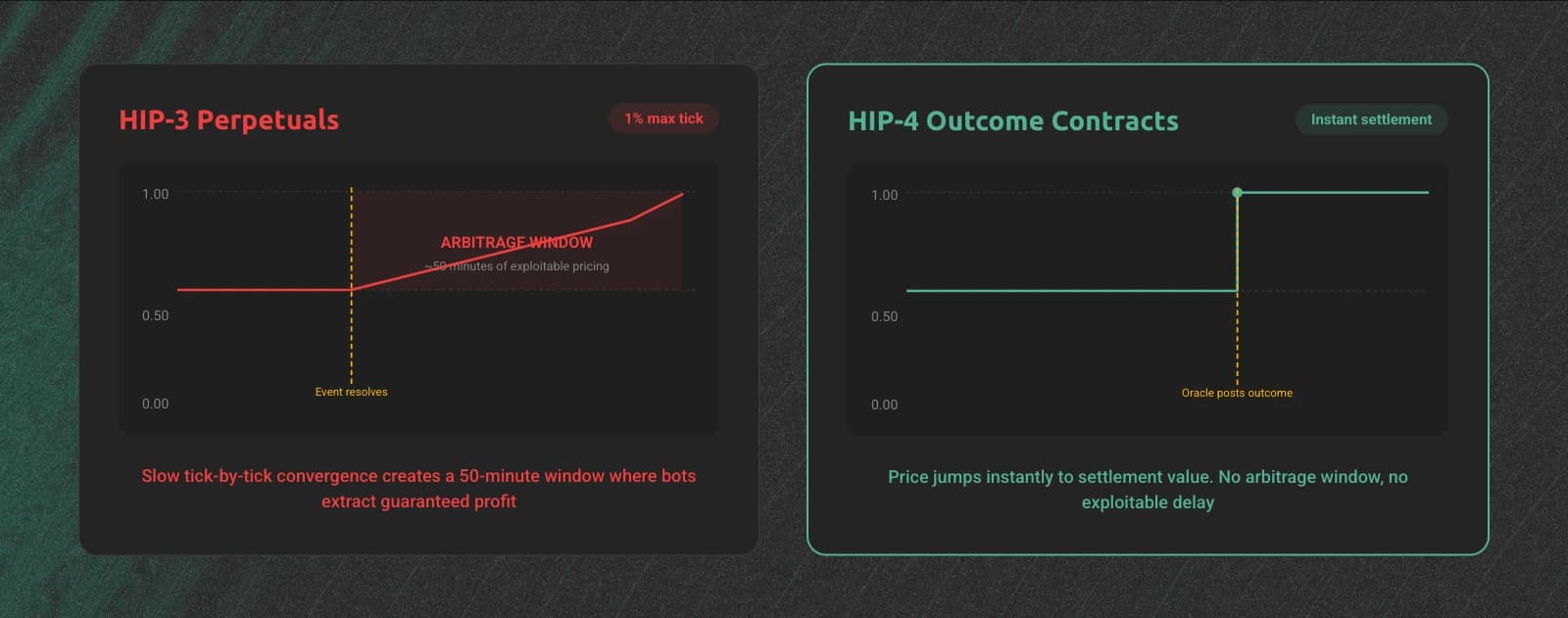
The answer is mechanical. HIP-3 enforces a 1% price change limit per oracle tick. For a standard perp tracking ETH or BTC, this constraint is invisible - prices rarely move more than 1% in a single update. But for a binary event, the outcome jumps from some intermediate probability to exactly 0 or 1 at resolution.
Consider a market trading at 0.50 (50% probability). When the event resolves YES, the price needs to jump from 0.50 to 1.00. Under HIP-3's 1% tick constraint, that requires approximately 50 sequential oracle ticks, each moving the price by 0.01. At Hyperliquid's tick interval, settling from 0.50 to 1.00 would take roughly 50 minutes.
During those 50 minutes, the outcome is already known. Anyone can buy the contract at a discount to the true settlement value (1.00) and extract guaranteed profit. This arbitrage window would be exploited instantly by automated traders, transferring value from existing position holders to fast actors.
HIP-4 solves this by eliminating continuous oracle feeds and funding rates entirely. When the oracle posts the final outcome, the price jumps directly to the settlement value. There is no tick-by-tick convergence, no arbitrage window, and no period where the contract trades at a known-incorrect price.
HIP-4 vs Polymarket vs Kalshi
With the mechanics covered, here is how HIP-4 stacks up against the two largest prediction market platforms.
| Feature | HIP-4 (Hyperliquid) | Polymarket | Kalshi |
|---|---|---|---|
| Architecture | On-chain CLOB on HyperCore | AMM + CLOB on Polygon | Centralized order book |
| Composability | Full - shared margin with perps/spot | None - isolated platform | None - isolated platform |
| Collateral | USDH (native stablecoin) | USDC | USD (bank deposits) |
| Market creation | Permissionless (phase 2, 1M HYPE stake) | Permissioned (Polymarket team approves) | Permissioned (CFTC-regulated) |
| Leverage | 1x only (fully collateralized) | 1x only | 1x only |
| Settlement | Oracle + optional challenge window | UMA oracle (optimistic) | Internal resolution |
| Throughput | ~200,000 orders/sec (shared engine) | Limited by Polygon throughput | Undisclosed |
| Regulation | Decentralized, no regulatory license | Acquired CFTC-licensed QCEX for $112M | CFTC-regulated |
| Cross-product hedging | Yes - same margin account as perps | No | No |
The Composability Advantage
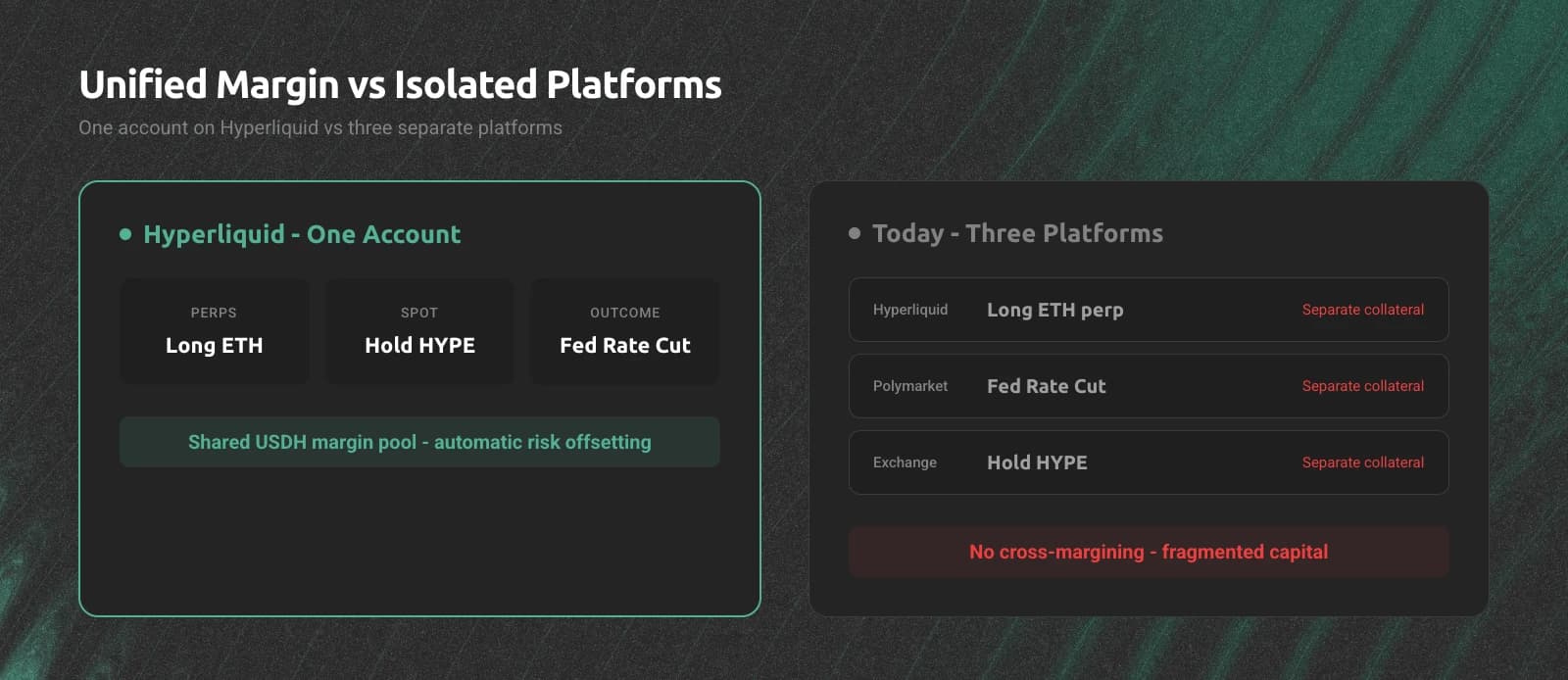
The most significant differentiator is composability with existing Hyperliquid markets. A trader can hold a long ETH perpetual and an outcome contract on "Fed cuts rates in July" within the same margin account with automatic risk offsetting. The unified margin system recognizes both positions and calculates net exposure accordingly.
On Polymarket, you need a separate wallet, separate collateral, and no cross-margining with any other DeFi position. Polymarket recently acquired CFTC-licensed QCEX for $112 million to facilitate US re-entry, signaling a push toward regulatory legitimacy - but its architecture remains standalone on Polygon with no DeFi composability.
On Kalshi, the experience is entirely off-chain. You deposit USD, trade on a centralized order book, and withdraw USD. There is no programmable composability, no smart contract integration, and no way to build automated strategies that span prediction markets and other DeFi instruments.
Where Polymarket and Kalshi Win
HIP-4 is not universally superior. Polymarket has the strongest brand recognition in crypto prediction markets and the deepest liquidity on established markets. Kalshi offers CFTC regulatory clarity, which matters for institutional participants and US-based firms with compliance requirements. And HIP-4 remains on testnet with no mainnet date confirmed, meaning it has zero production liquidity today.
Use Cases Beyond Prediction Markets
Prediction markets are the most obvious application, but HIP-4 outcome contracts are a general-purpose primitive with broader utility.
Bounded Options-Like Instruments
Outcome contracts behave similarly to binary options but with the transparency and composability of on-chain execution. A contract on "BTC above $200K by December 31" gives a defined, bounded payout structure. Combined with a BTC perpetual position, this creates hedging strategies that approximate traditional options payoffs without requiring a full options protocol.
Cross-Product Hedging
A market maker running a delta-neutral perpetual strategy can use outcome contracts to hedge against discontinuous events (regulatory announcements, protocol upgrades, macro decisions) that cause sharp price moves. The unified margin system means adding this hedge requires no capital movement to another platform and no collateral fragmentation.
Recurring Event Markets
HIP-4's slot recycling mechanism is purpose-built for recurring events. A builder deploys a slot for "Weekly BTC Range" markets, and after each week's market settles, the same slot hosts the next week's market. This reduces deployment friction and enables consistent market series: weekly economic data releases, monthly protocol metrics, or quarterly earnings-adjacent contracts.
Structured Products
Composing outcome contracts with perpetuals and spot positions opens the door to structured products. A vault contract on HyperEVM could automatically manage a portfolio that combines directional perp exposure with event-driven outcome contracts, offering users packaged risk-return profiles without manual position management.
Cross-Market Arbitrage
Because HIP-4 markets share infrastructure with Hyperliquid's existing markets, arbitrageurs can operate across spot, perps, and outcome contracts in the same transaction context. If an outcome contract on "ETH above $10K" trades at 0.30 while the perps market implies a different probability distribution, automated strategies can exploit the discrepancy with minimal latency and no cross-platform settlement risk.
What Developers Need to Know
API Access
HIP-4 markets use the same API infrastructure as existing Hyperliquid markets. If you have built on Hyperliquid's perpetual or spot APIs, the integration pattern is identical:
- Info endpoint: Query market data, order book state, and position information
- Exchange endpoint: Place and cancel orders, manage positions
- WebSocket: Real-time order book updates and trade feeds
- gRPC streaming: Low-latency data feeds for automated strategies
Python, Rust, and TypeScript SDKs are available. The existing Hyperliquid trading bot patterns apply directly to outcome contract markets with minimal modification.
Order Signing
All Hyperliquid orders, including HIP-4 outcome contracts, require EIP-712 typed data signatures. This adds complexity compared to simple REST API calls but provides cryptographic proof of order intent. The SDK libraries handle signature construction. If you are building custom integrations, account for the signing overhead in your latency budget.
Settlement-Driven Load Patterns
HIP-4 introduces a new infrastructure consideration: expiry-driven traffic spikes. When a high-profile outcome market approaches settlement, trading activity concentrates into the final hours or minutes. The oracle posting triggers immediate settlement of all positions, creating a burst of state changes and balance updates.
For applications monitoring multiple outcome markets, these settlement events can overlap - especially for builders running recurring weekly or monthly series. Your infrastructure needs to handle these spikes without degradation.
Public Hyperliquid endpoints limit you to 100 requests per minute with no WebSocket JSON-RPC support. For production applications tracking multiple outcome markets alongside perp and spot positions, dedicated infrastructure avoids rate-limiting at the worst possible moment - during settlement bursts when every millisecond counts.
Dwellir provides dedicated node clusters for Hyperliquid with higher rate limits, WebSocket feeds, and co-located infrastructure designed to remove the public endpoint bottleneck. For teams building trading applications with builder codes, outcome markets add another dimension of data to ingest and act on, making dedicated infrastructure more relevant.
Dual-Layer Architecture Considerations
Hyperliquid's dual-layer architecture (HyperCore for trading, HyperEVM for smart contracts) means developers building structured products or vaults that interact with outcome contracts need to understand both layers. HyperCore handles order matching and settlement. HyperEVM provides the programmable layer for composing positions into higher-level products.
Current Status and What Comes Next
HIP-4 went live on testnet in February 2026, with BTC and HYPE binary markets available in USDH. HYPE rallied over 40% in the week following the announcement, reflecting market enthusiasm for Hyperliquid's expansion into prediction markets.
The mainnet rollout follows a phased approach:
- Phase 1: Curated markets - the Hyperliquid team selects and approves which outcome markets go live. This allows controlled scaling and risk management while the system proves itself in production.
- Phase 2: Permissionless markets - any builder meeting the 1,000,000 HYPE staking requirement can deploy outcome markets. This mirrors the trajectory HIP-3 followed with perpetual futures.
The broader DeFi landscape provides tailwind. Prediction market monthly active users grew 400% year-over-year, and Hyperliquid processed $2.95 trillion in trading volume during 2025 with 1.4 million users and $6 billion in peak TVL. The state of DeFi in 2026 points toward composable, multi-product platforms - exactly the direction HIP-4 represents.
A specific mainnet date has not been announced. The official guidance is "within 2026."
Open Questions
HIP-4 is still early, and several important details remain unresolved.
Oracle specifics. The proposal specifies an "authorized oracle" but does not detail the full oracle infrastructure. Who operates it? How is oracle selection governed? What happens if the oracle is unavailable at settlement time? These questions matter for markets with large open interest.
Challenge window mechanics. The optional dispute window after oracle posting is mentioned but not fully specified. What evidence is required to challenge a settlement? Who adjudicates disputes? What happens to positions during the challenge period? The integrity of outcome markets depends on robust dispute resolution.
Portfolio margin integration. The current spec requires 1x isolated margin. Future iterations may integrate outcome contracts into Hyperliquid's portfolio margin system, unlocking capital efficiency for sophisticated traders running multi-product strategies. No timeline or mechanics for this integration are public yet.
Builder accountability. With 1,000,000 HYPE at stake, builders have strong economic incentives to operate honestly. But the slashing conditions and governance process for poorly defined or ambiguous outcomes need further specification.
Cross-chain oracle feeds. For outcome markets tied to events on other blockchains or in traditional finance, the oracle infrastructure needs reliable cross-chain and off-chain data delivery. The design of this pipeline will determine which types of events can be reliably supported.
Key Takeaways
HIP-4 is a composable prediction market primitive, not another isolated prediction market. Native integration with Hyperliquid's perp and spot infrastructure enables cross-product strategies in a single margin account - something no standalone prediction market platform offers.
Full collateralization removes liquidation risk. The 1x isolated margin requirement caps your maximum loss at exactly what you paid. No leverage, no liquidation cascades.
The market lifecycle is well-structured. The four-phase flow from deployment through opening auction, continuous trading, and oracle-driven settlement follows established financial market patterns adapted for on-chain execution.
Perpetuals cannot do what outcome contracts do. The 1% tick constraint in HIP-3 creates exploitable arbitrage windows during binary event resolution. HIP-4 solves this at the protocol level.
It is still early. Testnet only, no mainnet date confirmed, and critical details around oracle infrastructure and dispute resolution remain unspecified. Zero production liquidity for outcome markets exists today.
Developer integration is straightforward. Same APIs, same SDKs, same infrastructure patterns as existing Hyperliquid markets. The main new consideration is settlement-driven load spikes.
Building on Hyperliquid and need infrastructure that handles settlement spikes and real-time data across perps, spot, and outcome markets? Dwellir provides dedicated node clusters for Hyperliquid, WebSocket feeds, and co-located infrastructure.
- Get started: Create your account
- Hyperliquid infrastructure: Dedicated node clusters and RPC access
- Explore RPC options: Hyperliquid RPC Providers
- Talk to the team: Discuss your infrastructure needs