Base, Coinbase's Layer 2 blockchain solution, has rapidly gained traction since its launch, emerging as one of the most prominent Ethereum scaling solutions. Built on the Optimism OP Stack, Base delivers faster transaction speeds and lower fees while maintaining the security guarantees of the Ethereum mainnet. For developers building on Base, selecting the right RPC (Remote Procedure Call) provider is crucial for ensuring optimal performance, reliability, and cost-effectiveness.
This updated comparison examines six leading Base RPC providers (Dwellir, Alchemy, QuickNode, Infura, Chainstack, and dRPC) to help you make an informed decision based on your specific development needs, budget constraints, and scalability requirements.
Understanding Base RPC Provider Selection Criteria
If you need a full checklist, start with Dwellir's 8 Essential Factors to Consider When Choosing a Base RPC Provider, which dives deep into benchmarking methodology, RPS targets, and data freshness expectations. Keep the following pillars in mind as you compare vendors:
Performance and Latency: Response times directly impact user experience. The best providers deliver sub-100ms latency, ensuring your dApp remains responsive even under heavy load.
Reliability and Uptime: Downtime translates to lost revenue and frustrated users. Look for providers offering 99.9% or higher uptime guarantees with robust failover mechanisms.
Pricing Transparency: Some providers use complex compute unit (CU) or credit models that make cost forecasting difficult, while others offer straightforward per-request pricing. Dwellir's RPC providers without compute units guide explains how the various billing systems affect Total Cost of Ownership (TCO).
Scalability: Your provider should handle traffic spikes gracefully, with clear upgrade paths as your application grows.
Developer Experience: Quality documentation, responsive support, and ease of integration can significantly reduce development time.
6 Base RPC Providers: At-a-Glance
| Provider | Free Tier | Entry Price | Pricing Model | Ideal Use Case |
|---|---|---|---|---|
| Dwellir | 100K/day | $49/mo | 1:1 per response | Transparent pricing |
| Alchemy | 30M CU/mo | $5/mo + usage | Compute units | Developer platform |
| QuickNode | 50M credits | $49/mo | API credits | Global latency |
| Infura | 100K/day | $50/mo | Credit-based | MetaMask integration |
| Chainstack | 3M requests | $49/mo | Request-based | Managed infrastructure |
| dRPC | Public tier | $29/mo | Compute units | Decentralized network |
1. Dwellir – Transparent Pricing Without Compute Units
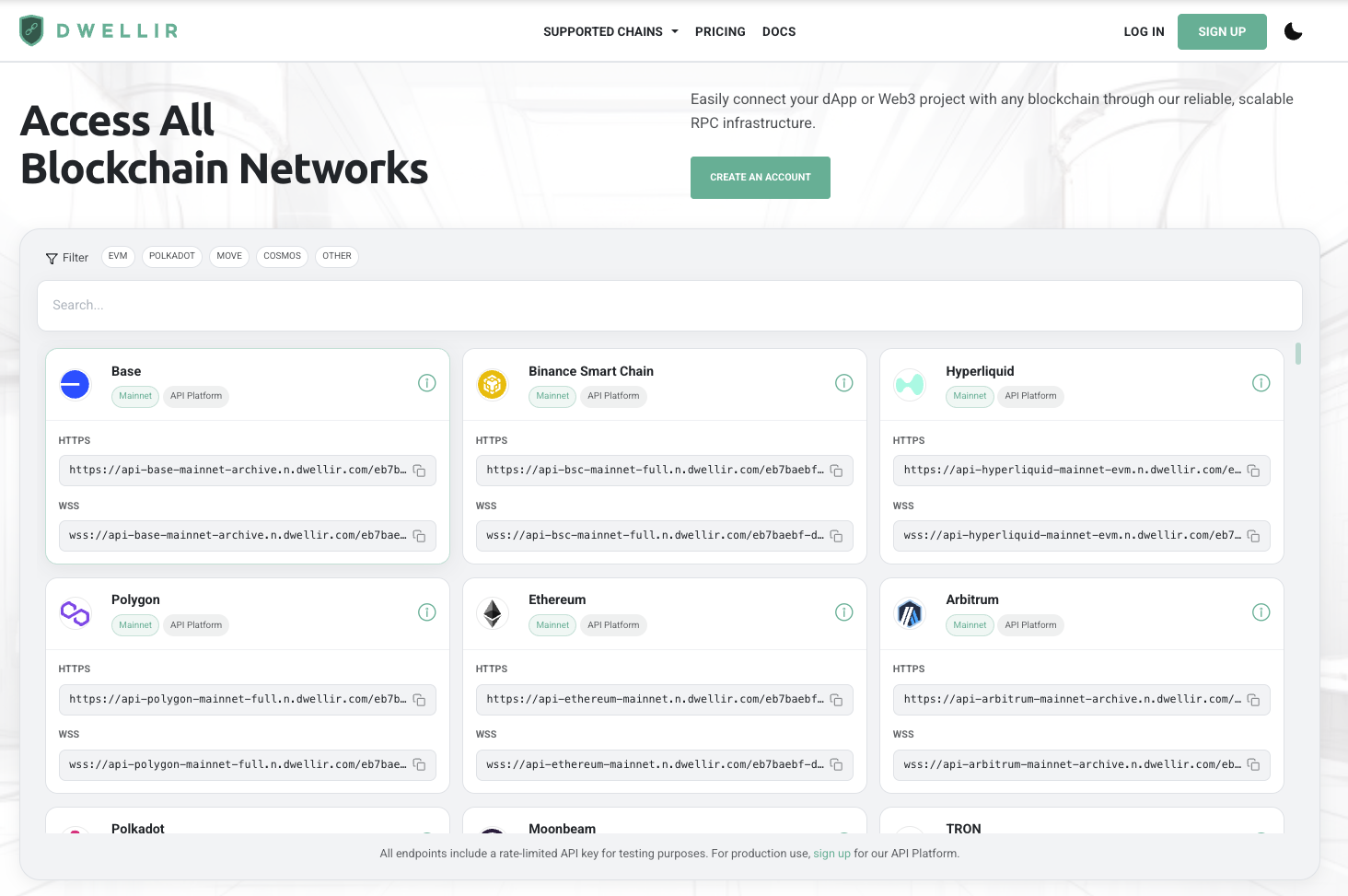
Dwellir's Base RPC overview shows how the platform delivers Base plus 140+ other networks under a fair 1:1 credit model, meaning one RPC response always equals one API credit regardless of method complexity. That same predictability extends to trace/debug calls, WebSocket streaming, and archive nodes, making budgeting straightforward for production teams. Dwellir's comprehensive Base docs walk through HTTPS and WSS integration, Flashblocks, and rate limit guidance.
Key Features
- Simple Credit System: Trace, debug, archive, and standard methods all cost the same, removing compute-unit guesswork.
- Extensive Network Coverage: 140+ blockchains through a single key, ideal for multi-chain dashboards and shared tooling.
- Protocol Support: HTTPS, WebSocket (WSS), and gRPC endpoints for Base mainnet and Sepolia.
- Performance Tiers: 20 to 5,000 sustained RPS with burst capacity up to 10,000 RPS plus autoscaling.
- Global Infrastructure: Distributed PoPs deliver <100 ms median latency for North America, EU, and APAC traffic.
- Dedicated Support: Growth plans and above include direct Slack channels and migration help.
Pricing Structure
| Plan | Price | Included Responses | Sustained RPS (Burst) | Overage |
|---|---|---|---|---|
| Free | Free | 100K responses per day | 20 RPS | N/A |
| Developer | $49/month | 25M responses per month | 100 RPS (bursts to 500) | $5 per 1M |
| Growth | $299/month | 150M responses per month | 500 RPS (bursts to 2,500) | $3 per 1M |
| Scale | $999/month | 500M responses per month | 5,000 RPS (bursts to 10,000) | $2 per 1M |
All paid plans include trace/debug APIs, WebSocket support, autoscaling, and 99.99% SLA coverage. Growth and Scale tiers add dedicated account management.
Pros and Cons
Advantages:
- Transparent, predictable pricing without compute unit complexity.
- Trace and debug endpoints included at no premium.
- Comprehensive multi-chain footprint for unified infrastructure.
- Generous burst protection for handling traffic spikes.
- Direct, personal support from the engineering team.
Considerations:
- Ecosystem-specific tooling (e.g., prebuilt monitors) is leaner than larger platforms.
Best For
Teams that value pricing transparency, rely on heavy trace/debug workloads, or need multi-network infrastructure beyond Base. Startups benefit from the Free plan, while scaling dApps avoid compute unit surprises across 140+ networks.
2. Alchemy – Comprehensive Developer Platform
Alchemy layers Base support into a wider developer platform that includes NFT APIs, token balance APIs, webhooks, Gas Manager, and simulation tooling. Their Base chain page highlights Flashblocks, Debug, and enhanced APIs, while the Pay As You Go FAQ outlines February 1, 2025 pricing changes.
Key Features
- Enhanced APIs: NFT, Token, and Notify APIs reduce time spent on indexing or running webhook infrastructure.
- Analytics Dashboard: Request volumes, latency, error breakdowns, and per-method CU consumption in one place.
- SDK Coverage: TypeScript, Python, Unity, and Kotlin SDKs plus CLI utilities accelerate integration.
- Simulation + Mempool Tools: Transaction simulation and mempool monitoring for pre-trade assessments.
- Enterprise Add-ons: Gas Manager, webhooks, and custom SLAs for compliance-sensitive teams.
Pricing Structure
| Plan | Price | Included Volume | Throughput | Notes |
|---|---|---|---|---|
| Free Tier | $0 | 30M compute units/month | 5 req/s, 2 deployments | Community support |
| Pay As You Go | $0 base + $0.525 per 1M CUs (flat, all usage) | Metered | 30 req/s + 10K CUPS, 30 deployments | Includes Notify, Enhanced APIs |
| Enterprise | Custom | 20B+ CU/month starting point | 700+ req/s with dedicated regions | Dedicated success, SSO, compliance |
Compute unit weights vary by method: eth_chainId costs 0 CUs and eth_blockNumber 10, while eth_getBalance costs 20, eth_call 26, and eth_getLogs 60 (Alchemy compute unit costs, checked 2026-09-14). Budgeting therefore requires tracking method mix, not just request count.
Pros and Cons
Advantages:
- Mature platform with best-in-class documentation and community resources.
- Advanced APIs minimize custom indexing work.
- Webhook and Gas Manager tooling unlock responsive architectures.
- Enterprise support with 24/7 engineering access.
Considerations:
- Compute unit pricing still requires monitoring to avoid overruns.
- Trace/debug operations carry heavy CU multipliers.
- Platform depth can feel overwhelming for simple RPC-only projects.
Best For
Teams that will leverage enhanced APIs, Notify webhooks, or Gas Manager while building on Base. Ideal for product groups where developer productivity outweighs raw infrastructure cost.
3. QuickNode – High-Performance Infrastructure
QuickNode spotlights performance, operating dozens of global PoPs and offering shared plus dedicated Base endpoints. The Base API overview confirms Flashblocks, Debug, Trace, and OP-Node APIs, while the API credit table details that Base calls consume 20 API credits per request.
Key Features
- Global Edge Network: Automatic routing to the nearest region minimizes latency for worldwide user bases.
- Streams & Webhooks: Real-time event streaming and webhook delivery for analytics and trading use cases.
- Dedicated Nodes: Isolation for workloads that need guaranteed resources or custom modules.
- Add-on Marketplace: Token/NFT APIs, trace bundles, enhanced analytics, and more for modular upgrades.
- Observability: Dashboard insights into response times, errors, and credit consumption.
Pricing Structure
| Plan | Price | Included Credits | Requests per Second | Overage |
|---|---|---|---|---|
| Discover (Free) | $0 | 10M API credits | 25 RPS | N/A |
| Build | $49/month | 80M API credits | 50 RPS | $0.62 per 1M credits |
| Accelerate | $249/month | 450M API credits | 125 RPS | $0.55 per 1M credits |
| Scale | $499/month | 950M API credits | 250 RPS | $0.53 per 1M credits |
| Business | $999/month | 2B API credits | Contact sales (higher limits) | Matches base rate |
Add-ons such as Streams, Functions, archive data, or dedicated node clusters are billed separately, and complex RPC methods can apply 2x–4x credit multipliers, so teams should model cost per workload.
Pros and Cons
Advantages:
- Consistently low latency backed by global routing.
- Streams/webhook stack simplifies event-driven architectures.
- Dedicated node option ensures deterministic performance.
- Strong documentation for Base-specific Flashblocks and OP-Node endpoints.
Considerations:
- Credit accounting (20 credits per Base call, 2x for trace) complicates cost predictions.
- Add-ons increase total spend for archive or trace-heavy use cases.
Best For
Performance-critical apps such as trading platforms, gaming projects, or geographically distributed experiences prioritize latency and need modular add-ons like Streams or dedicated nodes.
4. Infura – Enterprise-Grade Reliability
Infura pairs ConsenSys-backed infrastructure with seamless MetaMask integration and enterprise SLAs. The Infura Base network overview outlines HTTPS and WSS endpoints plus archive data, while the pricing page and daily limits guide explain the current credit quotas.
Key Features
- MetaMask + ConsenSys Ecosystem: Native wallet integration and tooling across Truffle, Linea, and other ConsenSys products.
- Decentralized Infrastructure Network (DIN): Partner-backed redundancy and failover for enterprise tiers.
- Security & Compliance: SOC-2-ready processes, IPFS gateway access, and private transaction relays (plan dependent).
- Archive & Trace Access: Full historical data plus trace/debug methods (credit-heavy but available).
- Monitoring Dashboard: Credit usage tracking and alerts to prevent throttling.
Pricing Structure
| Plan | Price | Daily Credit Pool | Credit/sec Ceiling | Notes |
|---|---|---|---|---|
| Core | $0 | 6M credits/day | 2,000 credits/sec | Community support, 3 API keys |
| Developer | $50/month | 15M credits/day | 4,000 credits/sec | 10 API keys, email support |
| Team | $225/month | 75M credits/day | 40,000 credits/sec | Unlimited keys, enhanced SLA |
| Enterprise | Custom | Custom credit pools | Custom (DIN-backed) | Dedicated support, private relays |
Credit costs vary by method (eth_call ≈80 credits, eth_getLogs ≈255, debug_ up to 1,000), so heavy analytics workloads quickly consume plan quotas.
Pros and Cons
Advantages:
- Established reliability backed by ConsenSys infrastructure.
- Deep integration with MetaMask and Ethereum-native tooling.
- Enterprise add-ons for compliance, IPFS, and private relays.
- Archive data and trace/debug methods included without separate SKUs.
Considerations:
- Credit system requires constant monitoring to avoid throttling.
- Higher price point versus purely request-based competitors.
- Limited non-EVM coverage compared to multi-chain providers.
Best For
Enterprises that need proven uptime, MetaMask alignment, or compliance-ready processes. Infura excels when corporate procurement values ConsenSys backing and audited infrastructure.
5. Chainstack – Managed Infrastructure with Unlimited Node Options
Chainstack focuses on managed node operations across multi-cloud providers plus turnkey add-ons like Unlimited Node and Warp Transactions. Their Base protocol page overview covers shared endpoints and dedicated nodes, while the pricing page and Unlimited Node marketplace listing detail request quotas and flat-fee RPS tiers.
Key Features
- Managed Shared + Dedicated Nodes: Deploy shared RPC, dedicated full nodes, or archive nodes with SOC 2 controls.
- Unlimited Node Add-on: Flat monthly fee unlocks unlimited requests within a chosen RPS tier (25–500 RPS).
- Multi-Cloud Footprint: AWS, GCP, Azure, and bare metal options with geo-balanced routing.
- Team Collaboration: Role-based access, per-project keys, and integrated observability.
- Advanced Services: Bolt subgraph hosting, Warp Transactions (priority propagation), and Trader Nodes.
Pricing Structure
| Plan | Price | Monthly Request Units | Included RPS | Notes |
|---|---|---|---|---|
| Developer | $0 | 3M request units | 25 RPS | Shared nodes, community support |
| Growth | $49/month | 20M request units | 250 RPS | Up to 10 project nodes |
| Pro | $199/month | 80M request units | 400 RPS | Priority support, 25 project nodes |
| Business | $499/month | 200M request units | 600 RPS | 50 project nodes, SSO |
| Enterprise | $990+/month | 400M+ request units | 1,200 RPS | Dedicated success manager |
| Unlimited Node Add-on | $149+/month | Unlimited (per chosen RPS tier) | 25–500 RPS | Flat-fee shared endpoint with burst protection |
Archive queries count as two request units, so factor that into batch analytics workloads.
Pros and Cons
Advantages:
- Managed dedicated nodes without handling cloud ops.
- Unlimited Node add-on removes per-request billing for bursty workloads.
- Rich add-ons (Bolt, Warp, Trader Node) for specialized use cases.
- SOC 2 Type II coverage for regulated teams.
Considerations:
- Higher effective cost per million than Dwellir's 1:1 model.
- Unlimited Node add-on requires Growth+ plans, increasing entry price.
- Smaller ecosystem of enhanced APIs compared to Alchemy.
Best For
Teams that want managed infrastructure, especially those needing dedicated nodes, subgraphs, or SOC 2 paperwork, without hiring protocol DevOps specialists.
6. dRPC – Decentralized Aggregated RPC Network
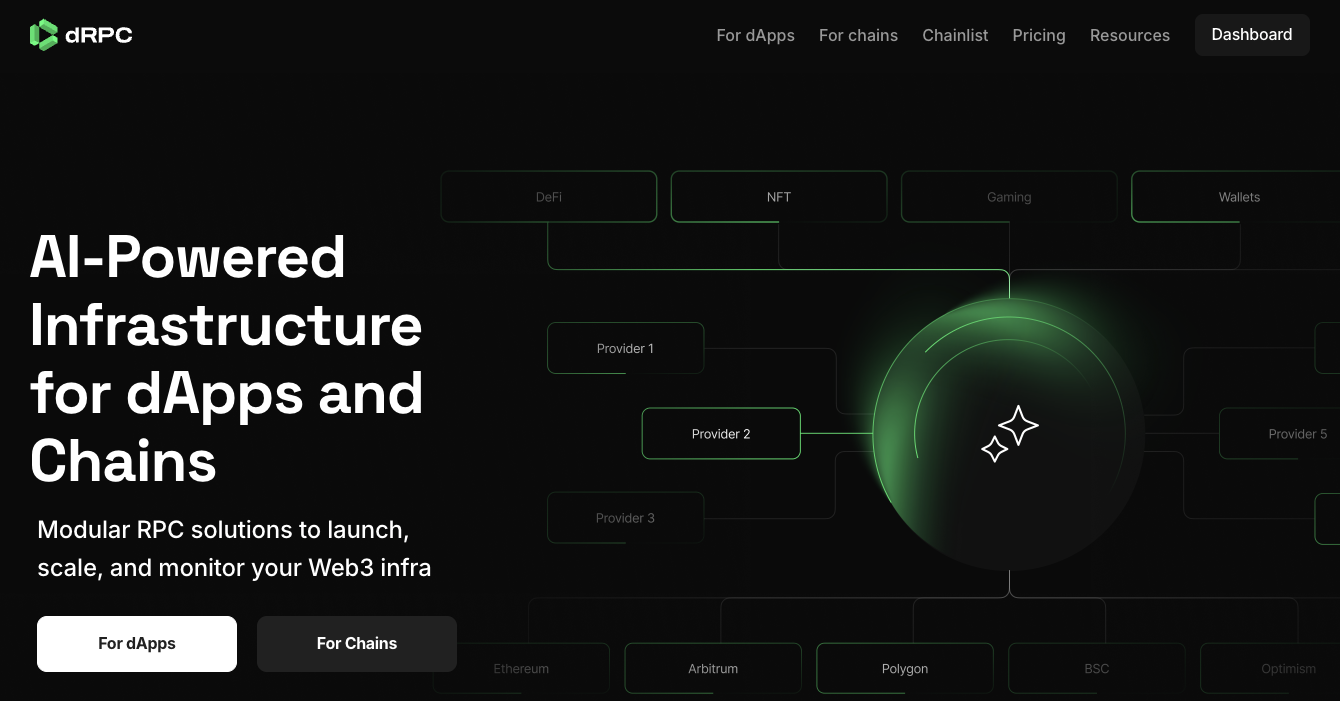
dRPC routes Base traffic across a decentralized marketplace of independent node operators. Its network documentation outline multi-region endpoints, while the pricing page details pay-as-you-go rates.
Key Features
- Decentralized Routing: Traffic automatically fails over between vetted providers to maximize uptime.
- Global Coverage: Operators across the US, EU, and APAC with HTTP and WSS support for Base mainnet and Sepolia.
- Trace & Archive Access: Included at the same rate once you move beyond the free tier.
- Open Observability: Usage dashboards plus per-operator telemetry to monitor latency and error rates.
- Startup Program: Discounted credits for early-stage teams (apply via console).
Pricing Structure
| Plan | Price | Included Volume | Network Throughput | Notes |
|---|---|---|---|---|
| Free | $0 | 210M compute units/month (~10M Base requests) | Rate-limited shared pool | Trace/Archive limited, great for prototyping |
| Pay As You Go | $6 per 1M requests | Metered (per successful response) | Up to 5,000 RPS aggregated | Trace/Archive/WSS included |
| Enterprise | Custom | Custom request pools | Custom routing policies | Private operator pools, SLA |
dRPC bills per successful response, so you avoid CU math; however, latency can fluctuate as traffic hops across third-party operators.
Pros and Cons
Advantages:
- Decentralized operator pool reduces single-vendor risk.
- Flat $6/M request pricing keeps costs predictable.
- Built-in archive, trace, and WSS access without add-ons.
- Startup discounts for qualifying teams.
Considerations:
- Still building long-term track record for sustained enterprise traffic.
- Less centralized support model compared to vertically integrated providers.
- Latency variance depends on underlying operator mix.
Best For
Builders who want decentralized redundancy or a low-cost backup provider to complement a primary RPC partner. Also useful for analytics teams that need multiple upstream sources to compare responses.
Feature Comparison Table
| Feature | Dwellir | Alchemy | QuickNode | Infura | Chainstack | dRPC |
|---|---|---|---|---|---|---|
| Pricing Model | Response-based (1 credit per response) | Compute units (Pay As You Go $0.525/M CU) | API credits (Base = 20 credits/request) | Credit quotas per method | Request buckets + Unlimited Node add-on | Request-based ($6/M) via decentralized operators |
| Entry Price | Free (100K/day) | Free (30M CUs) | $49 Build (80M credits) | Core Free (6M credits/day) | Free Developer (3M requests) | Free tier (~10M requests) |
| Mid-Tier Price | $299 (150M responses, 500 RPS) | PAYG flat $0.525/M CU | $299 Scale (500M credits) | $225 Team (75M credits/day) | $199 Pro (80M requests) | $6 per 1M requests PAYG |
Cost per 1M eth_call | $1.96 | $13.65 | $12.25 | $8.89 | $2.45 | $6.00 |
| Throughput | 20–5,000 RPS with bursts to 10,000 | 30 req/s on PAYG, 700+ with Enterprise | 50–400+ RPS depending on plan | 2K–40K credits/sec (method-dependent) | 25–500 RPS tiers | Up to 5,000 RPS aggregated |
| Trace/Debug Access | Included in every paid plan | Higher CU multipliers apply | Add-on required for trace APIs | Included (credit heavy) | Included; archive counts double units | Included after paid tier |
| Extras | 140+ chains, WSS + gRPC | NFT/Token APIs, Notify, Gas Manager | Streams, Webhooks, dedicated nodes | DIN failover, IPFS, MetaMask | Dedicated nodes, Bolt subgraphs, Warp Tx | Decentralized routing, startup credits |
True Cost: Price Per Million API Calls
Comparing Base providers on advertised "compute units" or "credits" is misleading, because each provider assigns a different weight to the same method. A standard eth_call costs 1 unit on Dwellir and Chainstack but 26 on Alchemy and 80 on Infura. A headline per-unit rate therefore tells you very little about what a million real Base requests will actually cost.
Here is what each provider charges for a single eth_call on Base:
| Provider | Units per eth_call | Unit Type |
|---|---|---|
| Dwellir | 1 | Response |
| Chainstack | 1 | Request unit |
| QuickNode | 20 | API credit |
| Alchemy | 26 | Compute unit |
| Infura | 80 | Credit |
| dRPC | n/a | Billed per successful request ($6 per 1M) |
Normalizing to cost per 1 million actual eth_call requests reverses the ranking that headline pricing suggests.
Entry Tier (~$49-50/month)
| Provider | Plan | Monthly | Advertised Volume | Actual eth_call Capacity | Cost per 1M Calls |
|---|---|---|---|---|---|
| Dwellir | Developer | $49 | 25M responses | 25,000,000 | $1.96 |
| Chainstack | Growth | $49 | 20M request units | 20,000,000 | $2.45 |
| dRPC | Pay As You Go | $49 | Metered per request | 8,166,667 | $6.00 |
| Infura | Developer | $50 | 15M credits/day (450M/mo) | 5,625,000 | $8.89 |
| QuickNode | Build | $49 | 80M API credits | 4,000,000 | $12.25 |
| Alchemy | Pay As You Go | $49 | 93.3M CU | 3,589,744 | $13.65 |
Growth Tier (~$199-299/month)
| Provider | Plan | Monthly | Advertised Volume | Actual eth_call Capacity | Cost per 1M Calls |
|---|---|---|---|---|---|
| Dwellir | Growth | $299 | 150M responses | 150,000,000 | $1.99 |
| Chainstack | Pro | $199 | 80M request units | 80,000,000 | $2.49 |
| dRPC | Pay As You Go | $299 | Metered per request | 49,833,333 | $6.00 |
| Infura | Team | $225 | 75M credits/day (2.25B/mo) | 28,125,000 | $8.00 |
| QuickNode | Accelerate | $249 | 450M API credits | 22,500,000 | $11.07 |
| Alchemy | Pay As You Go | $249 | 474.3M CU | 18,241,758 | $13.65 |
The spread is roughly 7x at both tiers, and it does not close as you scale. Alchemy's flat $0.525 per million compute units combined with a 26 CU weight on eth_call means Base traffic costs $13.65 per million calls whether you spend $49 or $2,000 a month. Providers that bill 1:1 (Dwellir, Chainstack) deliver 5-7x more actual Base requests per dollar than the compute-unit models at the same monthly spend.
Two caveats worth stating plainly. First, this normalizes on eth_call; if your Base workload is dominated by eth_getLogs or trace methods the compute-unit providers get relatively more expensive, not less, because those methods carry higher weights. Second, capacity is not the only thing you buy: the RPS ceiling, archive depth, and Flashblocks support in the tables above differ between these plans, and a cheaper plan you constantly throttle against is not cheaper.
Provider list prices verified 2026-09-14 against Alchemy, QuickNode, Chainstack, dRPC and Infura. Alchemy's per-method weights come from its published compute unit costs, and the QuickNode 20:1 weight is corroborated by Chainstack's published request-to-credit conversion. Infura's 80:1 credit weight is carried from Dwellir's Ethereum provider comparison. Confirm current weights in each provider's own documentation before committing to a plan.
Performance Considerations for Base
When evaluating Base RPC providers, performance metrics extend beyond simple response times:
Data Freshness: Providers handling Flashblocks should expose sub-second updates. QuickNode, Dwellir, and Alchemy all publish Flashblocks endpoints; confirm they meet your required lag budget.
Request Success Rate: Track the percentage of RPC calls returning 200s vs. throttles or timeouts. 99.9% uptime is meaningless if 5% of calls fail during spikes; ask for historical success SLAs.
Regional Distribution: Map user regions to provider PoPs. Dwellir and QuickNode maintain PoPs across 3+ continents; Chainstack's multi-cloud architecture lets you pin workloads to specific regions.
Failover Mechanisms: Determine whether failover is automatic (dRPC's routing, Infura's DIN) or manual (switching endpoints yourself).
Rate Limiting Behavior: Learn how each provider enforces caps. Dwellir allows bursting 10x, while credit-based providers typically return HTTP 402 when daily quotas are exhausted.
Pricing Strategy Comparison
The true cost table above gives the numbers. This is why the models produce those numbers:
Compute Unit Models (Alchemy): CU pricing can be efficient for lightweight workloads, but eth_getLogs and trace calls multiply costs quickly. Dwellir's compute-unit explainer shows how planning errors here can inflate budgets.
Credit Systems (QuickNode, Infura): Proprietary multipliers require dashboards and alerts to stay under caps. Team-wide governance is essential to prevent surprise throttling.
Response-Based (Dwellir): Every response costs one credit regardless of method. Ideal when workloads mix traces, logs, and standard calls, or when finance teams demand deterministic budgeting.
Request Buckets + Unlimited Node (Chainstack): Straightforward request counting with optional flat-fee RPS tiers keeps costs consistent for high-volume bots or monitoring.
Decentralized Request Pricing (dRPC): $6 per million requests makes it attractive as a cost-optimized backup, though latency variability means most teams still pair it with a primary provider.
Making Your Decision: Recommendations by Use Case
For Early-Stage Projects and Prototypes
Recommended: Dwellir Free or Alchemy Free Tier
Dwellir's Free plan offers predictable credits for integration work, while Alchemy's free 30M CU plan includes powerful APIs for rapid prototyping.
For Production dApps with Moderate Traffic
Recommended: Dwellir Developer/Growth or Chainstack Growth
Dwellir maintains trace/debug access without premiums, and Chainstack's $49 Growth tier adds managed infrastructure plus a path to Unlimited Node.
For High-Performance Trading or Gaming Applications
Recommended: QuickNode Scale + Dedicated Nodes
QuickNode's global edge network, Streams, and dedicated node options ensure low latency. Pair with Dwellir Scale if you need a second vendor for redundancy.
For Enterprise Applications Requiring Maximum Reliability
Recommended: Infura Team/Enterprise + Chainstack Business
Infura provides ConsenSys-backed SLAs and MetaMask alignment, while Chainstack's SOC 2 Type II compliance and dedicated nodes satisfy regulated teams.
For Multi-Chain or Decentralized Redundancy
Recommended: Dwellir Multi-Chain + dRPC PAYG
Dwellir handles 140+ chains under one bill, and dRPC's decentralized routing offers a backup endpoint priced at $6 per million requests to diversify vendor risk.
Key Takeaways and Next Steps
Choose Dwellir if you want transparent pricing, heavy trace/debug usage, and multi-chain coverage without renegotiating compute units.
Choose Alchemy if your team relies on enhanced APIs, Notify webhooks, and rich analytics to accelerate development.
Choose QuickNode if latency, Streams, or dedicated nodes trump raw cost and you can manage credit accounting.
Choose Infura if you need enterprise-grade SLAs, MetaMask alignment, or ConsenSys-backed compliance.
Choose Chainstack if managed dedicated nodes, SOC 2 paperwork, and Unlimited Node options are priorities.
Choose dRPC if you want decentralized redundancy or a budget-friendly backup endpoint.
Frequently Asked Questions
What is the cheapest Base RPC provider?
Dwellir, at $1.96 per million Base requests on the $49/month Developer plan, which includes 25 million responses under a 1:1 credit model. Chainstack is next at $2.45 per million. The compute-unit providers cost between $8.89 and $13.65 per million actual eth_call requests at the same monthly spend.
Do Base RPC providers support Flashblocks?
Select providers including Dwellir and Chainstack support Base Flashblocks for faster block confirmations. Check each provider's documentation for Flashblocks endpoint availability.
Are there free Base RPC endpoints?
Yes. Most providers offer free tiers. Dwellir provides 100,000 free requests per day, Alchemy offers 30 million compute units, and Chainstack includes 3 million requests. Public endpoints are also available but with strict rate limits.
How do compute units affect Base RPC pricing?
Compute unit providers weight each method differently, so the advertised per-unit rate is not the price you pay. On Alchemy eth_chainId costs 0 CU, eth_blockNumber 10, eth_call 26 and eth_getLogs 60. At Alchemy's flat $0.525 per million CU, one million eth_call requests costs $13.65 rather than $0.525. Providers with 1:1 pricing like Dwellir charge one credit for every method, so the advertised rate is the real rate.
What does one million Base RPC requests actually cost?
Between $1.96 and $13.65 depending on the provider and its unit weighting, measured on eth_call at entry-tier pricing in September 2026. Dwellir is $1.96, Chainstack $2.45, dRPC $6.00, Infura $8.89, QuickNode $12.25 and Alchemy $13.65. The spread comes from method weighting, not from headline plan prices, which cluster around $49 to $50. See the full breakdown above.
Related Resources
- Best Ethereum RPC Providers 2026 — Compare pricing and features across top Ethereum L1 infrastructure providers
- Top Optimism RPC Providers 2026 — Side-by-side comparison of another leading OP Stack Layer 2
- RPC Providers Without Compute Units — Find providers with simple per-request pricing
Ready to stress-test your Base infrastructure? Spin up the Dwellir Free plan in minutes or talk to our team for architectural guidance (no hard sell, just practical help optimizing your RPC stack).
The Base ecosystem evolves quickly, so revisit your provider mix regularly and rerun benchmarks as new features (like Flashblocks, OP Stack upgrades, or new pricing tiers) roll out. Mixing two complementary providers, one for primary traffic and another for redundancy, often delivers the best blend of reliability, performance, and budget control.