Top pick by use case
Short answers first, from list prices and published limits checked in September 2026. The numbers table and the methodology show the working.
- Lowest cost per request: Dwellir, $1.96 per million
eth_callon the $49 Developer plan. One credit per response for every method, including trace and debug. - Highest self-serve rate limit: Dwellir Scale, 5,000 responses per second with bursts to 10,000, at $999 per month. dRPC advertises 5,000 RPS on its $6 per million pay-as-you-go plan.
- MEV-protected transaction submission: dRPC or Infura, both route transactions through private channels. Pair either with a cheaper provider for reads.
- Enhanced APIs and simulation: Alchemy, if you will use its NFT, token and webhook APIs enough to justify $13.65 per million
eth_call. - SOC 2 documentation and managed dedicated nodes: Chainstack, $2.45 per million with SOC 2 Type II reports.
- Free tier for prototyping: dRPC (210M compute units a month, roughly 10 million requests) or Alchemy (30M compute units, roughly 1.15 million
eth_call). Dwellir's Free plan allows 100,000 responses a day at 20 RPS. - Trace-heavy indexing: Dwellir.
debug_traceTransactioncosts 1 credit, against 1,000 credits on Infura and 40 compute units on GetBlock.
Ethereum remains the gravity well of decentralized finance. Over $55.6 billion in TVL (DeFiLlama, April 2026), 2–3.6 million daily transactions, and 800,000+ validators securing the network make it the blockchain that institutional capital, protocol teams, and application developers build on first. That role deepened after the Dencun upgrade brought EIP-4844 blob transactions, cutting L2 data posting costs by 10-100x and accelerating an L2 ecosystem that now holds $40.5 billion in Total Value Secured across L2s (L2Beat).
That scale creates a concrete infrastructure problem. Public Ethereum endpoints cap you at roughly 100 requests per minute. A DeFi aggregator polling prices across 20 pools, a wallet tracking real-time token balances, or an indexer processing eth_getLogs across thousands of blocks will exhaust that limit in seconds. Then there is MEV exposure, with over $1.8 billion extracted from on-chain transactions to date. At that point, the difference between a commodity RPC endpoint and a production-grade one becomes a security question, not just a performance one.
This comparison breaks down 8 Ethereum RPC providers across pricing, features, MEV protection, and production considerations so you can match your infrastructure to your actual workload.
What to Look for in an Ethereum RPC Provider
Ethereum's architecture and ecosystem create specific requirements that differ from newer chains. Here is what matters most when evaluating providers.
MEV Protection: Front-running and sandwich attacks remain an active threat on Ethereum L1. If your application submits swaps, liquidations, or any value-bearing transactions, MEV protection through private mempools or Flashbots integration is not optional. It is a security requirement. Over $1.8 billion has been extracted from unprotected transactions.
Archive Node Access: Ethereum's 10-year history makes archive data essential for analytics platforms, block explorers, portfolio trackers, and any application that queries historical state. Not all providers include archive access at every tier, and those that do often charge premium compute units for archive queries.
WebSocket Support: DeFi applications, trading bots, and event-driven architectures depend on real-time data through WebSocket subscriptions. Polling via HTTP introduces latency that compounds across high-frequency workloads. Reliable WSS endpoints with stable connections are critical for production Ethereum applications.
Pricing Model Clarity: Most providers advertise pricing in "compute units" or "credits," but these units are not standardized. A single eth_call costs 1 unit on Dwellir, 20 on QuickNode, 26 on Alchemy, 80 on Infura, and 200 on Ankr. A provider advertising $0.10 per million compute units can actually cost $20 per million API calls once you account for the multiplier. The only reliable way to compare pricing is to normalize to cost per actual API call. See the true cost comparison below.
Multi-Chain Compatibility: Most Ethereum teams also deploy on L2s or maintain cross-chain infrastructure. A provider that covers Ethereum mainnet, Arbitrum, Base, and Optimism under a single API key and billing account reduces operational overhead significantly.
The numbers: price, credits, free tier, archive, WSS and RPS
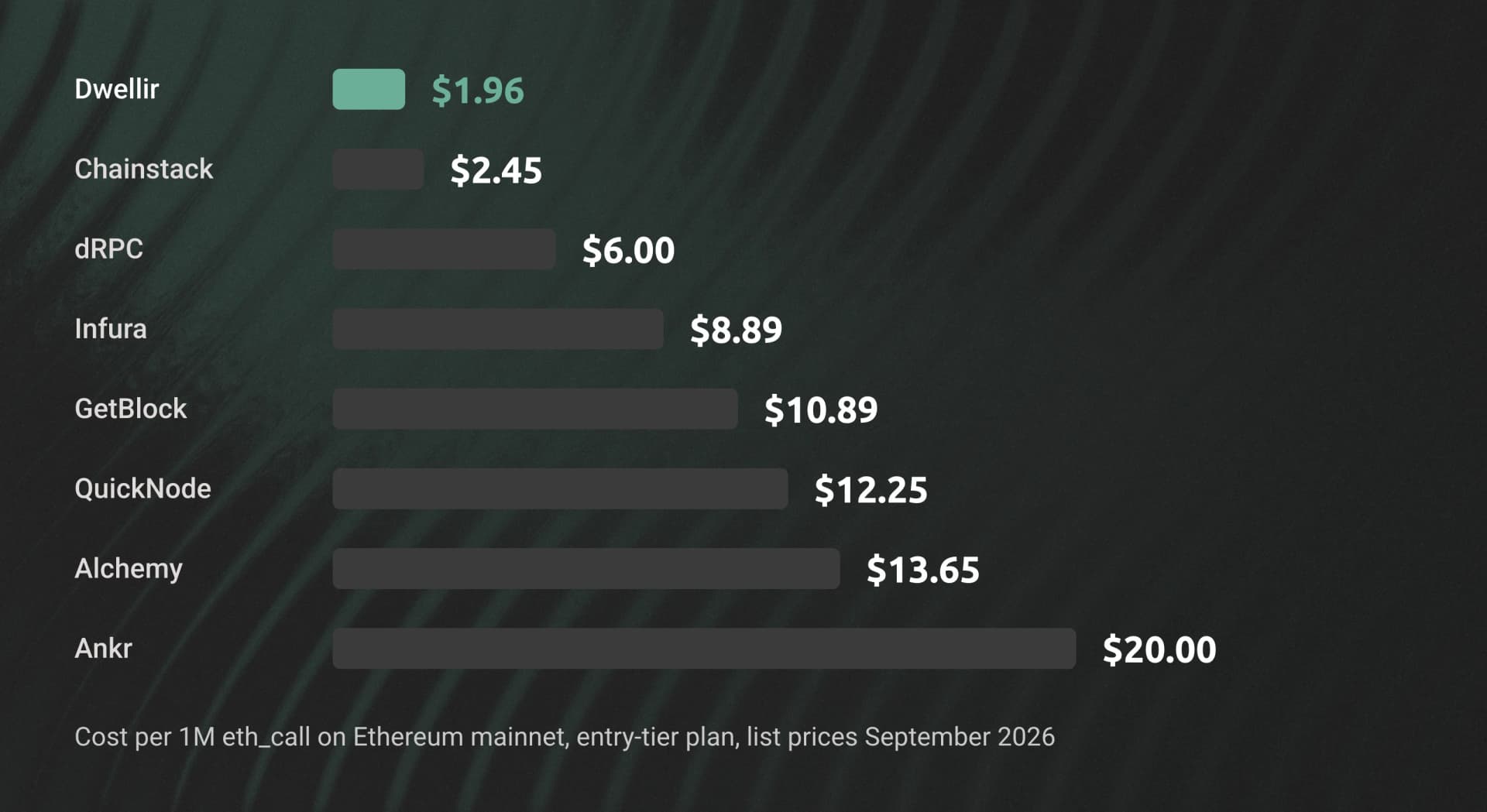
Entry-tier cost per million eth_call requests, the unit each provider bills in, and the highest rate limit you can buy without a sales call. Archive and WSS refer to Ethereum mainnet on standard shared plans. Sorted by cost.
| Provider | Cost per 1M eth_call (entry plan) | Credits model | Free tier | Archive | WSS | RPS cap (top self-serve plan) |
|---|---|---|---|---|---|---|
| Dwellir | $1.96 ($49, 25M responses) | 1 credit per response, every method | 100K responses/day, 20 RPS | Yes | Yes | 5,000, bursts to 10,000 ($999) |
| Chainstack | $2.45 ($49, 20M request units) | 1 request unit per call, archive 2 | 3M request units/month, 25 RPS | Yes (2 units) | Yes | 600 ($499) |
| dRPC | $6.00 (pay as you go) | Flat 20 CU per method, $6 per 1M requests | 210M CU/month (~10.5M requests) | Yes (paid plans) | Yes | 5,000 (advertised) |
| Infura | $8.89 ($50, 15M credits/day) | Credits, 80 per eth_call, 255 per eth_getLogs | 3M credits/day (~37K eth_call) | Yes | Yes | 500 eth_call/s, 40,000 credits/s ($225) |
| GetBlock | $10.89 ($49, 90M CU) | CU, 20 per eth_call, archive 2x | 50K CU/day (2,500 eth_call), 20 RPS | Yes (2x CU) | Yes | 800 ($499) |
| QuickNode | $12.25 ($49, 80M credits) | API credits, 20 per eth_call | 10M credits, 15 RPS, 1-month trial | Yes | Yes | 500 ($999) |
| Alchemy | $13.65 (pay as you go) | CU, 26 per eth_call, $0.525 per 1M CU | 30M CU/month (~1.15M eth_call) | Yes | Yes | ~1,150 eth_call/s, 30,000 CU/s |
| Ankr | $20.00 (pay as you go) | CU, 200 per eth_call, $0.10 per 1M CU | Public endpoint, ~30 RPS | Premium only | Premium only | ~1,500 per endpoint |
Dwellir's Free plan excludes eth_getLogs; paid plans allow a 500-block range on Developer and 10,000 blocks on Growth and Scale. The RPS column is the ceiling of the highest shared plan with a published price, so QuickNode's 500 costs $999 while Chainstack's 600 costs $499.
1. Dwellir - Transparent 1:1 Pricing Across All Methods
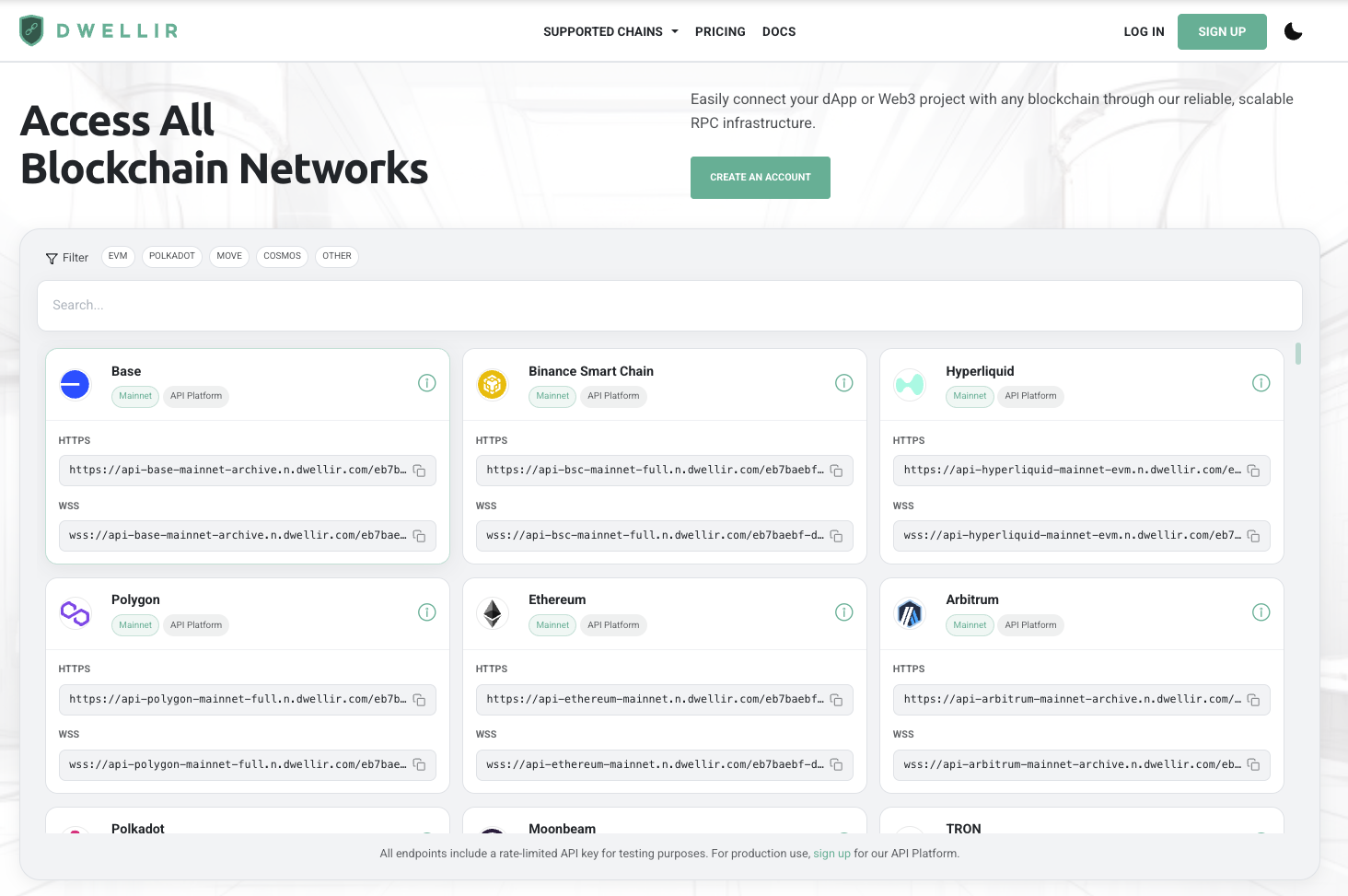
Dwellir provides Ethereum mainnet access with full archive node support and a pricing model built around simplicity: every RPC response costs 1 credit regardless of method complexity. Whether you call eth_chainId or run debug_traceTransaction, the cost is identical. This eliminates the compute unit math that makes budgeting unpredictable on Ethereum, where DeFi workloads routinely mix lightweight balance checks with heavy trace and log queries.
Dwellir supports both HTTPS and WebSocket (WSS) endpoints for Ethereum, with trace and debug APIs included in all paid plans at no extra cost. The same API key works across 150+ networks, making it straightforward for teams that operate across Ethereum L1 and its L2 ecosystem.
Key Features
- 1:1 Credit System: Every method (standard, trace, debug, archive) costs 1 credit. No compute unit multipliers.
- Archive Node Access: Full historical Ethereum state available on all endpoints.
- Protocol Support: HTTPS and WebSocket (WSS) for real-time event subscriptions.
- 150+ Network Coverage: Single API key spans Ethereum, Arbitrum, Base, Optimism, and 130+ more chains.
- Burst Protection: Sustained RPS from 20 to 5,000 with burst capacity up to 10,000 RPS.
- Trace and Debug APIs:
debug_traceTransaction,trace_block, and related methods included at no premium. - Crypto Payments: Pay in crypto on every paid plan, from Developer to Enterprise.
Pricing Structure
| Plan | Price | Included Responses | Sustained RPS | Overage |
|---|---|---|---|---|
| Free | Free | 100K responses per day | 20 RPS | N/A |
| Developer | $49/month | 25M responses per month | 100 RPS | $5 per 1M |
| Growth | $299/month | 150M responses per month | 500 RPS | $3 per 1M |
| Scale | $999/month | 500M responses per month | 5,000 RPS | $2 per 1M |
Teams that outgrow shared plans have two routes. Unlimited Nodes are single endpoints with the meter switched off, sold by RPS from 25 to 1,000 for $119 to $4,799 per month. Dedicated node clusters carry no rate limit and no request counting; archive clusters list from $2,400 per month.
Pros and Cons
Advantages:
- Predictable billing regardless of method mix. No compute unit calculations needed.
- Trace and debug endpoints included at no premium on all paid plans.
- Multi-chain footprint for unified Ethereum L1 + L2 infrastructure across 150+ networks.
- Direct engineering support on Growth plans and above.
- Burst protection up to 10,000 RPS handles traffic spikes without dropped requests.
Considerations:
- No built-in MEV protection. Teams handling MEV-sensitive transactions need a complementary solution such as dRPC or Infura.
- Enhanced APIs (NFT indexing, token metadata) less extensive than larger platform providers.
Best For
DeFi protocols, analytics platforms, and multi-chain teams that need cost-predictable Ethereum infrastructure with full archive access and advanced debugging capabilities. The 1:1 pricing model is particularly valuable for workloads with heavy trace and log queries where compute unit pricing creates budget uncertainty.
2. Alchemy - Full-Featured Developer Platform
For teams that need more than raw RPC access, Alchemy provides a comprehensive development platform with enhanced APIs for NFTs, tokens, and wallet activity that reduce custom indexing work. Transaction simulation catches errors before on-chain submission. A detailed analytics dashboard tracks request volumes, latency, and per-method compute unit consumption across your applications.
Alchemy supports Ethereum mainnet, Sepolia, and Holesky testnets with both HTTP and WebSocket connections. SDK coverage spans TypeScript and Python, and its documentation is among the most thorough in the ecosystem.
Key Features
- Enhanced APIs: NFT, Token, Transfers, and Notify APIs reduce the need for custom indexing infrastructure.
- Transaction Simulation: Validate transactions before submitting them on-chain to catch reverts and errors.
- Analytics Dashboard: Per-method compute unit tracking, latency breakdowns, and request volume monitoring.
- SDK Coverage: TypeScript and Python SDKs for rapid integration.
- Comprehensive Documentation: Extensive guides, code examples, and API references.
Pricing Structure
| Plan | Price | Included Volume | Throughput | Notes |
|---|---|---|---|---|
| Free Tier | $0 | 30M compute units/month | 300 CU/s (~12 eth_call/s) | Community support, 5 apps |
| Pay As You Go | $0 base + $0.525 per 1M CUs (flat) | Metered | 10,000 CU/s (~385 eth_call/s) | Priority support, 30 apps |
| Enterprise | Custom | Custom pools | Custom | VIP engineering, volume discounts |
Compute unit weights vary by method. eth_chainId costs 0 CU, eth_blockNumber 10, eth_call 26 and eth_getLogs 60, and archive queries cost more still. DeFi workloads with heavy log queries should model their actual method mix before estimating monthly costs.
Pros and Cons
Advantages:
- Mature platform with the most comprehensive documentation in the Ethereum RPC ecosystem.
- Enhanced APIs minimize custom development for NFT, token, and wallet-related features.
- Strong developer experience with SDKs, webhooks, and analytics tooling.
- Enterprise-grade SLAs and dedicated support available.
Considerations:
- Compute unit pricing requires careful workload modeling.
eth_getLogsand trace calls consume CUs at much higher rates than simple reads. - No MEV protection included.
- Platform complexity may exceed the needs of teams that only require standard RPC access.
Best For
Teams building Ethereum applications that benefit from enhanced APIs, transaction simulation, and analytics dashboards, where developer productivity justifies the compute unit pricing overhead.
3. Infura - Battle-Tested Ethereum Infrastructure
Infura has operated Ethereum infrastructure since 2016 and remains one of the most widely used providers in the ecosystem. As the default RPC backend for MetaMask, it handles an enormous share of Ethereum network traffic daily. ConsenSys backs the platform, which supports Ethereum mainnet, Sepolia, and Holesky testnets with both HTTPS and WebSocket connections.
Where Infura stands apart is MEV protection through Flashbots integration, routing transactions through private mempools to shield them from front-running and sandwich attacks. For DeFi applications handling significant value, this is a meaningful security feature.
Key Features
- MEV Protection: Flashbots integration routes transactions through private mempools.
- Archive Data Access: Historical Ethereum state queries supported.
- MetaMask Integration: Default provider for the most widely used Ethereum wallet.
- HTTPS and WebSocket: Both connection methods for mainnet and testnets.
- Operational Track Record: 10 years of Ethereum infrastructure operation.
Pricing Structure
| Plan | Price | Daily Credit Pool | Credit/sec Ceiling | Notes |
|---|---|---|---|---|
| Core (Free) | $0 | 3M credits/day | 500 credits/s (~6 eth_call/s) | 3 API keys |
| Developer | $50/month | 15M credits/day | 4,000 credits/s (50 eth_call/s) | 10 API keys, email support |
| Team | $225/month | 75M credits/day | 40,000 credits/s (500 eth_call/s) | Unlimited keys, enhanced SLA |
| Enterprise | Custom | Custom | Custom | Dedicated support, private relays |
Credits are metered per method: eth_call costs 80, eth_getLogs 255 and debug_trace* methods 1,000. Quotas are daily and reset at 00:00 UTC. Exhausting the daily pool returns HTTP 402 and severs open WebSocket connections until the reset, which constrains bursty workloads that spike on specific days.
Pros and Cons
Advantages:
- MEV protection via Flashbots, critical for DeFi transaction security.
- Deep Ethereum expertise built over a decade of infrastructure operation.
- Archive data access for historical state queries.
- Strong ecosystem integration as MetaMask's default provider.
Considerations:
- Daily credit caps (not monthly) can limit flexibility for workloads with variable traffic patterns.
- Higher cost at scale. The Team plan at $225/month buys about 28M
eth_callper month, compared to 150M responses for $299 on Dwellir. - Smaller multi-chain footprint than providers covering 100+ networks.
Best For
Teams that prioritize MEV protection for DeFi transactions and value the reliability of the longest-running Ethereum infrastructure provider.
4. QuickNode - Global Low-Latency Edge Network
For latency-sensitive Ethereum workloads, QuickNode routes requests through a global edge network that directs traffic to the nearest available node. The platform combines standard RPC access with Streams for real-time event streaming, webhooks for notifications, and dedicated node options for workloads that require isolated resources.
QuickNode supports Ethereum mainnet and testnets with a credit-based pricing model where different API methods consume different numbers of credits. An observability dashboard provides response time tracking, error monitoring, and credit consumption analytics.
Key Features
- Global Edge Network: Automatic routing to nearest regions for minimal latency.
- Streams and Webhooks: Real-time event streaming for monitoring on-chain activity.
- Dedicated Nodes: Isolated infrastructure for guaranteed, deterministic performance.
- Observability Dashboard: Response times, error rates, and credit consumption tracking.
- 24/7 Support: Round-the-clock assistance from infrastructure specialists.
Pricing Structure
| Plan | Price | Included Credits | Requests per Second | Overage |
|---|---|---|---|---|
| Discover (Free) | $0 | 10M API credits | 15 RPS | N/A |
| Build | $49/month | 80M API credits | 50 RPS | $0.62 per 1M credits |
| Accelerate | $249/month | 450M API credits | 125 RPS | $0.55 per 1M credits |
| Scale | $499/month | 950M API credits | 250 RPS | $0.53 per 1M credits |
| Business | $999/month | 2B API credits | 500 RPS | $0.50 per 1M credits |
Streams, Functions, and dedicated node clusters incur additional charges. Credit consumption varies by method.
Pros and Cons
Advantages:
- Consistently low latency through global edge routing.
- Streams and webhooks simplify event-driven Ethereum architectures.
- Dedicated node option for deterministic performance on high-value workloads.
- Strong documentation and responsive 24/7 support.
Considerations:
- Credit-based pricing requires workload modeling for budget accuracy since heavy methods consume more credits.
- No built-in MEV protection.
- Add-ons for Streams, Functions, and dedicated infrastructure increase total spend.
Best For
Latency-sensitive applications like trading platforms, arbitrage bots, and DeFi aggregators where response time directly impacts profitability. Best suited for teams comfortable managing credit-based billing.
5. Chainstack - Managed Infrastructure with SOC 2 Compliance
Enterprise and institutional teams face a requirement that most providers do not address: compliance documentation. Chainstack provides managed Ethereum infrastructure spanning shared endpoints, dedicated nodes, and an Unlimited Node add-on that removes per-request billing entirely. The platform deploys across AWS, GCP, and Azure with geo-balanced routing, and includes SOC 2 Type II compliance documentation for regulated financial institutions.
For teams without dedicated protocol DevOps, Chainstack handles node maintenance, upgrades, and monitoring while offering role-based access controls and per-project API key management for team collaboration.
Key Features
- Multi-Cloud Deployment: AWS, GCP, and Azure options with geo-balanced routing.
- Unlimited Node Add-on: Flat monthly fee for unlimited requests within chosen RPS tiers.
- SOC 2 Type II Compliance: Audit documentation for regulated environments.
- Team Collaboration: Role-based access and per-project API keys.
- Dedicated Nodes: Isolated infrastructure with full configuration control.
Pricing Structure
| Plan | Price | Monthly Request Units | Included RPS | Notes |
|---|---|---|---|---|
| Developer (Free) | $0 | 3M request units | 25 RPS | Shared nodes, community support |
| Growth | $49/month | 20M request units | 250 RPS | Up to 10 project nodes |
| Pro | $199/month | 80M request units | 400 RPS | Priority support |
| Business | $499/month | 200M request units | 600 RPS | SSO, 50 project nodes |
| Unlimited Node | $149+/month | Unlimited (per RPS tier) | 25-500 RPS | Flat-fee shared endpoint |
Archive queries count as 2 request units. The Unlimited Node add-on requires a Growth plan or above.
Pros and Cons
Advantages:
- SOC 2 Type II compliance documentation for regulated and institutional teams.
- Unlimited Node option eliminates per-request billing for predictable-traffic workloads.
- Multi-cloud deployment reduces vendor lock-in at the infrastructure layer.
- Team collaboration features with role-based access controls.
Considerations:
- Archive queries at 2x cost increase effective pricing for historical data workloads.
- Unlimited Node requires a Growth+ subscription as a prerequisite.
- Lower RPS ceilings on shared plans compared to some competitors.
Best For
Enterprise and institutional teams building on Ethereum that require SOC 2 compliance documentation and managed infrastructure without hiring dedicated protocol DevOps engineers.
6. dRPC - Decentralized Network with Built-In MEV Protection
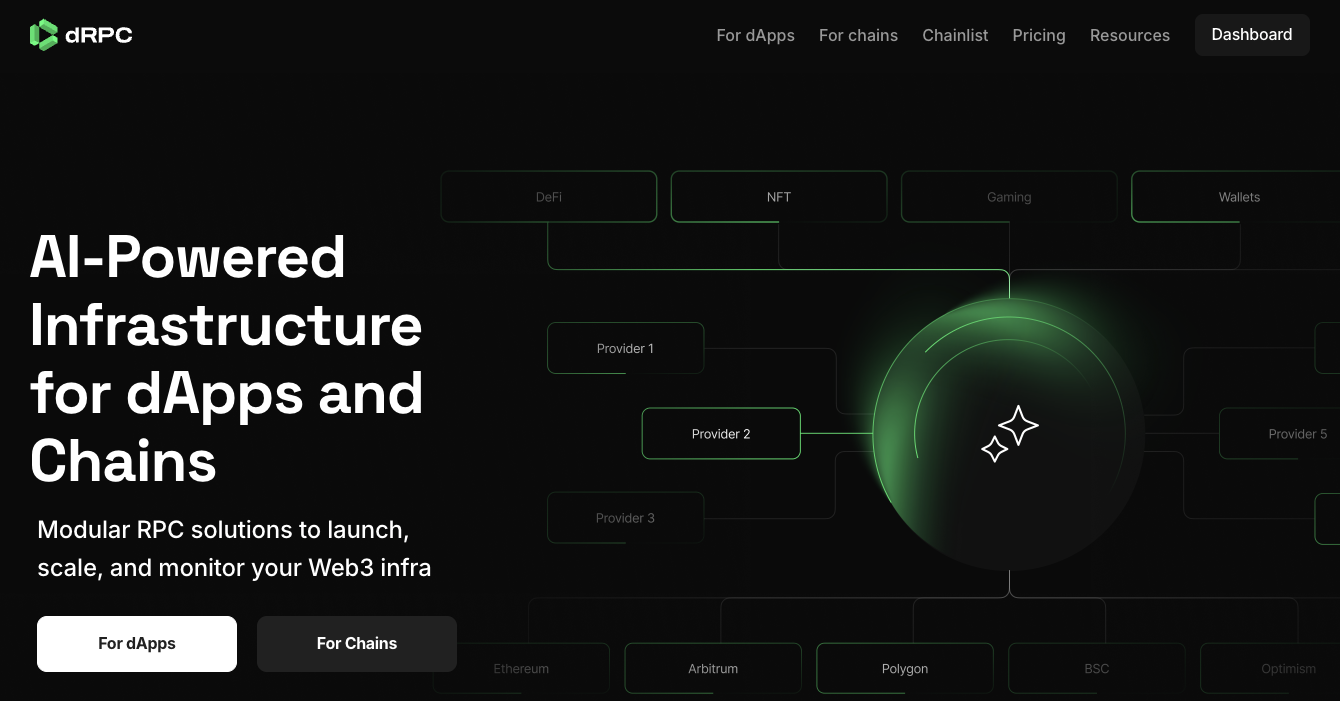
dRPC takes a fundamentally different architectural approach: aggregating Ethereum infrastructure from over 40 independent node operators across 7 geo-distributed clusters spanning the US, EU, and APAC regions. Traffic routes automatically based on latency, availability, and geography, with built-in failover between operators. If one operator experiences downtime, requests reroute transparently.
The standout feature for Ethereum is built-in MEV protection, routing transactions through private channels to shield them from front-running and sandwich attacks. Combined with debug and trace APIs included at no extra cost, dRPC delivers strong value for DeFi-focused Ethereum applications.
Key Features
- Decentralized Routing: Traffic fails over automatically between 40+ vetted node operators.
- MEV Protection: Built-in protection against front-running and sandwich attacks.
- Global Coverage: 7 geo-distributed clusters across US, EU, and APAC regions.
- High Throughput: Up to 5,000 RPS on paid plans.
- Debug and Trace APIs: Advanced debugging capabilities included.
Pricing Structure
| Plan | Price | Included Volume | Network Throughput | Notes |
|---|---|---|---|---|
| Free | $0 | 210M compute units/month | 40-250 RPS | Public nodes, prototyping |
| Growth | $6 per 1M requests | Metered | 5,000 RPS | 99.99% uptime SLA |
| Enterprise | Custom | 300M+ requests/month | Unlimited RPS | Volume discounts, SLA included |
Billing per successful response keeps costs aligned with actual usage. The free tier at 210M compute units per month is the most generous in this comparison.
Pros and Cons
Advantages:
- MEV protection included, critical for Ethereum DeFi applications handling significant value.
- Decentralized operator pool eliminates single-vendor downtime risk.
- Flat $6/M request pricing simplifies budgeting on the Growth plan.
- Most generous free tier (210M CUs monthly) for development and testing.
- 5,000 RPS ceiling exceeds most competitors.
Considerations:
- Latency can vary depending on the underlying operator serving your request.
- Less centralized support compared to vertically integrated providers.
- Compute unit model on the free tier differs from the per-request model on paid plans.
Best For
DeFi applications that require MEV protection, teams prioritizing uptime through operator diversity, and projects seeking a high-throughput secondary provider for redundancy.
7. Ankr - Decentralized Multi-Chain Network
Ankr operates a decentralized network of globally distributed nodes supporting Ethereum alongside 50+ other blockchain networks. Free public endpoints cover development and premium tiers add higher throughput and priority routing.
However, Ankr's pricing requires careful reading. The platform advertises $0.10 per million compute units, one of the lowest per-unit rates in the market. But Ankr assigns 200 compute units to a single eth_call, compared to 20-26 CUs on most competitors. That means 500 million compute units at $50/month translates to just 2.5 million actual API calls, an effective cost of $20 per million eth_call requests. That is the highest per-call rate among providers in this comparison.
Key Features
- Decentralized Architecture: Distributed node network reduces single points of failure.
- Multi-Chain Hub: Single platform covering 50+ blockchain networks.
- Public and Premium Endpoints: Free tier for development, premium for production.
- Geographic Distribution: Regional node distribution across 30+ regions for latency reduction.
- Simple Integration: Standard JSON-RPC interface with minimal setup.
Pricing Structure
| Plan | Price | Included CU Volume | CU per eth_call | Actual eth_call Capacity | Cost per 1M Calls |
|---|---|---|---|---|---|
| Public Endpoint | $0 | Rate-limited (30 RPS) | 200 | N/A | N/A |
| PAYG | $50/month | 500M CU | 200 | 2,500,000 | $20.00 |
| PAYG | $200/month | 2B CU | 200 | 10,000,000 | $20.00 |
| PAYG | $500/month | 5B CU | 200 | 25,000,000 | $20.00 |
| PAYG | $1,000/month | 10B CU | 200 | 50,000,000 | $20.00 |
| Enterprise | Custom | Custom | Custom | Custom | Custom |
The flat $20 per million eth_call rate does not improve with volume. Ankr's per-CU rate stays at $0.10/M regardless of tier, and the 200 CU multiplier per eth_call applies uniformly.
Pros and Cons
Advantages:
- Decentralized network architecture across 30+ regions.
- Multi-chain support simplifies cross-chain Ethereum + L2 infrastructure.
- Straightforward setup without complex configuration.
- Large CU volumes can suit workloads dominated by very lightweight methods with lower CU weights.
Considerations:
- Effective cost of $20 per million
eth_callrequests is the highest in this comparison. - Per-CU pricing ($0.10/M) obscures the actual per-call cost due to the 200 CU multiplier.
- No MEV protection included.
- Limited debug and trace API support compared to full-featured competitors.
- Advanced tooling (analytics, transaction simulation, enhanced APIs) less developed than enterprise-focused providers.
Best For
Teams running workloads dominated by very lightweight methods (where CU weights are lower) who also value decentralized infrastructure and multi-chain coverage. For standard DeFi workloads mixing eth_call, eth_getLogs, and trace methods, the effective per-call cost makes Ankr significantly more expensive than alternatives.
8. GetBlock - Simple Deployment with Regional Endpoints
Not every team needs a full-featured platform. GetBlock provides Ethereum node access through a straightforward interface that prioritizes simplicity. Regional data centers in Frankfurt, New York, and Singapore deliver consistent latency, and both shared and dedicated node options accommodate different performance requirements. GetBlock supports JSON-RPC and WebSocket connections with a 99.9% uptime SLA.
Key Features
- Instant Node Access: No synchronization wait. Connect immediately to Ethereum endpoints.
- Regional Endpoints: Frankfurt, New York, and Singapore data centers.
- Shared and Dedicated Options: Flexible infrastructure tiers.
- JSON-RPC and WebSocket: Both connection methods supported.
- 99.9% Uptime SLA: Reliability guarantees for production workloads.
Pricing Structure
| Plan | Price | Included CU | RPS | Notes |
|---|---|---|---|---|
| Free | $0 | 50,000 CU/day | 20 RPS | 2 endpoints |
| Starter | $49/month | 90M CU/month | 250 RPS | 30 endpoints |
| Advanced | $199/month | 385M CU/month | 450 RPS | 75 endpoints |
| Pro | $499/month | 1B CU/month | 800 RPS | 150 endpoints, 24/7 support |
GetBlock prices each call as chain multiplier times method multiplier. Ethereum's chain multiplier is 20, so a standard eth_call costs 20 CU, debug_traceTransaction 40 CU and any request served in archive mode double that. Limitless Nodes (a single chain with no CU metering) run from 25 RPS at $150 to 300 RPS at $1,000 per month, and dedicated nodes start at $1,000.
Pros and Cons
Advantages:
- Published CU formula (chain multiplier x method multiplier) that is easy to reproduce.
- Quick deployment with minimal configuration.
- Multiple regional endpoints for latency optimization.
- Limitless Node tiers remove CU metering for a flat monthly fee.
Considerations:
- Shared plans top out at 800 RPS, below Dwellir and dRPC.
- No MEV protection.
- Limited enhanced API offerings and debugging tools.
- Daily request caps on lower tiers restrict bursty workloads.
Best For
Solo developers or small teams that prioritize quick deployment and straightforward pricing over advanced features or high throughput.
Feature Comparison Table
| Feature | Dwellir | Alchemy | Infura | QuickNode | Chainstack | dRPC | Ankr | GetBlock |
|---|---|---|---|---|---|---|---|---|
| Pricing Model | 1:1 response-based | Compute units | Credits (daily pool) | API credits | Request units | Request-based | Compute units | Compute units (monthly) |
| Entry Price | Free (100K/day) | Free (30M CUs) | Free (3M credits/day) | Free (10M credits) | Free (3M req units) | Free (210M CUs) | Free (30 RPS) | Free (50K CU/day) |
| Mid-Tier Price | $299 (150M, 500 RPS) | PAYG $0.525/M CU | $225 (75M credits/day) | $249 (450M credits, 125 RPS) | $199 (80M, 400 RPS) | $6 per 1M requests | $200 (10M calls) | $199 (385M CU, ~19M calls) |
Cost per 1M eth_call | $1.96 | $13.65 | $8.89 | $12.25 | $2.45 | $6.00 | $20.00 | $10.89 |
| Max RPS (Shared) | 5,000 (10,000 burst) | ~1,150 eth_call/s | 500 eth_call/s | 500 | 600 | 5,000 | ~1,500 | 800 |
| MEV Protection | No | No | Yes (Flashbots) | No | No | Yes | No | No |
| Archive Access | Yes (paid plans) | Yes | Yes | Yes | Yes (2x cost) | Yes | Premium only | Yes (2x CU) |
| WebSocket | Yes (paid plans) | Yes | Yes | Yes | Yes | Yes | Yes | Yes |
| Debug/Trace APIs | Yes (no extra cost) | Yes (CU heavy) | Yes | Yes | Yes | Yes | Limited | Yes (2x method multiplier) |
| Multi-Chain Networks | 150+ | 30+ | 10+ | 25+ | 30+ | 50+ | 50+ | 50+ |
| SOC 2 Compliance | No | No | No | No | Yes (Type II) | No | No | No |
True Cost: Price Per Million API Calls
Comparing RPC providers on advertised "compute units" or "credits" is misleading because each provider assigns a different weight to the same API method. A standard eth_call costs anywhere from 1 unit to 200 units depending on the provider, meaning 500 million compute units on one platform delivers a fundamentally different number of actual API calls than 500 million on another.
Here is what each provider charges per eth_call:
| Provider | CU Weight per eth_call | Unit Type |
|---|---|---|
| Dwellir | 1 | Response |
| Chainstack | 1 | Request unit |
| GetBlock | 20 | Compute unit |
| QuickNode | 20 | API credit |
| dRPC | 20 | Compute unit |
| Alchemy | 26 | Compute unit |
| Infura | 80 | Compute unit |
| Ankr | 200 | Compute unit |
When you normalize to cost per 1 million actual eth_call requests, the ranking changes dramatically from what headline per-unit pricing suggests.
Entry Tier (~$49-50/month)
| Provider | Plan | Monthly | Advertised Volume | Actual eth_call Capacity | Cost per 1M Calls |
|---|---|---|---|---|---|
| Dwellir | Developer | $49 | 25M responses | 25,000,000 | $1.96 |
| Chainstack | Growth | $49 | 20M request units | 20,000,000 | $2.45 |
| dRPC | Pay As You Go | $49 | Metered per request | 8,166,667 | $6.00 |
| Infura | Developer | $50 | 450M credits | 5,625,000 | $8.89 |
| GetBlock | Starter | $49 | 90M CU | 4,500,000 | $10.89 |
| QuickNode | Build | $49 | 80M credits | 4,000,000 | $12.25 |
| Alchemy | PAYG | $49 | 93.3M CU | 3,589,744 | $13.65 |
| Ankr | PAYG | $50 | 500M CU | 2,500,000 | $20.00 |
Growth Tier (~$199-299/month)
| Provider | Plan | Monthly | Advertised Volume | Actual eth_call Capacity | Cost per 1M Calls |
|---|---|---|---|---|---|
| Dwellir | Growth | $299 | 150M responses | 150,000,000 | $1.99 |
| Chainstack | Pro | $199 | 80M request units | 80,000,000 | $2.49 |
| dRPC | PAYG | $299 | Metered per request | 49,833,333 | $6.00 |
| Infura | Team | $225 | 2.25B CU | 28,125,000 | $8.00 |
| GetBlock | Advanced | $199 | 385M CU | 19,250,000 | $10.34 |
| QuickNode | Accelerate | $249 | 450M credits | 22,500,000 | $11.07 |
| Alchemy | PAYG | $249 | 474.3M CU | 18,241,758 | $13.65 |
| Ankr | PAYG | $200 | 2B CU | 10,000,000 | $20.00 |
The pattern holds at every price point: providers using high compute unit multipliers advertise large unit volumes at low per-unit rates, but deliver fewer actual API calls per dollar. Ankr's 200x CU multiplier per eth_call makes it the most expensive provider per actual API call despite advertising the lowest per-unit rate. Providers using 1:1 pricing (Dwellir, Chainstack) deliver 4-10x more actual API calls per dollar than providers using high CU multipliers. Note also that Alchemy's rate no longer improves with volume: the flat $0.525 per million compute units fixes eth_call at $13.65 per million at any spend level.
Methodology
How the numbers in this post were produced, so you can reproduce or dispute them.
Cost per million is the monthly price of each provider's entry paid plan (about $49 to $50) divided by the number of eth_call requests that plan's included volume buys once the provider's own weight for eth_call is applied. Alchemy, dRPC and Ankr have no fixed entry bundle, so their metered rate is used. Overage rates, annual discounts and add-ons are excluded.
Unit weights come from each provider's published method-cost table: Alchemy compute unit costs (26 CU per eth_call), Infura credit costs (80), QuickNode API credits (20), GetBlock's formula (chain multiplier 20 x method multiplier 1), dRPC's flat 20 CU, and Ankr's 200 CU. Dwellir and Chainstack count one unit per call. Because eth_getLogs and trace methods carry higher weights everywhere except Dwellir, a log-heavy or trace-heavy workload makes the compute-unit providers more expensive than these tables show, not less.
RPS cap is the highest rate limit on a shared plan with a published price, converted to eth_call per second where the provider meters in units per second (Alchemy, Infura). Burst allowances are noted where published. Flat-rate and dedicated products (Dwellir Unlimited Nodes, Chainstack Unlimited Node, QuickNode Flat Rate, GetBlock Limitless) are compared in which RPC provider has the highest RPS.
Archive and WSS mean the provider serves historical state and WebSocket subscriptions on Ethereum mainnet on its standard shared plans. "Premium only" means the free public endpoint lacks them.
Not measured here: latency, error rates and data freshness. Those depend on your region and method mix. Run a short benchmark from your own infrastructure against the two or three providers this table narrows you to before committing.
Where the figures live: each price appears in the meta description, the FAQ, the top-pick block, the chart image and its markdownAlt, the numbers table, the true-cost tables and the conclusion. Correct all of them together; the chart is regenerated in Paper.
Verification dates: plan prices were checked against each provider's pricing page on 2026-09-14, rate limits on 2026-09-19, and the GetBlock CU formula and Dwellir plan limits on 2026-09-21. The modified date at the top of this post moves whenever a figure is rechecked.
Recommendations by Use Case
For DeFi Production and General Ethereum Development: Dwellir provides the strongest cost predictability for Ethereum workloads where DeFi method mixes make compute unit pricing unpredictable. The 1:1 credit model means debug_traceTransaction costs the same as eth_blockNumber, which matters when your application blends lightweight reads with heavy trace and log queries. For MEV-sensitive transactions specifically, pair Dwellir's infrastructure with dRPC or Infura for transaction submission through protected channels.
For MEV-Sensitive Applications: dRPC combines built-in MEV protection with the highest shared RPS ceiling (5,000) and a generous free tier. Infura provides MEV protection through Flashbots with the longest operational track record on Ethereum. Either serves as a strong primary or complementary provider for applications where front-running protection is non-negotiable.
For Enterprise and Regulated Teams: Chainstack is the clear choice when SOC 2 Type II compliance documentation is a requirement. Multi-cloud deployment across AWS, GCP, and Azure with role-based access controls meets institutional infrastructure standards.
Conclusion
For most Ethereum development and production workloads, Dwellir delivers the strongest combination of transparent pricing, full archive access, and multi-chain coverage. The 1:1 credit model eliminates the compute unit complexity that makes Ethereum infrastructure costs unpredictable, which is particularly valuable given the varied method mix typical of DeFi applications. Trace and debug APIs come included on all paid plans at no premium, and 150+ network coverage means the same API key works across Ethereum L1 and its L2 ecosystem.
For specialized requirements, dRPC and Infura stand out for MEV protection critical to high-value DeFi transactions, while Chainstack serves institutional teams that need SOC 2 compliance documentation.
Frequently Asked Questions
What is the cheapest Ethereum RPC provider?
Dwellir offers the lowest per-call pricing at $1.96 per million requests on the Developer plan, with a 1:1 credit model where every method costs the same regardless of complexity.
Do Ethereum RPC providers include MEV protection?
Not all providers include MEV protection. Infura and dRPC offer Flashbots integration for private transaction routing, while providers like Dwellir and Alchemy require a separate MEV solution.
What is the difference between archive and full Ethereum nodes?
Full nodes store recent blockchain state, while archive nodes preserve the complete historical state since genesis. Archive access is essential for analytics, block explorers, and DeFi applications querying past balances or contract states.
How do compute units affect Ethereum RPC pricing?
Providers like Alchemy and QuickNode charge different compute unit amounts per method. A single eth_call costs 26 CU on Alchemy versus 1 credit on Dwellir. Advertised per-unit prices must be multiplied by the method weight to get the true cost per API call.
Which Ethereum RPC provider has the highest rate limit?
On shared self-serve plans, Dwellir's Scale plan allows 5,000 responses per second with bursts to 10,000, and dRPC advertises 5,000 RPS. Ankr allows about 1,500 RPS per endpoint, Alchemy about 1,150 eth_call per second at its 30,000 CU/s self-serve cap, GetBlock 800 RPS, Chainstack 600 RPS, and QuickNode and Infura 500.
Which Ethereum RPC providers include archive and WebSocket access?
Dwellir, Alchemy, Infura, QuickNode, Chainstack, dRPC and GetBlock all serve Ethereum archive state and WebSocket subscriptions on their standard paid plans. Chainstack bills archive queries at 2 request units and GetBlock at double compute units. Ankr limits archive and WSS to its Premium tier.
Related Resources
- Best Base RPC Providers 2026 - Transparent pricing and performance comparison for Coinbase's Layer 2
- Best Polygon RPC Providers 2026 - Price per million, rate limits and archive access on Polygon PoS
- Best Arbitrum RPC Providers 2026 - Compare archive access, trace API pricing, and uptime across top Arbitrum infrastructure providers
- Which RPC Provider Has the Highest RPS? - Rate limits, burst rules and flat-rate RPS products compared
- Self-Hosted vs Managed RPC Nodes - The complete decision guide for running your own nodes
Ready to build on Ethereum? Start with Dwellir's Free plan to test your integration, or contact the Dwellir team to discuss infrastructure requirements for your production deployment.