Polygon PoS is an EVM chain, so every provider here serves the standard eth_* JSON-RPC methods with the same libraries. What differs is the price of a call, the rate limit you can buy without a sales call, and whether historical state is on the shared plan. This comparison ranks eight providers on those three things and lists the free public endpoints separately.
The numbers: price, credits, free tier, archive, WSS and RPS
Cost per million calls on the entry paid plan under the mix described in the methodology, the unit each provider bills in, and the highest rate limit you can buy without a sales call. Archive and WSS refer to Polygon PoS mainnet on standard shared plans. Rows follow the ranking.
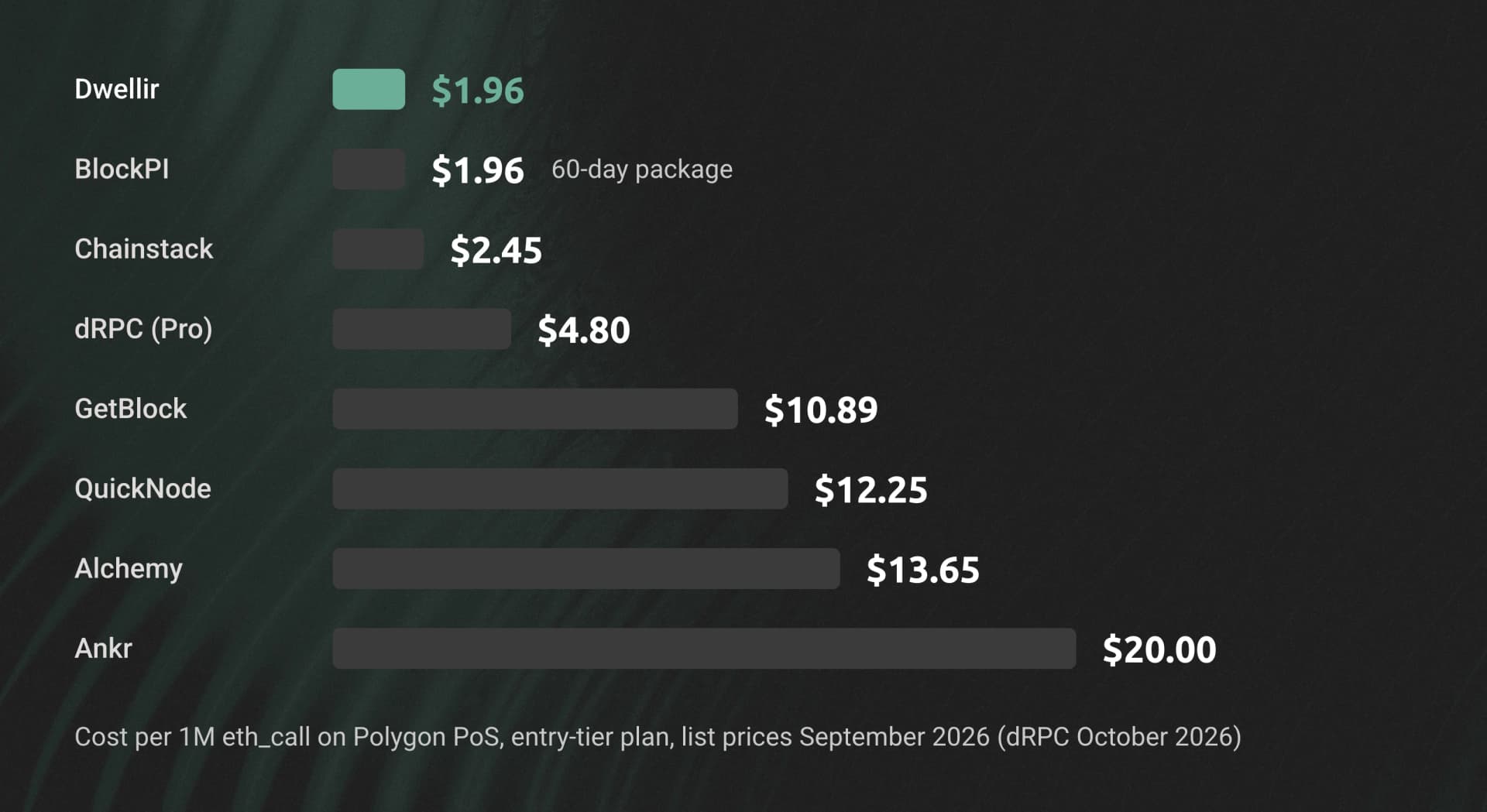
The chart shows eth_call alone. On the full mix, BlockPI rises to $2.84 per million because it weights eth_sendRawTransaction at 200 request units, and Alchemy lands at $13.60.
| Provider | Cost per 1M calls (entry plan, mix) | Unit model | Free tier | Archive | WSS | RPS cap (top self-serve plan) |
|---|---|---|---|---|---|---|
| Dwellir | $1.96 ($49, 25M responses) | 1 credit per response, every method | 100K responses/day, 20 RPS | No (full node; dedicated archive cluster) | Yes | 5,000, bursts to 10,000 ($999) |
| dRPC | $4.80 ($49 Pro, ~10M calls) | Flat 20 CU per method; Pro pool counts 16 CU per request, $6 per 1M overage | 210M CU/month (~10.5M calls) | Yes | Yes | 600 ($199 Scale) |
| Chainstack | $2.45 ($49, 20M request units) | 1 request unit per call, archive and debug 2 | 3M request units/month, 25 RPS | Yes (2 units) | Yes | 600 ($499) |
| BlockPI | $2.84 ($49, 500M RU, 60-day expiry) | Request units, 10-200 per method | 50M RU/month (~1.7M calls), 20 RPS | Yes (+30% RU) | Yes | 2,500 ($299 per 90 days) |
| Ankr | $20.00 (pay as you go) | 200 credits per call, $0.10 per 1M credits | 200M credits/month (~1M calls) | Yes | Premium only | About 1,500 per endpoint |
| GetBlock | $10.89 ($49, 90M CU) | 20 CU per call, archive and debug 2x | 50K CU/day (~2,500 calls), 20 RPS | Yes (2x CU) | Yes | 800 ($499) |
| QuickNode | $12.25 ($49, 80M credits) | 20 credits per call, debug and trace 2x | 10M credits, 15 RPS, 1-month trial | Yes | Yes | 500 ($999) |
| Alchemy | $13.60 (pay as you go) | 10-60 CU per method, $0.525 per 1M CU | 30M CU/month (~1.16M calls) | Yes | Yes | 300 included; up to 30,000 CU/s at $160/month per 5,000 CU/s |
Dwellir's Free plan excludes eth_getLogs; paid plans allow a 500-block range on Developer and 10,000 blocks on Growth and Scale. BlockPI's RPS cap is set by the highest package on the account, and its pay-as-you-go balance is capped at 20 RPS.
Top pick by use case
Short answers, from list prices and published limits checked on 2026-10-07. The numbers table and the methodology show the working.
- Lowest cost per call on a shared plan: Dwellir at $1.96 per million on the $49 Developer plan (25M responses a month, one credit per response for every method). Chainstack follows at $2.45.
- Flat monthly price: GetBlock's Limitless full node is the cheapest flat option at full use, $1.28 per million at 150 or 300 RPS. Dwellir's Unlimited Node starts lower, at $119 for 25 RPS ($1.83 per million).
- Highest self-serve rate limit: Dwellir Scale, 5,000 responses per second with bursts to 10,000, at $999 a month. dRPC's top self-serve plan, Scale, allows 600 RPS for $199 a month.
- Archive state on Polygon PoS: Chainstack (2 request units per archive read, otherwise $2.45 per million) or dRPC (archive at the same $4.80 per million on Pro). Dwellir's shared Polygon endpoints are full nodes; archive needs a dedicated cluster.
- Free tier for prototyping: dRPC, about 10.5 million calls a month. Dwellir's Free plan allows 100,000 responses a day at 20 RPS.
- Enhanced APIs and simulation: Alchemy, at $13.60 per million calls, if you will use its NFT, token and webhook APIs.
- Replacing a retired Blast API endpoint: Dwellir, which bills one credit per response like Blast's request model and covers 150+ chains. Dwellir's shared Polygon endpoints are full nodes, so if you used Blast for archive reads, look at Chainstack or dRPC.
1. Dwellir
Dwellir serves Polygon PoS on 1:1 pricing: one RPC response is one API credit, with no compute units, including on debug and trace methods. HTTPS and WebSocket share the same endpoint and key. See the Polygon network page and the Polygon RPC docs for setup.
Key features:
- WebSocket on the same endpoint
- Debug and trace APIs on the shared Polygon endpoint, at one credit per call
- Unlimited Node for flat, unmetered billing on the same URL and key
- 150+ networks, European infrastructure, autoscaling
- Crypto payment on every paid plan
Pricing:
| Plan | Monthly Cost | Responses Included | RPS (Burst) | Effective $/1M Calls | Overage $/1M Calls |
|---|---|---|---|---|---|
| Free | $0 | 100,000/day | 20 | $0 | - |
| Developer | $49 | 25M | 100 (500) | $1.96 | $5.00 |
| Growth | $299 | 150M | 500 (2,500) | $1.99 | $3.00 |
| Scale | $999 | 500M | 5,000 (10,000) | $2.00 | $2.00 |
| Unlimited Node | Monthly Cost | Calls Covered at Full RPS | Effective $/1M Calls |
|---|---|---|---|
| 25 RPS | $119 | 65M | $1.83 |
| 100 RPS | $479 | 260M | $1.84 |
| 250 RPS | $1,199 | 650M | $1.84 |
| 500 RPS | $2,399 | 1.3B | $1.85 |
| 1,000 RPS | $4,799 | 2.6B | $1.85 |
A dedicated Polygon node cluster lists at $12,600 per month and includes archive, redundant nodes, regions of your choice and no request counting.
Considerations: Dwellir runs Polygon as full nodes on the shared endpoints, not archive (api-polygon-mainnet-full). An eth_call or eth_getBalance at a block older than the retained window returns an error instead of data. Every other paid provider in this list serves Polygon archive state on a shared plan. GetBlock's Limitless full node is cheaper than the Unlimited Node at full use of 150 RPS or more ($1.28 against $1.84 per million).
On recent-state traffic, the flat unit is the advantage: eth_getLogs costs 60 compute units on Alchemy and 50 request units on BlockPI, and one credit here. Scale's 5,000 RPS sustained is more than eight times dRPC Scale at 600 RPS and 10 times QuickNode Business at 500 RPS.
Best for: Multi-chain teams running high-volume reads and sends on recent Polygon state who want one predictable unit across every method. Teams that need historical state should pair Dwellir with an archive provider or use a dedicated cluster.
2. dRPC
dRPC routes Polygon traffic across independent node operators behind a load balancer, and lists Polygon with archive. Its Polygon API docs cover the endpoints.
Key features:
- Archive on Polygon at the same price as recent-state calls
- WebSocket
- Debug and trace on paid plans, at the same flat 20 CU
- Free tier on public nodes, about 10.5M calls a month
- 130+ chains, crypto payment
- Front-running protection and the open-source NodeCore gateway
Pricing:
| Plan | Monthly Cost | Included | RPS | Effective $/1M Calls | Overage $/1M Calls |
|---|---|---|---|---|---|
| Free | $0 | 210M CU (public nodes, ~10.5M calls) | 100 | $0 | - |
| Pay as you go | $6/1M requests | No commitment | 100 | $6.00 | - |
| Pro | $49 | 163M CU (~10M calls at 16 CU) | 300 | $4.80 | $6.00 |
| Scale | $199 | 664M CU (~47M calls at 14 CU) | 600 | $4.20 | $6.00 |
| Enterprise | From $990 | Volume discounts, committed SLAs | Unlimited | Custom | Custom |
dRPC's Pro plan, $49 for about 10M calls ($4.80 per 1M), covers every method, archive and trace included, so a backfill against old blocks costs the same as reading the tip. Overage is $6 per 1M. That is about 2.5 times Dwellir's entry rate and twice Chainstack's. Because traffic is routed across third-party operators, the node operator serving your Polygon requests is not disclosed. Paid plans list 99.96% uptime, with committed SLAs on Enterprise.
Best for: Pay-as-you-go teams that want archive and trace at one flat per-request rate, with no monthly commitment and a decentralized failover pool.
3. Chainstack
Chainstack runs Polygon PoS mainnet and Amoy testnet as Global Nodes and dedicated nodes, full and archive, with Debug and Trace APIs. It bills request units with no method weights, which puts it closest to Dwellir on unit design. The Polygon quickstart walks through creating an endpoint.
Key features:
- Archive on Polygon (Global and Dedicated nodes)
- Debug and Trace APIs
- WebSocket on all plans
- Unlimited Node add-on from $149/month at 25 RPS
- SOC 2 Type II and ISO 27001; 70+ chains; crypto payment
Pricing:
| Plan | Monthly Cost | Request Units | RPS | Effective $/1M Calls | Overage $/1M Calls |
|---|---|---|---|---|---|
| Developer | $0 | 3M | 25 | $0 | $20.00 |
| Growth | $49 | 20M | 250 | $2.45 | $15.00 |
| Pro | $199 | 80M | 400 | $2.49 | $12.50 |
| Business | $499 | 200M | 600 | $2.50 | $10.00 |
| Enterprise | $990 | 400M | Unlimited | $2.48 | $5.00 |
A request under 127 blocks behind the tip costs 1 RU; 127 or more blocks behind costs 2 RU as an archive read, and debug and trace calls cost 2 RU regardless of block age.
Chainstack combines archive, trace, SOC 2 and 1:1 recent-block pricing on one shared endpoint. The costs sit in overage ($10-20 per 1M below Enterprise) and in old-state reads at 2 RU. Its Unlimited Node add-on starts at $149 for 25 RPS (Dwellir's is $119) and needs a Growth or higher plan.
Best for: Teams that need Polygon archive and trace on a shared endpoint, with SOC 2 documentation and near-flat per-request billing.
4. BlockPI
BlockPI lists Polygon mainnet with WebSocket, archive mode and debug_trace. It sells prepaid request-unit packages instead of monthly plans, and weights each method separately. BlockPI has had incidents on other EVM networks, including Linea, BNB Smart Chain and Arbitrum, so keep a second provider configured for failover. Endpoint details are in the BlockPI docs.
Key features:
- Archive mode on Polygon, at 30% more request units
- WebSocket and
debug_traceTransaction - 1,000 RPS on Elementary and 2,500 on Premium
- Packages that expire after 60 or 90 days
Pricing:
| Package | Price | Request Units | Valid | RPS | Effective $/1M Calls | Overage $/1M Calls |
|---|---|---|---|---|---|---|
| Free | $0 | 50M RU/month (~1.7M calls) | Monthly | 20 | $0 | - |
| Pay as you go | $0.01 per 50K RU | Balance | Ongoing | 20 | $5.80 | $5.80 |
| Elementary | $49 | 500M | 60 days | 1,000 | $2.84 | None, prepaid |
| Premium | $299 | 4B | 90 days | 2,500 | $2.17 | None, prepaid |
The effective figures assume the whole package is used before it expires. eth_call costs 20 RU ($1.96 per 1M on Elementary), receipts 15, eth_getLogs 50 ($4.90) and eth_sendRawTransaction 200 ($19.60), so write-heavy flows cost far more than the headline. The pay-as-you-go balance is capped at 20 RPS.
Best for: Read-heavy teams with steady volume who can use a package inside its validity window.
5. Ankr
Ankr serves Polygon through a distributed node network, with a keyless public endpoint and a Premium tier billed in credits. Ready-made URLs are on its Polygon RPC page.
Key features:
- One weight for every EVM method: 200 credits, archive and trace included
- Keyless public endpoint for testing (about 30 RPS)
- Archive data, WebSocket, debug and trace on Premium only
- 80+ chains
Pricing:
| Plan | Monthly Cost | Included | RPS | Effective $/1M Calls | Overage $/1M Calls |
|---|---|---|---|---|---|
| Public | $0 | Keyless, ~1,800 req/min | ~30 | $0 | - |
| Freemium | $0 | 200M credits (~1M calls) | Public limits | $0 | - |
| Premium PAYG | $10 minimum deposit | Usage-based | ~1,500 | $20.00 | $20.00 |
| Deal | $500-3,000 | Credits +20% bonus | ~1,500 | $16.67 | - |
The advertised $0.10 per million credits looks cheap, but at 200 credits per call one million Polygon calls costs $20.00, the highest rate in this comparison. In return the price never changes with the method or the block age. On Polygon, Premium eth_getLogs is capped at a 1,000-block range, which Ankr describes as temporary; the public endpoint allows 100 blocks.
Best for: Low-volume multi-chain projects that want a keyless endpoint for testing and one predictable weight on every call.
6. GetBlock
GetBlock sells shared Polygon endpoints on compute-unit plans and a flat-priced Limitless Node, with full and archive modes. Its endpoint setup guide generates HTTPS or WSS URLs.
Key features:
- Polygon chain multiplier of 20: standard calls cost 20 CU, debug and trace 40, archive-endpoint calls double
- Limitless Node: one chain, flat monthly price, full or archive
- Regional endpoints in Europe, the US and Asia
- SOC 2 Type II; 130+ networks
Pricing:
| Plan | Monthly Cost | CU | Calls Covered | RPS | Effective $/1M Calls | Overage $/1M Calls |
|---|---|---|---|---|---|---|
| Free | $0 | 50K/day | ~2,500/day | 20 | $0 | - |
| Starter | $49 | 90M | 4.5M | 250 | $10.89 | Top-up, price not published |
| Growth | $99 | 185M | 9.25M | 300 | $10.70 | Top-up, price not published |
| Advanced | $199 | 385M | 19.25M | 450 | $10.34 | Top-up, price not published |
| Scale | $349 | 700M | 35M | 600 | $9.97 | Top-up, price not published |
| Pro | $499 ($399 yearly) | 1B | 50M | 800 | $9.98 ($7.98 yearly) | $8.00 |
| Premium | $699 ($559 yearly) | 1.6B | 80M | 800 | $8.74 ($6.99 yearly) | $7.00 |
| Enterprise | from $999 | Custom | Custom | Custom | Custom | Custom |
| Limitless Node (one chain, flat) | Monthly Cost | Calls Covered at Full RPS | Effective $/1M Calls |
|---|---|---|---|
| Full, 25 RPS | $150 | 65M | $2.31 |
| Full, 50 RPS | $300 | 130M | $2.31 |
| Full, 150 RPS | $500 | 390M | $1.28 |
| Full, 300 RPS | $1,000 | 780M | $1.28 |
| Archive, 15 / 30 / 50 / 100 RPS | $150 / $300 / $500 / $1,000 | 39M-260M | $3.85 |
The shared plans cost five times Dwellir's per call. The Limitless full node at 150 or 300 RPS is the cheapest flat-rate Polygon option in this comparison if you keep it busy, and the archive Limitless node is $3.85 per million.
Best for: Teams with steady, high single-chain traffic who want a flat bill, or regional endpoints on a simple dashboard.
7. QuickNode
QuickNode serves Polygon PoS mainnet over HTTPS and WSS with archive, and documents every method and add-on in its Polygon docs. There is no keyless endpoint and no permanent free tier.
Key features:
- Archive on Polygon
- Debug and Trace APIs on paid plans (not on the free trial)
- Streams, Webhooks and a marketplace of add-ons
- SOC 1 Type 2, SOC 2 Type 2 and ISO 27001
- 75+ chains
Pricing:
| Plan | Monthly Cost | API Credits | Polygon Calls Covered | RPS | Effective $/1M Calls | Overage $/1M Calls |
|---|---|---|---|---|---|---|
| Free trial | $0 (1 month) | 10M | ~500K | 15 | $0 | - |
| Build | $49 | 80M | ~4M | 50 | $12.25 | $12.40 |
| Accelerate | $249 | 450M | ~22.5M | 125 | $11.07 | $11.20 |
| Scale | $499 | 950M | ~47.5M | 250 | $10.51 | $10.60 |
| Business | $999 | 2B | ~100M | 500 | $9.99 | $10.00 |
| Enterprise | Custom | Custom | Custom | Custom | Custom | Custom |
Annual billing lowers each tier, for example Build to $34 per month.
QuickNode charges 20 credits for each standard Polygon call, so the credit totals overstate request capacity by 20 times. Debug and trace calls cost 40 credits, and txpool_content and trace_replay* cost 80. The highest self-serve rate limit is 500 RPS on the $999 Business plan, a tenth of Dwellir Scale.
Best for: Regulated teams that need archive, trace and SOC reports from one vendor and can budget 20 credits per call.
8. Alchemy
Alchemy serves Polygon PoS with archive, WebSocket and the full Debug and Trace APIs, plus its own NFT, token and webhook APIs. There is no keyless public endpoint.
Key features:
- Archive on Polygon
- Debug (16 of 16 methods) and Trace (9 of 9) APIs on Pay as You Go
- NFT, Token and Webhook APIs
- 100+ blockchains; signed SLAs on Enterprise
Pricing:
| Plan | Monthly Cost | Included | Throughput | Effective $/1M Calls | Overage $/1M Calls |
|---|---|---|---|---|---|
| Free | $0 | 30M CU (~1.16M calls) | 25 RPS (500 CU/s) | $0 | - |
| Pay as You Go | $0.525/1M CU | Usage-based | 300 RPS (10,000 CU/s) | $13.60 | $13.60 |
| Enterprise | Custom | Custom | Custom | Custom | Custom |
Extra pay-as-you-go throughput costs $160 per month per 5,000 CU/s block, up to a 30,000 CU/s self-serve cap.
Alchemy weights each method: eth_blockNumber is 10 CU, eth_call 26, eth_sendRawTransaction 40 and eth_getLogs 60, so one million log queries costs $31.50. On the mix, a Polygon call averages 25.9 CU and one million calls cost $13.60, seven times Dwellir's entry rate. Raising throughput from 300 RPS to the 30,000 CU/s cap adds $640 a month on top of usage.
Best for: Teams that will use Alchemy's enhanced NFT, token and webhook APIs alongside RPC, and can model their compute-unit consumption.
Free and public endpoints
Polygon Labs maintains official public RPC endpoints that need no signup and cost nothing. Their rate limits are not published and there is no SLA, so they suit testing and personal projects. ChainList's Polygon entry lists more keyless URLs as a quick fallback.
Blast API, once a common free Polygon endpoint, was retired on October 31, 2025 after Alchemy acquired Bware Labs. Replace hard-coded Blast URLs with a provider from the list above.
How to Compare Polygon Pricing Across Unit Systems
Every headline rate in this comparison is quoted in a different unit. The only way to compare them is to convert each one to dollars per million calls, using the weight each provider assigns to each method.
Per-request billing. One response is one unit, whatever the method. Dwellir bills this way, and Chainstack does too on recent state (1 request unit per call, 2 for reads 127 or more blocks behind the tip and for every debug or trace call). Dwellir's Developer plan works out to $1.96 per 1M calls included, with overage at $5.00 per 1M ($2-5 across plans). Chainstack Growth is $2.45 per 1M included, $15 per 1M overage.
One flat weight per call. dRPC charges the same for every method ($4.80 per 1M on Pro, $6.00 pay as you go), GetBlock 20 CU on Polygon ($10.89 per 1M on Starter, double for debug, trace and archive), QuickNode 20 credits ($12.25 per 1M on Build, double for debug and trace) and Ankr 200 credits ($20.00 per 1M).
Weights per method. Alchemy charges $0.525 per 1M CU and BlockPI sells prepaid request units, and both give each method its own weight, so the cost of a call depends on the method.
Method by method, in dollars per 1M calls at each plan's included rate:
| Method | Dwellir (Developer) | BlockPI (Elementary) | Chainstack (Growth) | dRPC (Pro) | QuickNode (Business) | GetBlock (Starter) | Alchemy (PAYG) | Ankr (PAYG) |
|---|---|---|---|---|---|---|---|---|
eth_call | $1.96 | $1.96 | $2.45 | $4.80 | $9.99 | $10.89 | $13.65 | $20.00 |
eth_getTransactionReceipt | $1.96 | $1.47 | $2.45 | $4.80 | $9.99 | $10.89 | $10.50 | $20.00 |
eth_getLogs | $1.96 | $4.90 | $2.45 | $4.80 | $9.99 | $10.89 | $31.50 | $20.00 |
eth_sendRawTransaction | $1.96 | $19.60 | $2.45 | $4.80 | $9.99 | $10.89 | $21.00 | $20.00 |
debug_traceTransaction | $1.96 | $14.70 | $4.90 | $4.80 | $19.98 | $21.78 | $21.00 | $20.00 |
Dwellir and Chainstack overage runs $2-5 and $10-20 per 1M respectively, and Chainstack doubles the unit for reads 127 or more blocks behind the tip and for debug and trace calls.
The monthly totals below use a mostly-reads mix: 40% eth_call, 25% receipts, 15% eth_blockNumber, 10% eth_getLogs over small ranges, 5% eth_getBalance and 5% eth_sendRawTransaction, all on recent blocks. On that mix a Polygon call averages 25.9 CU on Alchemy, so 1M calls cost $13.60 and the free 30M CU covers about 1.16M calls. On BlockPI it averages 29 RU, so the Elementary package covers about 17M calls. On QuickNode every call is 20 credits, so Build's 80M credits cover 4M calls and Business's 2B credits cover 100M calls at $999.
Provider Comparison
| Provider | Free Tier | Entry Paid | Effective $/1M Calls | Archive on Polygon | WSS | Debug | Trace | getLogs Cap | Pricing Unit | Networks |
|---|---|---|---|---|---|---|---|---|---|---|
| Dwellir | 100K/day | $49/mo | $1.96 | No (dedicated cluster only) | Yes | Yes | Yes | 500 blocks (Developer), 10,000 (Growth+) | 1 response | 150+ |
| dRPC | 210M CU/mo | $49/mo | $4.80 | Yes | Yes | Paid only | Paid only | Not stated | 20 CU flat | 130+ |
| Chainstack | 3M RU/mo | $49/mo | $2.45 | Yes (2 RU) | Yes | Yes (2 RU) | Yes (2 RU) | Not stated | 1 RU (2 archive) | 70+ |
| BlockPI | 50M RU/mo | $49 prepaid | $2.84 | Yes (+30% RU) | Yes | Yes | Not stated | Not stated | RU (~29/req) | Not stated |
| Ankr | 200M credits/mo | $10 deposit | $20.00 | Yes | Premium | Premium | Premium | 1,000 blocks (Premium, "temporary") | 200 credits/call | 80+ |
| GetBlock | 50K CU/day | $49/mo | $10.89 | Yes (2x CU) | Yes | Yes (2x) | Yes (2x) | Not stated | CU (20/req) | 130+ |
| QuickNode | 10M credits, 1 month | $49/mo | $12.25 | Yes | Yes | Paid only | Paid only | Not stated | 20 credits/call | 75+ |
| Alchemy | 30M CU/mo | $0.525/1M CU | $13.60 | Yes | Yes | Paid only | Paid only | Not stated | CU (~25.9/req) | 100+ |
Effective Price per Million Calls
One denominator for every provider: dollars per 1M Polygon calls under the mix, at the entry paid plan and at the best self-serve rate, with overage alongside.
| Provider | Entry Paid Plan | Effective $/1M Calls | Best Self-Serve Rate | Overage $/1M Calls |
|---|---|---|---|---|
| Dwellir | Developer $49 | $1.96 | $1.83 (Unlimited Node, 25 RPS) | $2.00-5.00 |
| Chainstack | Growth $49 | $2.45 | $2.45 (Growth) | $5.00-20.00 |
| BlockPI | Elementary $49 prepaid | $2.84 (500M RU pack used within 60 days) | $2.17 (Premium packages) | None, prepaid |
| dRPC | Pro $49 | $4.80 | $4.20 (Scale) | $6.00 |
| GetBlock | Starter $49 | $10.89 | $1.28 (Limitless full node, 150+ RPS); $6.99 shared (Premium, yearly) | $7.00-8.00 (Pro/Premium) |
| QuickNode | Build $49 | $12.25 | $9.99 (Business) | $10.00-12.40 |
| Alchemy | Pay as you go | $13.60 | $13.60 | $13.60 |
| Ankr | Premium PAYG | $20.00 | $16.67 (Deal) | $20.00 |
What That Costs at Volume
Plans step at fixed tiers, so monthly bills differ from the per-million rates. Same mix, list prices.
| Provider | 10M req/mo | 50M req/mo | 100M req/mo |
|---|---|---|---|
| BlockPI (prepaid RU) | ~$49 | ~$108 | ~$217 |
| Dwellir (metered) | $49 | $174 | $299 |
| GetBlock (Limitless, full node) | $150 | $150-300 | $300-500 |
| Chainstack | $49 | $199 | $449 |
| Dwellir (Unlimited Node) | $119 | $119-479 | $479 |
| dRPC | $49 | $217 | $517 |
| GetBlock (shared) | $199 | $499 | ~$839 |
| QuickNode | ~$123 | ~$526 | $999 |
| Alchemy | ~$136 | ~$680 | ~$1,360 |
| Ankr | $200 | $1,000 | $2,000 |
At 10M requests, Dwellir's $49 ties Chainstack, BlockPI and dRPC Pro. At 50M and 100M, BlockPI is lower on list price if its packages are used before they expire and the traffic has few sends. GetBlock's Limitless full node is the cheapest flat option when traffic stays under its RPS cap. Among the other metered plans, Dwellir is the lowest at both volumes.
Methodology
How the ranking and the numbers in this post were produced, so you can reproduce or dispute them.
Ranking. This is an editorial ranking by Dwellir, the publisher of this post, and Dwellir is one of the providers in it. It weighs three things: the effective cost per million calls on the house mix, how predictable the bill is when your method mix, block age or volume changes, and what the plans include (free tier, archive, debug and trace, MEV protection or compliance). No single criterion sorts the list, so a provider can sit above a cheaper one. Dwellir ranks first on cost and a single unit for every method, with the archive gap stated in its section. dRPC ranks above the cheaper Chainstack because one rate covers archive, debug and trace ($4.80 per 1M on Pro, $6 overage), where Chainstack doubles archive reads and charges $10-20 per 1M in overage. BlockPI is third-cheapest on the mix ($2.84) but ranks fourth because its per-method weights, expiring packages and 20 RPS pay-as-you-go cap make the bill less predictable. Ankr ranks above the cheaper GetBlock because every Ankr method costs the same 200 credits, while GetBlock doubles archive and debug calls and does not publish overage for its lower tiers. QuickNode and Alchemy rank last: after Ankr they have the highest entry rates on the mix ($12.25 and $13.60), QuickNode multiplies debug and trace by 2-4x on top of its flat 20 credits per call, Alchemy weights each method at 10 to 60 CU, and neither includes debug or trace on its free tier.
Cost per million is each plan's monthly price divided by the number of calls its included volume buys on Polygon PoS under the mix, once the provider's own unit weights are applied. Alchemy and Ankr have no fixed entry bundle, so their metered rate is used. dRPC's figure is its $49 Pro plan, which covers about 10M calls. BlockPI sells packages that expire after 60 or 90 days, which is noted in the tables. Annual discounts are excluded unless marked.
Unit weights come from each provider's published method-cost table: Alchemy compute unit costs, QuickNode API credits (20 per Polygon call), BlockPI's EVM request unit table, GetBlock's formula (chain multiplier 20 for Polygon times method multiplier), dRPC's flat 20 CU (16 CU per request from the Pro pool) and Ankr's 200 credits. Dwellir and Chainstack count one unit per recent-state call.
RPS cap is the highest rate limit on a shared plan with a published price. Burst allowances are noted where published. Flat-rate and dedicated products are compared in which RPC provider has the highest RPS.
Archive and WSS mean the provider serves historical Polygon PoS state and WebSocket subscriptions on its standard shared plans. Dwellir's Polygon endpoints are full nodes, which is why its archive column says no; that was checked against the Dwellir Polygon network page on 2026-10-07.
Not measured here: latency, error rates and data freshness. Run a short benchmark from your own region against the two or three providers this comparison narrows you to before committing.
Verification date: plan prices, unit weights, rate limits and chain support were checked against each provider's pricing page and docs on 2026-10-07 (dRPC rechecked 2026-10-21). Ankr's rate limits are carried from a 2026-09-29 check. The modified date at the top of this post moves whenever a figure is rechecked.
Choosing the Right Provider
High-volume reads and sends on recent state: Dwellir. Every method costs one credit, Scale runs 5,000 RPS sustained, and the Unlimited Node starts at $119 for 25 RPS. The caveat is archive: the shared Polygon endpoint runs full nodes.
Archive and trace on a shared endpoint: dRPC or Chainstack. dRPC charges the same rate for archive and trace as for recent calls ($4.80 per million on Pro, $6 overage). Chainstack is cheaper on recent state at $2.45 per million, charges 2 RU for archive and debug, and adds SOC 2 Type II and ISO 27001.
Steady single-chain traffic on a flat bill: GetBlock Limitless or the Dwellir Unlimited Node. GetBlock's full node is $1.28 per million at 150 RPS or more if you keep it busy; Dwellir's Unlimited Node starts lower, at $119 for 25 RPS, and covers every method on the same key.
Prototyping: dRPC's free tier or Dwellir Free. dRPC covers about 10.5 million calls a month; Dwellir allows 100,000 responses a day at 20 RPS. The Polygon Labs public endpoints work for testing but publish no limits.
Most production Polygon teams run two providers: one for primary traffic and a second for failover. Rerun the cost-per-million arithmetic with your own method mix whenever a provider changes its unit weights, because that is where the 10x spread in this post comes from.
Frequently Asked Questions
What is the fastest Polygon RPC provider?
It depends on where your servers are. This comparison does not measure latency, and most published Polygon latency figures come from the providers themselves. Shortlist two or three providers on price and features, then run the same requests against each from your own region before you commit.
Are there free Polygon RPC endpoints?
Yes. dRPC's free tier covers about 10.5 million calls a month, BlockPI's about 1.7 million, Alchemy's about 1.16 million and Chainstack's 3 million. Dwellir's Free plan allows 100,000 responses a day at 20 RPS. Polygon Labs also runs keyless public endpoints with unpublished rate limits and no SLA.
How do Polygon RPC compute units work?
Providers such as Alchemy, BlockPI and Infura give each RPC method its own weight, so the same million calls costs a different amount depending on the methods you use. On Alchemy, eth_call is 26 compute units and eth_getLogs is 60. Dwellir charges one credit per response for every method; dRPC (20 CU), GetBlock (20 CU), QuickNode (20 credits) and Ankr (200 credits) charge one flat weight for standard calls.
Which Polygon RPC provider has the best pricing?
On a mostly-reads mix of Polygon calls, Dwellir costs $1.96 per million on its $49 Developer plan, Chainstack $2.45, BlockPI $2.84, dRPC $4.80, GetBlock $10.89, QuickNode $12.25, Alchemy $13.60 and Ankr $20.00. For flat-rate pricing at full use, GetBlock's Limitless full node works out to $1.28 per million at 150 RPS and Dwellir's Unlimited Node to $1.83-1.85.
Which Polygon RPC provider has the highest rate limit?
Among shared plans with a published price, Dwellir Scale allows 5,000 responses per second with bursts to 10,000 for $999 a month. BlockPI's Premium package allows 2,500 RPS, GetBlock 800, Chainstack and dRPC 600 and QuickNode 500. Alchemy includes 300 RPS on pay as you go and sells extra throughput at $160 a month per 5,000 CU/s.
Which Polygon RPC providers offer archive nodes?
Chainstack, dRPC, BlockPI, Ankr, GetBlock, QuickNode and Alchemy serve Polygon PoS archive state on paid plans. Chainstack charges 2 request units and GetBlock 2x compute units for archive reads, and BlockPI adds 30%. Dwellir's shared Polygon endpoints are full nodes; archive access needs a dedicated node cluster.
Related Resources
- Best Ethereum RPC Providers 2026 - Compare pricing and features across top Ethereum infrastructure providers
- Best Base RPC Providers 2026 - Price per million, rate limits and Flashblocks on Coinbase's Layer 2
- Which RPC Provider Has the Highest RPS? - Rate limits, burst rules and flat-rate RPS products compared
- RPC Providers Without Compute Units - Find providers with simple per-request pricing
Building on Polygon? Start with Dwellir's free tier to test your integration, compare plans, or contact the Dwellir team about a dedicated archive cluster.