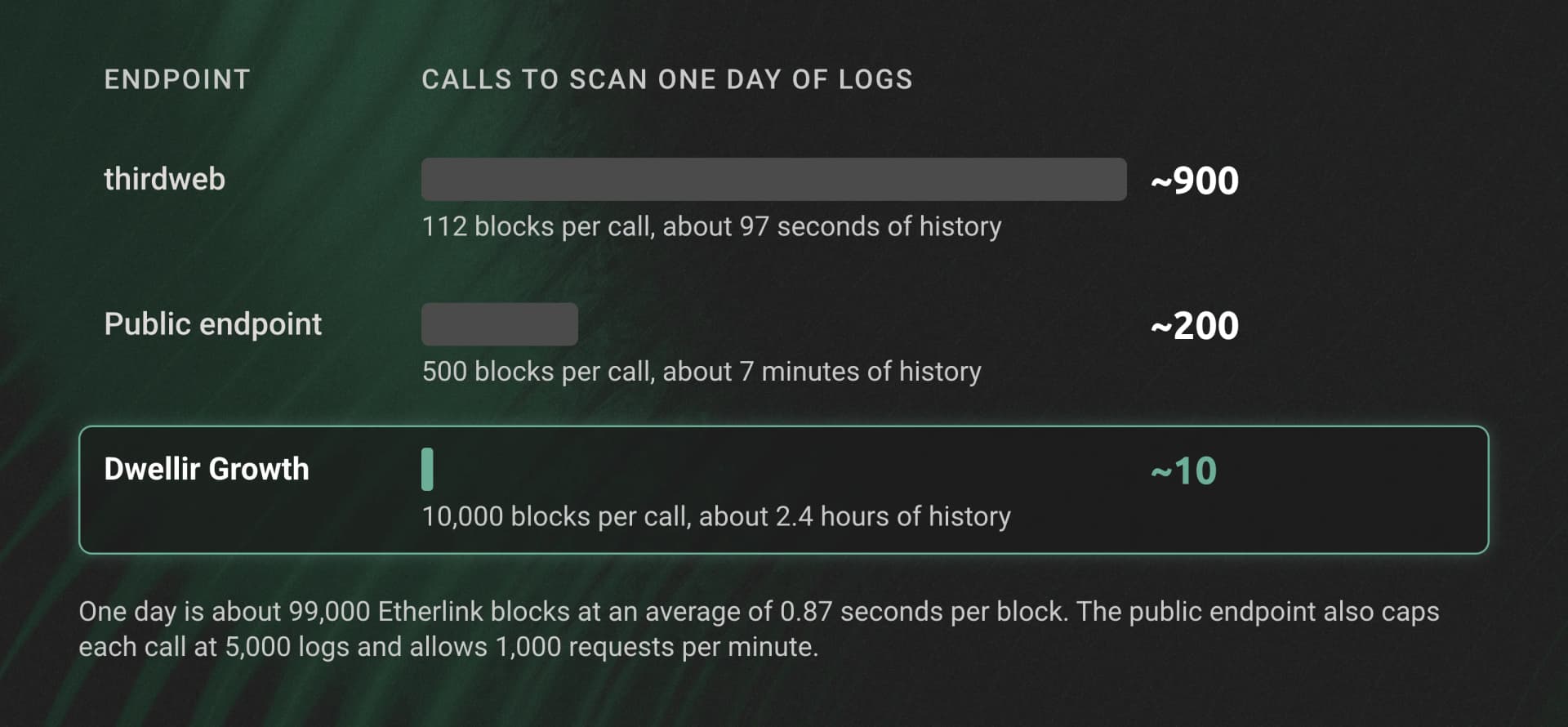
Point an indexer at Etherlink's public endpoint and the first backfill shows you the limits. The official endpoint caps eth_getLogs at 500 blocks and 5,000 returned logs per call. Etherlink averages about 0.87 seconds per block, so each call covers roughly 7 minutes of chain history. One day is around 99,000 blocks, or about 200 sequential calls to scan a day of events, all inside a budget of 1,000 requests per minute. The endpoint has no WebSocket, so you poll.
Transaction submission has its own catch. Etherlink's sequencer silently rejects transactions with fees set too low, and some wallets keep resubmitting them. A backend that treats "no error" as "accepted" will report transactions that never land.
The provider list also differs from other EVM chains. Alchemy, QuickNode, Tatum, Allnodes/PublicNode and Nodies do not serve Etherlink. The providers that do are a mix of per-request APIs and credit-weighted gateways, each with different limits on archive data, WebSocket and log query ranges.
Demand on the chain is shifting too. The 7.0 Ganesha kernel upgrade went live on August 21, 2026, and on September 16, 2026 Anchorage Digital Bank added custody for 7 Etherlink assets, including USDC, USDT, WXTZ, stXTZ and xU3O8 tokenized uranium. This comparison covers the 6 providers selling Etherlink RPC today. Pricing is a list-price snapshot from 2026-09-29, normalized to dollars per million calls on a read-heavy indexing mix, alongside archive, WebSocket and eth_getLogs limits.
Provider Comparison
| Provider | Free Tier | Entry Paid | Effective $/1M Calls | Archive on Etherlink | WSS | Debug | Trace | getLogs Cap | Pricing Unit | Networks |
|---|---|---|---|---|---|---|---|---|---|---|
| Dwellir | 100K/day | $49/mo | $1.96 | Yes | Yes | Not confirmed | No | 10,000 blocks (Growth) | 1 response | 140+ |
| dRPC | 210M CU/30 days (~10.5M calls) | $6/1M req | $6.00 | Unclear | Yes | Not confirmed | No | Not stated | 20 CU flat | 130+ |
| Spectrum Nodes | 10M credits (~200K calls) | $1.99/mo | $7.11 | Yes | Yes | Tracing listed | No | Not stated | 50 credits/call (100 debug) | 200+ |
| thirdweb | Not stated | $99/mo | $99.00 (1M included) | Not stated | Not stated | Not stated | No | 112 blocks | 1 request | 2,500+ |
| Ankr | Freemium, 200M credits (~1M calls) | $10 deposit | $20.00 | Unclear | Premium | Unclear | Unclear | Not stated | 200 credits/call | Not stated |
| GetBlock | 50K CU/day (~1,000 calls) | $49/mo | $27.22 | Paid plans | Yes | Not stated | No | Not stated | 50 CU/call (100 debug) | 100+ |
Etherlink's node does not implement the trace_* namespace, so tracing on any provider means the debug_trace* methods. For reference, the official public endpoint node.mainnet.etherlink.com allows 1,000 requests per minute, caps eth_getLogs at 500 blocks and 5,000 logs, and has no WebSocket.
Effective Price per Million Calls
One denominator for every provider: dollars per 1M Etherlink calls under a read-heavy indexing mix (mostly eth_call and receipts, with some eth_getLogs and sends; the full breakdown is in How to Compare Etherlink Pricing), at the entry paid plan and at the best self-serve rate.
| Provider | Entry Paid Plan | Effective $/1M Calls | Best Self-Serve Rate |
|---|---|---|---|
| Dwellir | Developer $49 | $1.96 | $1.83 (Unlimited Node, 25 RPS) |
| dRPC | Growth, pay as you go | $6.00 | $6.00 |
| Spectrum Nodes | Starter $1.99 | $7.11 | $5.95 (Enterprise $500) |
| thirdweb | Growth $99 | $99.00 (1M included) | $8.91 (Growth at 100M calls) |
| Ankr | Premium PAYG, $10 deposit | $20.00 | $16.67 (Deal, +20% credits) |
| GetBlock | Starter $49 | $27.22 | $19.95 (Pro, yearly billing) |
What That Costs at Volume
Plans step at fixed tiers, so monthly bills differ from the per-million rates. Same read-heavy indexing mix, list prices, including each plan's list price for usage beyond its included calls.
| Provider | 10M req/mo | 50M req/mo | 100M req/mo |
|---|---|---|---|
| Dwellir | $49 | $174 | $299 |
| dRPC | $60 | $300 | $600 |
| Spectrum Nodes | ~$76 | ~$353 | ~$604 |
| thirdweb | $171 | $491 | $891 |
| Ankr | $200 | $1,000 | $2,000 |
| GetBlock | $349 | Custom (Enterprise from $999) | Custom (Enterprise from $999) |
At 10M requests, Dwellir's $49 is the lowest paid total, and dRPC's free tier would also cover the volume if public-node routing is acceptable. At 50M and 100M, Dwellir stays the lowest, at $174 and $299 against $300 and $600 on dRPC, the next-lowest.
What Makes Etherlink Different for RPC
Etherlink is an EVM-compatible L2 built as an enshrined Smart Rollup on Tezos. It settles to Tezos rather than Ethereum, uses optimistic fraud proofs through a refutation game, and runs on octez-evm-node, which exposes a Geth-style API without being Geth. Chain ID is 42793, the gas token is XTZ (18 decimals on the EVM side), and the current EVM version is Osaka. Standard Solidity tooling works, but several details below the JSON-RPC surface change what you need from a provider.
Four Confirmation Tiers
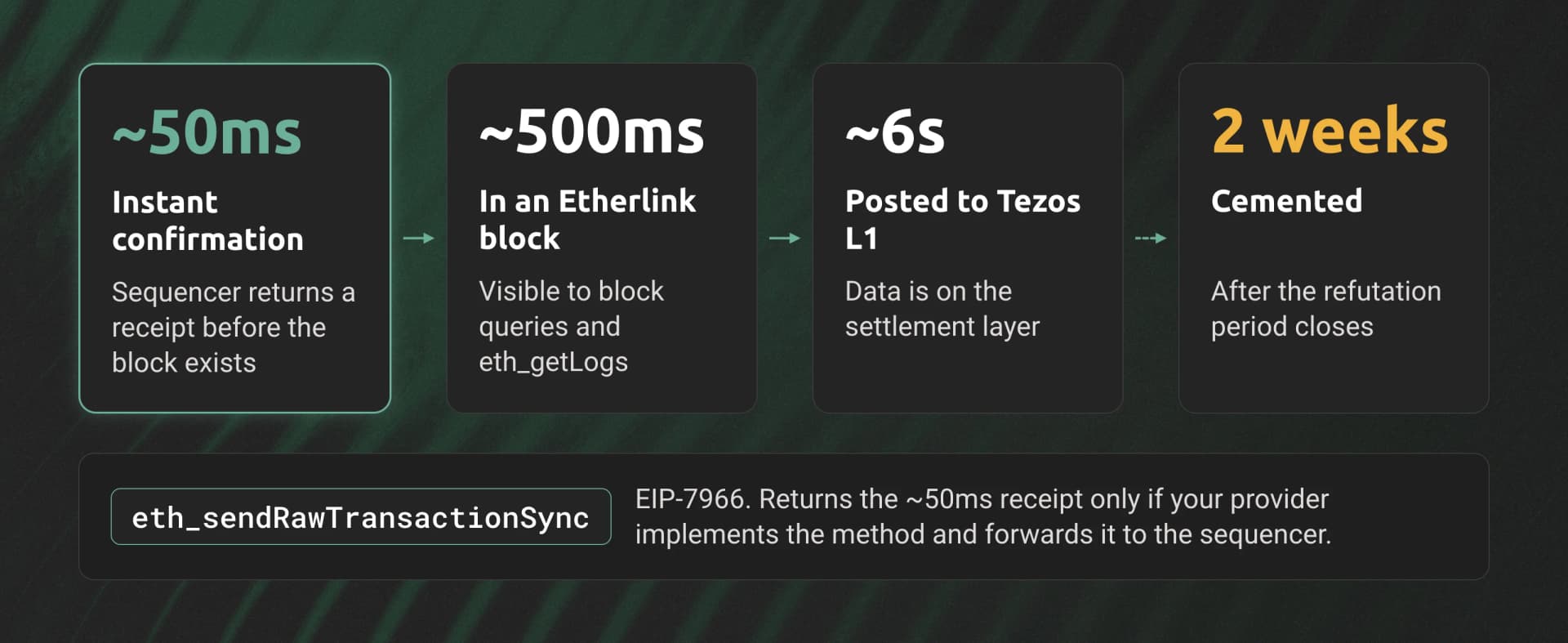
The sequencer confirms a transaction in about 50ms. The transaction lands in a block at around 500ms, the block is posted to Tezos L1 at around 6 seconds, and the state is cemented after a 2-week refutation period. Your application has to decide which tier it trusts for which action, and provider latency to the sequencer determines how much of the 50ms tier you actually see.
FCFS Ordering With No Tips
A single centralized sequencer orders transactions first-come, first-served, and Etherlink has no priority fee. MEV-protected RPC endpoints, a selling point on Ethereum, have little to protect against here. What matters is how quickly your provider forwards your transaction to the sequencer. If the sequencer censors a transaction, a delayed inbox on L1 forces inclusion after 12 hours.
Instant Receipts via eth_sendRawTransactionSync
Etherlink implements EIP-7966, which returns a receipt with a "pending" status in about 50ms, before the block exists. Trading and payment flows can use it to skip receipt polling, provided your provider passes the method through. Test it on any provider you evaluate.
Missing Standard Methods
Etherlink's endpoint support table, updated September 25, 2026, shows that the node does not support the filter methods (eth_newFilter, eth_getFilterChanges, eth_getFilterLogs, eth_newBlockFilter), eth_getProof, eth_createAccessList, eth_blobBaseFee or eth_syncing. The trace_* namespace is absent. debug_traceTransaction is supported, debug_traceBlockByNumber supports only the callTracer, and debug_traceCall supports callTracer and structLogger. There is no prestateTracer, and txpool_content always returns empty on mainnet. Libraries that fall back to filter polling for event watching will break, so plan on eth_getLogs or subscriptions instead.
Experimental WebSocket Subscriptions
eth_subscribe is marked experimental, WebSocket is not enabled by default on the EVM node, and the public endpoints do not offer it. Etherlink also defines custom subscriptions, tez_newIncludedTransactions and tez_newPreconfirmedReceipts, which expose the pre-block confirmation tier. On this chain, WebSocket support varies from provider to provider, so check it explicitly.
Nonstandard Block Hashes
You cannot recompute an Etherlink block hash from the header fields returned by eth_getBlockByNumber. Any tooling that verifies block hashes locally, such as some light-client and bridge code, needs to skip that check.
Frequent Kernel Upgrades
Etherlink shipped kernel 6.0 Farfadet in late 2025, six mostly security-focused releases (6.1 to 6.6) between December 2025 and July 2026, 7.0 Ganesha on August 21, 2026, and a 7.1 security fix through fast governance on August 29-30, 2026. Ganesha required octez-evm-node 0.64 or later. A provider that lags on node upgrades can serve stale or failing responses until it catches up, so ask each vendor how quickly it handled 7.0 and 7.1.
Tezos RPCs Alongside the EVM API
Since Ganesha, nodes also expose a subset of Tezos (octez-node) RPCs for the new Michelson interface. If you are building on Ganesha's Native Atomic Composability between Michelson and EVM contracts, confirm that your provider routes those paths.
What to Look for in an Etherlink RPC Provider
Etherlink's quirks translate into six checks when you evaluate a provider:
eth_getLogsblock range. The public endpoint allows 500 blocks, thirdweb caps at 112 blocks (about 97 seconds of history), and Dwellir's Growth plan allows 10,000 blocks (about 2.4 hours). With no filter methods, log queries carry all of your event indexing.- WebSocket support. Subscriptions are the only push-based option on Etherlink, and the public endpoint has none. At sub-second block times, polling burns request budget quickly.
- Archive access. Anchorage custody and tokenized treasury products like Midas bring reconciliation and audit queries against historical state. Not every provider in this list confirms archive data on Etherlink.
- Debug tracer coverage. With no
trace_*namespace,debug_traceTransactionwithcallTraceris your main diagnostic tool. Check that the provider exposes it on your plan. - Upgrade cadence. Nine kernel releases between late 2025 and August 2026 make a provider's node operations as important as its price.
- Pricing unit. GetBlock charges 50 CU and Spectrum Nodes 50 credits for a standard Etherlink call, while Dwellir, dRPC and thirdweb bill every method the same. Convert each plan to dollars per million calls before comparing.
How to Compare Etherlink Pricing Across Unit Systems
Every headline rate in this comparison is quoted in a different unit. The only way to compare them is to convert each one to dollars per million calls for the methods an indexing backend actually makes, using the weight each provider assigns to the method. On Etherlink that means pricing eth_getLogs first, because the missing filter methods push all event watching onto it.
Per-request billing. One response is one unit, whatever the method. Dwellir, dRPC and thirdweb bill this way. Dwellir's Developer plan works out to $1.96 per 1M calls included. dRPC charges a flat 20 CU for every Etherlink method, debug included, which is $6.00 per 1M calls. thirdweb includes 1M calls with its $99 Growth plan and bills further calls at a per-request usage rate, which works out to $8.91 per 1M at 100M calls a month.
Compute units and credits. The provider charges per million units and gives each method a weight, so the cost of a call depends on the method and, for some providers, the chain.
- Spectrum Nodes charges 50 credits for every Etherlink
eth_*method and 100 fordebug_trace*, which is $7.14 per 1M calls and $14.27 per 1M debug calls on Developer, falling to $5.95 per 1M calls on Enterprise. - Ankr charges $0.10 per 1M credits at 200 credits for every EVM method, a flat $20.00 per 1M calls. Deal plans add 20% bonus credits, which brings that to $16.67.
- GetBlock puts Etherlink in its 50x chain-multiplier group: standard
eth_*methods cost 50 CU anddebug_*ortrace_*100 CU, and archive-mode endpoints double that. On Starter that is $27.22 per 1M calls and $54.44 per 1M debug calls, and $19.95 per 1M calls on Pro with yearly billing.
The effective prices and monthly totals in the comparison at the top of this post use a read-heavy indexing mix: 40% eth_call, 25% eth_getTransactionReceipt, 15% eth_blockNumber, 10% eth_getLogs over small ranges, 5% eth_getBalance and 5% eth_sendRawTransaction, all on recent blocks. On that mix Spectrum and GetBlock both average 50 units per call, so Spectrum Developer's 70M credits cover 1.4M calls and GetBlock Starter's 90M CU cover 1.8M calls. Ankr is 200 credits on every call, $20.00 per 1M.
1. Dwellir
Dwellir serves Etherlink mainnet archive RPC over HTTPS and WebSocket from two sites in Sweden. Pricing is 1:1: one API response counts as one credit, whatever the method.
Key features:
- Archive RPC on Etherlink mainnet
- HTTPS and WSS endpoints (WebSocket at the
/wspath) eth_getLogsranges up to 10,000 blocks on Growth- Two Swedish data center sites
- Unlimited Node for flat, unmetered billing on the same URL and key
- 140+ networks, crypto payment on every paid plan
Pricing:
| Plan | Monthly Cost | Responses Included | RPS (Burst) | Effective $/1M Calls |
|---|---|---|---|---|
| Free | $0 | 100,000/day | 20 | $0 |
| Developer | $49 | 25M | 100 (500) | $1.96 |
| Growth | $299 | 150M | 500 (2,500) | $1.99 |
| Scale | $999 | 500M | 5,000 (10,000) | $2.00 |
| Unlimited Node | Monthly Cost | Calls Covered at Full RPS | Effective $/1M Calls |
|---|---|---|---|
| 25 RPS | $119 | 65M | $1.83 |
| 100 RPS | $479 | 260M | $1.84 |
| 250 RPS | $1,199 | 650M | $1.84 |
| 500 RPS | $2,399 | 1.3B | $1.85 |
| 1,000 RPS | $4,799 | 2.6B | $1.85 |
The 10,000-block eth_getLogs range on Growth is 20 times the public endpoint's 500-block cap, so scanning one day of Etherlink events takes about 10 calls instead of 200. Because every method costs one credit, an eth_getLogs over that range is billed the same as an eth_blockNumber, where GetBlock charges 50 CU and Spectrum Nodes 50 credits for the same call.
Pros:
- Flat 1:1 pricing across all methods, including log queries
- WebSocket available, which the public endpoint lacks
- Archive data included
- 5,000 RPS on Scale, the same cap as dRPC Growth
Considerations:
- Infrastructure is in Sweden only, which adds latency for teams in Asia or the Americas
- Debug methods on the Etherlink endpoint are not confirmed
- Support for
eth_sendRawTransactionSyncand thetez_*subscriptions is not yet confirmed, so test them on your workload
Best for: Teams running log-heavy indexing or backfills who want archive data and WebSocket on one endpoint at a predictable per-response price.
2. dRPC
dRPC serves Etherlink at https://etherlink.drpc.org and wss://etherlink.drpc.org, routing traffic across multiple independent node operators.
Key features:
- HTTPS and WSS endpoints
- Flat 20 CU per method on paid traffic, debug calls included
- Multi-operator routing with failover
- 5,000 RPS on the paid tier
- 130+ networks
Pricing:
| Plan | Monthly Cost | Included | RPS | Effective $/1M Calls |
|---|---|---|---|---|
| Free | $0 | 210M CU (public nodes, ~10.5M calls) | 100 | $0 |
| Growth | $6/1M requests | Pay as you go | 5,000 | $6.00 |
| Enterprise | Custom, from 300M req/mo | Volume discounts | Unlimited | Custom |
dRPC's flat rate of $6.00 per 1M calls covers every method, debug included. The free tier's 210M CU at 20 CU per method is about 10.5M calls every 30 days, enough to build and test a full Etherlink integration. Free traffic routes to public nodes, so its performance and method coverage depend on those operators.
Pros:
- Largest free allocation here, about 10.5M calls every 30 days
- One flat rate for every method, including debug
- No single-operator dependency
Considerations:
- Archive and debug coverage on Etherlink is less clearly documented than the pricing
- Free traffic runs on public nodes, so production workloads need the paid tier
Best for: Development and early production where you want a generous free tier and a per-request rate with no monthly commitment.
3. Ankr
Ankr launched Etherlink RPC on July 30, 2025, with Shadownet testnet support. Ankr is on Etherlink's docs list of node providers.
Key features:
- Freemium and Premium access
- Shadownet testnet endpoint
- WebSocket on Premium
- Around 1,500 RPS on Premium
Pricing:
| Plan | Monthly Cost | Included | RPS | Effective $/1M Calls |
|---|---|---|---|---|
| Freemium | $0 | 200M credits (~1M calls) | ~30 | $0 |
| Premium PAYG | $10 minimum deposit | Usage-based | ~1,500 | $20.00 |
| Deal | $500-3,000 | Credits +20% bonus | ~1,500 | $16.67 |
At 200 credits per EVM call, Premium works out at $20.00 per 1M calls on every method, and the 20% bonus on Deal plans brings that to $16.67. Ankr's Etherlink documentation lists 27 methods with no debug_* or trace_* entries, while its chains page advertises archive and debug/trace on Premium. Whether debug tracing and archive data are available on Etherlink specifically is unclear, so confirm before relying on them.
Pros:
- Etherlink support since July 2025, listed in the official docs
- Low $10 entry point for paid access
- Testnet coverage
Considerations:
- $20.00 per 1M calls on PAYG, against $1.96 on Dwellir Developer and $6.00 on dRPC
- Archive and debug availability on Etherlink is unclear
Best for: Low-volume projects that want a paid endpoint for a $10 deposit and already use Ankr on other chains.
4. GetBlock
GetBlock added Etherlink on November 13, 2025, with shared and dedicated nodes, JSON-RPC and WebSocket, and archive data on paid shared plans. Nodes run in Frankfurt, New York and Singapore.
Key features:
- Shared and dedicated Etherlink nodes
- JSON-RPC and WebSocket
- Archive on paid shared plans
- Three regions across Europe, North America and Asia
- Dedicated full nodes from $1,000/month, archive from $1,500/month
- 100+ networks
Pricing (per GetBlock's plans and limits docs):
| Plan | Monthly Cost | CU | Etherlink Calls Covered | RPS | Effective $/1M Calls |
|---|---|---|---|---|---|
| Free | $0 | 50K/day | ~1,000/day | 20 | $0 |
| Starter | $49 | 90M | 1.8M | 250 | $27.22 |
| Growth | $99 | 185M | 3.7M | 300 | $26.76 |
| Advanced | $199 | 385M | 7.7M | 450 | $25.84 |
| Scale | $349 | 700M | 14M | 600 | $24.93 |
| Pro | $499 ($399 yearly) | 1B | 20M | 800 | $24.95 ($19.95 yearly) |
| Premium | $699 | 1.6B | 32M | 800 | $21.84 |
| Enterprise | from $999 | Custom | Custom | Custom | Custom |
Effective price is the plan cost spread over the Etherlink calls its CU cover.
Etherlink is in GetBlock's 50x chain-multiplier group, so a standard eth_* call costs 50 CU and a debug_* or trace_* call 100 CU, and archive-mode endpoints double both. The CU totals on the pricing page therefore overstate Etherlink call capacity by 50 times. GetBlock's Etherlink landing page shows older plan numbers, so use the docs figures above.
Pros:
- Published Etherlink regions in Asia and North America as well as Europe
- Archive and WebSocket on paid shared plans
- Wide range of plan sizes
Considerations:
- 50 CU per call makes it the highest per-call rate here, $19.95-27.22 per 1M calls
- Archive-mode endpoints double the CU charge
- Dedicated nodes start at $1,000/month
Best for: Teams outside Europe who want shared Etherlink access with archive data closer to their users.
5. Spectrum Nodes
Spectrum Nodes is on Etherlink's docs list and offers HTTPS and WSS endpoints with archive and tracing shown for Etherlink.
Key features:
- HTTPS and WSS
- Archive and tracing listed for Etherlink
- Low-cost entry plans
- 200+ networks, crypto and card payment
Pricing:
| Plan | Monthly Cost | Credits | Etherlink Calls Covered | RPS | Effective $/1M Calls |
|---|---|---|---|---|---|
| Free | $0 | 10M | ~200K | 25 | $0 |
| Starter | $1.99 | 14M | 280K | 50 | $7.11 |
| Developer | $9.99 | 70M | 1.4M | 50 | $7.14 |
| Growth | $35 | 245M | 4.9M | 75 | $7.14 |
| Business | $150 | 1.15B | 23M | 200 | $6.52 |
| Enterprise | $500 | 4.2B | 84M | 350 | $5.95 |
Effective price is the plan cost spread over the Etherlink calls its credits cover.
Spectrum charges 50 credits for every eth_* call on Etherlink and 100 for debug_trace*, so the credit totals cover 50 times fewer calls than the headline figures.
Pros:
- Archive, tracing and WebSocket on one listing
- Entry plans from $1.99/month
- Listed in the official Etherlink docs
Considerations:
- 50 credits per call, 100 for debug
- Top self-serve throughput is 350 RPS
Best for: Small teams and side projects that need archive and WebSocket on Etherlink for a few dollars a month.
6. thirdweb
thirdweb serves Etherlink at https://42793.rpc.thirdweb.com as part of its developer platform.
Key features:
- Chain-ID-based endpoint for easy SDK integration
- Tiered per-request pricing
- Up to 1,000 RPS on Scale
- 2,500+ chains
Pricing:
| Plan | Monthly Cost | RPC Included | RPS | Effective $/1M Calls |
|---|---|---|---|---|
| Growth | $99 | 1M | 250 | $99.00 (1M included) |
| Scale | $499 | 1M | 1,000 | $499.00 (1M included) |
| Pro | from $1,499 | 1M | Unlimited | $1,499 (1M included) |
With only 1M calls included, the per-request usage rate sets the real cost: 100M calls on Growth work out to $8.91 per 1M, and the usage rate steps down at higher monthly volumes.
eth_getLogs on thirdweb's Etherlink endpoint is capped at 112 blocks, as reported in DefiLlama SDK issue #262. At 0.87-second blocks that is about 97 seconds of history per call, so scanning one day takes close to 900 calls. thirdweb does not state archive, WebSocket or trace support for Etherlink.
Pros:
- Fits naturally if you already use thirdweb's SDKs and wallets
- Published per-request tiers
Considerations:
- 112-block
eth_getLogscap makes indexing slow - Archive, WebSocket and debug support not stated
- Plan fee plus per-request charges
Best for: Frontends already built on thirdweb's SDK that make light read and write calls.
The Official Public and Relay Endpoints
Etherlink runs https://node.mainnet.etherlink.com for wallets like MetaMask and for dApps that want to test. It allows 1,000 requests per minute (about 16.7 RPS), caps eth_getLogs at 500 blocks and 5,000 logs, has no WebSocket, and "may be updated without notice." It works as a first endpoint during development, but those limits rule it out as a production dependency.
The relay endpoint, https://relay.mainnet.etherlink.com, accepts only eth_sendRawTransaction and eth_blockNumber. It cannot serve reads, which makes it a secondary submission path alongside a full provider.
Choosing the Right Provider
Best all-round choice: Dwellir. Etherlink's missing filter methods push all event indexing onto eth_getLogs, and Dwellir's Growth plan allows 10,000-block ranges at the same one-credit price as any other call. Archive data and WebSocket come on the same endpoint, at $1.99 per 1M calls on Growth ($1.96 on Developer) against $6.00 on dRPC and $20.00 on Ankr. Teams outside Europe should benchmark latency from their region first, since both sites are in Sweden.
Best for development and redundancy: dRPC. dRPC's free tier gives about 10.5M calls every 30 days with WebSocket, and its flat $6.00 per 1M on paid traffic makes it a straightforward secondary provider. Add Etherlink's relay endpoint as a fallback submission path.
Best for teams outside Europe: GetBlock. GetBlock runs Etherlink nodes in Frankfurt, New York and Singapore, with archive data and WebSocket on paid shared plans and dedicated nodes from $1,000/month. Expect a higher per-call rate, $19.95-27.22 per 1M calls, in exchange for regions closer to users in Asia and the Americas.
Getting Started with Dwellir
Before you commit to any provider, test it against your own workload. Find the largest eth_getLogs block range a single call accepts before the provider errors. Submit a test transaction through eth_sendRawTransactionSync and check whether you get a pending receipt in about 50ms. Ask which octez-evm-node version the provider runs and how quickly it upgraded for 7.0 Ganesha and the 7.1 fix.
Dwellir's Etherlink endpoints follow this format:
# HTTPS
curl -X POST https://api-etherlink-mainnet.n.dwellir.com/<YOUR_API_KEY> \
  -H "Content-Type: application/json" \
  -d '{"jsonrpc":"2.0","method":"eth_blockNumber","params":[],"id":1}'

# WebSocket (using wscat)
wscat -c wss://api-etherlink-mainnet.n.dwellir.com/<YOUR_API_KEY>/ws
Building on Etherlink? Create a Dwellir account to get an API key, see the Etherlink network page for endpoint details, or talk to the Dwellir team about archive access and Unlimited Nodes for indexing workloads.
For comparisons on other networks, see Top Arc RPC Providers and Best RPC Node Providers of 2026.