HIP-3 lets anyone who stakes 500,000 HYPE deploy their own perpetual markets on HyperCore, Hyperliquid's trading engine. The deployer runs the oracle and the market settings, and the protocol runs matching, margin and liquidations.
That split is the whole idea, and it decides how you read the data. A HIP-3 market trades on the same order books and API as BTC or ETH perps, but under a different name (xyz:GOLD, not GOLD), on a dex with its own margin and its own oracle. This post explains how HIP-3 works, which markets are live today, and which requests return HIP-3 order books, candles, funding and history, on the public API and on Dwellir.
What is HIP-3?
HIP-3 (Hyperliquid Improvement Proposal 3) is Hyperliquid's framework for permissionless, builder-deployed perpetual futures. In the words of the official HIP-3 page, the deployer is responsible for "market definition, including the oracle definition and contract specifications" and "market operation, including setting oracle prices, leverage limits, and settling the market if needed."
A deployer gets a perp dex: a named set of markets, such as xyz, with independent margining, order books and settings. Each market on it is named dex:COIN. HIP-3 "inherits the HyperCore stack including its high performance margining and order books", and the API to trade HIP-3 perps is the same as for other HyperCore actions. HIP-3 went live on mainnet on 13 October 2025 (Coinperps); the first xyz:XYZ100 candle in Dwellir's Hyperliquid Index is from 12:24 UTC that day.
Most live HIP-3 markets track assets outside crypto: US stocks, indices such as xyz:SP500, commodities such as xyz:GOLD and xyz:CL, FX pairs and pre-IPO names.
How does HIP-3 work?
A HIP-3 market goes through six stages: the deployer stakes HYPE, wins deploy slots, registers the dex and its markets, keeps the oracle running, and then trades on HyperCore under the threat of slashing. The step-through below follows one market through each stage and shows who controls it.
The life of a HIP-3 market
Six steps from staked HYPE to a live market, and who controls each one. Pick a step, or let them advance while the diagram is on screen.
Stake 500,000 HYPE
The deployer stakes 500,000 HYPE and keeps it staked for at least 183 days after the dex is deployed. One staked deployer gets one perp dex, with its own order books, margin and settings.
- 500,000 HYPE
- 183 days minimum
- 1 perp dex per deployer
Win a slot in the Dutch auction
The first 3 assets on a dex need no auction. Each further asset takes a slot from a Dutch auction that all perp dexes share, with the same parameters as the HIP-1 auction, or one of the deployer's reserve deployments, which pay the current auction price without waiting for the cycle.
- First 3 assets free
- 31-hour auction cycle
- Shared by all perp dexes
{"type":"perpDeployAuctionStatus"}Register the dex and its markets
registerAsset2 names the dex (2 to 4 lowercase letters) and each market, with size decimals, a starting oracle price, a margin table and a margin mode. The deployer also sets leverage tiers, funding multipliers, open interest caps and a fee scale.
- xyz:GOLD
- 1x to 50x leverage
- Fee change once per 30 days
perpDeploy.registerAsset2Push oracle and mark prices
The deployer, or a separate oracleUpdater address, calls setOracle with oracle and mark prices. Calls must be at least 2.5 seconds apart, and the docs expect one every 3 seconds even when nothing changed. HyperCore clamps each mark move to 1% of the previous mark.
- About every 3 s
- 1% mark clamp
- 10 s stale fallback
perpDeploy.setOracleTrade on HyperCore
Orders use the same API as core perps. HyperCore runs matching, margining and the clearinghouse for each dex on its own, and an onchain backstop liquidator per dex for assets with cross margin enabled; other positions fall back to auto-deleveraging. Coins carry the dex prefix in every request.
- xyz:GOLD, not GOLD
- Backstop liquidator per dex
{"type":"l2Book","coin":"xyz:GOLD"}Slashing if the deployer breaks the market
Validators can slash the stake by stake-weighted vote: up to 100% for invalid state transitions or long downtime, 50% for brief downtime, 20% for degraded performance. Slashed HYPE is burned, and stake stays slashable through the unstaking queue. Deployers are subject to slashing for all listed markets on their dex. A badly designed market that does not harm correctness, uptime or performance is a subjective matter the protocol does not intervene in.
- Validators vote
- Up to 100% burned
- 7-day unstaking queue
Who controls this
Deployer
- Keep the stakeThis step500,000 HYPE, held 183 days after deployment
- Market definitionDex name, markets, size decimals, collateral token
- Leverage and marginMargin tables up to 50x, isolated or cross, open interest caps
- Funding and feesFunding multipliers and clamps, deployer fee scale
- Oracle and mark pricessetOracle about every 3 s, by the deployer or an oracleUpdater
- Halting and settlementhaltTrading settles positions at the mark price
Hyperliquid
- The stake requirementThis stepChecks the 500,000 HYPE before a dex can deploy
- The deploy auctionOne Dutch auction for extra assets, across all perp dexes
- Oracle guardrails1% mark clamp, 10x start-of-day clamp, stale mark fallback
- Matching and order booksThe HyperCore engine, with one set of books per dex
- Margin and liquidationsClearinghouse per dex, backstop liquidator for cross-margin assets, auto-deleveraging
- SlashingStake-weighted validator vote; slashed HYPE is burned
Source: Hyperliquid HIP-3 docs and deployer actions, read 2026-11-03.
Stake 500,000 HYPE
The deployer stakes 500,000 HYPE on mainnet, an amount the docs say is "expected to decrease over time as the infrastructure matures." The requirement holds for at least 183 days after the dex is deployed. One deployer gets one perp dex.
Win deploy slots in the Dutch auction
The first 3 assets on a dex need no auction. Every further asset takes a slot from a Dutch auction with the same parameters as the HIP-1 auction, shared across all perp dexes, or one of the deployer's reserve deployments, which pay the current auction price without waiting for the cycle. {"type":"perpDeployAuctionStatus"} returns the current auction; on 2026-11-03 it reported "durationSeconds":111600, a 31-hour cycle.
Register the dex and its markets
The deployer registers each market with registerAsset2 (coin, size decimals, starting oracle price, margin table, margin mode) and sets leverage tiers up to 50x, funding multipliers and clamps, open interest caps and a deployer fee scale. The fee scale can change once every 30 days on mainnet. The fee consequences, including why HIP-3 trading costs more than core perps, are in Hyperliquid fees explained.
Run the oracle
The deployer, or a separate oracleUpdater address, calls setOracle with oracle and mark prices. Calls must be at least 2.5 seconds apart, and deployers "are expected to call setOracle every 3 seconds even with no changes." Each mark move is clamped to 1% of the previous mark, and a stale mark falls back to the local mark after 10 seconds (HIP-3 deployer actions). That 1% clamp is also why binary event markets needed their own standard, HIP-4.
Trade on HyperCore
Orders go through the normal Exchange endpoint. HyperCore matches them, margins them in the dex's own clearinghouse and liquidates through an onchain backstop liquidator per dex, at 0x4000000000000000000000000000000000000000 plus the dex index. That liquidator only takes assets with cross margin enabled; other assets, and the liquidator itself as a last resort, fall back to auto-deleveraging. Most HIP-3 assets today are isolated-only; cross margin is opt-in per asset and cannot be turned off once enabled. IOC orders on HIP-3 assets can also buy order priority.
Slashing if the deployer misbehaves
Validators can slash the deployer's stake by stake-weighted vote: up to 100% for invalid state transitions or prolonged downtime, up to 50% for brief downtime and up to 20% for degraded performance. Slashed HYPE is burned, not paid to traders, and stake stays slashable during the 7-day unstaking queue. Deployers are subject to slashing for all listed markets on their dex, so one oracle edge case can cost the stake behind every market. Slashing covers protocol correctness, uptime and performance. A badly designed market that does not harm protocol correctness, uptime or performance is a subjective matter the protocol does not intervene in.
What does the deployer control and what does Hyperliquid control?
The deployer controls everything that defines a market: the asset, the oracle, leverage, funding and fees. Hyperliquid controls everything that executes it: matching, margin, liquidations and the guardrails on the deployer's inputs.
| Area | HIP-3 deployer | Hyperliquid protocol |
|---|---|---|
| Listing | Chooses the dex name (2-4 lowercase letters) and its markets | Runs the shared deploy auction for assets after the first 3 |
| Prices | Sends oracle and mark prices with setOracle about every 3 s | Clamps mark moves to 1% and falls back to the local mark after 10 s |
| Risk | Sets margin tables (1x to 50x), margin mode and open interest caps | Runs the clearinghouse, a backstop liquidator for cross-margin assets, and auto-deleveraging |
| Funding | Sets funding multipliers (0-10), interest rates and clamps | Computes and pays funding hourly |
| Fees | Sets a deployer fee scale and recipient, once per 30 days | Charges the protocol fee and applies staking and referral discounts |
| Operations | Can halt a market, which settles positions at the mark, and can delegate actions to sub-deployers | Matches orders on the same engine and API as core perps |
| Accountability | Keeps 500,000 HYPE staked for at least 183 days | Validators vote on slashing; slashed stake is burned |
You can see the deployer's settings in the API. The perpDexs response for xyz lists its deployer, fee recipient, per-asset open interest caps, funding multipliers and the sub-deployers allowed to call setOracle or haltTrading.
Which HIP-3 markets are live?
On 2026-11-03, 4 of the 10 registered HIP-3 dexes had live markets, and one of them, xyz, held 96.7% of HIP-3 open interest. Of 321 markets ever listed, 168 were live.
| Dex | Name | Markets listed | Live | Open interest | 24h volume | Collateral |
|---|---|---|---|---|---|---|
xyz | XYZ (trade[XYZ]) | 142 | 120 | $4,268M | $3,587M | USDC |
io | EntropyIO | 18 | 14 | $128M | $65M | USDC |
para | Paragon | 40 | 33 | $16M | $5M | USDC |
mkts | Markets By Kinetiq | 24 | 1 | $0.1M | $0.1M | USDC |
flx, vntl, hyna, km, abcd, cash | Six dexes | 97 | 0 | 0 | 0 | USDH, USDE, USDT0, USDC |
Measured by Dwellir at 21:09 UTC on 2026-11-03 from the public Info API: metaAndAssetCtxs per dex, open interest as the sum of openInterest times markPx, volume as the sum of dayNtlVlm, and a market counted live when meta does not mark it isDelisted. This is a single snapshot of perp open interest, not an official statistic.
Together that is about $4.41 billion of HIP-3 open interest and $3.66 billion of 24-hour volume. The main dex held $10.81 billion of open interest at the same moment, so HIP-3 was about 29% of Hyperliquid perp open interest. HIP-3 open interest was around $790 million in January 2026 and $3.2 billion in early June, per FinanceFeeds citing Grayscale and Nansen.
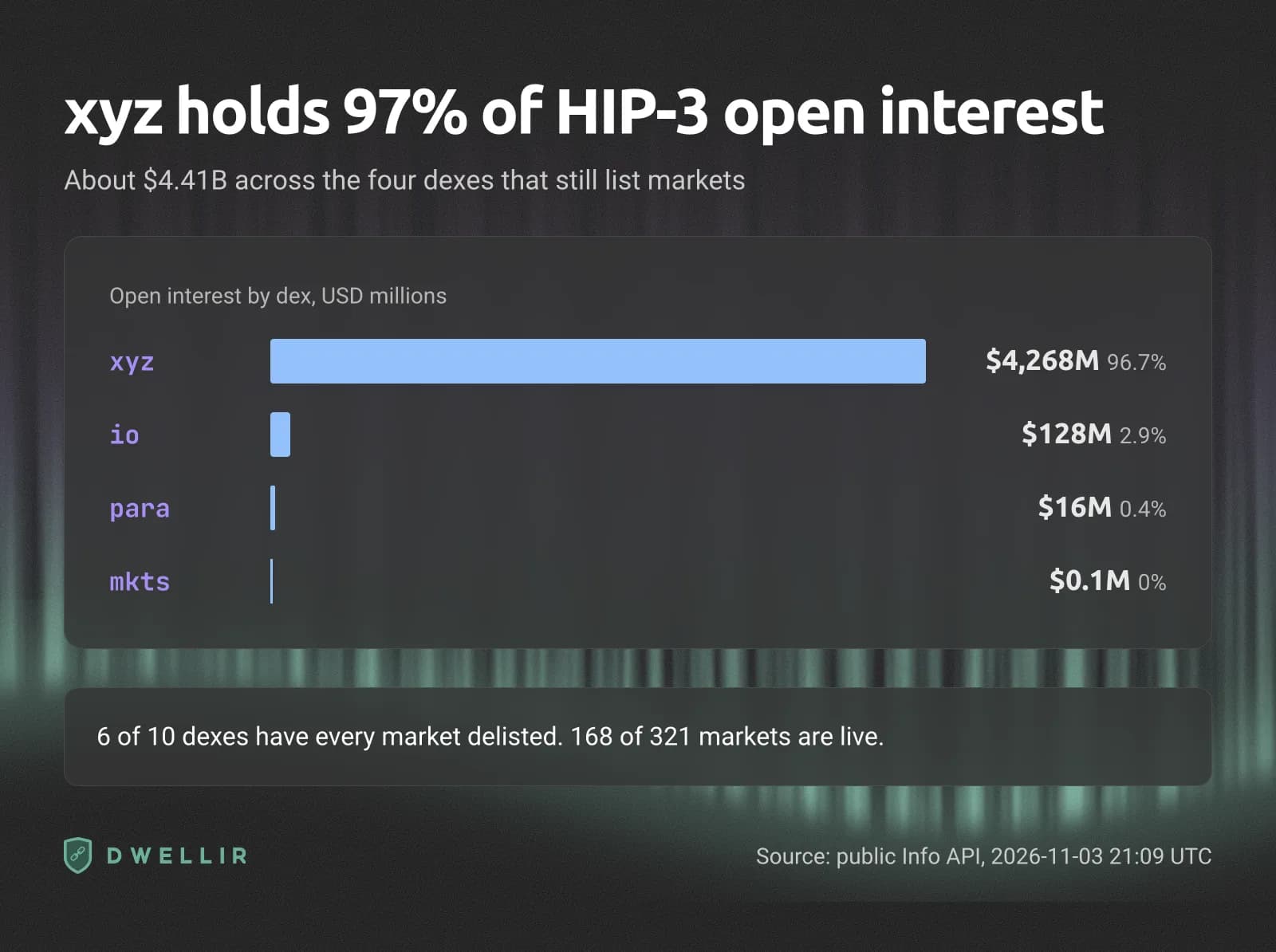
The largest xyz markets by 24-hour volume in the same snapshot were xyz:CL (crude oil, $438M), xyz:SP500 ($299M, with $371M open interest), xyz:XYZ100, xyz:SKHX, xyz:BRENTOIL and xyz:NVDA. io lists single stocks plus io:OAI and io:ANTH. para lists equities, ETFs such as para:SMH and Treasury yields. Delisted markets keep their index in meta, so code that maps asset IDs must not skip them.
To get this list yourself, an agent can do it in one prompt: our research agent run answered "Which HIP-3 perp DEXes are live?" on 2026-10-13 with the same 4 dexes.
HIP-3 vs HIP-4 vs core perps
HIP-3 markets are perpetual futures that third parties deploy and run; HIP-4 markets are fully collateralized outcome contracts; core perps are the markets Hyperliquid lists itself, which the docs say are "based on community request and organic demand."
| Core perps | HIP-3 perps | HIP-4 outcomes | |
|---|---|---|---|
| Listed by | Hyperliquid | Any deployer with 500,000 HYPE staked | Hyperliquid first; stake for permissionless deployment not published in the HIP-4 docs |
| Coin name in the API | BTC, ETH | xyz:GOLD, para:SMH | #10, #31 (encoded outcome and side) |
| Price range | Unbounded | Unbounded, with mark moves clamped to 1% per oracle update | Settles between 0 and 1 |
| Leverage and liquidations | Yes | Yes, set per market by the deployer | No leverage, no liquidations |
The 1% mark clamp is one reason HIP-4 exists: a HIP-3 perp tracking an event would take about 50 oracle ticks to move from 0.50 to 1.00. What is Hyperliquid HIP-4 covers outcome markets and that argument in detail. HIP-1 (native tokens) and HIP-2 (Hyperliquidity) are spot standards; HIP-3 reuses the HIP-1 auction parameters for its extra perp slots.
How do I get HIP-3 market data?
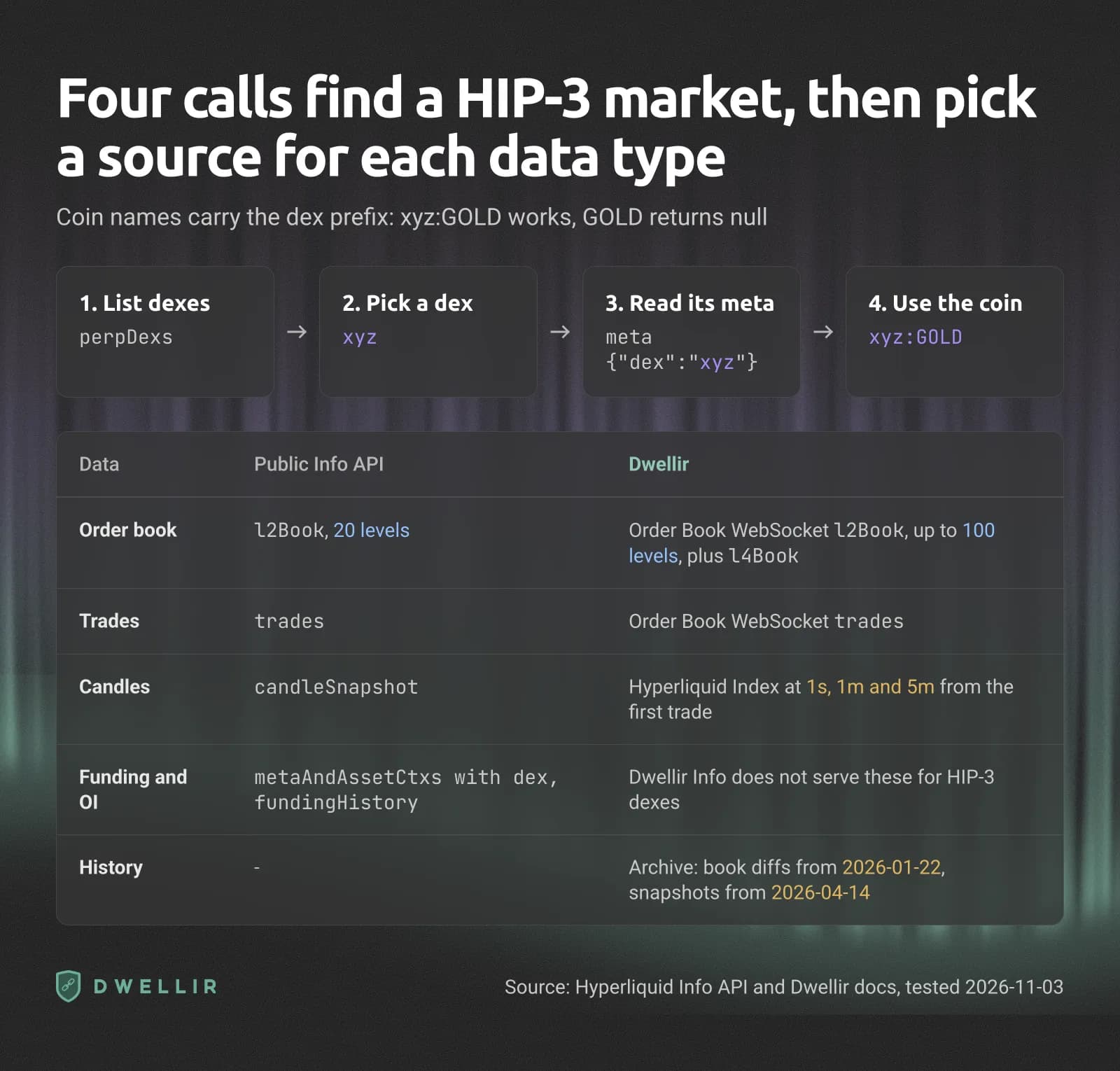
Every HIP-3 market-data request names the market as dex:COIN, such as xyz:GOLD. Discovery and per-dex snapshots take a dex field instead. All requests below are POST to the public https://api.hyperliquid.xyz/info with Content-Type: application/json, and every response was captured on 2026-11-03.
List the dexes and their markets
perpDexs returns every dex. Element 0 is null, which stands for the main dex.
curl -s https://api.hyperliquid.xyz/info -H 'Content-Type: application/json' \
-d '{"type":"perpDexs"}' | jq -c '[.[] | if . == null then null else .name end]'[null,"xyz","flx","vntl","hyna","km","abcd","cash","para","mkts","io"]meta with a dex field returns that dex's markets, including delisted ones:
curl -s https://api.hyperliquid.xyz/info -H 'Content-Type: application/json' \
-d '{"type":"meta","dex":"xyz"}' | jq -c '.universe[3]'{"szDecimals":4,"name":"xyz:GOLD","maxLeverage":25,"marginTableId":25,"lastFeeScaleChangeTime":"1970-01-01T00:00:00","deployerFeeScale":"1.0"}HIP-3 entries carry fields core perps do not: deployerFeeScale, lastFeeScaleChangeTime, growthMode, marginMode and isDelisted. Use meta for the full universe; the assetToStreamingOiCap list in perpDexs had 138 of the 142 xyz markets. allPerpMetas returns the main dex and every HIP-3 dex in one call. The Dwellir docs for perpDexs and meta describe both.
Get prices, open interest and funding for a dex
metaAndAssetCtxs with dex returns [meta, contexts], with one context per market in universe order. Index 3 is xyz:GOLD:
curl -s https://api.hyperliquid.xyz/info -H 'Content-Type: application/json' \
-d '{"type":"metaAndAssetCtxs","dex":"xyz"}' | jq -c '.[1][3]'{"funding":"0.0000064091","openInterest":"80627.3532","prevDayPx":"3947.6","dayNtlVlm":"51954160.6762899905","premium":"0.0003185525","oraclePx":"3924.0","markPx":"3925.3","midPx":"3925.25","impactPxs":["3925.2","3925.3"],"dayBaseVlm":"13202.7805"}openInterest is in the asset's units (troy ounces here), so multiply by markPx for notional. oraclePx is the price the deployer sends with setOracle.
Order books, candles and funding history: prefix the coin
Requests that take a coin take the full dex:COIN name and no dex field. The unprefixed name returns HTTP 500 with a null body:
curl -s https://api.hyperliquid.xyz/info -H 'Content-Type: application/json' \
  -d '{"type":"l2Book","coin":"GOLD"}'
# null (HTTP 500)

curl -s https://api.hyperliquid.xyz/info -H 'Content-Type: application/json' \
-d '{"type":"l2Book","coin":"xyz:GOLD"}' | jq -c '{coin, time, bid: .levels[0][0:2], ask: .levels[1][0:2]}'{"coin":"xyz:GOLD","time":1793740995118,"bid":[{"px":"3925.2","sz":"61.8858","n":20},{"px":"3925.1","sz":"16.1949","n":7}],"ask":[{"px":"3925.3","sz":"5.0323","n":2},{"px":"3925.8","sz":"3.8208","n":1}]}Candles and funding history work the same way:
curl -s https://api.hyperliquid.xyz/info -H 'Content-Type: application/json' \
  -d '{"type":"candleSnapshot","req":{"coin":"xyz:GOLD","interval":"1h","startTime":1793725200000,"endTime":1793732400000}}'
# [{"t":1793725200000,"T":1793728799999,"s":"xyz:GOLD","i":"1h","o":"3930.4","c":"3935.5","h":"3935.5","l":"3929.1","v":"870.9581","n":842}, ...]

curl -s https://api.hyperliquid.xyz/info -H 'Content-Type: application/json' \
  -d '{"type":"fundingHistory","coin":"xyz:GOLD","startTime":1793729000000}'
# [{"coin":"xyz:GOLD","fundingRate":"0.0000211005","premium":"0.0006376085","time":1793732400035}, ...]
Funding on HIP-3 markets is hourly, as on core perps. For per-user state, clearinghouseState and openOrders take a dex field; without it they return the main dex only.
Stream HIP-3 books and trades over WebSocket
The public WebSocket at wss://api.hyperliquid.xyz/ws accepts the prefixed coin in the same subscriptions as core perps. These all returned data for xyz:GOLD on 2026-11-03:
{"method":"subscribe","subscription":{"type":"l2Book","coin":"xyz:GOLD"}}
{"method":"subscribe","subscription":{"type":"trades","coin":"xyz:GOLD"}}
{"method":"subscribe","subscription":{"type":"bbo","coin":"xyz:GOLD"}}
{"method":"subscribe","subscription":{"type":"candle","coin":"xyz:GOLD","interval":"1m"}}
{"method":"subscribe","subscription":{"type":"activeAssetCtx","coin":"xyz:GOLD"}}
{"method":"subscribe","subscription":{"type":"allMids","dex":"xyz"}}
{"method":"subscribe","subscription":{"type":"allDexsAssetCtxs"}}
allMids takes a dex field, and allDexsAssetCtxs streams contexts for every dex at once, keyed by dex name (the main dex is the empty string ""). The public WebSocket allows 10 connections and 1,000 subscriptions per IP, which is enough for a few markets and tight for all 168.
Asset IDs for orders
To place an order you need the asset ID: 100000 + 10000 × perp dex index + index in meta (asset IDs). xyz is element 1 of perpDexs and xyz:GOLD is index 3 of its meta, so the formula gives 110003. The HyperEVM developer guide uses the same formula for HyperCore precompiles.
Where Dwellir fits
Dwellir serves HIP-3 order books and trades on its Order Book WebSocket and HIP-3 candles on the Hyperliquid Index; for per-dex contexts, l2Book snapshots, candle snapshots and funding history, use the public Info API. This table records what each Dwellir surface returned for HIP-3 requests on 2026-11-03:
| HIP-3 data | Dwellir surface | Tested 2026-11-03 |
|---|---|---|
| Dex list and markets | Info endpoint: perpDexs, meta with dex, allPerpMetas | Works |
| A user's HIP-3 positions | Info endpoint: clearinghouseState with dex | Works |
| Prices, open interest, funding per dex | Info endpoint: metaAndAssetCtxs with dex | Not served: "only the default perp dex is served". Use the public API |
l2Book, candleSnapshot, fundingHistory, allMids | Info endpoint | Not served ("type not allowed"). Use the public API, or the products below |
| Live order book, up to 100 levels, individual orders and trades | Order Book WebSocket: l2Book, l4Book, trades | Live l2Book for xyz:GOLD, io:NVDA, para:SMH; l4Book and trades for xyz:GOLD; delisted dexes subscribe but return empty books |
| Candles, 1s, 1m and 5m | Hyperliquid Index | Works for every dex tried, live and delisted |
The Order Book WebSocket takes the same subscription shape as the public one, at wss://api-hyperliquid-mainnet-orderbook.n.dwellir.com/YOUR_API_KEY/ws:
{"method":"subscribe","subscription":{"type":"l2Book","coin":"xyz:GOLD","nLevels":2}}{"channel":"l2Book","data":{"coin":"xyz:GOLD","time":1793740695922,"levels":[[{"px":"3925.6","sz":"39.7064","n":9},{"px":"3925.5","sz":"11.9669","n":5}],[{"px":"3925.7","sz":"9.7982","n":3},{"px":"3925.8","sz":"4.8401","n":2}]]}}nLevels goes up to 100 per side, against 20 on the public feed, and trades messages carry both counterparties in users. The L4 book feed shows individual orders with their owner and order ID instead of aggregated levels; an l4Book subscription for xyz:GOLD returned a full snapshot in the same test. The L2 book reference lists every field. The docs name the xyz: prefix, and l2Book also worked for io: and para:. Hyperliquid order book data explains L2 against L4 and the Hyperliquid order book product page has pricing.
HIP-3 candles on the Index use the same market symbol:
curl "https://api-hyperliquid-index.n.dwellir.com/YOUR_API_KEY/v1/candles?market=xyz:GOLD&interval=1m"{"s":"xyz:GOLD","i":"1m","t":1793740620000,"T":1793740679999,"o":"3925.5","h":"3925.7","l":"3925.5","c":"3925.7","v":"0.5881","q":"2308.70321","n":9,"x":true}For where HIP-3 fits among HyperCore, HyperEVM and the other Hyperliquid APIs, see the Hyperliquid infrastructure stack.
How do I get HIP-3 historical data?
HIP-3 history starts at each market's first trade, so the oldest xyz data is from 13 October 2025 and the newest dexes have only weeks. Dwellir has two sources: the Hyperliquid Index for candles and the S3 archive for node-level records.
The Hyperliquid Index serves 1s, 1m and 5m candles for HIP-3 markets back to their first trade, including dexes that are now fully delisted. Candles are sparse, so a minute with no trade has no candle. These are the first 1m candles for one market per dex, from /v1/candles/range with no start time:
| Market | First 1m candle (UTC) |
|---|---|
xyz:XYZ100 | 2025-10-13 12:24 |
vntl:SPACEX | 2025-11-13 14:05 |
hyna:ETH | 2025-12-08 04:22 |
flx:GOLD | 2025-12-12 14:26 |
km:GOLD | 2026-01-28 11:59 |
cash:GOLD | 2026-02-05 17:00 |
para:SMH | 2026-10-07 08:23 |
io:NVDA | 2026-10-27 15:03 |
curl "https://api-hyperliquid-index.n.dwellir.com/YOUR_API_KEY/v1/candles/range?market=xyz:GOLD&interval=5m&start=2026-11-03T12:00:00Z&end=2026-11-03T12:10:00Z&limit=2"{"data":[{"s":"xyz:GOLD","i":"5m","t":1793707200000,"T":1793707499999,"o":"3908.2","h":"3908.6","l":"3905.4","c":"3905.4","v":"23.4343","q":"91558.645039999953669277","n":56,"x":true},{"s":"xyz:GOLD","i":"5m","t":1793707500000,"T":1793707799999,"o":"3904.9","h":"3905","l":"3901.2","c":"3903.4","v":"17.3447","q":"67687.951469999997059499","n":75,"x":true}],"hasMore":false}Full-history exports of the same candles are in Parquet; the candle docs explain how to find HIP-3 symbols.
For order book history, the Hyperliquid historical data archive keeps node records, and HIP-3 coins appear in them under their prefixed names:
| Archive prefix | From | HIP-3 content in the docs |
|---|---|---|
node_raw_book_diffs_by_block | 2026-01-22 | Book diff sample with "coin": "xyz:XYZ100" |
orderbook_snapshots | 2026-04-14 | Every resting order in every market; the archive docs show no HIP-3 sample. The gRPC order book snapshot stream lists the xyz: prefix |
replica_cmds | 2025-01-25 | Deployer perpDeploy actions, including every setOracle call |
periodic_abci_states | 2026-04-14 | HIP-3 state, such as backstop liquidator state and dex limits |
A snapshot plus the diffs after it rebuilds the book at any block from 2026-04-14. HIP-3 oracle inputs are in replica_cmds, but applied mark prices are not stored as their own records (why). If you need a particular dex or date range, ask the Dwellir team to confirm coverage for that dex before you buy. For vendor coverage of HIP-3 history beyond Dwellir, Hyperliquid historical data for backtesting compares the options.
Getting started
- Create a free Dwellir account for the Info endpoint, then call
perpDexsandmetawithdexto map the HIP-3 markets you care about. - Add the Order Book WebSocket for live HIP-3 books and trades, and the Hyperliquid Index for candles from each market's first trade.
- For order-level HIP-3 history, contact the Dwellir team with the dexes and dates you need.
Frequently asked questions
What is HIP-3 on Hyperliquid?
HIP-3 (Hyperliquid Improvement Proposal 3) lets anyone who stakes 500,000 HYPE deploy their own perpetual markets on HyperCore. The deployer defines the market and runs its oracle, leverage, funding and fee settings, while Hyperliquid's protocol runs matching, margining and liquidations. HIP-3 launched on mainnet on 13 October 2025.
How much HYPE do you need to deploy a HIP-3 market?
A HIP-3 deployer must stake 500,000 HYPE on mainnet and keep it staked for at least 183 days after the dex is deployed. The first 3 assets on a dex need no auction; each further asset goes through a Dutch auction shared by all perp dexes. Validators can slash the stake, and slashed HYPE is burned.
Which HIP-3 DEXs are live?
On 2026-11-03, 4 of the 10 registered HIP-3 dexes had live markets: xyz (trade[XYZ], 120 live markets), io (EntropyIO, 14), para (Paragon, 33) and mkts (Markets by Kinetiq, 1). The other six had every market delisted. xyz held 96.7% of the roughly $4.41 billion HIP-3 open interest, measured from the public Info API.
How do I get HIP-3 order book data?
Use the coin name with its dex prefix, such as xyz:GOLD. On the public API, send {"type":"l2Book","coin":"xyz:GOLD"} to /info or subscribe to l2Book over WebSocket; the unprefixed GOLD returns HTTP 500 with a null body. Dwellir's Order Book WebSocket serves HIP-3 books with up to 100 levels per side.
Where can I get HIP-3 historical data?
Dwellir's Hyperliquid Index serves HIP-3 candles at 1s, 1m and 5m from each market's first trade; the first xyz:XYZ100 candle is 2025-10-13 12:24 UTC. The Dwellir archive has raw book diffs from 2026-01-22, whose documented sample includes an xyz: coin, and order book snapshots from 2026-04-14. Ask the Dwellir team to confirm coverage for a specific dex.
What is the difference between HIP-3 and HIP-4?
HIP-3 adds builder-deployed perpetual futures with leverage, funding and liquidations, and needs a 500,000 HYPE stake. HIP-4 adds outcome markets: fully collateralized contracts that settle between 0 and 1, with no leverage or liquidations. The HIP-4 docs do not publish a stake requirement for permissionless HIP-4 deployment.