The Hyperliquid API gives you the last 5,000 candles per request, the last 10,000 fills per account, and no order book history at all. That is enough to chart a market. It is not enough to backtest a strategy.
Every backtest on Hyperliquid starts with the same question: whose archive do you use? The official S3 buckets carry no vendor fee but update roughly monthly and contain no candles. Fourteen vendors sell tick, book, and candle history. Some charge nothing, some charge $6,000 a month, and they advertise coverage starting anywhere from April 2023 to June 2026.
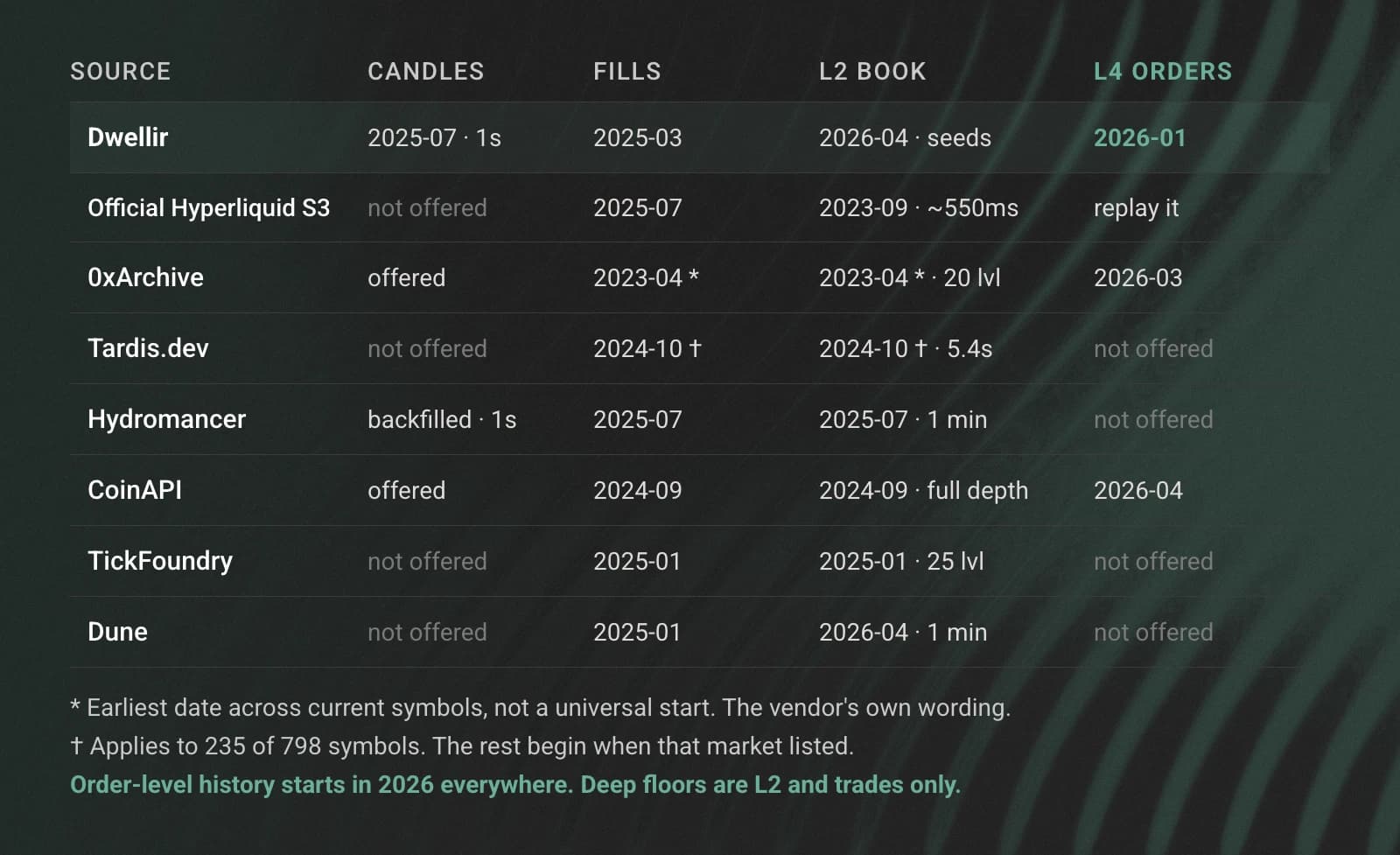
Those start dates are the trap. A date on a pricing page is usually the earliest date for the earliest symbol for one data type, and the tier that actually decides an execution backtest, order-level history, starts in 2026 at every provider that publishes a start date for it. The right choice depends on whether your strategy trades on bars, on fills, or on the book, and on reading the coverage claim properly before you pay.
This guide compares 20 routes to Hyperliquid historical data: two official buckets, the public REST API, three open-source tools, and 14 commercial providers including Dwellir. Every coverage date, format, and price below was checked against the provider's own source on 20 September 2026. Where a vendor's claim could not be verified, the article says so.
Every Option at a Glance
| Route | What you get | Coverage start | Format and delivery | Cost | Best for |
|---|---|---|---|---|---|
Official hyperliquid-archive S3 | L2 book snapshots, daily asset contexts (funding, OI, prices) | 2023 (earliest documented path is Sep 2023) | LZ4 JSON and CSV, AWS CLI | Free data, requester-pays egress (~$0.09/GB) | Cheap book depth studies, validation |
Official hl-mainnet-node-data S3 | Fills by block, legacy fills and trades, replica commands, blocks, misc events | Fills by block from 2025-07-27 | LZ4 JSONL, AWS CLI | No vendor fee, $2 to $3 egress per month of fills | Trade-level backtests on a budget |
| Public REST API | Candles (14 intervals), own fills, funding, current book | Rolling window only | JSON over HTTPS | Free | Candle backfill, forward recording |
| Open-source tools | hyperliquid-data, hyperliquid-backtest, hyperliquid-historical | Follow the sources above | Parquet, CSV, Rust structs | Free plus egress | Scripting the free routes |
| Dwellir | Raw node archive (10 S3 prefixes), tick data, 1s/1m/5m OHLCV exports, candle and fills APIs | Replica commands 2025-01-12, fills 2025-03-22, candles and ticks 2025-07-27, order events 2026-01-22 | S3 archive, CSV.gz, Parquet, REST, WebSocket | API from $49/month, about $2 per million responses, 1 response = 1 credit; exports by credit; archive quoted per dataset | Full-fidelity replay plus self-serve candles |
| Hydromancer Reservoir | Fills, 1s candles, daily account snapshots, 20-level L2 at 1-minute cadence | Fills ~2025-07-28, candles backfilled further | Parquet on requester-pays S3 in Tokyo | No vendor fee, but you pay AWS egress, about $46 for a full fills pull; REST from $300/month | Parquet starting point if you accept the egress bill |
| Tardis.dev | Trades, 20-level book snapshots (~5.4 s), BBO, funding and OI context | 2024-10-29, but only for 235 of 798 symbols; the rest start when the market listed | Daily CSV.gz, replay API | Perpetuals plan $350 to $3,000/month | Cross-exchange tick research |
| 0xArchive | 20-level L2, trades, funding, OI, liquidations, candles, L4 resting book | L2 and trades floor Apr 2023 as an earliest-symbol figure, not universal; liquidations Jul 2025; L4 Mar 2026 | REST, WebSocket replay, Parquet, SDKs | Free tier; $49, $199, $799/month | Broadest route matrix across market types |
| Bitquery | Fills with attribution, L3 market-by-order, order lifecycle, liquidations, funding per trader | Not published | GraphQL, WebSocket, S3 data lake | $39 to $239/month for a 30-day window; archive quoted | Trader-level attribution research |
| Dune | Decoded actions, fills, trades, OI, funding, 1-minute book | Fills Jan 2025, trades Jul 2025, book Apr 2026 | SQL tables | Enterprise and trial accounts only | Signal research in SQL |
| CoinAPI | Event-driven full-depth book and trades; L4 per-order with maker and taker wallets | Standard feed 2024-09-27, L4 2026-04-30, oracle and TWAP 2026-06-17 | CSV.gz flat files on S3, WebSocket. No Parquet | $1 per credit, then per GiB per day: $8 book, $24 trades, $32 oracle at the entry tier | The richest L4 schema, if you can budget it |
| TickFoundry | Top of book, 25-level L2 on every change, fills with taker wallet and PnL | 2025-01-25 | Parquet, CSV, REST, SFTP | $2 to $4 per market-day; $89 or $199/month | Reconstructed books with HIP-3 |
| CryptoStruct | Tick trades, full-depth L2, 1-minute OHLCV | April 2024 | zstd JSONL, CSV.gz, Parquet | EUR 1 per instrument-day, no account | Ad hoc instrument-days |
| CryptoHFTData | L2, trades, ticker, mark price, OI, liquidations | Not published | Hourly Parquet, REST, Python SDK | $0 | Free exploratory L2 |
| SonarX | Public 20-level L2 summary every 20 blocks; full L2 and L4 commercially | Not published | Gzipped JSON on S3 (CC0); Snowflake, BigQuery, Databricks | Public bucket free; enterprise quoted | Warehouse-native teams |
| Crypto Data API, datastore.sh, HyperliquidRPC | Aggregates (daily candles, funding), on-chain tables, quoted exports | 2023 for daily candles, May 2023 for hourly funding; Jul 2025 for on-chain tables; unpublished | Parquet, JSON, quoted | $0.25 per file to $2,000 full history; quoted | Niche or bespoke pulls |
The rest of this article covers what sits behind each row, which claims to verify before you pay, and how to match a data source to the strategy you are testing.
How to Read a Coverage Claim
The coverage column above is the most misread number in this market. Three things hide inside a single date.
A floor is usually the earliest symbol, not every symbol. 0xArchive publishes an April 2023 floor for core perp L2 and trades. Their own documentation defines what that means: "An observed floor is the earliest date returned across the current symbols for that market type and data type; it is not a universal start for every symbol." A market listed in 2026 has 2026 history no matter what the floor says.
Tardis makes the same pattern measurable, because their coverage API exposes every symbol. Of 798 Hyperliquid symbols, 235 carry the advertised 2024-10-29 start. The remaining 563 begin later, clustered around each listing date, with 68 starting in January 2026 alone. The two-year headline is real for the majors and irrelevant for everything else.
A floor applies to one data type, not the whole product. This is the difference that decides whether a backtest is possible. 0xArchive's deep 2023 history is 20-level L2 and trades. Their liquidations begin July 2025, and their order-level L4 begins March 2026. Their documentation says so directly: "Do not read the April 2023 core native-L2 and trades floor as a universal L4, L3, or lifecycle floor."
Among the providers that publish an order-level start date, all of them are in 2026. Dwellir's order statuses and book diffs begin 22 January 2026, 0xArchive's L4 in March 2026, CoinAPI's L4 in April 2026. Bitquery and HyperliquidRPC sell order-level data without publishing when theirs begins, which is its own answer. Nobody advertises a deep L4 archive, because nobody was recording one.
Cadence decides what the data can answer. A 20-level book sampled every 5.4 seconds and a 20-level book sampled every minute are both "L2 order book history". Neither can tell you where your order sat in the queue. Tardis snapshots l2Book roughly every 5.4 seconds for all history before 17 June 2026, when the faster 5-level fastBook feed starts. Hydromancer's Reservoir book snapshots land once a minute and refresh weekly. SonarX samples every 20 blocks and publishes weekly with a two-day lag.
So when you compare two providers, compare the same data type, on the same symbol, at a cadence your strategy can actually use. The tables in this article are organised that way.
Four Kinds of Backtest Data on Hyperliquid
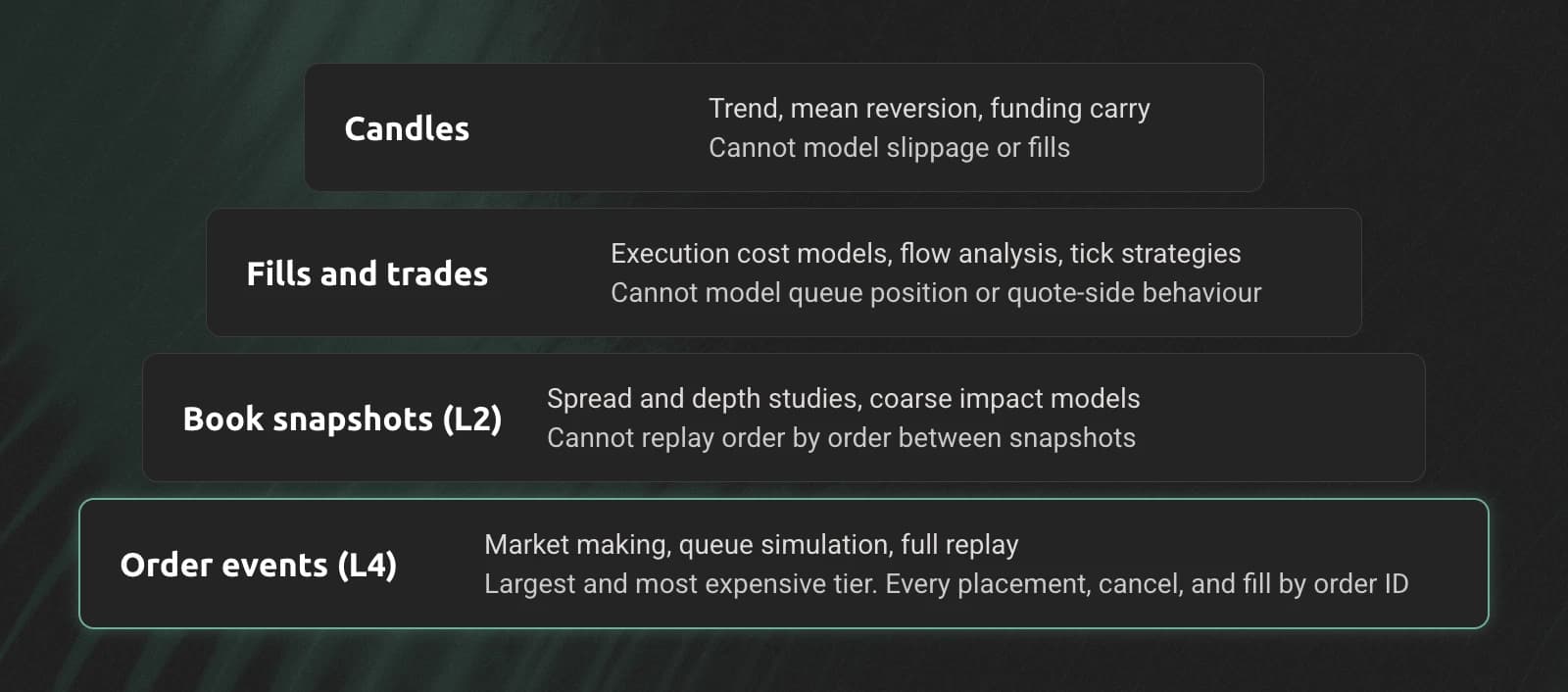
Hyperliquid runs a central limit order book on HyperCore. Every order, cancel, fill, funding payment, and liquidation is a state transition that validators execute and nodes can log. That produces four tiers of historical data, each supporting a different class of backtest.
| Tier | Contents | Supports | Cannot support |
|---|---|---|---|
| Candles (OHLCV) | Open, high, low, close, volume per interval | Trend, mean reversion, funding carry | Slippage, fill probability |
| Fills and trades | Every execution with price, size, side, often wallet and fee | Execution cost models, flow analysis, tick strategies | Queue position, quote-side behaviour |
| Book snapshots (L2) | Aggregated depth per price level at a point in time | Spread and depth studies, coarse impact models | Order-level replay between snapshots |
| Order events (L4) | Every placement, cancel, modification, and fill by order ID | Market making, queue simulation, full replay | Nothing, but it is the largest and most expensive tier |
The source matters as much as the tier. Three methods produce Hyperliquid history:
- Feed capture. A collector subscribes to the public WebSocket and records what it receives. Tardis, CryptoStruct, and CryptoHFTData work this way. Gaps in the collector are gaps in the data, and book depth is whatever the feed pushed, typically 20 levels at the feed's cadence.
- Node records. A Hyperliquid node writes its own fills, order statuses, book diffs, and replica commands to disk. The official S3 buckets and Dwellir publish these files. This is the venue's own record, so the other two methods get validated against it.
- Chain replay and indexing. A pipeline replays node records into normalized tables or reconstructed books. TickFoundry, Bitquery, and Dune work this way, and CoinAPI describes its L4 line as captured at the consensus source in Tokyo. 0xArchive does not publish its method. You get clean schemas, but the reconstruction is a derived product with its own error rate.
For a backtest that needs the ground truth, node records win. For a backtest that needs a queryable table by Friday, an indexed product wins. Most teams end up with one of each.
The Free Official Routes
Official S3 buckets
Hyperliquid publishes two requester-pays S3 buckets. Both store LZ4-compressed files, and pulling from them needs an AWS account with billing enabled.
The hyperliquid-archive bucket holds L2 book snapshots and daily asset contexts:
# L2 book snapshots for one coin, one hour
aws s3 cp \
  s3://hyperliquid-archive/market_data/20230916/9/l2Book/SOL.lz4 \
  /tmp/SOL.lz4 --request-payer requester

# Daily asset contexts: funding, open interest, mark, oracle, mid, volume
aws s3 cp \
  s3://hyperliquid-archive/asset_ctxs/[date].csv.lz4 \
  /tmp/ctx.csv.lz4 --request-payer requester
The hl-mainnet-node-data bucket holds node output: node_fills_by_block (the current fill format, from 2025-07-27), the legacy node_fills and node_trades prefixes, replica_cmds, explorer_blocks, and misc_events_by_block for transfers, staking, and other non-trade events.
Three caveats decide whether this route works for you. First, the docs state that data is "uploaded to the bucket approximately once a month" with "no guarantee of timely updates and data may be missing." Second, the docs are explicit that "no other historical data sets are provided via S3 (e.g. candles or spot asset data)," so you build candles yourself from fills. Third, the fill format changed on 2025-07-27, so a downloader that reads one prefix returns nothing for the earlier part of the archive.
Egress is cheap. AWS charges about $0.09 per GB out of us-east-1 after a 100 GB monthly free allowance. All-coin fills run 0.8 to 1.0 GiB per day, so a month of fills costs $2 to $3 to download. Community estimates from 2025 put the full fills archive at $5 to $25; at today's volumes the 14 months of node_fills_by_block alone is closer to $30 to $40 before the free allowance. Pulling into an EC2 instance in the same region avoids the charge entirely.
Book snapshots across hundreds of coins are the expensive part. Even then, the engineering time to reconcile three fill formats costs more than any transfer bill.
Public REST API
The info endpoint is free and needs no key. It is also a live API with short memory:
| Endpoint | Historical limit |
|---|---|
candleSnapshot | Only the most recent 5,000 candles per request. Intervals from 1m to 1M, no 1s |
userFills | 2,000 most recent fills |
userFillsByTime | 2,000 per response, only the 10,000 most recent ever available |
historicalOrders | 2,000 most recent |
fundingHistory | Paginated 500 at a time; walk startTime forward |
l2Book | Current snapshot only, 20 levels per side |
Rate limits are 1,200 request-weight per minute per IP. Most info calls weigh 20, and candleSnapshot adds weight per 60 candles returned, so a full 5,000-bar response costs about 103 weight. That caps a single IP near 55,000 bars per minute, which makes a multi-year 1-minute backfill slow but possible.
The 10,000-fill ceiling on userFillsByTime is the hard wall: an active account's execution history beyond that point is unrecoverable from the API.
The REST API is the right tool for one job: start recording now. Subscribe to trades, l2Book, and activeAssetCtx over WebSocket, persist raw messages, and build your own forward archive. It costs nothing and gives you a validation set for whichever vendor you buy from later.
Open-source tooling
Three projects wrap the free routes:
hyperliquid-data(PyPI, version 0.1.0, August 2026) pulls candles and funding from REST and book, trades, fills, and liquidations from S3 into Parquet. Itshl-data costcommand lists the objects a pull would touch and prints the egress estimate before you spend anything. It handles the 2025-07-27 prefix cutover and dedupes double-counted trades to the taker row. It is alpha software.hyperliquid-backtest(crates.io, version 0.1.2) is a Rust backtester with funding PnL built in. It sources candles fromcandleSnapshot, so it inherits the 5,000-bar cap and has no book or fill data. The last release was October 2025.hyperliquid-historical(GitHub, c-i) downloads and decompresseshyperliquid-archiveobjects to CSV. No cost gate, no node-data prefixes.
pip install hyperliquid-data
hl-data cost --dataset fills --start 2026-06-01 --end 2026-06-30
# Sample output from the project README:
# TOTAL 24.61 GiB (720 objects)  EGRESS COST ~$2.21 (@ $0.09/GB, requester-pays)
hl-data fills pull --start 2026-06-01 --root data
Commercial Providers
Each provider below follows the same structure: what it holds, when coverage starts, how it ships, what it costs, and the caveat that matters for a backtester.
1. Dwellir
Dwellir operates Hyperliquid nodes and preserves their output in the source record formats, then processes that archive into tick data and OHLCV candles. It publishes a prefix-by-prefix coverage table for those raw node records, which is rare in this comparison.
Data types. The historical data archive holds ten prefixes:
| Prefix | From | Contents |
|---|---|---|
replica_cmds | 2025-01-12 | Every signed action, the replay input |
node_trades | 2025-03-22 | First fill-stream generation, ends 2025-06-21 |
node_fills | 2025-05-25 | Second generation, ends 2025-07-27 |
node_fills_by_block | 2025-07-27 | Current fill format, block envelope with builder attribution |
node_order_statuses_by_block | 2026-01-22 | Order placements, cancels, and lifecycle (L4) |
node_raw_book_diffs_by_block | 2026-01-22 | Raw book deltas for reconstruction |
periodic_abci_states | 2026-04-14 | Full L1 state every 10,000 blocks |
orderbook_snapshots | 2026-04-29 | Generated book seeds |
misc_events_by_block | 2026-07-01 | Funding, liquidations, vault and transfer events |
node_twap_statuses_by_block | 2026-07-01 | TWAP parent order state |
On top of the archive, tick data converts node_fills_by_block into a flat schema (timestamp in milliseconds, pair, price, size, side, trade ID, wallet, block number) with optional PnL, fee, and builder fields.
OHLCV full-history exports deliver one file per market per interval at 1s, 1m, or 5m for every perp, spot pair, and HIP-3 market. The same candles are queryable over REST and WebSocket, and the Hyperliquid Index fills API answers wallet, builder, and market queries without a download.
Coverage. Replica commands from January 2025, fills from March 2025, order events and book diffs from January 2026, candles and processed ticks from 2025-07-27.
Formats and delivery. Raw prefixes as LZ4 objects on S3. Tick data as gzipped CSV or Parquet, delivered as bulk exports. OHLCV exports as CSV.gz or Parquet, generated self-serve from the dashboard with 30-day download retention. Candles and fills over REST, JSON-RPC, and WebSocket.
import duckdb

# One click in the dashboard produces btc-1s-full.parquet
df = duckdb.sql("""
    SELECT t, o, h, l, c, v, n
    FROM read_parquet('btc-1s-full.parquet')
    ORDER BY t
    LIMIT 10
""").df()
Pricing. Plans start at $49 per month for 25 million responses and run to $999 per month for 500 million. Both ends work out near $2 per million responses on the included allowance. One response equals one credit regardless of which method you call.
That last sentence is the part that matters for a backtest, because most of this market prices data in units that grow with how much you pull:
| Provider | How historical volume is billed |
|---|---|
| Dwellir | 1 response = 1 credit, any method. Full-history exports cost one credit per market, interval and format, whatever the file size. Re-downloads free for 30 days |
| Hydromancer | candleSnapshot costs 20 tokens per call against your monthly allowance |
| 0xArchive | Parquet exports billed $0.50 to $4 per GB on top of the plan, with per-export minimums |
| CoinAPI | Per GiB per UTC day, per dataset. Book $8, trades $24, oracle prices $32 at the entry tier, tapering with daily volume |
| Official S3 and Hydromancer Reservoir | AWS egress per GB, $0.090 in us-east-1 or $0.114 in Tokyo |
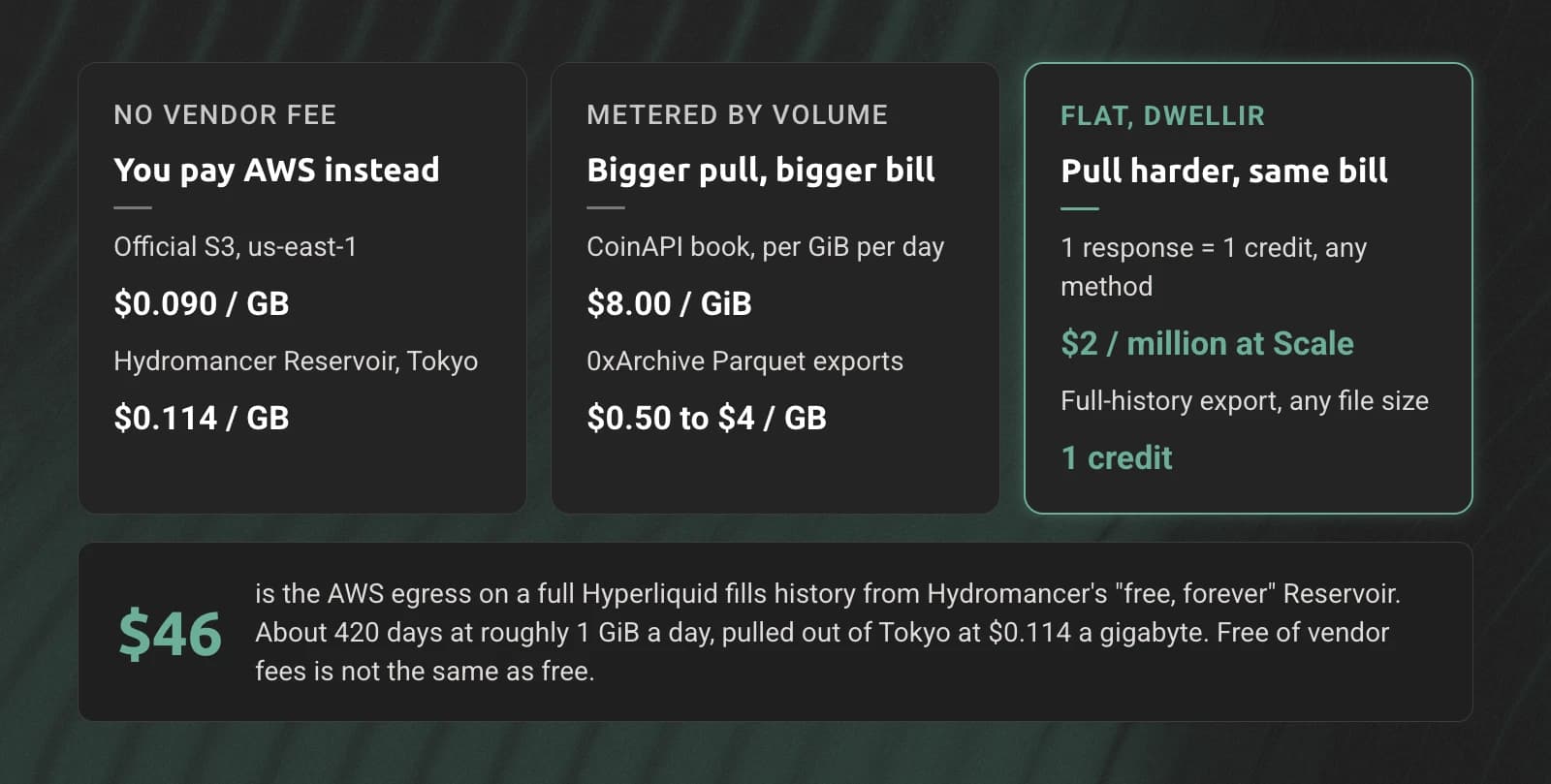
Pull a year of 1-minute candles for 50 perps and the difference is concrete. Taken as exports it is 50 credits, one per market, each returning that market's full archive as a single file. The number does not move if the files turn out larger than you expected, and re-downloading within the 30-day window costs nothing.
Raw archive prefixes and tick exports are licensed per dataset as a monthly feed or a full-history purchase, so the price is set by which dataset you want and for how long, not by how many gigabytes you move. For a book-reconstruction job that pulls hundreds of gigabytes, a per-dataset licence and a per-GB meter are very different invoices. Pricing is quoted by the Dwellir team; tell us the prefix, the date range and the format and you will get a number back rather than a discovery call.
Best for. Teams that need the venue's own records for a full replay, or that want 1-second candles for every market without building a fetcher. Raw archive, processed ticks, and self-serve candles from one operator removes the usual step of stitching a vendor's candles to someone else's fills.
Caveat. Order statuses and book diffs start in January 2026, so an L4 replay before that date needs replica_cmds and your own execution logic. Book reconstruction requires a snapshot seed plus ordered diffs; raw diffs alone cannot establish the starting book. Archive and tick access go through support rather than a checkout page.
2. Hydromancer Reservoir
Hydromancer publishes Reservoir, a requester-pays S3 archive in Parquet at s3://hydromancer-reservoir, alongside a paid REST and WebSocket API for Hyperliquid and HIP-3 deployer markets. It is marketed as "free, forever," which is true of Hydromancer's fees and not true of your bill. More on that below.
Data types. Fills with a 27-column schema covering trades, liquidations, ADL, builder fills, and TWAP fills. 1-second OHLCV candles. Daily snapshots of positions, spot balances, and account values. 20-level L2 book snapshots at 1-minute cadence. No L4, and no funding or open interest dataset in the archive.
Coverage. The documentation states fills are fully available from 2025-07-28, with TWAP fills from 2025-08-02, while the marketing page claims "complete history back to launch." Treat the fills, snapshots, and book as starting in late July 2025, with candles backfilled further.
Formats and delivery. Parquet on S3, queryable directly from DuckDB, Polars, or Spark with no API key and no rate limit. Fills update daily, book snapshots weekly. The archive's licence is not stated.
Pricing. Hydromancer charges nothing for Reservoir. AWS does. Their own FAQ puts it plainly: "Data is delivered through AWS S3 in requester-pays mode, so you cover the AWS data-transfer cost on your end."
That cost is not trivial, for one reason people miss: the bucket sits in ap-northeast-1. Tokyo is AWS's more expensive egress region.
| Region | Egress, first 10 TB per month |
|---|---|
| Asia Pacific (Tokyo), where Reservoir lives | $0.114 per GB |
| US East (N. Virginia), where the official Hyperliquid buckets live | $0.090 per GB |
Run the arithmetic on the headline dataset. Hyperliquid all-coin fills run 0.8 to 1.0 GiB per day. Reservoir's fills start around 28 July 2025, so a full pull today is about 420 days, roughly 406 GB. At $0.114 per GB that is about $46 of AWS egress, or nearer $35 if you have not touched the 100 GB monthly free allowance. Add the 1-second candles and the per-minute book snapshots across every market they carry and a full-archive pull plausibly runs $57 to $74. That last figure is an estimate; Hydromancer does not publish dataset sizes.
None of that makes Reservoir a bad deal. It makes it a priced product whose invoice arrives from Amazon instead of Hydromancer. Budget for it, and pull into an ap-northeast-1 instance if you want to avoid the egress line entirely.
The paid REST API runs $300 per month for 500,000 tokens, $1,200 for 3 million, and $2,500 for 15 million. A candleSnapshot call costs 20 tokens, so candle-heavy workloads consume the allowance 20 times faster than the headline suggests.
Best for. Fill-level research and builder or wallet attribution, for teams who already run in AWS Tokyo and would rather pay Amazon than sign a contract.
Caveat. 1-minute, 20-level book snapshots are an order of magnitude too coarse for execution modelling. The coverage claims conflict between docs and marketing: the documentation gives a July 2025 fills cutover while the marketing page says "complete history back to launch." And "free" describes the vendor invoice, not the total.
3. Tardis.dev
Tardis is the established multi-exchange tick vendor. It records Hyperliquid's public WebSocket from Tokyo and serves both raw messages and normalized CSVs in the same schema it uses for dozens of other venues.
Data types. Trades, l2Book 20-level snapshots at roughly 5.4-second cadence, bbo since 2025-06-26, a 5-level fastBook at about 500 ms since 2026-06-17, and perp and spot asset context (funding, open interest, mark price). Normalized datasets include trades, incremental L2, quotes, 5- and 25-level book snapshots, and derivative ticker. No L4, no candles, no separate liquidation dataset.
Coverage. 2024-10-29 is the floor, and it is worth being precise about who gets it. Tardis exposes per-symbol coverage through a public API, so this is measurable rather than inferred. Of 798 Hyperliquid symbols, 235 start on 2024-10-29. The other 563 start when that market listed, with 68 of them beginning in January 2026. Book data is not restricted to the majors; every symbol except two aggregate rows carries incremental_book_L2. The depth is simply newer for newer markets.
One structural detail to plan around: from 17 June 2026 the normalized book_snapshot_5 and book_snapshot_25 datasets switch from being derived from 20-level l2Book to 5-level fastBook. That is a change of source partway through the series, not a continuous history.
Formats and delivery. Daily gzipped CSV over HTTP, a replay API with Python and Node clients, and the Tardis Machine local replay server on Professional and Business tiers. The free evaluation path is narrower than it sounds: the no-API-key sample set is three files, all BTC, all dated 2024-12-01, covering incremental_book_L2, trades, and derivative_ticker. You can evaluate the schema for free. You cannot evaluate your own symbol for free.
Pricing. Hyperliquid sits in the Perpetuals plan: $350 per month Academic, $700 Solo, $1,000 Professional, $3,000 Business. All-exchange plans run $650 to $6,000. Annual billing unlocks 4 years of history on lower tiers; monthly billing restricts you to recent data.
Best for. Teams already backtesting CEX perps in the Tardis schema who want Hyperliquid in the same pipeline.
Caveat. A 5.4-second book cadence for all history before June 2026 cannot model queue position or realistic fills, and the sub-second fastBook feed only covers the last three months. Feed capture also means collector outages are permanent gaps, and the advertised two-year depth reaches under a third of the symbol universe.
4. 0xArchive
0xArchive is an independent API for Hyperliquid and Lighter with the broadest declared data matrix in this comparison and a $49 paid entry point.
Data types. Native L2 capped at 20 levels per side, full-depth L2 aggregated from L4 on core and HIP-3 only, L4 resting book and ordered diffs, trades, funding at roughly 1-minute cadence, open interest, liquidations, candles, order flow, and order history, across core perps, spot, HIP-3, and HIP-4 outcome markets.
Coverage. This is the headline number in the market and it rewards a close read. The published floors for Hyperliquid core:
| Data type | Observed floor |
|---|---|
| Native L2 order book, 20 levels | 15 April 2023 |
| Trades | 15 April 2023 |
| Funding, open interest | 20 May 2023 |
| Liquidations | 27 July 2025 |
| L4 resting book and order records | 10 March 2026 |
Spot trades start 22 March 2025, spot L2 and TWAP 5 May 2026. HIP-3 trades start 13 October 2025 with L2, funding and OI from 16 February 2026. HIP-4 begins 2 May 2026.
Two caveats come from 0xArchive themselves. First, a floor is "the earliest date returned across the current symbols for that market type and data type; it is not a universal start for every symbol." Second, and unusually candid for a vendor: "Do not read the April 2023 core native-L2 and trades floor as a universal L4, L3, or lifecycle floor."
Note where liquidations start: 27 July 2025, the exact date Hyperliquid's node fill stream cut over to node_fills_by_block. The datasets that can only come from node records begin at the node-record boundary, like everyone else's.
Formats and delivery. REST with bounded queries, WebSocket replay, Parquet exports from a data catalog, SDKs in Python, TypeScript, and Rust, and an MCP server.
Pricing. Free tier with 50,000 credits and the last 30 days. Build $49 per month, Pro $199, Scale $799, each with full archive access. Parquet exports are billed on top at $0.50 to $4 per GB with per-export minimums.
Best for. The broadest route matrix in one API, spanning core, spot, HIP-3 and HIP-4, at a $49 entry point.
Caveat. The April 2023 floor for L2 and trades predates Hyperliquid's public mainnet, and no published methodology explains where that data comes from. The marketing copy also references "1 year of REST history" while the pricing table says "full archive." Before committing, pull one day from the specific 2023 window and the specific symbol you care about, and check that trades and book are both populated rather than one carrying the other. The free tier gives you 30 days of history, which is not the window you need to test this.
5. Bitquery
Bitquery indexes HyperCore itself rather than recording the WebSocket, which gives it trader identity on every order and fill.
Data types. Fills for both sides with aggressor flag, fees, and builder fee. L3 market-by-order with trader attribution. Candles at any interval from 1 second. Full order lifecycle, TWAPs, liquidations with liquidator, hourly funding per trader, positions, mark and oracle prices, and signed L1 actions. Perps, spot, and HIP-3. Bitquery labels its order-level data L3 rather than L4. Market-by-order rows carry order IDs and trader identity, so for queue simulation the content overlaps with what CoinAPI and 0xArchive call L4.
Coverage. Not published. GraphQL and WebSocket serve a rolling window of about 30 days.
Formats and delivery. GraphQL queries and WebSocket subscriptions on the same schema. Full history ships through an S3 data lake in Parquet, CSV, or JSONL, and through Kafka.
Pricing. Personal $39 per month (non-commercial), Pro $79, Scale $239, on annual billing. A historical data add-on is listed from $70 to $120 per month per chain. The full archive through the data lake is priced on request.
Best for. Research that needs identity: maker and taker attribution, per-trader funding and PnL, liquidator behaviour.
Caveat. The subscription tiers are not the backtesting dataset. A serious backtest needs the separately negotiated data lake, whose coverage start and price are both unpublished.
6. Dune
Dune indexes Hyperliquid into SQL tables that sit next to its other chains.
Data types. Raw, decoded, and curated tables, including perp_trades, hourly and daily market metrics, hourly positions, daily account snapshots, oracle prices, and a 1-minute order book model.
Coverage. Decoded actions and fills from January 2025, trade history from 2025-07-27, open interest and funding from 2025-09-27, and order book depth from April 2026 with historical ingestion in progress. Fills land about 20 minutes behind live.
Formats and delivery. SQL tables queried in the Dune editor or over the Dune API. No file exports of the raw archive.
Pricing. The Hyperliquid tables are private and available to enterprise customers and trial accounts. The community table hyperliquid.market_data with 12 market-metric columns is updated monthly.
Best for. Signal research, universe selection, and joining Hyperliquid activity to other chains in SQL.
Caveat. No order book before April 2026, so no pre-2026 execution simulation, and the good tables are not on the free plan.
7. CoinAPI
CoinAPI is a long-standing multi-venue data vendor that added a dedicated Hyperliquid L4 product line in 2026. Of everything in this comparison, its order-level schema is the most detailed.
Data types. The standard feed carries trades, quotes, order book and metadata across more than 700 symbols. The separate HYPERLIQUIDL4 line is the interesting part. Its per-order book entries carry the exchange order ID, price, size, original size, the wallet address behind the order, client order ID, order type, an update type of set, rejected or delete, and an eighteen-value status enum, plus trigger conditions and parent-child bracket relationships. Its trade records carry both user_taker and user_maker, so each fill names both sides. Four further datasets cover oracle prices, TWAP statuses, misc events and system events.
Coverage. Standard Hyperliquid from 27 September 2024, though CoinAPI's own earlier integration post says October 2024, so treat the September date as the more precise of two conflicting statements from the same vendor. L4 quotes, trades and limit book from 30 April 2026. Oracle prices, TWAP statuses, misc events and system events from 17 June 2026. Coverage is explicitly not uniform per symbol; delistings and inactivity end some series early.
Formats and delivery. Hourly-refreshed gzipped CSV on S3, plus a dedicated real-time WebSocket endpoint sharing the same field names. Parquet is not available for Hyperliquid; the only Parquet CoinAPI documents is for a 50-level snapshot dataset. Files are partitioned hourly from 9 June 2026 and daily before that, so Hyperliquid L4 straddles the switch.
One thing worth correcting about CoinAPI, because it is easy to get wrong: their REST historical order book is 20 levels sampled once a second, and their own documentation says it is not suitable for tick-perfect replay. The flat files are a different product. The full limit book dataset is event-driven, starts with a snapshot and then applies updates, and goes as deep as the venue publishes. Judge CoinAPI on the flat files, not the REST endpoint.
Pricing. Credits at $1 each pay as you go, or committed plans from $64 to $1,024 per month that buy credits at $0.85 down to $0.65. Consumption is then billed per GiB per UTC day, per dataset, on a tapering scale:
| Dataset | First tier | Middle tier | Above |
|---|---|---|---|
| Order book, L2, L3 and L4 | $8.00 per GiB to 1 GiB/day | $4.00 to 10 GiB/day | $2.00 |
| Trades | $24.00 per GiB to 0.5 GiB/day | $12.00 to 5 GiB/day | $6.00 |
| Quotes and BBO | $8.00 per GiB to 0.5 GiB/day | $4.00 to 5 GiB/day | $2.00 |
| Hyperliquid oracle prices | $32.00 per GiB to 1 GiB/day | $16.00 to 8 GiB/day | $8.00 |
The mechanic to understand is that tiers reset at the end of each UTC day. Because the rate falls as daily volume rises, the same total download costs materially less pulled in one day than trickled over thirty. A month of L4 book across five major symbols works out near $174 in a single-day pull and closer to $420 taken day by day, on the same bytes. Those figures assume roughly 0.5 GiB per symbol per day, which is an estimate; CoinAPI publishes no Hyperliquid file sizes and points you at a sizing script instead.
New accounts get a one-time $25 credit that never expires, after payment verification. There are no free Hyperliquid sample files, though other venues have them.
Best for. Teams that want genuine per-order data with both wallets on every fill, inside the same schema and contract as their CEX feeds.
Caveat. L4 history began on 30 April 2026, so under five months exists. A longer backtest falls back to the 2024 standard feed, which is a different granularity. Per-GiB-per-day billing also makes budgeting awkward in exactly the case you care about, a large multi-symbol replay, and the wallet addresses that make the schema valuable are also what make the files big.
8. TickFoundry
TickFoundry rebuilds Hyperliquid books by replaying the chain's order-event stream rather than recording the WebSocket.
Data types. Top of book on every change, 25-level L2 with resting order counts per level, and every fill with taker wallet, fee, and realized PnL. 851 coins including 289 HIP-3 markets. Each coin-day ships a scorecard reporting agreement with Hyperliquid's published snapshots, typically around 99.6% at top of book. No candles, funding, open interest, or liquidations.
Coverage. 2025-01-25 for all three datasets.
Formats and delivery. Parquet and CSV downloads, REST at 60 or 600 requests per minute by tier, SFTP on Premium, S3 delivery on Custom.
Pricing. Five market-days free. Explorer $89 per month with 10-level depth and 90 days of history, Premium $199 with 25 levels and 180 days. A la carte market-days at $2 for top of book or $4 for full depth.
Best for. Microstructure work on Hyperliquid specifically, including HIP-3 markets, where reconstructed books and per-fill wallet data beat feed capture.
Caveat. The reconstruction is scored, not exact, depth caps at 25 levels, and subscription tiers limit historical depth to 90 or 180 days.
9. CryptoStruct
CryptoStruct sells tick archives across 36 venues at EUR 1 per instrument-day with no account and no minimum.
Data types. Tick trades, full-depth L2 snapshots and updates, 1-minute OHLCV and VWAP, and spread metrics for 565 Hyperliquid instruments (270 spot, 295 perps). No L4, no wallets.
Coverage. April 2024 to present.
Formats and delivery. One zstd JSONL file per instrument per UTC day with microsecond timestamps, converted free to CSV.gz or Parquet at download. Guest card checkout in the browser.
Pricing. EUR 1 per instrument-day, no minimum order, no subscription, no account.
Best for. Buying exactly the instrument-days a study needs, with Hyperliquid and CEX data in one normalized schema.
Caveat. Feed capture with L2 aggregation only. The free sample list does not currently include a Hyperliquid instrument.
10. CryptoHFTData
CryptoHFTData runs a free data lake of hourly Parquet objects across nine venues including Hyperliquid.
Data types. L2 order book, trades, ticker, mark price, open interest, and liquidations for spot and perps.
Coverage. Not clearly documented for Hyperliquid. Check the catalog endpoint for the symbol you need before planning around it.
Formats and delivery. Hourly Parquet objects compressed with zstd, laid out as {exchange}/{date}/{hour}/{symbol}_{data_type}.parquet, reachable over a REST API or the Python SDK.
Pricing. $0 today, with a permanent free tier promised and no paid plan published.
Best for. Zero-cost exploratory research and cross-venue basis studies.
Caveat. No published start date, no SLA, and books are feed-capture snapshots.
11. SonarX
SonarX is an enterprise warehouse vendor that also publishes a free public bucket.
Data types. The public bucket holds 20-level L2 summary snapshots (price, size, order count) every 20 blocks for standard and HIP-3 perp markets. Commercial products add full-depth L2, L4, and liquidations.
Coverage. Not published for either the public bucket or the commercial datasets.
Formats and delivery. The public bucket at s3://sonarx-hyperliquid-public serves gzipped JSON, CC0 licensed, requester-pays, with no account needed. Commercial data ships through Snowflake, Databricks, BigQuery, Kafka, or Parquet and CSV exports.
Pricing. The public bucket is free. Commercial pricing is not published.
Best for. Teams that already live in a warehouse and want Hyperliquid joined to other chains, plus anyone who wants a no-signup HIP-3 book sample.
Caveat. The public bucket updates weekly with a two-day lag at 20-block cadence, which rules out fill simulation.
12. Crypto Data API, datastore.sh, and HyperliquidRPC
Three smaller routes fit specific needs:
- Crypto Data API sells aggregate archives: daily candles back to 2023, hourly funding for all perps from May 2023, 1-minute candles for 229 perps from 2026-03-30, and liquidation tapes from mid-2026. Pro Plus at $99 per month unlocks the archive, or single files cost $0.25 and a month of history $3.00 via x402 micropayments. No trade tape, no book.
- datastore.sh sells nine typed Parquet tables (swaps, L2 snapshots, funding, ledger updates, deposits, withdrawals, delegations, validator rewards, gossip auctions) covering July 2025 to July 2026, with checksums and manifests. $200 for the latest month, $2,000 for full history, paid in USDC or SOL. On-chain analytics rather than execution data.
- HyperliquidRPC offers quoted exports of trades, order status events, book deltas, top of book, TWAPs, and events in Parquet, CSV, or JSONL. Coverage dates and pricing are not published, and fulfilment is manual.
Matching a Data Source to Your Backtest
| Backtest type | Minimum data tier | Start here | Then validate against |
|---|---|---|---|
| Daily or hourly trend | Candles | Public REST candleSnapshot, Crypto Data API daily bars | Dwellir 1m exports |
| Funding carry or basis | Funding and OI series | Official asset_ctxs, 0xArchive funding, Crypto Data API hourly funding | Dwellir misc events, Dune metrics |
| Intraday on 1-minute bars | Candles at 1m or finer | Dwellir 1s/1m exports, Hydromancer 1s candles | Official fills rebuilt to bars |
| Execution and slippage | Fills and trades tape | Dwellir tick data, official node_fills_by_block, Tardis trades | Your own forward recording |
| Spread and depth sensitivity | L2 snapshots | TickFoundry 25-level, CryptoStruct full depth, SonarX public bucket | Dwellir orderbook_snapshots |
| Market making or queue simulation | L4 order events | Dwellir order statuses and book diffs, CoinAPI L4, 0xArchive L4 | Official replica_cmds replay |
| Wallet or builder attribution | Fills with identity | Dwellir Index fills, Bitquery, Hydromancer fills | Official fills |
| HIP-3 markets | Any tier with HIP-3 support | Dwellir, TickFoundry, 0xArchive, Hydromancer | Public REST per-dex info calls |
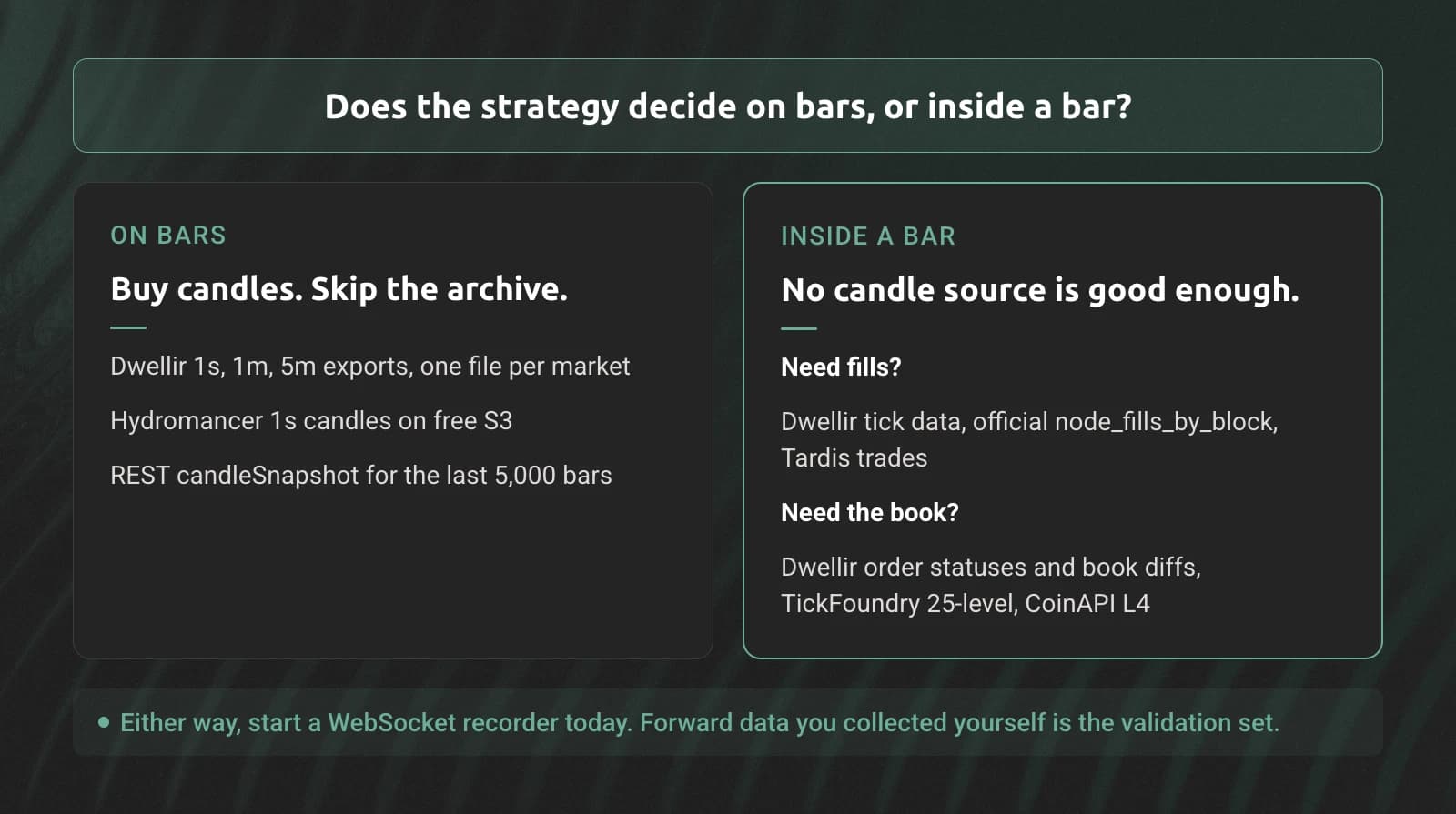
Two rules cut through most of the choices. If the strategy decides on bars, buy candles and skip the archive. If the strategy decides inside a bar, no candle source is good enough, and the choice is between a fills tape and a book replay.
Validate Before You Trust
Every dataset in this list is a derived product except the official buckets and the node-record archives. Before a large purchase, pull one representative day and check:
- Timestamps. Exchange time, block time, or collector local time? Dwellir tick data carries the source fill time in milliseconds and the block number; feed recorders carry receipt time.
- Trade definition. Every fill, or one row per match? The official node fill data lists each match twice, once per side. Dedupe to the taker row or you double volume.
- Book reconstruction. Can you rebuild a valid state after a gap? A diff stream without a snapshot seed cannot.
- Funding conventions. Interval rate or annualized, and stamped at payment time or accrual time?
- Symbol changes. Spot pairs use
@index notation, HIP-3 markets use adeployer:TICKERprefix, and delisted markets vanish from some vendors' catalogs. - Coverage floors, per symbol and per data type. A vendor's earliest date is usually the earliest date for one symbol on one schema. Query the symbol you actually trade, for the schema you actually need, at the oldest date you plan to test. If a provider cannot answer that from a coverage endpoint, treat the headline number as marketing.
- Total cost, not vendor cost. A requester-pays bucket is free of subscription and not free of invoice. Work out the gigabytes first, multiply by the region's egress rate, and compare that against a flat plan before deciding which is cheaper.
Record the provider, retrieval date, schema version, and original files with the backtest. A result you cannot reproduce six months later is not a result.
Recommendations
Best all-round choice: Dwellir. Dwellir is the only operator serving all four data tiers from its own node records: replica commands from January 2025, fills from March 2025, processed ticks and 1-second candles from July 2025, and order-level events from January 2026. On the tier that decides execution backtests, order-level history, that January 2026 start is the earliest of the three providers that publish one. Self-serve OHLCV exports start a bar-based backtest in minutes, and the raw archive lets the same team graduate to full replay without switching vendors or stitching one vendor's candles onto another's fills.
The commercial model is the other half of it. One response is one credit whatever you call, exports are priced per file rather than per gigabyte, and archive datasets are licensed per dataset rather than metered by volume. A backtest that pulls hard does not produce a bill that scales with how hard it pulled.
Start with an export from the dashboard, where the free tier is enough to check the schema against your own symbols. For archive or tick access, email the team with four things: the prefix or product, the date range, the format, and one line on the use case. You will get a scoped quote back.
Best for zero budget: official S3 plus hyperliquid-data. Fills egress costs $2 to $3 per month of history, the tool handles the format cutover, and you own the pipeline. Accept the monthly upload cadence and the absence of candles and spot data. Note that this route and Hydromancer's Reservoir are the same deal in different clothes: no vendor fee, an AWS bill, and all the reconstruction work still ahead of you. The official buckets are in a US region, so the egress is cheaper than Reservoir's Tokyo rate.
Best for cross-exchange research: Tardis or CryptoStruct. If Hyperliquid is one venue among ten in your study, a normalized multi-exchange schema saves more time than any single-venue archive, and CryptoStruct's EUR 1 per instrument-day pricing lets you buy only the days you test.
Whatever you buy, start a WebSocket recorder today. The API throws away your fills after 10,000 rows and keeps no book history, so the only way to own that record is to write it down as it happens. It is also the validation set you use to check whichever archive you pay for.