Search "Hyperliquid fees" and you will find fee tables that disagree with each other. Some stop at $5B in volume, and some say your tier updates on every fill. Hyperliquid's schedule now runs to $7B, and tiers update once a day.
This guide uses Hyperliquid's own fee schedule, checked on 7 October 2026 against both the documentation and a live userFees API response. It covers what you pay to trade perps and spot, how volume tiers and HYPE staking stack, what HIP-3 deployers and builders add on top, the non-trading costs, and how to read your exact rate from the API.
Hyperliquid Fees at a Glance
| Fee | Base rate | Notes |
|---|---|---|
| Perps taker | 0.045% | Falls to 0.024% at tier 6 |
| Perps maker | 0.015% | 0% from tier 4, rebates up to -0.003% |
| Spot taker | 0.070% | Falls to 0.025% at tier 6 |
| Spot maker | 0.040% | 0% from tier 4 |
| HYPE staking discount | 5% to 40% off | Multiplies with your tier |
| HIP-3 deployer share | Set per market | 2x the normal fee at a deployer scale of 1, up to 6x at scale 3 |
| Builder fee | Up to 0.1% perps, 1% spot | Only on orders from a builder frontend you approved |
| Funding | Hourly, variable | Paid between traders, not to Hyperliquid |
| HyperCore gas | None | Orders and cancels pay no gas; first transfer to a new account pays 1 USDC once |
| USDC withdrawal | $1 | To Arbitrum, about 5 minutes |
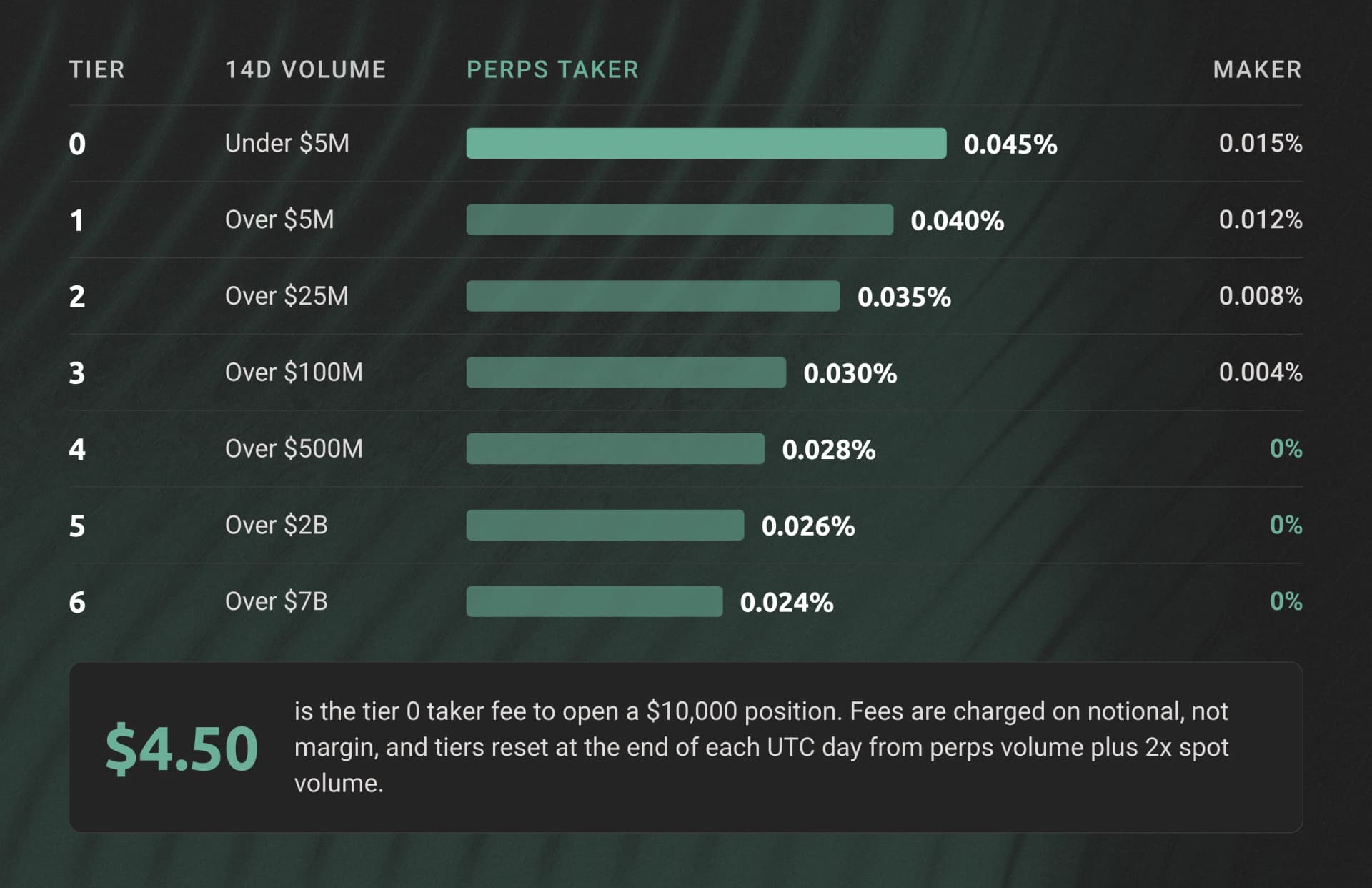
Every trading fee is charged on notional value, not on margin. A $1,000 margin position at 10x leverage is a $10,000 position, so a base-tier taker pays $4.50 to open it and $4.50 to close it.
Perpetuals Fee Tiers
Hyperliquid places every account in one of 7 tiers based on 14-day weighted volume. The tier sets your taker and maker rate for both perps and spot.
| Tier | 14-day weighted volume | Taker | Maker |
|---|---|---|---|
| 0 | Under $5M | 0.045% | 0.015% |
| 1 | Over $5M | 0.040% | 0.012% |
| 2 | Over $25M | 0.035% | 0.008% |
| 3 | Over $100M | 0.030% | 0.004% |
| 4 | Over $500M | 0.028% | 0.000% |
| 5 | Over $2B | 0.026% | 0.000% |
| 6 | Over $7B | 0.024% | 0.000% |
Three rules decide which row you sit in:
- Weighted volume is perps volume plus 2x spot volume.
- Tiers are recalculated at the end of each UTC day, not on every fill.
- Sub-accounts share the master account's volume and tier. Vaults are counted separately.
For most traders tier 0 is the real schedule. Moving to tier 1 takes $5M in 14 days, roughly $357,000 of notional every day.
Spot Fee Tiers
Spot uses the same volume thresholds with higher rates.
| Tier | 14-day weighted volume | Spot taker | Spot maker |
|---|---|---|---|
| 0 | Under $5M | 0.070% | 0.040% |
| 1 | Over $5M | 0.060% | 0.030% |
| 2 | Over $25M | 0.050% | 0.020% |
| 3 | Over $100M | 0.040% | 0.010% |
| 4 | Over $500M | 0.035% | 0.000% |
| 5 | Over $2B | 0.030% | 0.000% |
| 6 | Over $7B | 0.025% | 0.000% |
Two spot modifiers change the effective rate:
- On pairs where both sides are quote assets (a stablecoin against a stablecoin, for example), taker fees, maker rebates and volume contribution are all 80% lower.
- Pairs quoted in an aligned quote asset (AQAv1) get 20% lower taker fees, 50% larger maker rebates and 20% more volume credit. The same applies to HIP-3 markets that use an aligned quote asset as collateral. As of 7 October 2026, Hyperliquid's HIP-3 documentation says no aligned quote assets are live on mainnet, so check before you count on this discount.
Because spot volume counts double toward your tier, an account that trades both markets climbs tiers faster than its perps volume alone suggests.
HYPE Staking Discounts
Staking HYPE applies a discount on top of your volume tier. The discount is a multiplier, so it shrinks every rate in the tables above by the same percentage.
| Staking tier | HYPE staked | Fee discount | Perps taker at tier 0 | Perps maker at tier 0 |
|---|---|---|---|---|
| None | Under 10 | 0% | 0.0450% | 0.0150% |
| Wood | Over 10 | 5% | 0.0428% | 0.0143% |
| Bronze | Over 100 | 10% | 0.0405% | 0.0135% |
| Silver | Over 1,000 | 15% | 0.0383% | 0.0128% |
| Gold | Over 10,000 | 20% | 0.0360% | 0.0120% |
| Platinum | Over 100,000 | 30% | 0.0315% | 0.0105% |
| Diamond | Over 500,000 | 40% | 0.0270% | 0.0090% |
The formula is rate = tier_rate x (1 - staking_discount). A tier 3 trader with Diamond staking pays 0.030% x 0.6 = 0.018% taker.
You can stake from one address and trade from another by linking them. Read the terms before you do it: the link is permanent, the staking address can sweep funds from the linked trading address, and the staking address loses its own fee discount. Link only addresses you control.
Maker Rebates
From tier 4, makers pay nothing. Separately, market makers with a large share of total maker volume get paid a rebate, whatever their volume tier.
| Rebate tier | Share of 14-day weighted maker volume | Maker fee |
|---|---|---|
| 1 | Over 0.5% | -0.001% |
| 2 | Over 1.5% | -0.002% |
| 3 | Over 3.0% | -0.003% |
Rebates are paid continuously to the trading wallet. Rebate tier 3 pays $3,000 per $100M of maker fills, and reaching it takes billions in 14-day maker volume at current exchange volume.
HIP-3 Market Fees
HIP-3 lets anyone who stakes 500,000 HYPE deploy their own perp markets. The first 3 markets in a deployer's dex skip the auction, and later ones go through a Dutch auction. Each deployer sets a fee scale for its markets. The scale decides what the trader pays on top of the normal protocol fee.
With a scale of 1 or less, the protocol keeps its normal fee and the deployer adds scale x normal fee. Above 1, both the protocol and the deployer take scale x normal fee. Fee units charged to the trader, where 1 is the normal fee:
| Growth mode | Deployer scale | To protocol | To deployer | Trader pays |
|---|---|---|---|---|
| Off | 0 | 1 | 0 | 1x |
| Off | 0.5 | 1 | 0.5 | 1.5x |
| Off | 1 | 1 | 1 | 2x |
| Off | 3 | 3 | 3 | 6x |
| On | 0 | 0.1 | 0 | 0.1x |
| On | 1 | 0.1 | 0.1 | 0.2x |
| On | 9.99 | 0.999 | 0.999 | about 2x |
Growth mode cuts protocol fees, rebates and volume contribution by 90% or more for a market, and it stacks with staking discounts. Only markets fully separate from validator-operated perps qualify, so crypto perps, crypto indexes and gold markets are excluded. A deployer can change growth mode once every 30 days per asset.
The practical rule: a HIP-3 market is not priced like BTC-PERP. Check the market's fee before you trade, either in the trading interface or from the fee fields on your fills.
Builder Fees and Referral Discounts
Frontends, bots and wallets built on Hyperliquid can charge a builder fee on orders they route. The caps are 0.1% on perps and 1% on spot. A builder fee only applies after you approve it: your main wallet (not an API or agent wallet) signs ApproveBuilderFee with a maximum rate, you can revoke it any time, and you can hold at most 10 active approvals.
If you trade through a third-party app, your all-in cost is the Hyperliquid fee plus that app's builder fee. Query your approved maximum with the maxBuilderFee Info request. The builder codes guide covers the builder side of this, including how to set and claim the fee.
Referral codes give the referred trader 4% off fees for their first $25M of volume. The discount does not apply to vaults or sub-accounts.
Costs Beyond Trading Fees
| Cost | Amount | Detail |
|---|---|---|
| Funding | Variable, settled hourly | Exchanged between longs and shorts. See the funding rates guide |
| USDC withdrawal | $1 | Bridge to Arbitrum, about 5 minutes |
| USDC deposit | No protocol fee | Arbitrum USDC only from a wallet. Deposits under 5 USDC are lost |
| Account activation | 1 quote token | Charged once on the first transfer into a new HyperCore account |
| HyperEVM gas | Paid in HYPE | EIP-1559; base fee and priority fee are both burned |
| HyperCore to HyperEVM transfer | 200,000 gas | At the next block's base fee, paid in HYPE |
| Order priority fee | Optional, in HYPE | Burned. See Hyperliquid priority fees |
| Extra API rate limit | 0.0005 USDC per request | Via reserveRequestWeight |
HyperCore orders and cancels carry no gas, which is why Hyperliquid can quote a single fee per trade. Gas only appears when you use HyperEVM smart contracts or move assets between HyperCore and HyperEVM.
Where Hyperliquid Fees Go
Hyperliquid fees go to the community rather than to a company: to the HLP vault, to the Assistance Fund and, on HIP-3 and HIP-1 markets, to deployers. The Assistance Fund converts its fees to HYPE as part of L1 execution, and that HYPE is burned. HIP-3 deployers can keep up to 50% of the fees their markets generate. Priority fees and HyperEVM gas are burned directly.
Worked Examples
| Trader | Trade | Rate | Fee |
|---|---|---|---|
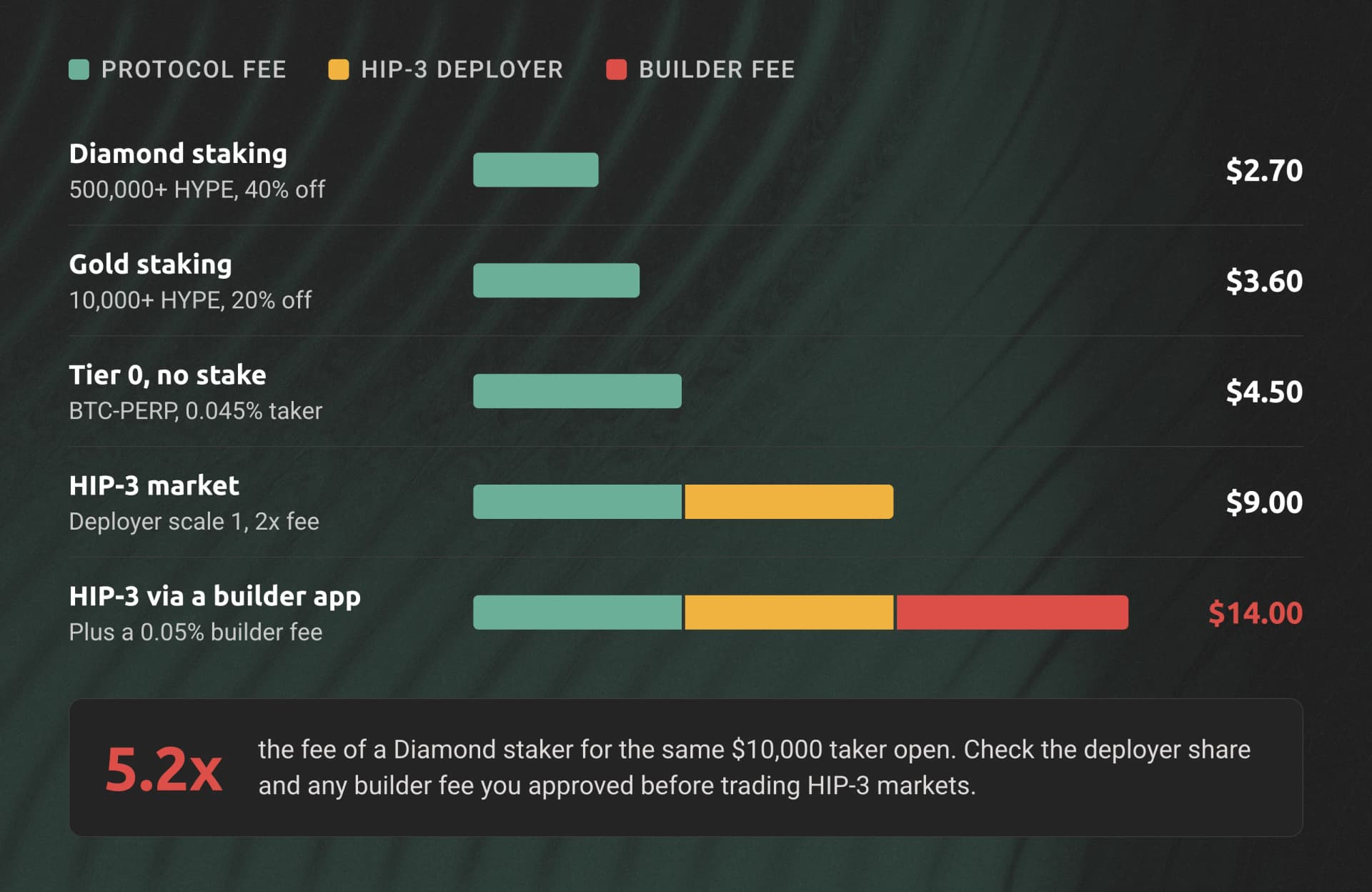
| Retail taker, tier 0, no stake | Open and close a $10,000 BTC perp | 0.045% x 2 | $9.00 |
| Same trader, Gold staking (10,000+ HYPE) | Same round trip | 0.036% x 2 | $7.20 |
| Maker, tier 0, no stake | $10,000 limit order filled | 0.015% | $1.50 |
| Tier 3 desk, Diamond staking | $1M taker fill | 0.018% | $180 |
| Spot buyer, tier 0 | Buy $5,000 of a token | 0.070% | $3.50 |
| Retail taker on a HIP-3 market, scale 1, via a builder charging 0.05% | $10,000 taker open | 0.090% + 0.05% | $14.00 |
The last row is the expensive one. A trader who moves from a validator-operated perp in the official interface to a HIP-3 market through a third-party frontend can pay over 3x the fee for the same notional.
How to Check Your Fee Rate With the API
The userFees Info request returns your rates after volume tier and staking discount. A referral discount comes back separately as activeReferralDiscount and applies on top: effective = userCrossRate x (1 - activeReferralDiscount). The rates come back as decimals (0.00045 is 0.045%), and "cross" means taker while "add" means maker.
curl -s -X POST https://api.hyperliquid.xyz/info \
  -H 'Content-Type: application/json' \
  -d '{"type":"userFees","user":"0xYOUR_ADDRESS"}'
import json, urllib.request

INFO_URL = "https://api.hyperliquid.xyz/info"  # or your Dwellir Info endpoint
USER = "0xYOUR_ADDRESS"

def info(payload):
    req = urllib.request.Request(INFO_URL, data=json.dumps(payload).encode(),
                                 headers={"Content-Type": "application/json"})
    with urllib.request.urlopen(req, timeout=10) as r:
        return json.load(r)

fees = info({"type": "userFees", "user": USER})
pct = lambda x: f"{float(x) * 100:.4f}%"
print("perps taker:", pct(fees["userCrossRate"]))
print("perps maker:", pct(fees["userAddRate"]))
print("spot taker: ", pct(fees["userSpotCrossRate"]))
print("spot maker: ", pct(fees["userSpotAddRate"]))
print("staking discount:", fees["activeStakingDiscount"])
ref = float(fees["activeReferralDiscount"])
print("referral discount:", ref)
print("effective perps taker:", pct(float(fees["userCrossRate"]) * (1 - ref)))
For an account with no volume, stake or referral, this prints 0.0450%, 0.0150%, 0.0700% and 0.0400%. The same response includes dailyUserVlm, your taker and maker volume for each recent day, and feeSchedule, the full tier table, so a bot can work out how far it is from the next tier without hardcoding thresholds.
To see what you actually paid, read fee on each fill from userFills. It is the total, including any builderFee, which is listed separately so you can split out the builder's share. IOC priority fees are recorded as priorityGas in the user_fills files that nodes write, not in the userFills Info response.
The public Info endpoint is rate limited per IP. Bots that poll account state across many wallets can run the same requests against Dwellir's Hyperliquid Info endpoint, where limits scale with your plan. For fee analysis over months of fills rather than the last few days, the Hyperliquid historical data guide compares the archive options.
Key Numbers and Next Steps
At tier 0, the numbers to remember are 0.045% and 0.015% on perps, charged on notional, with no gas per trade. The levers that move them are volume, HYPE staking and maker share. The costs that surprise people are HIP-3 deployer shares and builder fees on third-party frontends, and both show up on your fills if you check.
If you are building a trading bot or frontend on Hyperliquid and need Info, gRPC or order book data without public rate limits, see Dwellir's Hyperliquid pricing or create an account.