Your bot listens on the Hyperliquid public WebSocket, sees order book updates in 100-200ms, places orders through the official API in 600-700ms, and needs the full listen -> decide -> execute loop to stay inside roughly 1 second. That sounds like one latency problem. It isn't.
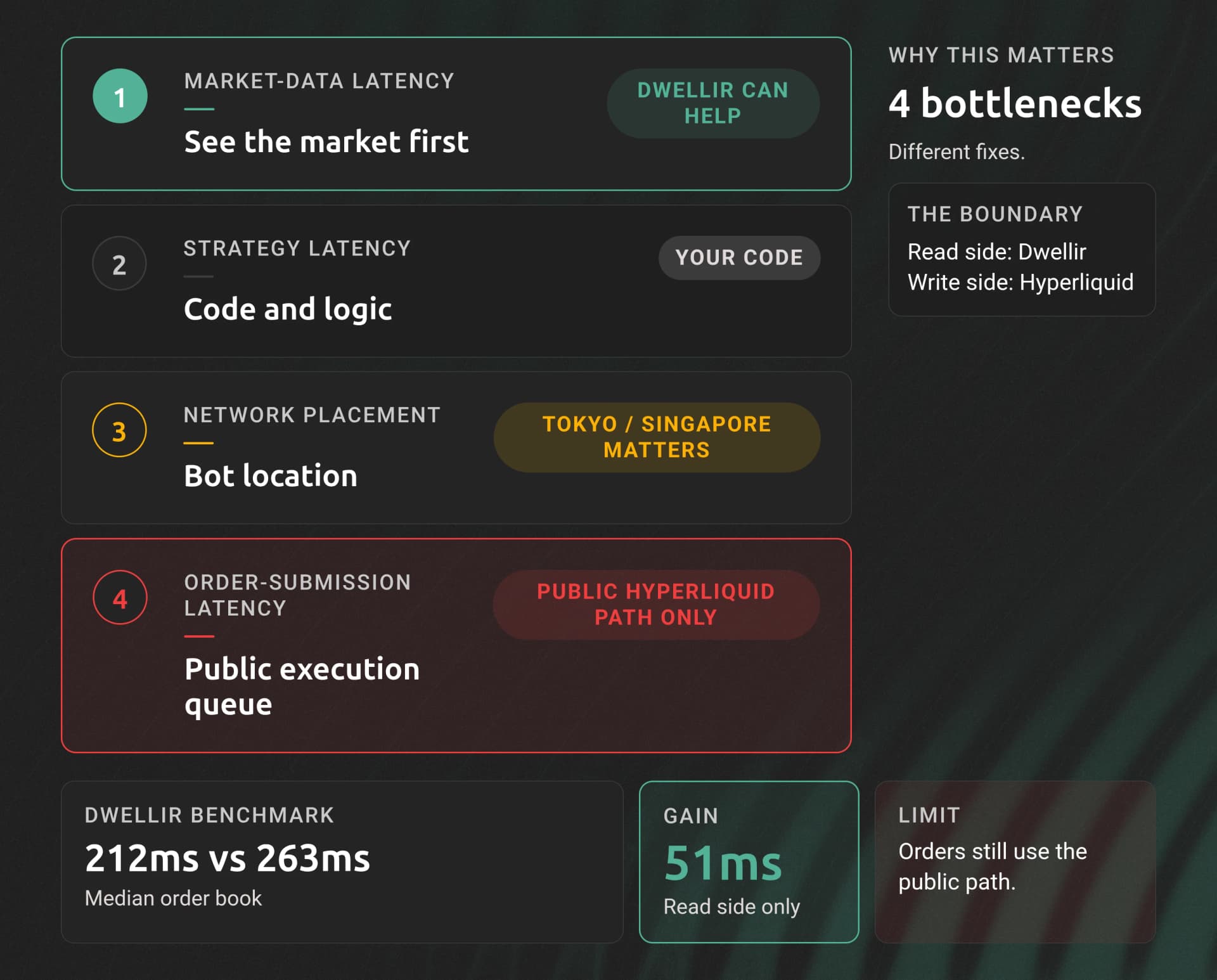
On Hyperliquid, "latency" usually means 4 different delays stacked on top of each other:
- how fast you receive market data
- how long your strategy takes to compute
- how far your infrastructure sits from the exchange path
- how quickly your order reaches and moves through Hyperliquid's execution flow
If you blur those together, you end up buying the wrong thing. A faster data feed does not automatically make order submission faster — in fact, every order on Hyperliquid is sent through the same public infrastructure, and no third-party provider (Dwellir included) has any control over that path. A dedicated node cluster does not fix a slow strategy loop. gRPC is not necessary if you only need a full snapshot every 5 minutes.
This guide breaks the stack apart so you can see which part is yours to optimize, which part Hyperliquid controls, and where Dwellir's Hyperliquid stack actually changes the outcome.
Hyperliquid Latency Is 4 Different Bottlenecks
Most customer questions about "low-latency Hyperliquid infrastructure" map to one of these layers:
| Layer | What It Affects | Typical Symptom | Who Controls It |
|---|---|---|---|
| Market-data latency | Order book updates, fills, streamed state | "My bot sees the move too late" | Your provider and deployment |
| Strategy latency | Parsing, analytics, signal generation | "The model reacts too slowly" | Your code and hardware |
| Network placement | Distance between your bot and exchange-adjacent infrastructure | "Should I run this in Tokyo?" | Your deployment choice |
| Order-submission latency | Sending an order into Hyperliquid and getting it acknowledged | "Can I place orders faster?" | Only Hyperliquid's public execution path — no provider controls this |
This distinction matters because the fixes are different.
If you need deeper and faster order book visibility, you are solving a read-side latency problem. If you need your order to land earlier in the queue after your strategy decides, you are solving a write-side latency problem. Those are complementary levers, not substitutes.
What Hyperliquid Controls vs What You Control
Hyperliquid controls the final execution path. No infrastructure provider creates a private shortcut around that.
That is the first misconception to kill: every single order on Hyperliquid must go through the public infrastructure. Dwellir has zero control over order placement, order routing, queue position, or execution. A higher Dwellir plan can unlock better market-data access, more capacity, or dedicated infrastructure. It does not create a secret order-entry rail, a private write path, or any shortcut around Hyperliquid's official submission route. There is no version of this where Dwellir touches your order flow.
Hyperliquid's own latency guidance is clear about where serious optimization happens. For geographically colocated clients, Hyperliquid documents roughly 0.2 second median end-to-end latency and 0.9 second p99. The docs also recommend:
- running a non-validating node against a reliable peer
- using
--disable-output-file-buffering - provisioning at least
32logical cores - provisioning at least
500 MB/sdisk throughput - reconstructing the order book locally from node outputs when you need the lowest possible latency
That gives you the boundary line:
- Hyperliquid's public infrastructure handles 100% of order submission, matching, acknowledgement, queue position, and final execution semantics. No provider, including Dwellir, can change or shortcut any part of this path.
- You control how quickly you receive data, how fast your strategy runs, and how close your systems sit to the exchange path.
Once you see the system that way, most infrastructure decisions get easier.
Read-Side Latency: Where Dwellir Helps Most
Dwellir's clearest advantage on Hyperliquid is read-side market-data latency.
The Order Book Server is built for teams that need faster and deeper order book visibility than the public feed gives them. This is where the most concrete benchmark lives today.
Across 2,662 matched trades, Dwellir measured:
- 212ms median latency on the Order Book Server versus 263ms on the public API
- 339ms mean latency versus 368ms on the public API
- 1,977ms max latency versus 9,118ms on the public API
- Dwellir faster in 75.5% of observed cases
The median improvement is 51ms. For a charting app, that may be noise. For a strategy trying to react inside a 1-second block window, it is material.
This is also the right place to be precise about what "faster" means:
- You receive order book changes sooner.
- You can trigger signals earlier.
- You can reduce the stale-data portion of your decision loop.
- You do not gain a private write path for order placement. All orders still go through the public Hyperliquid infrastructure that everyone else uses, and Dwellir has zero control over that path.
If your strategy edge depends on seeing L2 or L4 changes as early as possible, faster reads are valuable on their own. They let your bot decide sooner, which is the only part Dwellir can improve directly before your order goes back through Hyperliquid's normal execution path.
Order Book Server vs gRPC vs Historical Data
Not every latency question should end with "buy gRPC" or "get the premium plan."
The support pattern is consistent: some teams truly need continuous streaming, some need better order book depth, and some only need snapshots or backfills. The correct setup depends on your workload.
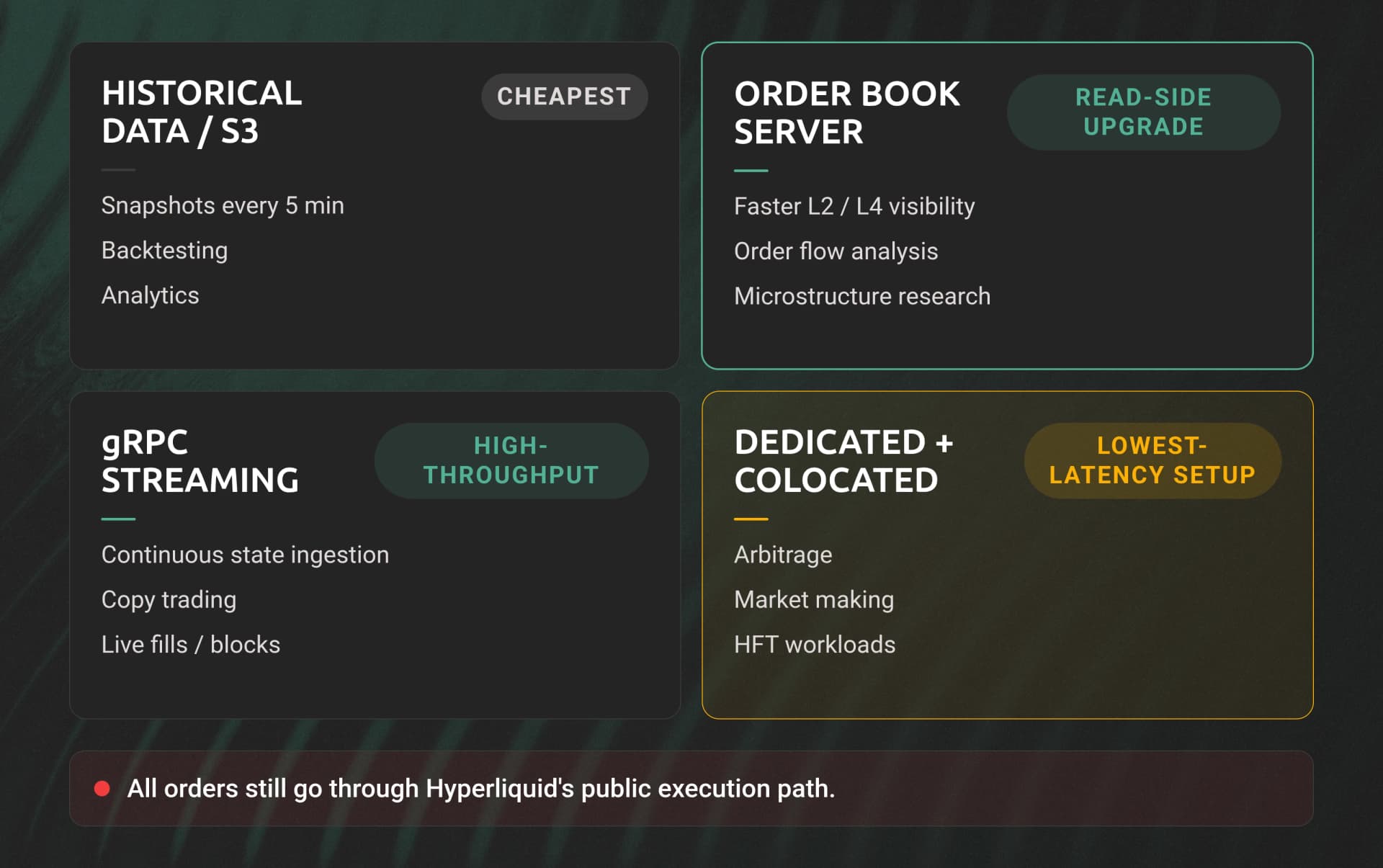
| Need | Best Fit | Why |
|---|---|---|
| Full order book snapshots every few minutes | Hyperliquid historical data / S3 | Cheapest option when streaming is unnecessary |
| Faster L2/L4 order book visibility | Dwellir Order Book Server | Improves read-side latency and market depth access |
| Continuous block, fill, or snapshot streaming | Dwellir gRPC Streaming API | Better for high-throughput real-time consumers |
| Serious arbitrage or HFT deployment | Dedicated node cluster + colocated execution | Reduces contention and network distance |
| General app integration or HyperEVM usage | Standard Hyperliquid RPC | Good base layer, but not a latency cure-all |
Here is the practical decision rule:
Use Historical Data When Your Workload Is Periodic
If you only need a full snapshot every 5 minutes for analytics or backtesting, paying for a live low-latency stream is usually wasteful. This is the most common overbuy.
For those workloads, historical data on S3 is the right answer. You avoid streaming complexity, lower your bill, and still get the state you need.
Use the Order Book Server When You Need Faster Market Reads
If your strategy depends on seeing market structure faster than the public API exposes it, the Order Book Server is the first meaningful upgrade. It is especially relevant for:
- order flow analysis
- microstructure research
- L2 or L4 order book strategies
- bots reacting to short-lived spread dislocations
This is the cleanest starting point for teams who know the bottleneck is incoming data, not periodic history.
Use gRPC When You Need High-Throughput Live Streaming
gRPC makes sense when your system consumes continuous real-time state and needs a more robust streaming interface than a basic WebSocket pattern. That often means:
- copy trading systems
- live fill ingestion
- real-time block consumers
- distributed services feeding multiple downstream processes
The mistake is assuming gRPC is the universal latency upgrade. It is not. It is a better fit for certain real-time architectures, not a mandatory step for every Hyperliquid workload.
Geography Matters More Than Most Teams Expect
Once you have the right data path, physical placement becomes the next lever.
Internal support guidance keeps pointing serious Hyperliquid teams toward Tokyo, and Dwellir's hosted order book infrastructure is documented from Tokyo and Singapore edge locations. That lines up with how latency-sensitive trading systems behave everywhere else: distance still matters.
If your bot runs far from the exchange-adjacent infrastructure, every market-data update and every order submission pays that round-trip tax. Geography is the only piece of order-side latency you can influence — the order itself still travels through Hyperliquid's public infrastructure, and Dwellir has zero control over what happens once it arrives. You can improve code, codecs, and stream handling all you want, but geography still sets a floor.
For latency-sensitive trading, ask these questions in order:
- Is my bot running in the right region?
- Is my market-data path optimized before my strategy sees it?
- Is my strategy loop itself fast enough?
- Am I confusing faster reads with faster writes?
That order matters because poor placement can erase the gains from every other optimization.
What to Measure Before You Spend More
Before you move to gRPC, pay for dedicated infrastructure, or relocate a bot, instrument the full loop. Most teams still talk about latency as one number because they only measure the final result.
You want 4 separate timestamps:
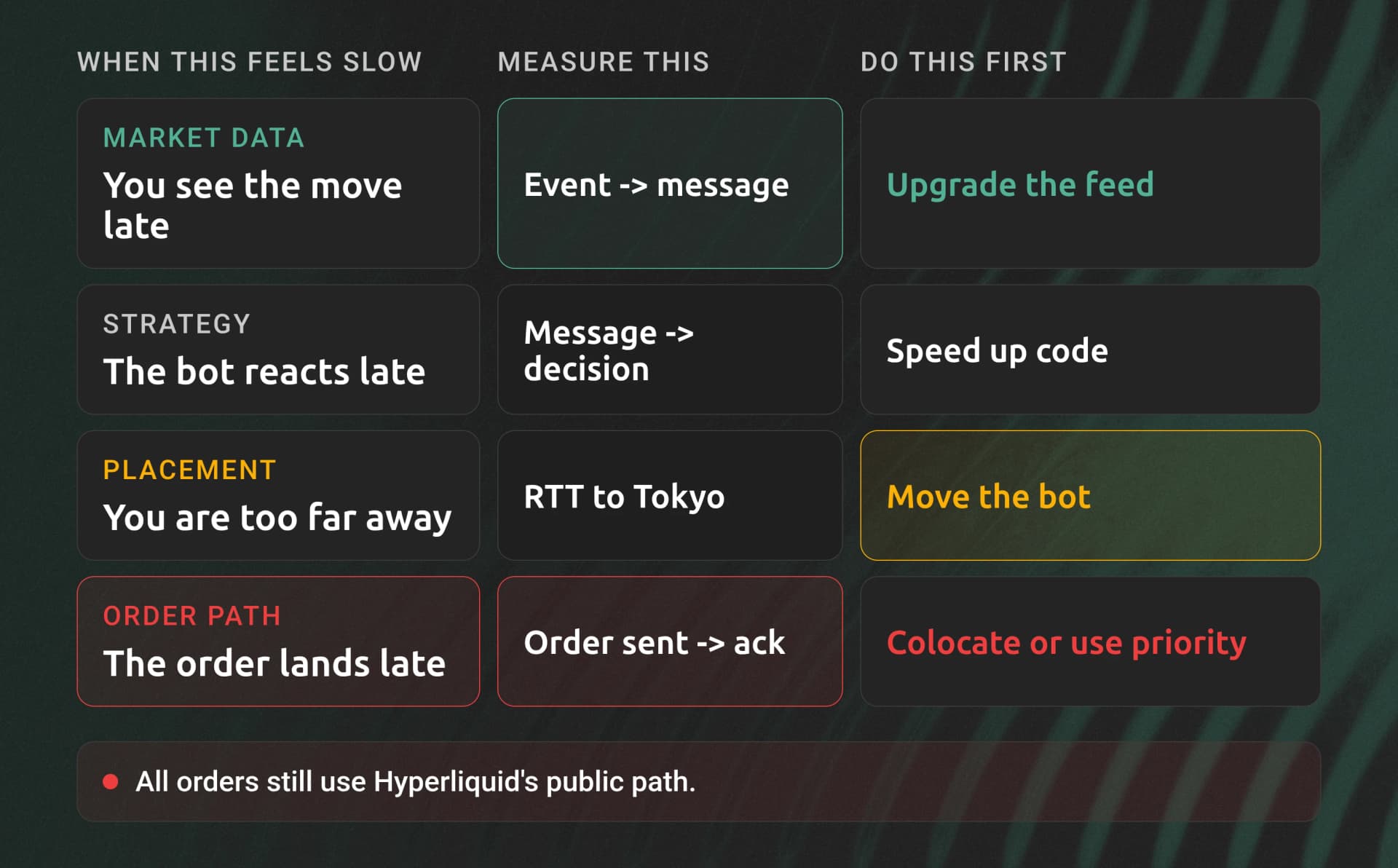
- market event -> message received: how long it takes for order book or fill data to reach your process
- message received -> strategy decision: how much time your parsing, state updates, and model evaluation consume
- strategy decision -> order sent: how long signing, serialization, and client-side dispatch take
- order sent -> acknowledgement or fill: entirely governed by Hyperliquid's public execution path (plus the network distance your packet has to travel to reach it) — no provider controls this segment
Once you break the loop apart, the infrastructure decision becomes obvious.
If the first number is the problem, upgrade the read side. If the second and third numbers dominate, optimize the bot before buying more infrastructure. If the fourth number remains the bottleneck after everything else is clean, then you are in true execution-latency territory and need to think about colocation and Hyperliquid's write-side mechanisms.
A Practical Upgrade Path for Hyperliquid Teams
Most teams do not need the full low-latency stack on day 1. A staged upgrade path works better:
| Stage | Setup | Solves |
|---|---|---|
| 1 | Public endpoints | Initial integration and low-frequency workloads |
| 2 | Order Book Server | Faster and deeper read-side market data |
| 3 | gRPC Streaming API | High-throughput continuous streaming |
| 4 | Dedicated node cluster + colocated execution | Production-grade latency-sensitive trading |
The jump between stages should be driven by the bottleneck you can already observe.
Solo Quant or Researcher
Start with the Order Book Server if your work depends on live L2 or L4 depth. Do not jump straight to dedicated infrastructure unless your current setup is already signal-complete and the remaining issue is latency.
Copy Trading or Live Stream Replication
Move toward gRPC sooner. These systems benefit from continuous event delivery and cleaner real-time fanout more than they benefit from periodic snapshots or manual polling.
Snapshot Analytics or Backtesting
Stay on historical data until you prove you need live reads. If your pipeline runs every 5 minutes, you are not latency-bound in the same way a trading engine is.
Arbitrage, Market Making, or HFT
Treat the full loop as the unit of optimization. Faster data helps. Colocation helps. Dedicated infrastructure helps. But once your order leaves your bot, it travels exclusively through Hyperliquid's public execution path — Dwellir has zero control over what happens from that point on, and no provider can change that.
Priority Fees Are Write-Side Optimization, Not a Data Upgrade
If you have read the Hyperliquid priority fees guide, this is where it fits into the stack.
Priority fees solve a write-side problem. They affect where your order sits in the execution queue after it reaches Hyperliquid. They do not make market data arrive faster.
That means a serious trading setup may combine all of the following:
- faster read-side market data through the Order Book Server
- better real-time streaming through gRPC
- shorter physical distance through Tokyo or Singapore deployment
- write-side improvements through Hyperliquid priority mechanisms
Those are not competing purchases. They optimize different parts of the loop.
The mistake is expecting a market-data product to fix execution ordering, or expecting priority fees to make your bot see the market sooner. Read-side and write-side latency have to be tuned separately.
5 Ways to Reduce Hyperliquid Latency
If you want the short version, the practical playbook looks like this:
- Separate the bottleneck first. Decide whether your problem is reads, compute, geography, or order submission.
- Move closer to the action. Run latency-sensitive bots in the right region, usually Tokyo for the most demanding Hyperliquid setups.
- Upgrade the data path before rewriting the bot. Better market-data access often removes more delay than micro-optimizing strategy code too early.
- Use the right product for the workload. Historical data for periodic snapshots, Order Book Server for faster reads, gRPC for continuous streaming, dedicated infrastructure for serious trading.
- Treat write-side latency separately. Use Hyperliquid's own execution-side tools, including priority features, when queue position matters.
FAQ
Can Dwellir improve Hyperliquid order placement latency?
No. All orders on Hyperliquid must go through the public infrastructure, and Dwellir has zero control over that path. Dwellir improves market-data access and infrastructure options around the read side. Your orders still go through Hyperliquid's normal public execution path, the same one every other participant uses.
How much faster is Dwellir's Hyperliquid Order Book Server than the public feed?
Dwellir's published benchmark shows a 51ms median improvement: 212ms median latency on Dwellir versus 263ms on the public API, with Dwellir faster in 75.5% of observed cases.
When do you need Hyperliquid gRPC?
You need gRPC when your application consumes continuous real-time state at meaningful volume: copy trading, live fill processing, block streaming, or services feeding multiple downstream consumers. You do not need it for snapshot-only analytics.
Should you run your Hyperliquid bot in Tokyo?
If you are latency-sensitive, yes, you should evaluate Tokyo first. Dwellir's order book infrastructure runs from Tokyo and Singapore, and internal deployment guidance consistently points serious trading workloads toward Tokyo.
Do you need a dedicated node cluster for Hyperliquid arbitrage?
Not always. Start by proving where your delay comes from. If the constraint is still read-side visibility or network distance after basic optimizations, then dedicated and colocated infrastructure becomes the next logical step.
What is the difference between read-side and write-side latency?
Read-side latency is how fast you see the market. Write-side latency is how fast your order reaches and progresses through Hyperliquid's execution flow. Faster reads help you react sooner. They do not guarantee a better execution position once you send the order.
The Right Answer Depends on the Strategy
Hyperliquid latency is not one number and not one product decision. It is a stack.
If your problem is seeing the market late, optimize the read side first. If your problem is queue position after decision time, look at Hyperliquid's write-side mechanisms. If your problem is distance, move the bot. If your workload only needs snapshots, skip the streaming products entirely.
That is where Dwellir fits most clearly today: faster market-data access, better streaming options, and infrastructure paths for teams whose edge depends on reacting sooner. All orders still go through Hyperliquid's public infrastructure, Dwellir has zero control over that path, and no provider can change that. The read side is where Dwellir helps, and that honesty is the useful part.
For teams building on Hyperliquid, the next step is to map your workload to the right layer:
- Explore Dwellir's Hyperliquid docs
- Review the Order Book Server
- Read the priority fees guide
- Talk to the Dwellir team if you need dedicated or colocated infrastructure