Arc is an open, EVM-compatible Layer 1 blockchain from Circle, the issuer of USDC, built for stablecoin payments, FX and tokenized assets. It pays gas in USDC and makes every block final in under one second with Malachite BFT consensus, run by a permissioned set of institutional validators.
Circle's Arc public mainnet launched on 16 September 2026 with chain ID 5042. This page covers what a developer needs to know about Circle Arc before writing code for it: how the two layers work, what USDC as gas means for your fee and balance logic, who signs the blocks, how Arc compares with Tempo, Plasma and Stable, and how to connect. Every chain reading here was taken from Arc mainnet on 3 November 2026.
Arc at a glance
| Arc | |
|---|---|
| Built by | Circle (launched by Arc Network Services LLC) |
| Mainnet chain ID | 5042 (0x13b2) |
| Testnet chain ID | 5042002 (0x4cef52) |
| Gas token | USDC: 18 decimals native, 6 decimals through the ERC-20 interface |
| Minimum base fee | 20 Gwei, about 0.00042 USDC for a 21,000-gas transfer |
| Block time | About 0.5 s |
| Finality | Deterministic, on commit, under 1 s, no reorgs |
| Consensus | Malachite (Tendermint BFT), permissioned Proof-of-Authority validators |
| Execution client | Reth |
| Public testnet | 28 October 2025 |
| Public mainnet | 16 September 2026 |
| Public RPC | https://rpc.mainnet.arc.io, wss://rpc.mainnet.arc.io |
| Explorer | explorer.arc.io |
What is Arc?
Arc is Circle's own blockchain for moving and settling stablecoins, with USDC as the asset that pays for every transaction. Circle describes it as "an open blockchain network built for the world's financial markets, real-time money movement, and agentic economic activity" in its founding validator announcement.
For a developer, the Arc blockchain is a standard EVM target with three payment rules built into the protocol. Fees are priced in dollars. A block is final the moment it commits. The validators are named institutions rather than anonymous stakers. Solidity, Foundry, Hardhat, viem and ethers all work, and viem ships an arc chain definition.
Circle had reasons to run its own chain rather than deploy on someone else's. On an Ethereum L2 a payment app still holds ETH for gas and still waits for settlement, and the issuer controls neither the fee market nor the validator set. On Arc, Circle controls the stack around USDC: CCTP for cross-chain transfers, Gateway, EURC, the USYC yield token and the StableFX exchange engine all run natively on the chain. The top stablecoins explained post covers USDC itself.
How does Arc work?
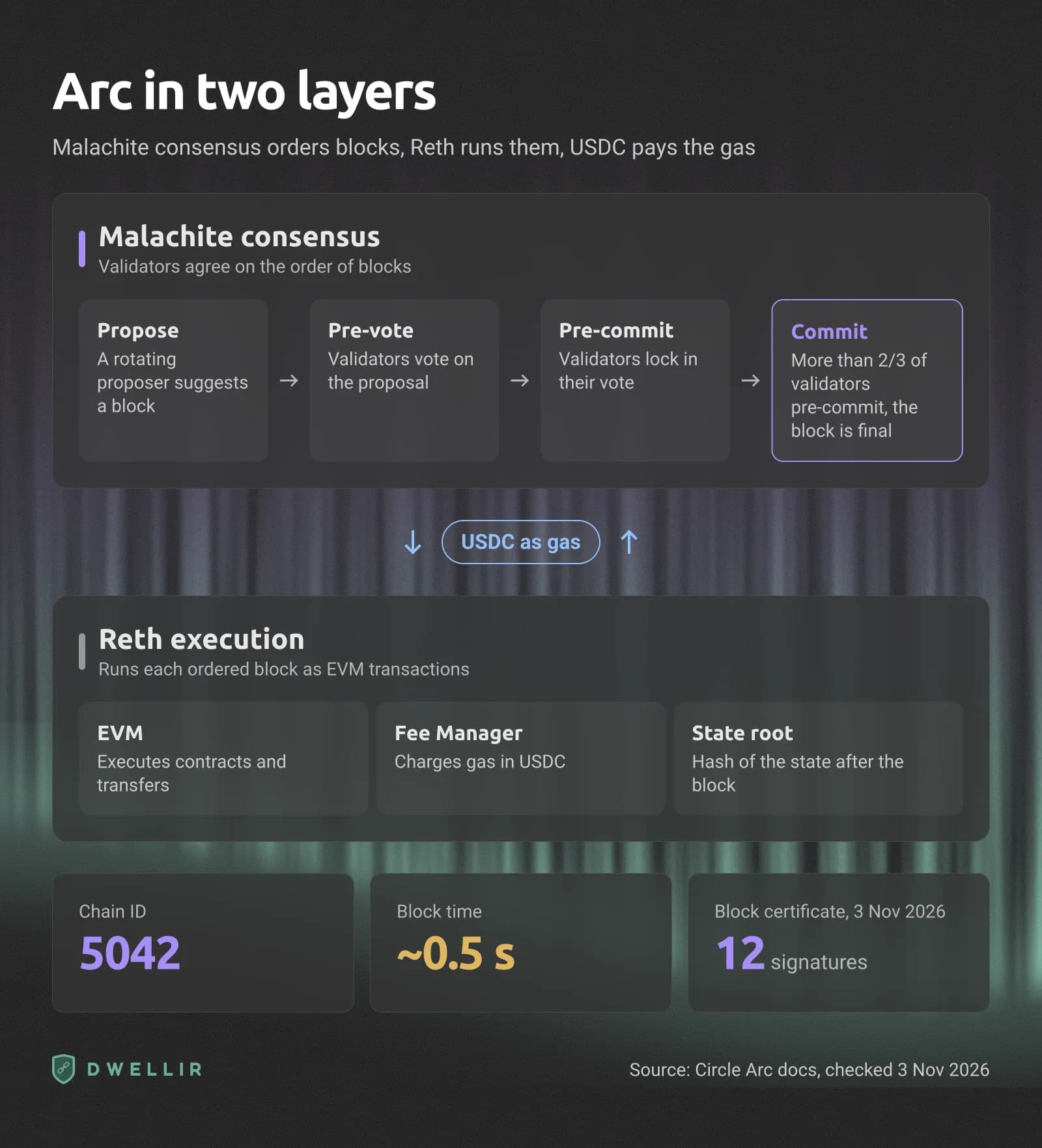
Arc splits the work into two layers: Malachite orders and finalizes blocks, and Reth executes the transactions and keeps the state. Circle's system overview lists the lifecycle of one transaction:
- Submit. A wallet sends a signed transaction to an Arc node over JSON-RPC.
- Mempool. The node checks signature, balance and nonce, then holds the transaction.
- Propose. A rotating validator, the proposer for the round, bundles pending transactions into a candidate block.
- Pre-vote and pre-commit. Validators vote on the block twice. If more than two thirds pre-commit to the same block, it commits.
- Commit and execute. The block is final. Reth applies each transaction, deducts the USDC fee and computes the new state root.
Malachite is "a high-performance implementation of the Tendermint BFT protocol", the same family of consensus used by Cosmos chains. Reth is the Rust Ethereum execution client that also runs on Ethereum mainnet. Arc adds its own modules to Reth's pipeline, starting with the Fee Manager. Circle benchmarks the design at 3,000+ TPS with 20 validators and under 350 ms finality. That is Circle's benchmark, and we have not measured it.
The explainer below follows one 1 USDC transfer through those steps, with the values read from mainnet.
A USDC payment on Arc, step by step
One 1 USDC transfer from signature to settled balance. Pick a step to stop on it.
1. Your wallet signs a transfer
The wallet signs an EIP-1559 transaction for chain ID 5042. The value is native USDC, counted in 18 decimals, and maxFeePerGas has to be at least the 20 Gwei floor.
- chainId
- 5042Arc mainnet
- value
- 10000000000000000001 USDC at 18 decimals
- maxFeePerGas
- 2000000000020 Gwei, the protocol floor
- gas
- 21000a plain transfer
2. The fee is paid in USDC
Gas is priced in USDC, so the fee comes out of the same balance as the payment. There is no second token to hold.
21,000 gastimes20 Gweiequals0.00042 USDC
21,000 × 20 Gwei = 420,000 Gwei, and 1 Gwei is 0.000000001 USDC.
eth_gasPrice returned 20.001 Gwei on 3 Nov 2026, so the same transfer cost 0.000420021 USDC.
3. Validators vote in two rounds
A rotating proposer from the permissioned validator set puts the transfer in a block. Validators pre-vote, then pre-commit. The block commits when more than two thirds pre-commit to it.
The commit certificate for block 29,390,167 carried 12 validator signatures (arc_getCertificate, 3 Nov 2026).
4. The block is final on commit
A committed block cannot be reorganised, so there are no confirmations to wait for. The finalized, safe and latest tags all return the same block.
- latest
- 29,390,097
- safe
- 29,390,097
- finalized
- 29,390,097
- about 0.5 s per block
- final in under 1 s
- no reorgs
Three block tags read from Dwellir’s Arc endpoint on 3 Nov 2026.
5. The recipient has 1 USDC more
One balance, two interfaces. The native view counts 18 decimals and the ERC-20 contract counts 6. Divide the native value by 10^12 to get the ERC-20 amount.
Why does Arc use USDC for gas?
Arc uses USDC for gas so that users and applications pay fees in the same dollar asset they already hold, with no second token to buy, store or top up. A payroll service on Arc keeps one balance. A checkout can quote the network fee in dollars.
The fee model is EIP-1559 with EWMA smoothing, according to Circle's gas and fees reference. The minimum base fee is 20 Gwei and the maximum is 20,000 Gwei. Gwei here means 10^-9 USDC, because the native unit is USDC at 18 decimals. A plain 21,000-gas transfer at the floor costs:
21,000 gas × 20,000,000,000 wei = 420,000,000,000,000 wei = 0.00042 USDCOn 3 November 2026, eth_gasPrice returned 20.001 Gwei and the latest block's base fee was exactly 20 Gwei, so the network was sitting on the floor. Circle's own design target is about $0.001 per ERC-20 transfer under normal load.
The decimals deserve a minute of attention. The native interface (eth_getBalance, msg.value, fees) counts USDC in 18 decimals. The ERC-20 contract at 0x3600000000000000000000000000000000000000 returns 6 from decimals(). Both read the same balance. A transaction with maxFeePerGas under 20 Gwei can sit in the mempool with no receipt. The guide to building financial apps on Arc shows the code for both cases, plus indexing USDC transfers without double counting.
Is Arc mainnet live?
Yes. Arc public mainnet has been live since 16 September 2026, with chain ID 5042. Circle announced the date on 5 August 2026, and the Arc docs carry the banner "Arc Mainnet is now live".
Two dates come before that. The public testnet opened on 28 October 2025 with chain ID 5042002, and it still runs. The mainnet chain itself is older than its public launch: block 0 is dated 12 May 2026, and the chain ran as a private mainnet with more than 100 builders until September. Block numbers count from May, so a block height says nothing about how long the public network has existed.
One chain ID trap: ChainList has an "ARC Mainnet" at chain ID 1243. That is an unrelated older network. Circle's Arc is 5042.
Who runs Arc's validators?
Arc's validators are a permissioned Proof-of-Authority set of regulated institutions, chosen by Circle. The founding cohort announced on 5 August 2026 is Circle plus BlackRock, DTCC, Galaxy, Global Payments, ICE, Mastercard, MoneyGram, SBI Group, Standard Chartered, Sumitomo Corporation and Visa.
You can see the set at work. Arc exposes arc_getCertificate, which returns the validator signatures that committed a block. The certificate for block 29,390,167, read on 3 November 2026, was committed in round 0 with 12 signatures. Circle does not publish the live validator list; 12 happens to match the size of the founding cohort, but the certificate does not say who signed. Circle's 20-validator figure comes from its benchmark, so do not read it as the live count.
The trade-off is plain. Named institutions give fast, deterministic finality and a clear legal counterparty, at the cost of permissionless validation. Circle says it intends to widen validator participation and governance over time, in its testnet announcement. It has not published a date or mechanism for that change, so treat a wider validator set as a plan, not a feature.
Arc vs Tempo, Plasma and Stable
Arc is one of four stablecoin-first Layer 1s with live mainnets, and the only one of them with USDC as its native token. Chain IDs below were checked against each public RPC on 3 November 2026. The other rows come from Dwellir's stablechain RPC guide, which has the full comparison and a transfer on each chain.
| Arc | Tempo | Plasma | Stable | |
|---|---|---|---|---|
| Backed by | Circle | Stripe, Paradigm | Bitfinex, Framework, Founders Fund | Bitfinex, Hack VC, Tether |
| Chain ID | 5042 | 4217 | 9745 | 988 |
| Gas paid in | USDC (native) | Any USD TIP-20 stablecoin | XPL | USDT0 (native) |
| Finality | On commit, under 1 s | On inclusion, sub-second | 2 to 3 blocks | On inclusion, about 0.7 s |
| Consensus | Malachite BFT, PoA | Simplex BFT, permissioned | PlasmaBFT, trusted validators | StableBFT (CometBFT), dPoS |
| Public mainnet | 16 Sep 2026 | 18 Mar 2026 | 25 Sep 2025 (Mainnet Beta) | 8 Dec 2025 |
| Providers | Arc RPC providers | Tempo RPC providers | Plasma RPC providers | Stable RPC providers |
The practical difference for an application is the issuer. Arc suits a product built around USDC, EURC and Circle's cross-chain tools. Tempo lets a payer choose among several dollar stablecoins for fees. Plasma and Stable are built around USDT.
How do I connect to Arc?
Point any EVM library at an Arc RPC endpoint with chain ID 5042. Circle runs a public endpoint at https://rpc.mainnet.arc.io and wss://rpc.mainnet.arc.io, and the testnet at https://rpc.testnet.arc.io. Circle's RPC endpoints page also lists Alchemy, Blockdaemon, dRPC and QuickNode. Testnet USDC comes from the Circle faucet.
For production traffic, Dwellir serves Arc mainnet over HTTPS and WSS:
https://api-arc-mainnet.n.dwellir.com/YOUR_API_KEY
wss://api-arc-mainnet.n.dwellir.com/YOUR_API_KEY
A quick check that the endpoint is on the right chain:
curl -s https://api-arc-mainnet.n.dwellir.com/YOUR_API_KEY \
  -H 'content-type: application/json' \
  -d '{"jsonrpc":"2.0","id":1,"method":"eth_chainId","params":[]}'
# {"jsonrpc":"2.0","id":1,"result":"0x13b2"}
The same check in viem, with the finality tags and the fee for a plain transfer. We ran this on viem 2.57.16, which includes the arc chain:
import { createPublicClient, http, formatUnits } from 'viem';
import { arc } from 'viem/chains';

const client = createPublicClient({
  chain: arc,
  transport: http('https://api-arc-mainnet.n.dwellir.com/YOUR_API_KEY'),
});

const chainId = await client.getChainId();
const latest = await client.getBlock({ blockTag: 'latest' });
const finalized = await client.getBlock({ blockTag: 'finalized' });
const gasPrice = await client.getGasPrice();

console.log('chain ID', chainId);
console.log('latest', latest.number, 'finalized', finalized.number);
console.log('gas price', formatUnits(gasPrice, 9), 'Gwei');
console.log('21,000-gas transfer', formatUnits(21_000n * gasPrice, 18), 'USDC');
Output on 3 November 2026:
chain ID 5042
latest 29390660n finalized 29390660n
gas price 20.001421687 Gwei
21,000-gas transfer 0.000420029855427 USDC
latest and finalized are the same block, which is what deterministic finality looks like from the client side.
On the Dwellir endpoint, rpc_modules returns eth, net, web3, rpc, debug and trace. debug_traceBlockByNumber with the callTracer and trace_block both return traces, and an eth_call against block 10,000,000 returns historical state, because the nodes keep archive state. txpool_* is not served. Billing is one credit per response for every method, the free plan includes 100,000 responses a day, and paid plans start at $49 a month. The Arc documentation lists every supported method, and the Arc network page has plans and dedicated-node options. To compare providers on price and features, read the Arc RPC provider comparison.
What's live on Arc and what's roadmap
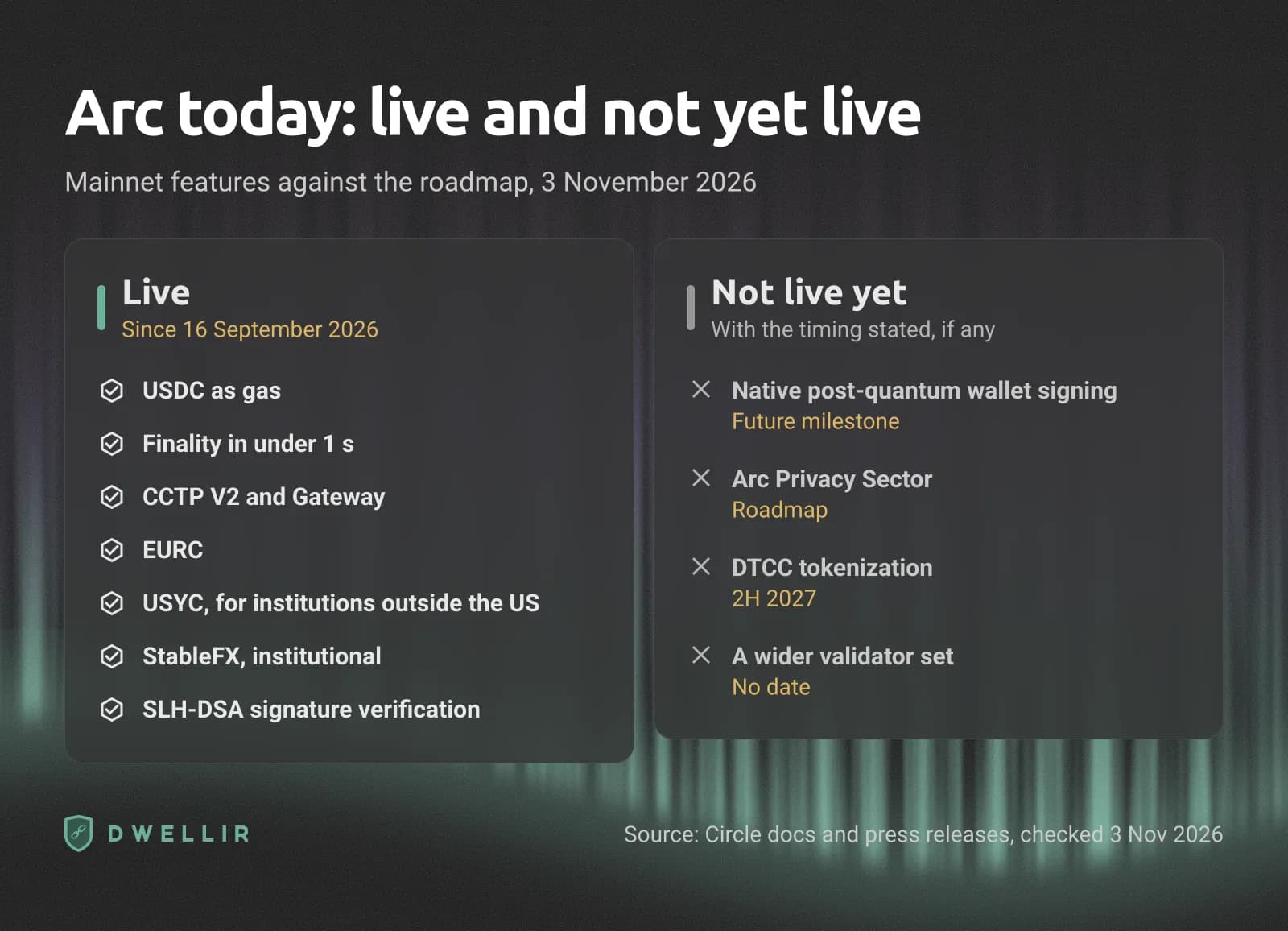
Arc's announcements mix shipped features with plans. This is the state on 3 November 2026, from Circle's docs and press releases.
| Feature | Status | Source |
|---|---|---|
| USDC gas, 20 Gwei floor, deterministic finality | Live since 16 Sep 2026 | Gas and fees, finality |
| CCTP V2 and Circle Gateway (Arc domain 26) | Live | Contract addresses |
| EURC (6 decimals) | Live | Contract addresses |
| USYC | Live, institutions outside the US only, $100,000 minimum | Contract addresses |
| StableFX request-for-quote FX with FxEscrow settlement | Live, institutional | Contract addresses |
| SLH-DSA post-quantum signature verification for contracts | Live | Post-quantum security |
| Native post-quantum wallet signing | Future milestone, likely via EIP-8141 | Post-quantum security |
| Arc Privacy Sector (confidential execution) | Roadmap: "not yet available on Arc" | Opt-in privacy |
| Tokenization of DTC-custodied assets with DTCC | Announced for the second half of 2027 | Circle, 5 Aug 2026 |
| Wider validator participation | Stated intent, no date | Circle, 28 Oct 2025 |
If your launch depends on confidential balances or a permissionless validator set, plan for Arc as it is today and treat those items as upgrades.
Getting started
Arc behaves like any EVM chain until money moves, and then the fee floor, the decimals and one-block finality change your code. Start with chain ID 5042, the 20 Gwei floor and the 18 vs 6 decimal split, then read the Arc build guide before you write a ledger.
To try it on Dwellir, create a free API key and run the viem snippet above against api-arc-mainnet.n.dwellir.com. For dedicated Arc nodes or higher limits, contact the Dwellir team.
Frequently asked questions
What is Arc blockchain?
Arc is an open, EVM-compatible Layer 1 blockchain from Circle, the issuer of USDC, built for stablecoin payments, FX and tokenized assets. USDC is its native gas token, and Malachite BFT consensus makes every block final in under one second. A permissioned set of institutional validators runs the network, and Reth executes the transactions.
Is Arc mainnet live, and what is its chain ID?
Yes. Arc public mainnet launched on 16 September 2026 with chain ID 5042 (0x13b2). The public testnet launched on 28 October 2025 and uses chain ID 5042002. ChainList's "ARC Mainnet" at chain ID 1243 is an unrelated older network. Circle's public RPC is https://rpc.mainnet.arc.io and the explorer is explorer.arc.io.
Does Arc use USDC for gas?
Yes. Arc has no separate gas token: fees are priced and paid in USDC from the same balance you send. The native interface counts USDC in 18 decimals and the ERC-20 contract at 0x3600000000000000000000000000000000000000 counts 6, for one shared balance. The minimum base fee is 20 Gwei, so a 21,000-gas transfer at the floor costs 0.00042 USDC.
How fast is finality on Arc?
Arc blocks are final when they commit, in under one second, and cannot be reorganised. Blocks arrive about every 0.5 seconds. A block commits after more than two thirds of validators pre-commit to it in Malachite, so the finalized, safe and latest block tags return the same block number and one receipt is enough to treat a payment as settled. The blockchain finality explainer compares this with other chains.
Who runs Arc's validators?
Arc runs on a permissioned Proof-of-Authority validator set of regulated institutions. Circle's founding cohort, announced on 5 August 2026, is Circle plus BlackRock, DTCC, Galaxy, Global Payments, ICE, Mastercard, MoneyGram, SBI Group, Standard Chartered, Sumitomo Corporation and Visa. A block certificate read on 3 November 2026 carried 12 validator signatures.
Which RPC providers support Arc?
Circle runs the public endpoint rpc.mainnet.arc.io over HTTPS and WebSocket and lists Alchemy, Blockdaemon, dRPC and QuickNode as partner RPCs. Dwellir serves Arc mainnet over HTTPS and WSS with archive state and the debug and trace namespaces, billed at one credit per response. The Arc RPC provider comparison covers pricing for eight providers.
Sources
Chain readings (eth_chainId, block tags, eth_gasPrice, arc_getCertificate, rpc_modules, traces and historical eth_call) were taken from Dwellir's Arc endpoint and Circle's public RPC on 3 November 2026. Third-party pages were checked the same day.