When is a blockchain transaction actually done? Not when it lands in a block. A block can be orphaned by a reorg, and your "confirmed" transaction reverses. The property that tells you a transaction is truly settled is finality, and it varies enormously between chains: from about an hour on Bitcoin to a second or two on BFT chains.
This explainer covers what finality means, the different kinds, how long it takes across major chains, and why it decides when your application can safely act.
What Finality Means
Finality is the point at which a transaction can no longer be reversed or removed from the canonical chain. It is the formal version of "this is settled." Finality and reorgs are two sides of the same coin: a chain with strong finality cannot reorg past the finalized point, so the more finality a chain offers, the less reorg risk you carry.
The Three Kinds of Finality
Probabilistic finality (Bitcoin and PoW chains). A transaction is never 100 percent final, but the probability of reversal drops exponentially as blocks pile on top. "Final enough" is a policy choice, which is why Bitcoin convention is about 6 confirmations.
Deterministic or absolute finality (BFT chains). Once the consensus protocol commits a block, it is irreversible, full stop. Cosmos chains (CometBFT/Tendermint) and Avalanche work this way.
Economic finality (Ethereum PoS). Not absolute, but reverting a finalized block would require an attacker to forfeit at least one-third of all staked ETH, millions of ETH, making reversal economically irrational. Conflicting validator votes are slashable.
One more distinction: Ethereum finalizes at epoch granularity (two epochs, about 12.8 minutes). Single-slot finality, finalizing within one ~12-second slot, is a roadmap goal but not live as of 2026.
How the Mechanisms Work
- Casper FFG (Ethereum) justifies and finalizes checkpoints at the start of each 32-slot epoch. After two epochs of two-thirds attestations a checkpoint is finalized, and reverting it requires a third of validators to burn their stake. It runs alongside the LMD-GHOST fork choice; together they are called Gasper.
- Tendermint / CometBFT (Cosmos) is deterministic BFT: every block finalizes the moment it is committed through a round of two-thirds pre-votes and pre-commits. Instant finality, roughly 1 to 3 seconds, no reorgs.
- Avalanche (Snowman) uses repeated sub-sampled voting to finalize non-conflicting transactions deterministically in about 1 to 2 seconds.
- Solana confirms optimistically in a couple of seconds and reaches deterministic finality at maximum lockout after 31 confirming blocks (roughly 13 seconds today). Its approved Alpenglow upgrade targets 100 to 150 millisecond finality but is not yet on mainnet.
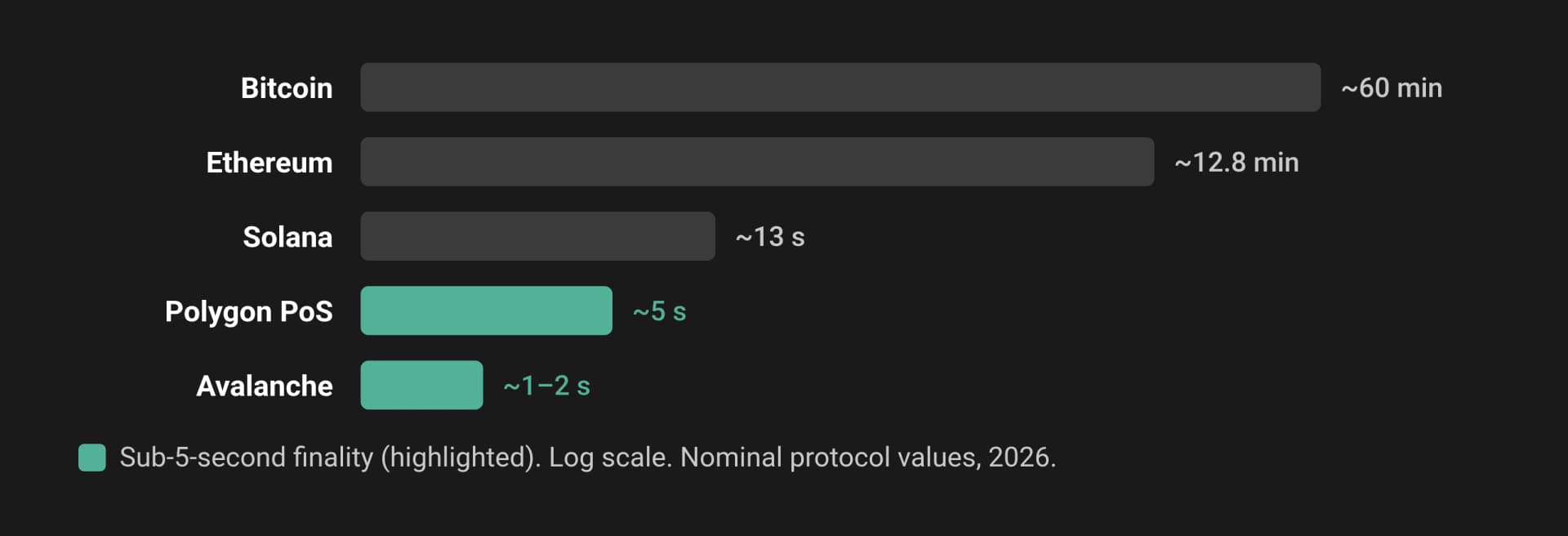
Time to Finality by Chain
Approximate, nominal protocol values as of 2026-06-03. Real latency varies with network conditions.
| Chain | Finality type | Mechanism | Time to finality |
|---|---|---|---|
| Bitcoin | Probabilistic | Nakamoto PoW | ~60 min (6 confirmations) |
| Ethereum | Economic | Casper FFG + LMD-GHOST | ~12.8 min (2 epochs) |
| Solana | Deterministic (tiered) | Tower BFT (Alpenglow on roadmap) | ~13 s today |
| Polygon PoS | Fast / near-instant | Heimdall v2 + Rio | ~5 s (reorgs eliminated post-Rio) |
| BNB Chain | Fast finality | PoSA + Maxwell | ~1.9 s |
| Cosmos / BFT | Deterministic | Tendermint / CometBFT | ~1 to 3 s |
| Avalanche | Deterministic | Snowman | ~1 to 2 s |
Why Finality Matters
- Bridges must wait for source-chain finality before minting or releasing on the destination. Acting on a transaction that later reorgs creates unbacked assets, so finalized-tag reads are standard practice.
- Exchange deposit crediting is the classic loss vector. Crediting before finality is exactly what 51 percent and deep-reorg attackers exploit, as Ethereum Classic and Bitcoin Gold showed.
- High-value settlement (institutional, real-world assets) needs irreversibility guarantees, which is why fast deterministic finality is a selling point for payment-focused chains.
What This Means for Your Code
On EVM chains, block tags map directly to finality levels:
latestis fast and reorg-able, fine for UX and general reads.safeis recent and unlikely to reorg, good for status checks.finalizedis economically settled. Use it before any irreversible action: payouts, bridge mints, deposit credits.
The rule is simple: wait for finality before doing anything you cannot undo. On probabilistic chains, substitute "enough confirmations for the value at risk." On chains with instant deterministic finality, a latest-equivalent read is already effectively final, which is a real developer-experience simplification. These reads all go through your RPC endpoint, so reliable finalized reads matter. See what is RPC in blockchain for the fundamentals, and what is a chain reorg for the failure mode finality prevents.
The Takeaway
Finality answers the only question that matters before you act on a transaction: can this still be reversed? Bitcoin says "almost never, eventually." Ethereum says "not without burning a third of all staked ETH." BFT chains say "no, as of the moment it committed." Match your confirmation policy to the chain and the value at stake, read the finalized tag before irreversible actions, and you will not be the one crediting a deposit that disappears.
Need dependable finalized reads across chains with very different finality models? Create a free Dwellir account for an endpoint on 100+ networks.