How long does Hyperliquid market data take to reach your trading bot? We measured it from AWS Tokyo (ap-northeast-1) for five sources: Dwellir, QuickNode, Hydromancer, GoldRush and the Hyperliquid public API.
The Short Answer
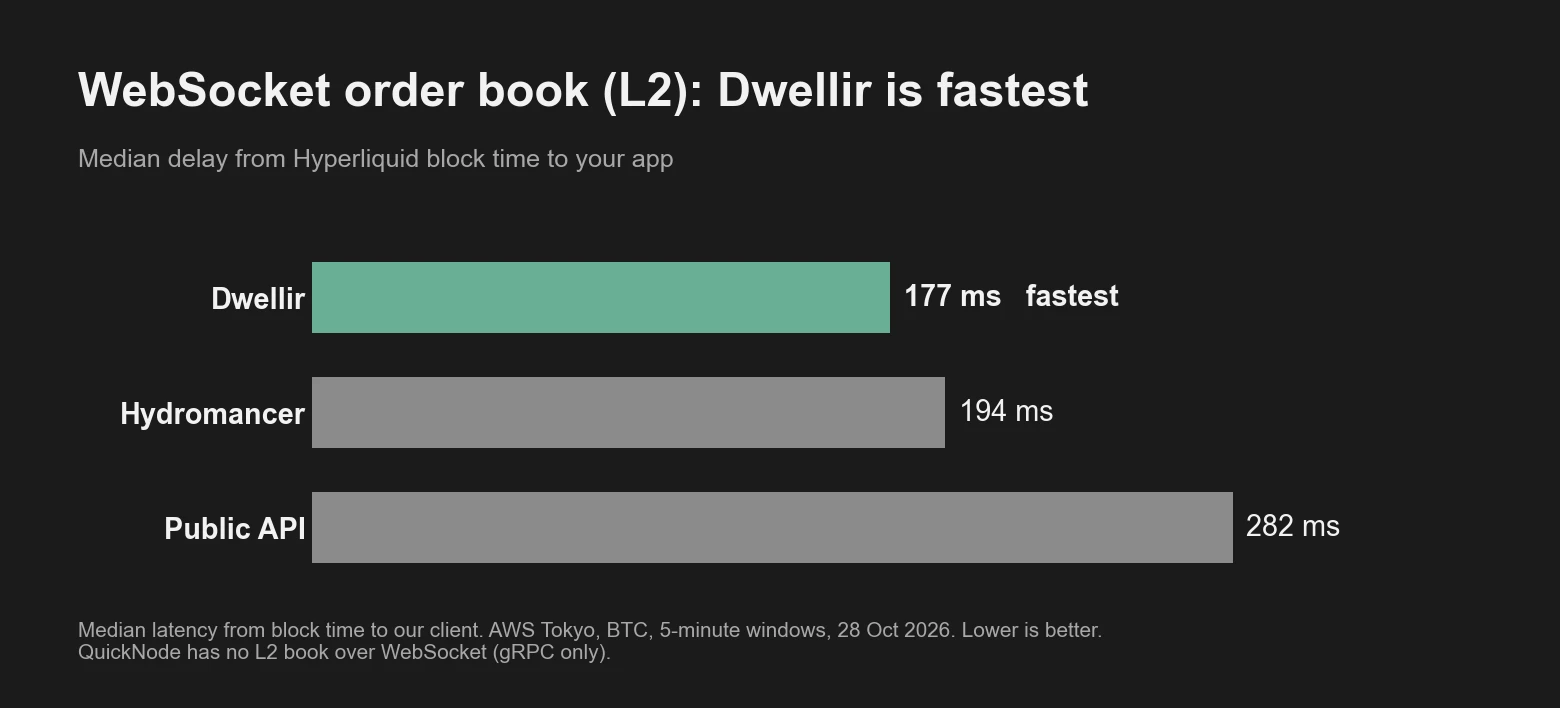
- Fastest WebSocket order books: Dwellir. It had a median of 177 ms for the L2 book and 190 ms for the order-level (L4) book. That is 8 to 27 ms ahead of Hydromancer and about 100 ms ahead of the public API.
- Fastest WebSocket trades: Hydromancer and Dwellir, nearly tied. The medians were 177 ms and 187 ms.
- Fastest gRPC: QuickNode, by up to 13 ms. The two were tied on the L2 book, and Dwellir was close on every feed.
- Slowest: QuickNode WebSocket and GoldRush. Both were two to five times slower than the leaders.
"Latency" here means data freshness: the time from the HyperCore block timestamp to the moment the message reached our app. It is not RPC request time (how fast a single API call returns) and not order-to-fill time. Lower is better. The median is the typical message; the "slowest 5%" (p95) shows how bad the slow moments get.
Fastest Hyperliquid Order Book API (L2 and L4)
L2 order book (price levels)
| Provider | Median | Slowest 5% |
|---|---|---|
| Dwellir | 177 ms | 259 ms |
| Hydromancer | 194 ms | 298 ms |
| Public API | 282 ms | 548 ms |
Dwellir was fastest for both typical and slow messages. The public API was about 100 ms behind, and it sent only one L2 update about every 5 seconds. The top-of-book (BBO) feed gave the same order: Dwellir 182 ms, Hydromancer 195 ms, public API 266 ms.
QuickNode does not offer the L2 book or BBO over WebSocket. Its documentation lists them as gRPC only, so they are in the gRPC section below. Dwellir serves these feeds from its Hyperliquid Order Book Server.
L4 order book (every individual order)
The L4 book lists every resting order on its own, rather than the total size at each price.
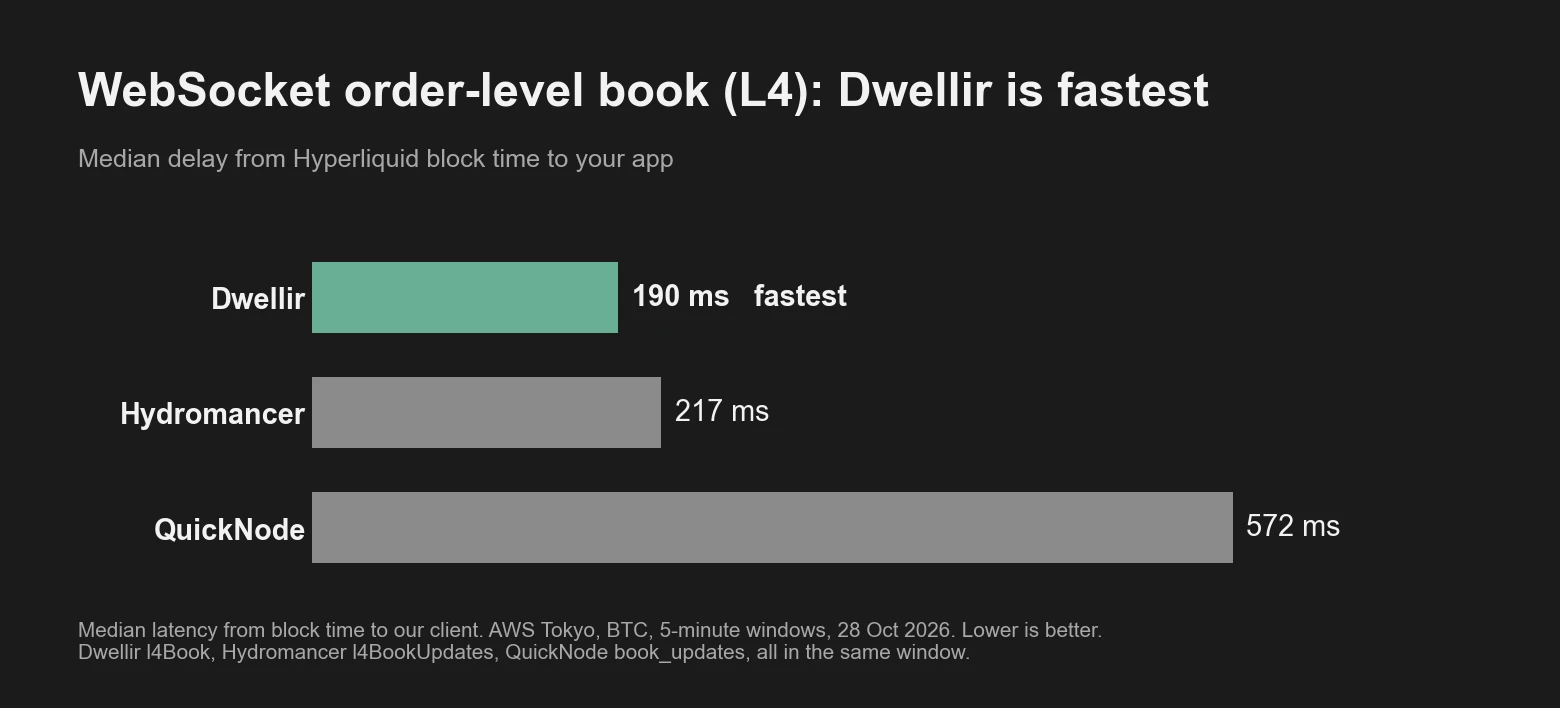
| Provider | Feed | Median | Slowest 5% |
|---|---|---|---|
| Dwellir | l4Book | 190 ms | 275 ms |
| Hydromancer | l4BookUpdates | 217 ms | 352 ms |
| QuickNode | book_updates | 572 ms | 730 ms |
All three feeds send each order change per block, and all three ran in the same 5-minute window. Dwellir was 27 ms ahead of Hydromancer at the median. In an earlier 5-minute window the same day, without QuickNode, the gap was 8 ms. QuickNode was three times slower. Its payloads carry its own receive time (local_time), which shows its node had each update about 166 ms after block time, so most of the delay comes after QuickNode's node, in its WebSocket delivery. See the L4 order book docs for the message format.
Which Provider Has the Fastest Hyperliquid Trades Feed?
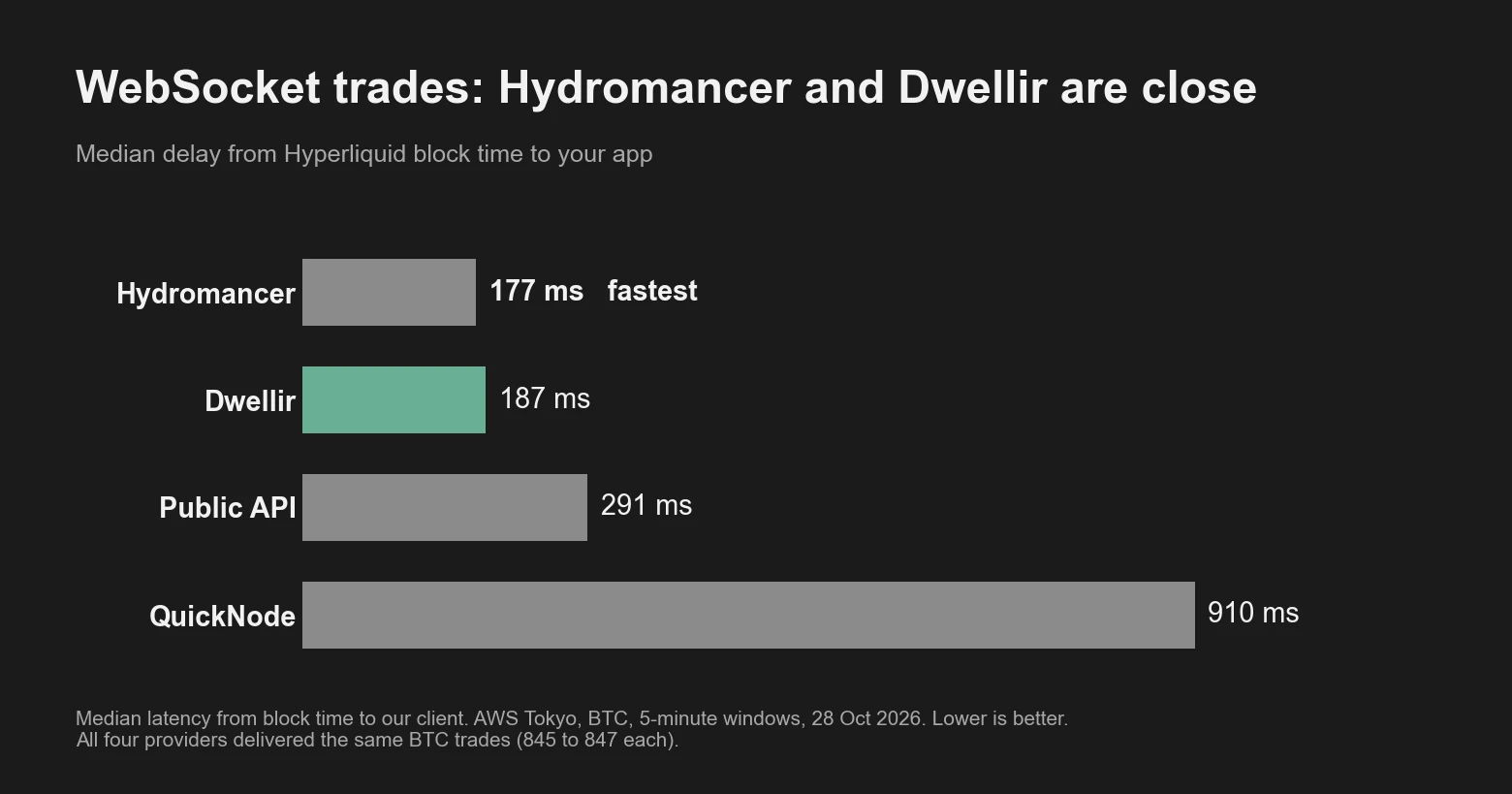
| Provider | Median | Slowest 5% |
|---|---|---|
| Hydromancer | 177 ms | 375 ms |
| Dwellir | 187 ms | 310 ms |
| Public API | 291 ms | 600 ms |
| QuickNode | 910 ms | 1,248 ms |
Every provider delivered the same BTC trades (845 to 847 each). Hydromancer was 10 ms faster for the typical trade, and Dwellir was 65 ms faster in the slowest 5%. QuickNode's WebSocket trades were about five times slower than the leaders.
Which Provider Has the Fastest Hyperliquid gRPC Stream?
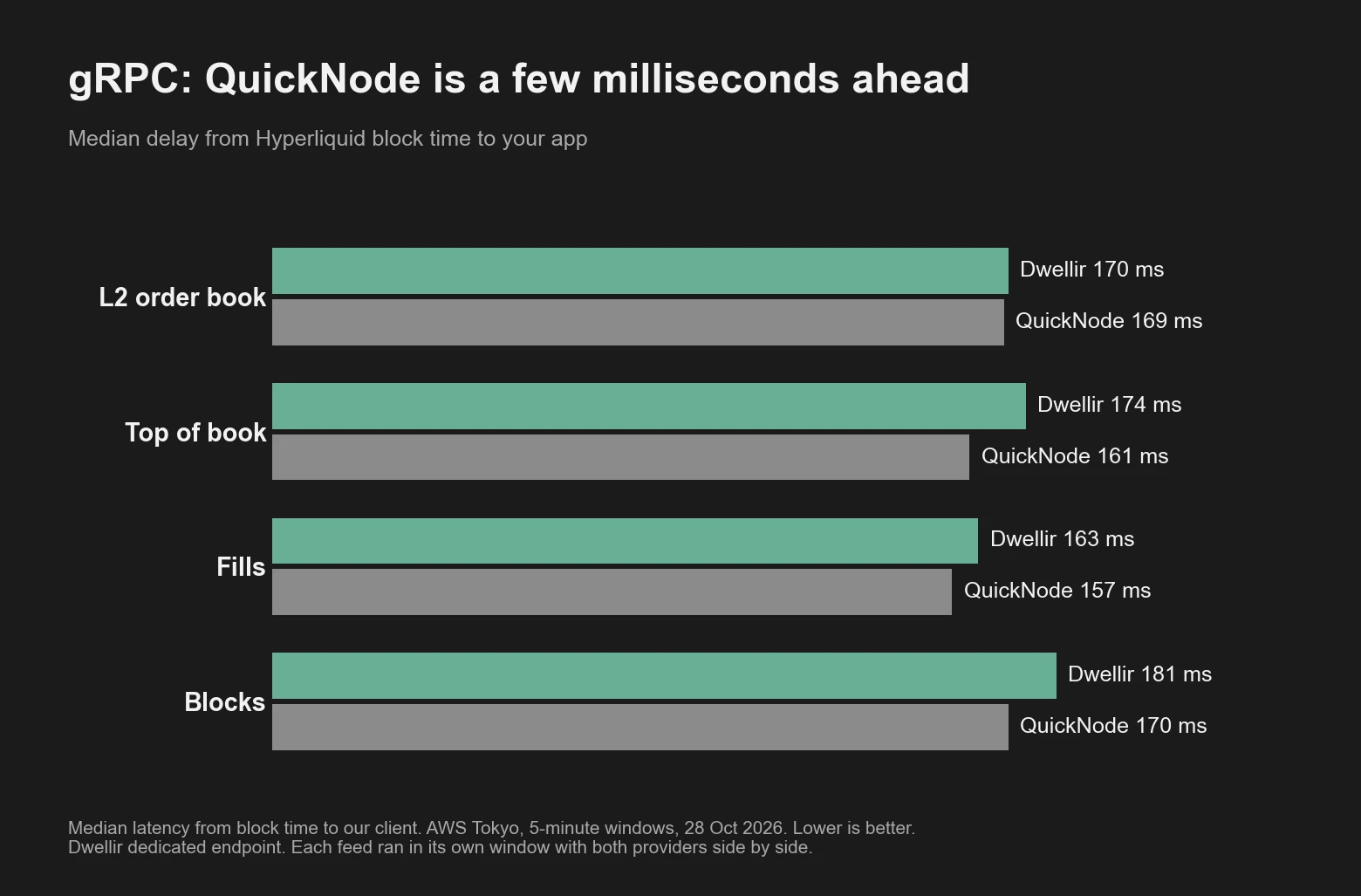
| Feed | Dwellir | QuickNode |
|---|---|---|
| L2 order book | 170 ms | 169 ms |
| Top of book (BBO) | 174 ms | 161 ms |
| L2 book changes | 171 ms | 168 ms |
Fills (StreamFills) | 163 ms | 157 ms |
| Order statuses | 177 ms | 167 ms |
| Raw book changes | 170 ms | 160 ms |
| Blocks | 181 ms | 170 ms |
| TWAP statuses | 167 ms | 158 ms |
| Misc events | 168 ms | 160 ms |
QuickNode was ahead on eight of the nine gRPC feeds, by 3 to 13 ms at the median, and tied with Dwellir on the L2 book (1 ms apart). The gap is mostly how early each node receives the block: QuickNode's payloads carry its own receive time (local_time), which put its node at about 155 ms after block time, and its gRPC delivery added only a few milliseconds. Hydromancer and GoldRush do not offer gRPC. Read more about Dwellir's Hyperliquid gRPC API.
How Does GoldRush Compare?
GoldRush was not part of the 28 October runs. It ran in a 30-minute window on 23 October, side by side with Dwellir:
| Feed | GoldRush | Dwellir |
|---|---|---|
| L2 order book | 548 ms | 171 ms |
| L4 order book | 360 ms | 178 ms |
Trades (GoldRush allFills) | 684 ms | 181 ms |
GoldRush was two to four times slower than Dwellir at the median. It has no trades or BBO channel, so its trades row uses its allFills stream filtered to BTC.
WebSocket or gRPC: Which Should You Use?
- Order books over WebSocket: choose Dwellir. It was fastest for L2, BBO and L4.
- Trades over WebSocket: Hydromancer or Dwellir. They are within 10 ms, and Dwellir has fewer slow trades.
- gRPC: QuickNode was a few milliseconds faster; Dwellir was close on every feed.
- Avoid for latency-sensitive work: QuickNode's WebSocket feeds, GoldRush and the public API.
- Host in Tokyo. Among the leading providers the gaps are a few milliseconds; a server far from Tokyo adds delay to every message.
The Dwellir figures above are from a Dwellir dedicated node. Dwellir's shared endpoints were within 15 ms of it at the median on every feed. Their slow moments can be slower: in the 28 October window, the shared L2 book's slowest 5% was 493 ms against 259 ms on the dedicated node.
What Does Not Change: Order Placement
A faster data feed shows you market changes sooner. It does not make orders fill faster. Orders are signed and sent to Hyperliquid's own /exchange endpoint at api.hyperliquid.xyz, and none of the providers in this test relay them. To cut the rest of your delay, run your bot in Tokyo. Our guide to Hyperliquid latency covers each step.
Methodology: How We Measured Hyperliquid Latency
- Server: one AWS server in Tokyo (
ap-northeast-1). Its clock was synced to within a few microseconds. - Latency: the time a message reached our client minus the block time inside the message, recorded before parsing.
- Fair test: for each feed, every provider ran at the same time over its own connection, so all saw the same blocks and market load.
- Market: the BTC perpetual for order book, BBO and trade feeds (20 levels for the L2 book). gRPC fills, order statuses, book changes, blocks, TWAP and misc events cover all coins.
- Length: 5 minutes per feed on 28 October 2026. The L4 window, with QuickNode
book_updates, ran later the same day. GoldRush ran in a 30-minute window on 23 October.
Expect a few milliseconds of variation between runs.
What Comes Next
We will rerun this benchmark and update this post over the coming months.
In November, Dwellir is releasing ultra-low latency clusters for high-performance trading teams, built for low and steady read latency. They start at $10,000 a month. Contact the Dwellir team to get early access.
Frequently Asked Questions
What is the fastest Hyperliquid WebSocket API?
In our Tokyo test on 28 October 2026, Dwellir had the fastest Hyperliquid WebSocket order books: a median of 177 ms for the L2 book and 190 ms for the order-level (L4) book. Hydromancer was 8 to 27 ms behind, the public API about 100 ms behind, and QuickNode's order-level feed about 380 ms behind.
What is the fastest Hyperliquid gRPC API?
QuickNode was up to 13 ms faster than Dwellir at the median on the gRPC feeds we tested from Tokyo; on the L2 book the two were tied (169 ms against 170 ms). Most of the gap is when each provider's node receives the block. Hydromancer and GoldRush do not offer gRPC.
Is the Hyperliquid public API fast enough for trading?
The public WebSocket API was about 100 ms slower than Dwellir at the median and about twice as slow in its slowest 5% of messages. Its l2Book channel also sent about one update every 5 seconds, against about 14 a second from Dwellir. It is fine for dashboards, but slow for latency-sensitive trading.
Should I use WebSocket or gRPC for Hyperliquid data?
Both are fast when the provider runs them well: Dwellir's medians were 163 to 190 ms on both. gRPC gives typed messages and feeds such as fills, order statuses and blocks. WebSocket is simpler to start with and uses the same subscription format as the public API.
Where should I host a Hyperliquid trading bot?
Host it in Tokyo (AWS ap-northeast-1 or nearby), where these results were measured. Among the leading providers, a few milliseconds separate the fastest from the next, while a server far from Tokyo adds network delay to every message.
How was Hyperliquid latency measured?
For every message we took the time it reached our client and subtracted the Hyperliquid block time inside the message. All providers for a feed ran at the same time, from one AWS server in Tokyo with a clock synced to within a few microseconds, for 5 minutes per feed.
What is the best Hyperliquid RPC provider for low-latency trading?
It depends on the transport. In our Tokyo test Dwellir had the fastest WebSocket order books, Hydromancer and Dwellir were nearly tied on WebSocket trades, and QuickNode was a few milliseconds ahead on gRPC. For request-based RPC (Info API and HyperEVM), see our Hyperliquid RPC providers comparison.
Does a faster data provider make my Hyperliquid orders fill faster?
No. A faster provider shows you market changes sooner, so your bot can react sooner. Orders are signed and sent to Hyperliquid's own exchange endpoint (api.hyperliquid.xyz/exchange), and the providers in this test do not change how fast an order is matched.
What is the Hyperliquid L4 order book?
The L4 order book lists every individual resting order, with its size, price and owner, rather than the total size at each price level (L2). It lets a bot see queue position and track single orders. Dwellir streams it as l4Book, Hydromancer as l4BookUpdates and QuickNode as book_updates over WebSocket.
How often is this Hyperliquid benchmark updated?
We rerun the benchmark from Tokyo and update this post and its date when the numbers change. Each update lists the date and window length of every run.
Related Resources
- Hyperliquid Order Book Server and docs
- Hyperliquid gRPC API and docs
- Hyperliquid WebSocket API docs
- Hyperliquid latency explained
- Best Hyperliquid RPC providers
- Hyperliquid WebSocket subscription limits
- Hyperliquid peering
- Switch from QuickNode
- Contact the Dwellir team to run this benchmark against your own workload