The official HyperEVM endpoint allows 100 requests per minute. A trading bot that polls five eth_call requests per second needs 300. It runs about 13 million calls a month, and the bill for those calls depends on how each provider counts a call.
At Dwellir and Chainstack, 13 million calls fit inside a $49 plan. At dRPC, the $49 Pro plan covers about 10 million calls and the rest add about $18 at the $6.00 overage rate. At QuickNode, the $49 Build plan covers 4 million calls and the rest add about $112 in extra credits. At Alchemy, 13 million calls cost about $177. The same workload costs $49 at one provider and more than three times that at another.
This comparison covers 6 providers selling managed HyperEVM RPC, plus two free or self-run options. Prices are a list-price snapshot from 2026-10-07, converted to dollars per million calls, alongside archive, debug, trace and HyperCore data coverage.
What makes Hyperliquid different for RPC
Hyperliquid runs two execution layers on one HyperBFT consensus. HyperCore holds the order books, fills and positions. HyperEVM, at chain ID 999, runs Solidity contracts and exposes Ethereum JSON-RPC. An EVM RPC endpoint gives you HyperEVM. It does not give you HyperCore order books or fills. Those come from the Info API, node feeds or an order book service. See how Hyperliquid's infrastructure works for the full picture.
Two block types on HyperEVM
HyperEVM produces small blocks every second with a 3M gas limit, and big blocks every minute with a 30M gas limit. Transactions go to small blocks by default. A bot reading state on every small block makes about 86,400 eth_blockNumber or eth_call requests a day per polled value, which is where per-call pricing starts to matter.
Public limits are low on every surface
The official limits are 100 requests per minute on EVM JSON-RPC at rpc.hyperliquid.xyz/evm, 1,200 weight per minute per IP on the REST info and exchange API, and 10 WebSocket connections per IP. The public EVM endpoint has no WebSocket for new heads, so a bot on the public endpoint has to poll.
HyperCore data is a separate purchase
Order book depth, fills and order statuses are HyperCore data. Providers sell them as separate products: gRPC streams, an Info API proxy, or an order book WebSocket. Compare quotes on the exact feed and depth you need (L2 aggregated levels or L4 individual orders), not on the HyperEVM endpoint alone.
What to look for in a Hyperliquid RPC provider
Cost per call on your method mix. Bots and indexers are polling-heavy, and compute-unit providers weight eth_call and eth_getLogs at 20-60 units each. Convert every quote to dollars per million calls before comparing.
WebSocket on HyperEVM. The public endpoint has none. Check that eth_subscribe for newHeads and logs works on the plan you buy.
Archive, debug and trace. Backtests, PnL reconstruction and contract debugging need historical state and traces. Alchemy has no Trace API on HyperEVM, and some providers charge double for archive reads.
HyperCore coverage. If you trade on HyperCore, you need order book and fill data next to the EVM endpoint. Check whether the provider sells L2 or L4 depth, and from which regions.
Dedicated capacity. Shared endpoints share throughput with other customers. For latency-sensitive trading, compare dedicated node prices and what they include.
Top pick by use case
Short answers. The pricing method, the comparison table and the methodology show the working.
- Lowest cost per HyperEVM call: Dwellir, $1.96 per million on the $49 Developer plan. One credit per response for every method, including debug and trace.
- HyperEVM plus HyperCore (Hyperliquid) data from one provider: Dwellir. gRPC streams of the node feeds from $299 a month plus usage, and an Order Book WebSocket with L2 and L4 depth from $199 a month plus usage.
- Dedicated infrastructure for latency-sensitive trading: Dwellir's Dedicated Node Cluster, from $4,000 a month for two backend nodes with gRPC and the Order Book server included and no usage charges.
- SOC 2 documentation with archive and trace: Chainstack, $2.45 per million on the $49 Growth plan, SOC 2 Type II and ISO 27001.
- Pay as you go with no plan: dRPC, $6.00 per million calls with archive at the same price, capped at 100 RPS.
- Hyperliquid-only provider with a Tokyo region: HypeRPC, with Nanoreth archive and an order book WebSocket. Prices are not published.
- Free tier for prototyping: dRPC (210M compute units a month, about 10.5 million calls), Chainstack (3M request units a month) or Dwellir (100,000 responses a day at 20 RPS).
How to compare Hyperliquid pricing across unit systems
Every headline rate in this comparison is quoted in a different unit. The only way to compare them is to convert each one to dollars per million calls for the methods a bot or indexer actually makes, using the weight each provider assigns to the method.
Per-request billing. One response is one unit, whatever the method. Dwellir bills this way, and Chainstack does too on recent state (1 request unit per call, 2 for reads 127 or more blocks behind the tip and for every debug or trace call). Dwellir's Developer plan works out to $1.96 per 1M calls included, with overage at $5.00 per 1M ($2-5 across plans). Chainstack Growth is $2.45 per 1M included, $15 per 1M overage.
Compute units and credits. The provider charges per million units and gives each method a weight, so the cost of a call depends on the method.
- Alchemy charges $0.525 per 1M CU. That is $13.65 per 1M
eth_call, $31.50 per 1Meth_getLogs, $21.00 per 1Meth_sendRawTransaction, $10.50 per 1Meth_getTransactionReceiptoreth_getBalance, and $21.00 per 1Mdebug_traceTransaction. - QuickNode assigns a flat 20 credits to every Hyperliquid call, which is $10.00 per 1M calls at Business's overage rate and $12.40 at Build's. Debug and trace calls carry a 2x multiplier, $20.00 per 1M at the Business overage rate.
- dRPC assigns 20 CU to every method, so every call costs the same. The $49 Pro plan works out to $4.80 per 1M calls, Scale ($199) to $4.20, and pay as you go and overage to $6.00, with trace and archive included on paid plans.
- HypeRPC meters in compute units but does not publish its prices or its method weights, so there is no per-call figure to compare.
Method by method, in dollars per 1M calls at each plan's included rate:
| Method | Dwellir (Developer) | Chainstack (Growth) | dRPC (Pro) | QuickNode (Business) | Alchemy (PAYG) |
|---|---|---|---|---|---|
eth_call | $1.96 | $2.45 | $4.80 | $9.99 | $13.65 |
eth_getTransactionReceipt | $1.96 | $2.45 | $4.80 | $9.99 | $10.50 |
eth_getLogs | $1.96 | $2.45 | $4.80 | $9.99 | $31.50 |
eth_sendRawTransaction | $1.96 | $2.45 | $4.80 | $9.99 | $21.00 |
debug_traceTransaction | $1.96 | $4.90 | $4.80 | $19.98 | $21.00 |
Dwellir and Chainstack overage runs $2-5 and $15 per 1M respectively, and Chainstack doubles the unit for reads 127 or more blocks behind the tip and for debug and trace calls.
The monthly totals later in this post use a mostly-reads mix: 40% eth_call, 25% receipts, 15% eth_blockNumber, 10% eth_getLogs over small ranges, 5% eth_getBalance and 5% eth_sendRawTransaction, all on recent blocks. On that mix a call averages 25.9 CU on Alchemy (eth_blockNumber is 10 CU), so 1M calls cost $13.60 and the free 30M CU covers about 1.16M calls. On QuickNode every call is 20 credits, so Build's 80M credits cover 4M calls and Business's 2B credits cover 100M calls at $999.
1. Dwellir
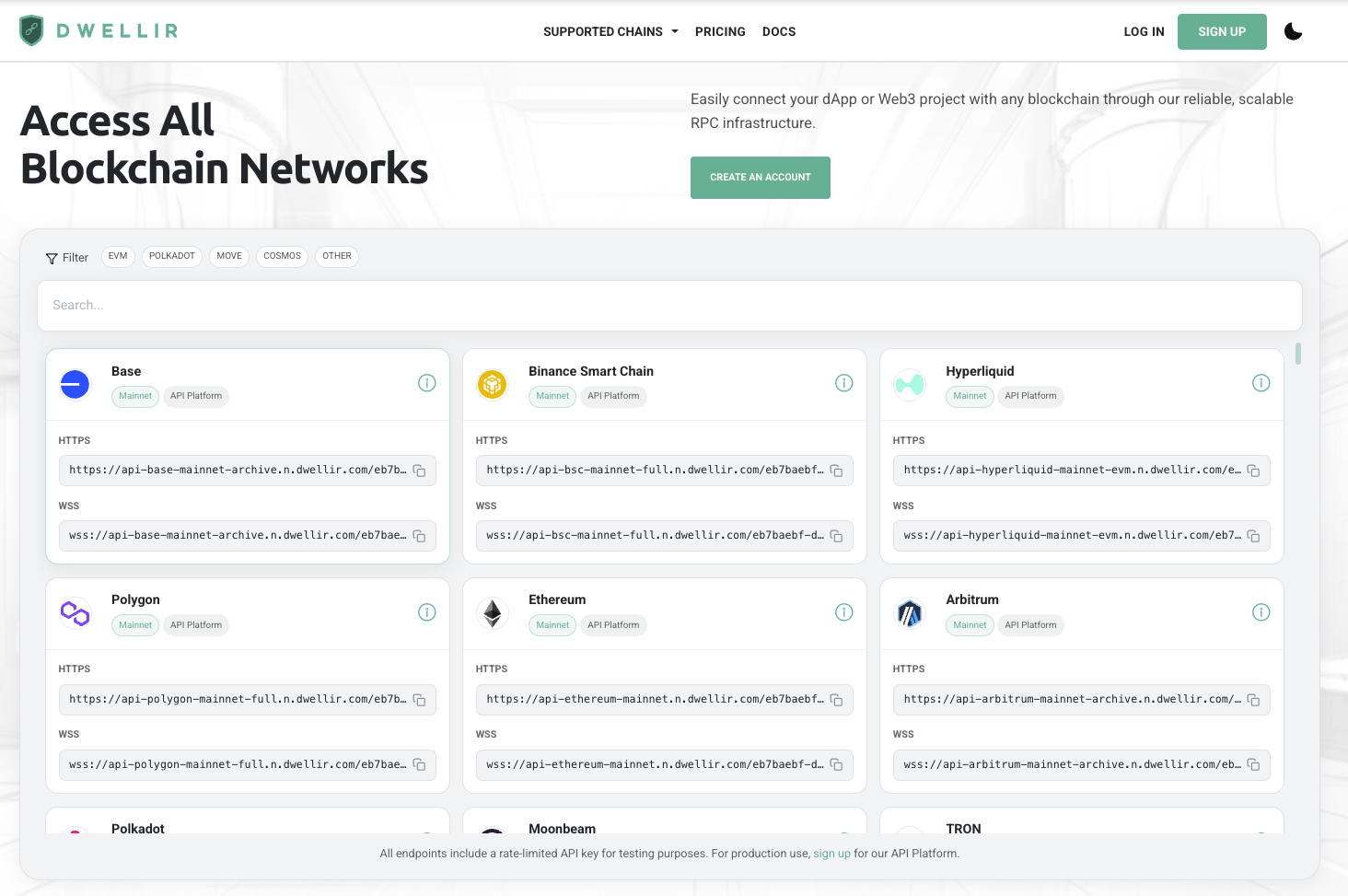
Dwellir serves HyperEVM on 1:1 pricing: one RPC response is one API credit, with no compute units, including on debug and trace. The endpoint is https://api-hyperliquid-mainnet-evm.n.dwellir.com/<your-api-key>, with WSS on the same host and the debug and trace namespaces enabled on every plan. Dwellir also runs the HyperCore (Hyperliquid) side: an Info endpoint, gRPC streams of the node feeds, an Order Book WebSocket and a historical data archive.
Key features:
- WebSocket on the same endpoint as HTTPS
debug_*andtrace_*on every plan at one credit per call- gRPC streaming of blocks, fills, order statuses and raw book diffs, $299 a month plus usage
- Order Book WebSocket with L2 and L4 depth from Singapore and Tokyo, $199 a month plus usage
- Unlimited Node for flat, unmetered billing on the same URL and key
- 150+ networks, crypto payment on every paid plan
Pricing:
| Plan | Monthly Cost | Responses Included | RPS (Burst) | Effective $/1M Calls | Overage $/1M Calls |
|---|---|---|---|---|---|
| Free | $0 | 100,000/day | 20 | $0 | - |
| Developer | $49 | 25M | 100 (500) | $1.96 | $5.00 |
| Growth | $299 | 150M | 500 (2,500) | $1.99 | $3.00 |
| Scale | $999 | 500M | 5,000 (10,000) | $2.00 | $2.00 |
| Unlimited Node | Monthly Cost | Calls Covered at Full RPS | Effective $/1M Calls |
|---|---|---|---|
| 25 RPS | $119 | 65M | $1.83 |
| 100 RPS | $479 | 260M | $1.84 |
| 250 RPS | $1,199 | 650M | $1.84 |
| 500 RPS | $2,399 | 1.3B | $1.85 |
| 1,000 RPS | $4,799 | 2.6B | $1.85 |
The Dedicated Node Cluster starts at $4,000 a month with two backend nodes serving HyperEVM and HyperCore. It includes Info endpoints, gRPC and the Order Book server, all unmetered, with no request counting.
Considerations: The Free plan excludes eth_getLogs, and the Developer plan caps eth_getLogs at 500 blocks per request (10,000 on Growth and Scale). The HyperEVM network page does not state whether the shared endpoint serves full archive state, so confirm historical eth_call depth for your workload before you rely on it. gRPC and Order Book usage is billed at one credit per message on top of the add-on fee, so a high-volume L4 feed on a shared plan can cost more than a dedicated cluster.
Best for: Bots and indexers that make many recent-state calls and need HyperCore data from the same provider. Teams running latency-sensitive strategies at volume should price the Dedicated Node Cluster.
2. Chainstack
Chainstack serves HyperEVM on Global Node (shared) and dedicated nodes, with full and archive on mainnet and testnet, and debug and trace on both. Its Hyperliquid materials also advertise HyperCore access. It bills one request unit per call on recent state.
Key features:
- Archive, debug and trace on HyperEVM, at 2 request units per call
- SOC 2 Type II and ISO 27001
- Unlimited Node add-on from $149 a month for 25 RPS, on top of Growth or higher
- 70+ networks
Pricing:
| Plan | Monthly Cost | Request Units Included | RPS | Effective $/1M Calls | Overage $/1M Calls |
|---|---|---|---|---|---|
| Developer | $0 | 3M | 25 | $0 | $20.00 |
| Growth | $49 | 20M | 250 | $2.45 | $15.00 |
| Pro | $199 | 80M | 400 | $2.49 | $12.50 |
| Business | $499 | 200M | 600 | $2.50 | $10.00 |
| Enterprise | $990 | 400M | Unlimited | $2.48 | $5.00 |
Annual billing lowers Growth to $40, Pro to $166, Business to $416 and Enterprise to $825 a month.
Considerations: Reads 127 or more blocks behind the tip and every debug or trace call cost 2 request units, so backtests and trace-heavy indexing cost $4.90 per million on Growth. Overage on Growth is $15 per million, six times the included rate, so size the plan to your volume. The 600 RPS cap on Business is the highest shared limit below Enterprise.
Best for: Teams that need archive, trace and compliance documentation on one shared endpoint at close to per-request pricing.
3. dRPC
dRPC lists HyperEVM (chain ID 999) with archive. It charges a flat 20 compute units per method at $0.30 per million CU, so every call costs the same, archive and trace included.
Key features:
- The same price for every method: $4.80 per million calls on Pro, $4.20 on Scale and $6.00 on pay as you go
- Archive at the same price as recent state
- Free tier of 210M CU a month on public nodes, about 10.5 million calls
- 300 RPS on Pro, 600 RPS on Scale and 100 RPS on pay as you go
Pricing:
| Plan | Monthly Cost | Included | RPS | Effective $/1M Calls | Overage $/1M Calls |
|---|---|---|---|---|---|
| Free | $0 | 210M CU (public nodes, ~10.5M calls) | 100 | $0 | - |
| Pro | $49 | 163M CU (~10M calls) | 300 | $4.80 | $6.00 |
| Scale | $199 | 664M CU (~47M calls) | 600 | $4.20 | $6.00 |
| Pay as you go | $6/1M requests | No commitment | 100 | $6.00 | - |
| Enterprise | From $990 | Volume discounts, dedicated clusters | Unlimited | Custom | Custom |
Considerations: At $4.80 per million on Pro, dRPC costs about 2.4 times Dwellir and twice Chainstack on included volume. Pay as you go at $6.00 per million needs no monthly commitment but is capped at 100 RPS. Its chain list does not say whether WebSocket is available on HyperEVM. It sells no HyperCore data.
Best for: Archive and trace reads on HyperEVM at a flat price, and spiky workloads that do not fit a monthly plan.
4. HypeRPC
HypeRPC is a Hyperliquid-only provider. It serves HyperEVM through Nanoreth (archive, trace calls and past state) and HLNode, a 1:1 Info API over REST and WebSocket, and an order book WebSocket with L2 and L4 data up to 100 levels. It runs in Tokyo and Europe and sells sentry peering in Tokyo by application.
Key features:
- HTTPS and WSS on every plan
- Nanoreth archive and trace calls on HyperEVM
- Info API and order book WebSocket for HyperCore data
- Tokyo (JP) and EU regions
Pricing: HypeRPC sells Free, Starter, Growth and Pro plans metered in compute units, with an RPS cap and a set number of API keys per plan, plus compute-unit top-ups. Prices and method weights are only shown after you sign up to its console, so there is no per-call figure to compare as of 2026-10-07.
Considerations: Without published prices or compute-unit weights, you cannot estimate a monthly bill before signing up. Debug support is not stated. It covers one network, so multi-chain teams need a second provider.
Best for: Hyperliquid-only teams that want an archive HyperEVM endpoint and HyperCore order book data from a Tokyo region, and are willing to get a quote first.
5. QuickNode
QuickNode serves HyperEVM with archive, and its Hyperliquid API overview lists HyperCore data including gRPC streams. It assigns 20 API credits to every Hyperliquid call and 40 to debug and trace calls.
Key features:
- Archive and WebSocket on HyperEVM
- Debug and trace on paid plans, not on the free trial
- Hyperliquid Peering listed on paid plans
- SOC 1 Type 2, SOC 2 Type 2 and ISO 27001
Pricing:
| Plan | Monthly Cost | API Credits | RPS | Effective $/1M Calls | Overage $/1M Calls |
|---|---|---|---|---|---|
| Free trial | $0 (1 month) | 10M | 15 | $0 | - |
| Build | $49 | 80M | 50 | $12.25 | $12.40 |
| Accelerate | $249 | 450M | 125 | $11.07 | $11.20 |
| Scale | $499 | 950M | 250 | $10.51 | $10.60 |
| Business | $999 | 2B | 500 | $9.99 | $10.00 |
| Enterprise | Custom | Custom | Custom | Custom | Custom |
Annual billing takes about 30% off: Build $34, Accelerate $212, Scale $424 and Business from $849 a month.
Considerations: At 20 credits per call, Build's 80M credits cover 4M HyperEVM calls, and the free trial's 10M credits cover 500,000. Build is capped at 50 RPS, so a bot running more than 50 calls per second needs Accelerate or higher whatever its monthly volume. Debug and trace calls cost $19.98 per million on Business.
Best for: Teams that already run QuickNode across other chains and want HyperEVM and HyperCore streams under the same account.
6. Alchemy
Alchemy serves HyperEVM with archive and WebSocket, and supports 14 of its 16 Debug API methods there. It has no Trace API on HyperEVM.
Key features:
- Free tier of 30M CU a month, about 1.16M calls on the mix
- Pay as you go with 300 RPS (10,000 CU/s) included
- Enhanced APIs, webhooks and SDKs shared across 100+ networks
Pricing:
| Plan | Monthly Cost | Included | Throughput | Effective $/1M Calls | Overage $/1M Calls |
|---|---|---|---|---|---|
| Free | $0 | 30M CU (~1.16M calls) | 300 CU/s (15 req/s) | $0 | - |
| Pay as you go | $0.525/1M CU | Usage-based | 10,000 CU/s (300 req/s) included | $13.60 | $13.60 |
| Enterprise | Custom | Custom | Custom | Custom | Custom |
Each additional 5,000 CU/s of throughput costs $160 a month, up to a self-serve ceiling of 30,000 CU/s.
Considerations: The rate is flat at $0.525 per million CU at any spend, so the effective price does not fall with volume: $13.60 per million calls on the mix, $31.50 per million eth_getLogs. Going from the included 10,000 CU/s to the 30,000 CU/s ceiling adds $640 a month. No trace_* methods on HyperEVM, and no HyperCore data.
Best for: Teams already on Alchemy for other chains that want one dashboard and its enhanced APIs, and accept the higher per-call price on HyperEVM.
Other options
Altitude public RPC. Altitude runs a free public HyperEVM endpoint. It is shared, has no SLA and publishes no rate limit or price. It is useful for prototyping and not for production bots.
Self-hosted Nanoreth. Nanoreth is an open-source HyperEVM archive node. Running it removes per-call fees but adds hardware, storage, monitoring and on-call costs. It makes sense for teams with an infrastructure engineer and a need for full data ownership. If you run your own Hyperliquid node, Dwellir's peering service reserves gossip peer slots for it at $500 a month per slot.
Provider comparison
| Provider | Free Tier | Entry Paid | Effective $/1M Calls | Archive on HyperEVM | WSS | Debug | Trace | getLogs Cap | Pricing Unit | Networks |
|---|---|---|---|---|---|---|---|---|---|---|
| Dwellir | 100K/day | $49/mo | $1.96 | Not stated | Yes | Yes | Yes | 500 blocks (Developer), 10,000 (Growth+) | 1 response | 150+ |
| Chainstack | 3M RU/mo | $49/mo | $2.45 | Yes (2 RU) | Yes | Yes (2 RU) | Yes (2 RU) | Not stated | 1 RU (2 archive) | 70+ |
| dRPC | 210M CU/mo | $49/mo | $4.80 | Yes | Not stated | Paid plans | Paid plans | Not stated | 20 CU flat | 130+ |
| HypeRPC | Yes (limits not published) | Not published | Not published | Yes (Nanoreth) | Yes | Not stated | Yes | Not stated | CU (not published) | 1 |
| QuickNode | 10M credits, 1 month | $49/mo | $12.25 | Yes | Yes | Paid only | Paid only | Not stated | 20 credits/call | 75+ |
| Alchemy | 30M CU/mo | $0.525/1M CU | $13.60 | Yes | Yes | Paid only | No | Not stated | CU (~25.9/req) | 100+ |
For reference, the official public endpoint rpc.hyperliquid.xyz/evm allows 100 requests per minute and has no WebSocket for new heads.
Effective price per million calls
One denominator for every provider: dollars per 1M HyperEVM calls under the mix, at the entry paid plan and at the best self-serve rate, with overage alongside.
| Provider | Entry Paid Plan | Effective $/1M Calls | Best Self-Serve Rate | Overage $/1M Calls |
|---|---|---|---|---|
| Dwellir | Developer $49 | $1.96 | $1.83 (Unlimited Node, 25 RPS) | $2.00-5.00 |
| Chainstack | Growth $49 | $2.45 | $2.45 (Growth) | $5.00-20.00 |
| dRPC | Pro $49 | $4.80 | $4.20 (Scale) | $6.00 |
| QuickNode | Build $49 | $12.25 | $9.99 (Business) | $10.00-12.40 |
| Alchemy | Pay as you go | $13.60 | $13.60 | $13.60 |
| HypeRPC | Not published | Not published | Not published | Not published |
What that costs at volume
Plans step at fixed tiers, so monthly bills differ from the per-million rates. Same mix, list prices.
| Provider | 10M req/mo | 50M req/mo | 100M req/mo |
|---|---|---|---|
| Dwellir (metered) | $49 | $174 | $299 |
| Chainstack | $49 | $199 | $449 |
| Dwellir (Unlimited Node) | $119 | $119-479 | $479 |
| dRPC | $49 | $217 | $517 |
| QuickNode | ~$123 | ~$526 | $999 |
| Alchemy | ~$136 | ~$680 | ~$1,360 |
| HypeRPC | Not published | Not published | Not published |
At 10M requests, Dwellir, Chainstack and dRPC (Pro) all cost $49. At 50M and 100M, Dwellir has the lowest list price here, and QuickNode and Alchemy cost about three to four and a half times as much. The Unlimited Node at 50M is $119 if average traffic stays under 25 RPS and $479 for the 100 RPS tier.
Methodology
How this list was ordered and how the numbers were produced, so you can reproduce or dispute them.
Ranking. This is an editorial ranking by Dwellir, the publisher of this post, and Dwellir is one of the providers in it. It weighs three things: the effective cost per million calls on the house mix, how predictable the bill is when your method mix, block age or volume changes, and what the plans include (free tier, archive, debug and trace, MEV protection or compliance). No single criterion sorts the list, so a provider can sit above a cheaper one. On HyperEVM the published-price providers happen to follow entry-plan cost on the mix. HypeRPC publishes no prices, so it is placed on coverage: a Hyperliquid-only provider with a Tokyo region, Nanoreth archive and an order book WebSocket. QuickNode and Alchemy close the list because they are the two most expensive per call on this mix among providers that publish prices. QuickNode charges a flat 20 credits per call but doubles debug and trace; Alchemy weights each method at 10 to 60 CU and has no Trace API on HyperEVM.
Cost per million is each plan's monthly price divided by the number of calls its included units buy on the mix, after applying the provider's own method weights. Alchemy has no fixed bundle, so its metered rate is used. Annual discounts and add-ons are excluded. Volume figures add overage or the next tier at list price.
Unit weights come from each provider's published tables: Alchemy compute unit costs, QuickNode API credits per Hyperliquid method, dRPC's flat 20 CU with its per-plan request pools, and Chainstack's request-unit rules. Dwellir counts one unit per response.
Feature columns mean the provider serves the feature on HyperEVM mainnet on a self-serve plan. "Not stated" means the provider's public pages do not say.
Not measured here: latency, error rates and data freshness. Those depend on your region and method mix. Run a short benchmark from your own infrastructure against the two or three providers this list narrows you to before committing.
Verification date: plan prices, method weights and chain support were checked on each provider's pricing and documentation pages on 2026-10-07 (dRPC and Alchemy rechecked 2026-10-21). The modified date at the top of this post moves whenever a figure is rechecked.
Choosing the right provider
Trading bots and indexers on recent state: Dwellir. Every HyperEVM method costs one credit, Scale runs 5,000 RPS sustained, and the Unlimited Node starts at $119 for 25 RPS. If you also need order book or fill data, gRPC and the Order Book WebSocket come from the same account, and the Dedicated Node Cluster includes both from $4,000 a month.
Archive, trace and compliance on a shared endpoint: Chainstack. Archive and trace cost 2 request units, $4.90 per million on Growth, with SOC 2 Type II and ISO 27001. $449 covers 100M recent-block requests.
Spiky archive reads with no commitment: dRPC. $6.00 per million on every method with no plan, up to 100 RPS, or $4.80 on the $49 Pro plan, archive included.
Hyperliquid-only with a Tokyo region: HypeRPC, once you have a quote.
Existing QuickNode or Alchemy accounts: both serve HyperEVM with archive, at $9.99-12.25 and $13.60 per million calls. Alchemy has no Trace API on HyperEVM.
Streaming HyperEVM blocks with viem
The public endpoint has no WebSocket, so a bot there has to poll. This example subscribes to new HyperEVM blocks over Dwellir's WebSocket instead.
import { createPublicClient, defineChain, webSocket } from 'viem'

const WSS = 'wss://api-hyperliquid-mainnet-evm.n.dwellir.com/<your-api-key>'

const hyperEvm = defineChain({
  id: 999,
  name: 'HyperEVM',
  nativeCurrency: { name: 'HYPE', symbol: 'HYPE', decimals: 18 },
  rpcUrls: { default: { http: [], webSocket: [WSS] } },
})

const client = createPublicClient({ chain: hyperEvm, transport: webSocket(WSS) })

// Small blocks arrive about once a second; big blocks once a minute
client.watchBlocks({
  onBlock: (block) => {
    console.log(block.number, block.gasUsed, block.transactions.length)
  },
})
For HyperCore order book and fill data, use the gRPC streams or the Order Book WebSocket instead of the EVM endpoint.
Getting started
Before you commit, run your real workload against two or three providers. Two Hyperliquid-specific checks matter most: whether eth_subscribe works on HyperEVM on the plan you buy, and how far back historical eth_call and eth_getLogs go.
Free tiers exist at Dwellir, Chainstack, dRPC, Alchemy, HypeRPC and QuickNode (one-month trial). For more on the data side, see Hyperliquid historical data for backtesting and self-hosted vs managed RPC nodes.
Building on Hyperliquid? Create a Dwellir account to test the free tier, compare Hyperliquid pricing, or contact the Dwellir team about a Dedicated Node Cluster.
Frequently asked questions
Why is the Hyperliquid public RPC not enough for production?
The official HyperEVM endpoint at rpc.hyperliquid.xyz/evm allows 100 requests per minute and has no WebSocket for new heads. A bot polling five eth_call requests per second needs three times that limit, and an indexer backfilling HyperEVM at 100 requests per minute takes days for work a paid endpoint finishes in minutes.
What does one million Hyperliquid RPC requests cost?
Between $1.96 and $13.60 per million HyperEVM calls at entry pricing, on a mostly-reads mix checked on 2026-10-07. Dwellir is $1.96, Chainstack $2.45, dRPC $4.80, QuickNode $12.25 and Alchemy $13.60. HypeRPC does not publish prices. The entry plans cost about $49 a month at every metered provider, so the spread comes from how each provider weights a request. See the effective price table.
Which Hyperliquid RPC providers offer HyperCore data as well as HyperEVM?
Dwellir streams HyperCore (Hyperliquid) node feeds over gRPC from $299 a month plus usage and runs an Order Book WebSocket with L2 and L4 depth from $199 a month plus usage. HypeRPC offers an Info API and an order book WebSocket with L2 and L4 levels. Chainstack and QuickNode also advertise HyperCore access. Alchemy and dRPC serve HyperEVM JSON-RPC only.
Which Hyperliquid RPC providers offer dedicated node clusters?
Dwellir's Dedicated Node Cluster starts at $4,000 a month with two backend nodes, HyperEVM JSON-RPC, Info endpoints, gRPC and the Order Book server included, and no usage charges. Chainstack also sells dedicated HyperEVM nodes, with archive, alongside its shared Global Node.
Which providers support debug and trace on HyperEVM?
Dwellir enables debug and trace on every plan at one credit per call. Chainstack supports both at 2 request units per call, dRPC on its paid plans, and QuickNode on paid plans at 40 credits per call. Alchemy supports most of its Debug API on HyperEVM but no Trace API.
Related resources
- RPC providers without compute units
- Hyperliquid infrastructure stack
- Hyperliquid architecture and public rate limits
- Dwellir gRPC API reference
- Dwellir Order Book WebSocket
- Hyperliquid documentation
This content is for informational purposes only and does not constitute financial or investment advice. Always conduct your own research when selecting infrastructure providers.