Your DeFi protocol just launched on PulseChain. Transactions cost under $0.01 and execute in 10 seconds. TVL stands at $64.5 million (DeFiLlama, April 2026), with PulseX serving as the dominant DEX in the ecosystem. The opportunity is real.
Then you try to provision RPC infrastructure. Alchemy doesn't support PulseChain. Neither does QuickNode, Chainstack, Ankr, GetBlock, or Infura. The providers that power Ethereum, Polygon, and most major chains haven't added PulseChain to their networks.
This creates an immediate problem. PulseChain forked Ethereum's entire state at genesis, copying every token, NFT, and smart contract. Your application needs archive access to query this pre-fork history. You need WebSocket support for real-time DEX monitoring. You need production-grade reliability. But your usual infrastructure providers aren't an option.
Finding PulseChain RPC infrastructure means evaluating providers you haven't worked with before.
What to Look for in a PulseChain RPC Provider
PulseChain's state fork architecture creates specific infrastructure requirements:
Archive Node Availability: PulseChain copied Ethereum's entire state at genesis. Applications analyzing token migrations, comparing pre-fork and post-fork states, or building analytics dashboards need archive access back to block zero. This matters more than on chains launching from genesis.
Cost Alignment with On-Chain Economics: Transactions cost under $0.01 on PulseChain. When you're making 100 million monthly requests and paying $300-500 for RPC infrastructure while on-chain transactions cost pennies, infrastructure becomes your dominant cost factor. Pricing models directly impact unit economics.
WebSocket Support for DeFi: PulseX and other protocols generate high-frequency activity. DEX aggregators, yield optimizers, and portfolio trackers need real-time event monitoring through WebSocket connections.
Multi-Chain Compatibility: Many PulseChain applications bridge assets or compare liquidity across Ethereum, BSC, and other networks. Unified multi-chain access simplifies infrastructure management and reduces API key sprawl.
Transparent Pricing: Compute unit models create unpredictable costs for DeFi applications with varied method call patterns. Direct pricing enables accurate budgeting.
1. Dwellir - Transparent 1:1 Pricing Across 140+ Networks
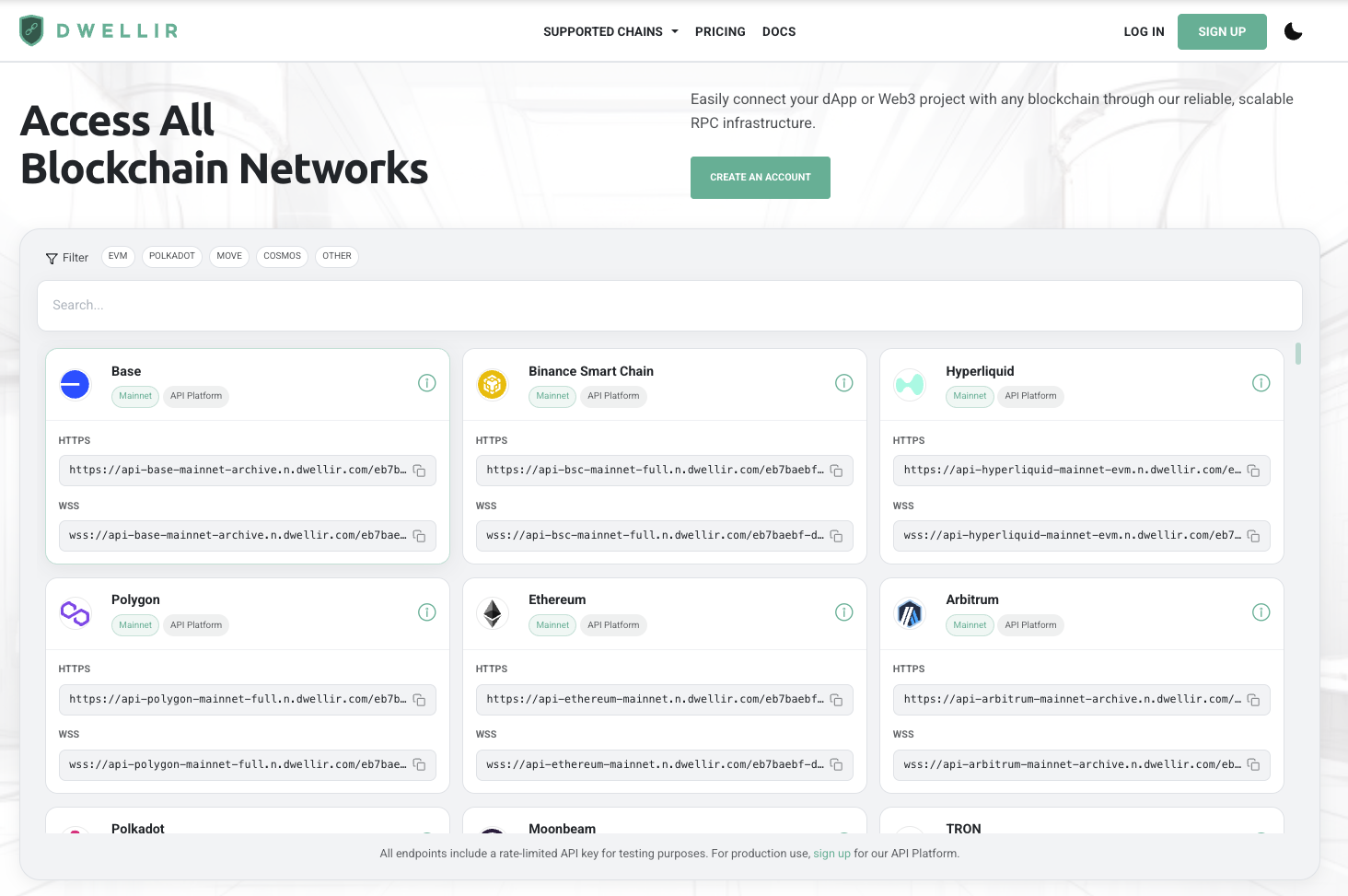
Dwellir uses a 1:1 credit model where every RPC response costs one API credit regardless of method complexity. eth_chainId and debug_traceTransaction both cost one credit. This pricing consistency extends across 140+ supported blockchains including Ethereum, BSC, Polygon, and PulseChain.
Plans range from 20 to 5,000 sustained RPS with burst capacity up to 10,000 RPS on the highest tier. Archive access comes standard on all paid plans, enabling historical queries back to PulseChain's genesis block.
Key Features
- 1:1 Credit System: All RPC methods cost exactly one credit, eliminating compute unit calculations and pricing unpredictability.
- Full Archive Access: Complete PulseChain history from genesis included on all paid plans.
- HTTPS and WebSocket: Both protocol types supported for polling and real-time event streaming.
- 140+ Network Coverage: Single API key works across PulseChain, Ethereum, Polkadot, Cosmos, and 137 other networks.
- Trace and Debug APIs: Advanced debugging methods included without premium pricing.
- Burst Protection: RPS limits include burst multipliers (up to 5x sustained rate) for traffic spikes.
Pricing Structure
| Plan | Price | Included Responses | Sustained RPS | Burst RPS | Overage |
|---|---|---|---|---|---|
| Free | Free | 100K per day | 20 RPS | 100 RPS | N/A |
| Developer | $49/month | 25M per month | 100 RPS | 500 RPS | $5 per 1M |
| Growth | $299/month | 150M per month | 500 RPS | 2,500 RPS | $3 per 1M |
| Scale | $999/month | 500M per month | 5,000 RPS | 10,000 RPS | $2 per 1M |
Dedicated node clusters for PulseChain run $875/month with unlimited RPS and responses for teams requiring guaranteed isolated resources and cryptocurrency payment options.
Pros and Cons
Advantages:
- Predictable costs without compute unit complexity, valuable for DeFi applications with varied method patterns.
- Archive access and trace/debug APIs included without premium pricing.
- Multi-chain coverage simplifies infrastructure for cross-chain applications.
- Direct engineering support on Growth plans and above.
- Burst protection handles traffic spikes without throttling.
Considerations:
- PulseChain-specific tooling (prebuilt monitors, ecosystem dashboards) less extensive than specialized providers.
- Newer to PulseChain compared to ecosystem-native options.
Best For
DeFi protocols, cross-chain bridges, and analytics dashboards that need cost predictability, multi-chain access, and full archive data. The Free plan provides an accessible entry point for testing integrations before scaling to production volumes.
2. Moralis - Extended RPC Methods with Token and NFT APIs
For teams building data-heavy applications, Moralis provides Extended RPC Methods that reduce development time. The platform added PulseChain support in January 2025.
Beyond standard JSON-RPC, Moralis offers enhanced endpoints like eth_getTokenBalances for retrieving all token holdings in a single call and eth_getTokenPrice for real-time pricing data. Portfolio trackers, NFT galleries, and DeFi dashboards can reduce individual RPC calls and eliminate custom indexing work.
The platform uses a compute unit model where different methods consume varying CUs based on computational intensity. eth_blockNumber consumes 1-2 CUs while archive queries and enhanced methods consume more. Archive node access is included across all paid tiers.
Key Features
- Extended RPC Methods: Enhanced endpoints like
eth_getTokenBalances,eth_getTokenPrice,eth_getTransactionsreduce development time. - Token and NFT APIs: Indexed data for token balances, transfers, and NFT ownership without custom indexing.
- DeFi APIs: Liquidity pool data, token swaps, and yield farming positions via prebuilt endpoints.
- Archive Node Access: Full historical data included on all paid plans.
- WebSocket Support: Real-time event monitoring for blocks, transactions, and contract events.
Pricing Structure
| Plan | Price | Included Volume | Notes |
|---|---|---|---|
| Free | $0 | 40,000 CU per day | Development and testing |
| Starter | $49/month | 2M CU per month | Basic production workloads |
| Pro | $199/month | 100M CU per month | High-volume applications |
Compute unit weights vary by method: lightweight calls consume 1-2 CUs, standard RPC methods 5-10 CUs, and enhanced methods like eth_getTokenBalances consume more based on address activity.
Pros and Cons
Advantages:
- Extended RPC methods significantly reduce development time for common use cases.
- Indexed Token and NFT APIs eliminate need for custom subgraphs.
- Strong documentation with PulseChain-specific examples.
- Archive access included without extra charges.
Considerations:
- Compute unit pricing requires workload modeling for accurate cost estimates.
- Limited to 2 API keys on Starter plan, 5 on Pro.
- Trace-heavy applications may see higher costs than 1:1 pricing models.
Best For
DeFi dashboards, portfolio trackers, and NFT marketplaces that benefit from indexed data APIs and can leverage extended RPC methods to reduce custom development work.
3. thirdweb - Unlimited Requests with RPS-Based Pricing
If your application needs Account Abstraction or embedded wallets, thirdweb combines RPC access with user experience infrastructure. The platform prices based solely on rate limits, not request volume.
The Starter plan at $5/month provides unlimited requests capped at 25 RPS. The Growth plan at $99/month increases the ceiling to 10,000 RPS while maintaining unlimited requests. For workloads where RPS needs are clear but total volume fluctuates, this eliminates request counting.
Beyond RPC access, thirdweb provides Account Abstraction infrastructure, embedded wallet SDKs, and gas sponsorship capabilities for PulseChain applications. These features enable gasless transactions and social login experiences that abstract blockchain complexity from end users.
Key Features
- Unlimited RPC Requests: Pricing based on RPS limits, not request volume.
- Account Abstraction: Smart wallet infrastructure for gasless transactions and social recovery.
- Embedded Wallets: Email/social login SDKs for onboarding users without seed phrases.
- Gas Sponsorship: Sponsor transaction fees for users to reduce friction.
- WebSocket Support: Real-time event monitoring included.
- 100+ Network Coverage: Single platform for PulseChain and other major chains.
Pricing Structure
| Plan | Price | RPC Requests | Rate Limit | Features |
|---|---|---|---|---|
| Starter | $5/month | Unlimited | 25 RPS | All networks, WebSocket, Account Abstraction |
| Growth | $99/month | Unlimited | 10,000 RPS | Priority support, higher limits |
| Pro | $1,499+/month | Unlimited | Custom RPS | Enterprise SLA, dedicated support |
Additional costs apply for Account Abstraction operations and gas sponsorship usage based on smart wallet interactions.
Pros and Cons
Advantages:
- Unlimited requests eliminate volume-based billing complexity.
- Account Abstraction and embedded wallets accelerate user-facing application development.
- Clear, predictable pricing based on RPS needs.
- Generous free tier for development with 2 RPS unlimited requests.
Considerations:
- RPS-based model less cost-effective for low-frequency, high-burst workloads.
- Account Abstraction features incur additional costs beyond base RPC pricing.
- Less focus on advanced debugging compared to infrastructure-first providers.
Best For
Consumer-facing DeFi applications prioritizing user experience through Account Abstraction, gasless transactions, or social login. Also ideal for teams with predictable RPS needs but variable total volume.
4. NOWNodes - European Provider with 24/7 Support
For teams requiring uptime guarantees and round-the-clock support, NOWNodes offers a 99.95% SLA with 24/7 technical assistance. The European-based provider supports 65+ blockchain networks including PulseChain.
Pricing is denominated in EUR with plans scaling from 100K free requests monthly to 100M requests on the Enterprise tier. Archive node access and WebSocket support come standard across all paid plans. The platform maintains geographically distributed infrastructure with endpoints in Europe, North America, and Asia-Pacific.
Key Features
- 99.95% Uptime SLA: Guaranteed availability with response credits for downtime.
- 24/7 Technical Support: Round-the-clock assistance from infrastructure specialists.
- Archive Node Access: Full historical data included on all paid plans.
- WebSocket Support: Real-time event streaming for monitoring PulseChain activity.
- 65+ Network Coverage: Multi-chain infrastructure spanning major ecosystems.
- Geographic Distribution: Regional endpoints in Europe, Americas, and APAC.
Pricing Structure (EUR)
| Plan | Price | Included Requests | Rate Limit | Support |
|---|---|---|---|---|
| Free | €0 | 100K per month | 15 RPS | Community support |
| Pro | €20/month | 1M per month | Increased RPS | Email support |
| Business | €200/month | 30M per month | Higher RPS | Priority support |
| Enterprise | €500/month | 100M per month | Custom RPS | 24/7 dedicated support |
Exact RPS limits for paid tiers available upon registration. Overage pricing calculated based on plan tier.
Pros and Cons
Advantages:
- Strong uptime SLA with financial guarantees for downtime.
- 24/7 support provides responsive assistance across time zones.
- European base beneficial for teams requiring GDPR-compliant infrastructure.
- Clear pricing tiers with volume-based scaling.
Considerations:
- EUR pricing introduces currency conversion for USD-based teams.
- Mid-tier pricing runs higher than alternatives ($223/month at €200 for 30M requests vs. competitors offering 150M+ at similar price points).
- RPS limits not publicly disclosed, requiring registration for details.
Best For
European teams prioritizing local infrastructure and GDPR compliance, or applications requiring guaranteed uptime SLAs with 24/7 technical support for production workloads.
5. PublicNode by Allnodes - High-Performance Free RPC
For development workloads or cost-sensitive projects, PublicNode offers privacy-first, free RPC access backed by Allnodes. The platform provides PulseChain access at approximately 637 RPS capacity with no registration required.
PublicNode has handled over 55 million PulseChain requests with sub-100ms latency for users in the Americas region. The service operates as a public good with no paid upgrade paths, no tracking, no data collection, and no API key requirements.
Key Features
- No Registration Required: Start using immediately without accounts or API keys.
- High RPS Capacity: ~637 RPS available, significantly higher than typical free tiers.
- Privacy-First: No user tracking, analytics, or data collection.
- WebSocket Support: Both HTTPS and WSS endpoints available.
- Americas-Optimized: Best latency for North and South American regions.
- Production Proven: 55M+ requests handled with consistent uptime.
Pricing Structure
Completely free with no paid tiers or upgrade paths.
Endpoints:
- HTTPS:
https://pulsechain-rpc.publicnode.com - WebSocket:
wss://pulsechain-rpc.publicnode.com
Pros and Cons
Advantages:
- Zero cost infrastructure for development and production.
- No registration friction - immediate access.
- High RPS capacity exceeds most commercial free tiers.
- Privacy-focused with no tracking or data collection.
- Reliable performance with proven track record.
Considerations:
- No guaranteed SLA or support channels for issues.
- Americas-optimized latency may be suboptimal for European/Asian users.
- No archive access or advanced debugging endpoints.
- Best for Americas region - other regions should consider alternatives.
Best For
Development workloads, hobby projects, or applications with modest RPS needs that prioritize zero infrastructure costs. Also suitable as a backup RPC endpoint for failover scenarios.
6. Official PulseChain RPC - Network-Native Infrastructure
The official PulseChain RPC serves as the network's canonical infrastructure maintained by the PulseChain team. It's the most widely used RPC endpoint in the ecosystem, with optimized latency for Europe, Asia, and Australia.
Both HTTPS and WebSocket connections are supported without rate limiting or registration. As the network-native option, it provides a baseline for reliability and compatibility but lacks service level agreements, dedicated support, or archive access guarantees.
Key Features
- Network-Native: Official infrastructure operated by PulseChain team.
- No Rate Limits: Publicly accessible without throttling.
- WebSocket Support: Both HTTPS and WSS protocols available.
- Global Availability: Best performance in Europe, Asia, and Australia.
- Zero Cost: Completely free with no restrictions.
Pricing Structure
Completely free with no paid tiers.
Endpoints:
- HTTPS:
https://rpc.pulsechain.com - WebSocket:
wss://rpc.pulsechain.com
Pros and Cons
Advantages:
- Official network infrastructure with maximum compatibility.
- Most widely used endpoint in the PulseChain ecosystem.
- Optimized latency for Europe, Asia, and Australia.
- No registration or API key requirements.
- Zero infrastructure costs.
Considerations:
- No SLA guarantees or support channels.
- Potential congestion during network-wide activity spikes.
- Limited to basic RPC methods without enhanced APIs.
- No archive access guarantees for historical queries.
Best For
Development workloads in Europe, Asia, or Australia regions, or as a backup endpoint for production failover. Best for applications with modest RPC needs that can tolerate variable performance during peak usage.
Feature Comparison Table
| Feature | Dwellir | Moralis | thirdweb | NOWNodes | PublicNode | Official RPC |
|---|---|---|---|---|---|---|
| Pricing Model | 1:1 response-based | Compute units | Unlimited (RPS-limited) | Request-based | Free | Free |
| Entry Price | Free | $49 Starter | $5 Starter | €20 Pro | Free | Free |
| Mid-Tier Price | $299 (150M, 500 RPS) | $199 (100M CU) | $99 (10K RPS) | €200 (30M) | Free | Free |
| Archive Access | Yes | Yes | Limited info | Yes | No | No |
| WebSocket | Yes | Yes | Yes | Yes | Yes | Yes |
| Debug/Trace APIs | Yes | Yes | Limited | Yes | No | No |
| Enhanced APIs | No | Yes | Yes | No | No | No |
| Multi-Chain | 140+ networks | Multiple networks | 100+ networks | 65+ networks | Multiple networks | PulseChain only |
| SLA Guarantee | Growth+ | No | Pro+ | 99.95% | No | No |
| 24/7 Support | Growth+ | No | Pro+ | Yes | No | No |
Choosing Your PulseChain RPC Provider
DeFi Protocols and DEX Frontends: Dwellir delivers cost-predictable infrastructure with archive access and trace APIs included. The 1:1 pricing model eliminates surprise costs from varied method calls typical in DeFi applications.
Portfolio Trackers and Analytics Dashboards: Moralis provides indexed Token and NFT APIs that eliminate custom subgraph development. Extended RPC methods like eth_getTokenBalances reduce request volumes.
Consumer-Facing Applications: thirdweb enables Account Abstraction, embedded wallets, and gas sponsorship for user-friendly Web3 experiences. Unlimited requests at fixed RPS pricing simplifies budgeting.
European Teams Requiring SLAs: NOWNodes offers 99.95% uptime guarantees with 24/7 support and European-based infrastructure for GDPR compliance.
Development and Testing: PublicNode provides high-performance free access at ~637 RPS with no registration, ideal for Americas-based developers.
Basic RPC Needs (Europe/Asia/Australia): The official PulseChain RPC offers network-native infrastructure optimized for these regions at zero cost.
Conclusion
For most PulseChain production workloads, Dwellir provides transparent 1:1 pricing that eliminates compute unit complexity. Archive access and trace/debug APIs come included without premium charges. For teams building cross-chain applications that interact with Ethereum, BSC, or other ecosystems alongside PulseChain, the 140+ network support provides unified infrastructure management.
Moralis fits teams building data-heavy dashboards where indexed Token and NFT APIs reduce development time. thirdweb suits consumer applications requiring Account Abstraction and embedded wallets. NOWNodes serves European teams needing guaranteed SLAs with 24/7 support.
Frequently Asked Questions
What is the best PulseChain RPC provider?
Dwellir offers the best combination of transparent 1:1 pricing, archive node access, and multi-chain coverage for PulseChain. Most major providers like Alchemy, QuickNode, and Chainstack do not support PulseChain, making the provider landscape more limited than other EVM chains.
How does PulseChain RPC differ from Ethereum RPC?
PulseChain forked Ethereum's entire state at genesis, so the JSON-RPC interface is identical. The key difference is that PulseChain archive nodes contain both post-fork PulseChain history and the inherited pre-fork Ethereum state. Applications analyzing token migrations or comparing pre-fork and post-fork data need archive access back to block zero.
Are there free PulseChain RPC endpoints?
Yes. PublicNode offers free PulseChain RPC at approximately 637 RPS with no registration required. The official PulseChain RPC (rpc.pulsechain.com) is also free with no rate limits. Dwellir provides 100K free requests per day. These options work for development, though production applications should use dedicated infrastructure.
Can I access PulseChain archive nodes through RPC providers?
Dwellir includes full archive access on all paid plans with no premium pricing. Moralis and NOWNodes also offer archive node access on paid tiers. The free public endpoints from PublicNode and the official PulseChain RPC do not include archive access.
Related Resources
- Best Ethereum RPC Providers — Compare providers for Ethereum, the chain PulseChain forked from
- RPC Providers Without Compute Units — Why transparent pricing matters for PulseChain's high-volume DeFi applications
Start with Dwellir's Free plan to test your integration with 100K daily requests and 20 RPS, or contact the Dwellir team for higher-volume infrastructure requirements.