Berachain launched its mainnet on February 6, 2025 and rapidly established itself as one of the most significant new Layer 1 blockchains of the year. Built on the Cosmos SDK with full EVM compatibility, Berachain introduces Proof-of-Liquidity (PoL), a novel consensus mechanism where validators stake active liquidity rather than idle tokens. This design creates tighter alignment between network security and ecosystem activity, making it particularly attractive for DeFi applications.
The results speak for themselves: Berachain's TVL peaked at $3.26 billion in February 2025 before settling to $74.2 million as of April 2026, reflecting the broader cooldown across newer L1 ecosystems. The network operates with a unique tri-token model where BERA handles gas and staking, BGT (Berachain Governance Token) manages governance, and HONEY serves as the native stablecoin. Combined with 2-3 second block times and EVM-identical execution, Berachain has become a go-to destination for liquid staking protocols, yield farming platforms, and DeFi applications seeking high throughput with aligned economic incentives.
Selecting the right RPC provider directly impacts application performance, reliability, and operational costs. This comparison examines seven leading Berachain RPC providers to help you make an informed decision for your specific requirements.
What to Look for in a Berachain RPC Provider
Berachain's DeFi-native architecture creates specific infrastructure requirements:
Low Latency for PoL Applications: With 2-3 second block times and high-frequency DeFi activity, providers need global distribution and sub-100ms response times. Liquid staking and yield optimization applications are particularly sensitive to delays.
Burst Capacity for Market Volatility: Berachain's DeFi ecosystem experiences traffic spikes during high-activity periods. Providers should offer adequate burst protection to prevent failed transactions when it matters most.
Pricing Predictability: Complex compute unit models can create budget surprises for DeFi applications with varied method calls. Straightforward pricing models simplify cost forecasting.
MEV Considerations: Given Berachain's DeFi focus, MEV protection matters for applications handling significant transaction value.
1. Dwellir - Transparent Pricing Without Compute Units
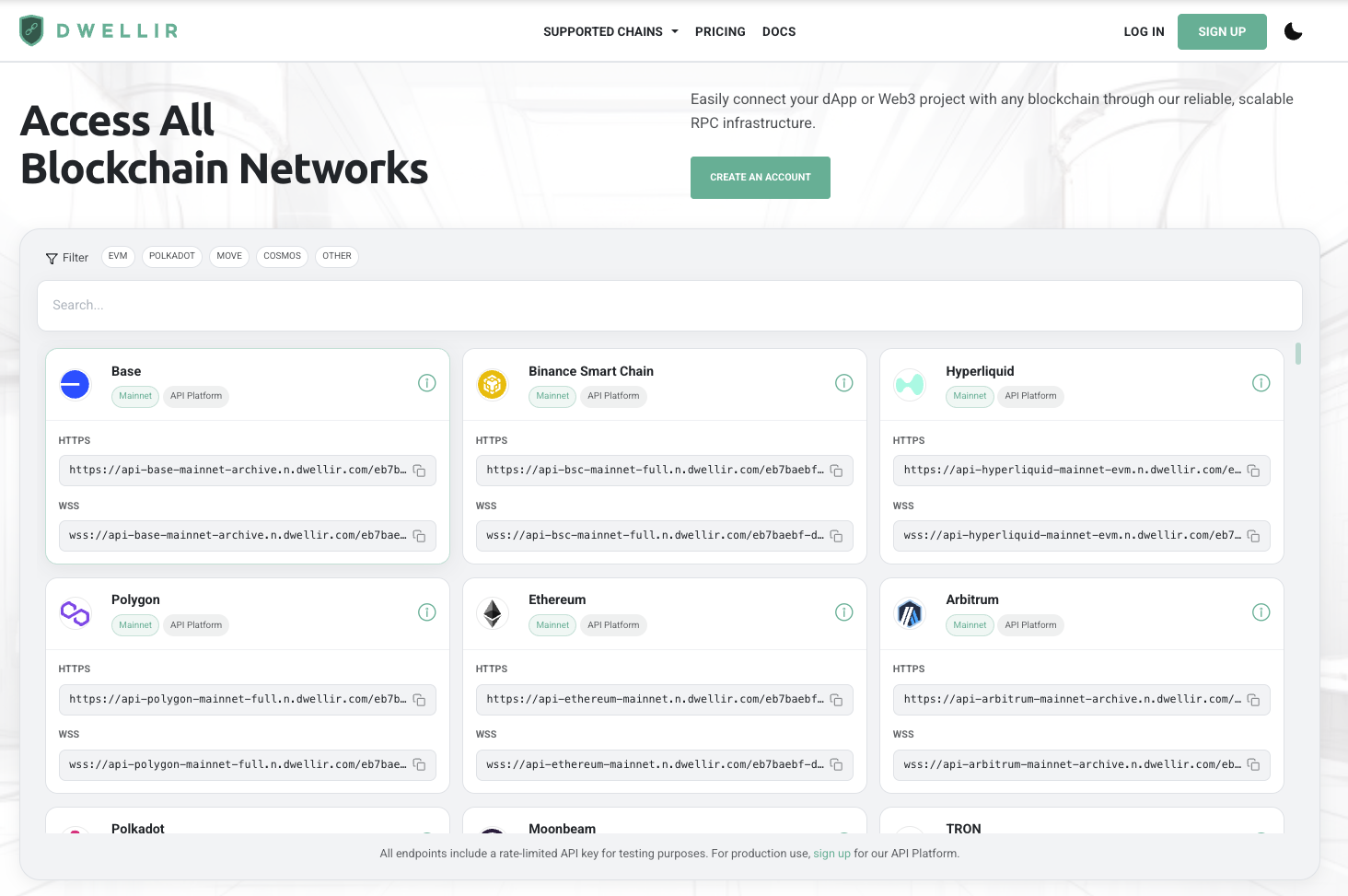
Dwellir provides Berachain mainnet access with archive node support and a transparent 1:1 credit model. Every RPC response costs one API credit regardless of method complexity, whether it's a simple eth_chainId call or a resource-intensive trace operation. This pricing consistency extends across 140+ supported blockchains, making Dwellir well-suited for teams building multi-chain applications that span Berachain alongside other networks.
Key Features
- 1:1 Credit System: Trace, debug, and standard methods all cost the same, eliminating compute unit calculations.
- Archive Node Access: Full historical Berachain data available through mainnet archive endpoints.
- Protocol Support: HTTPS and WebSocket (WSS) endpoints for real-time event monitoring.
- 140+ Network Coverage: Single API key works across Berachain and other blockchains.
- Performance Tiers: 20 to 5,000 sustained RPS with burst capacity up to 10,000 RPS.
- Trace and Debug APIs: Advanced debugging included in all paid plans at no extra cost.
Pricing Structure
| Plan | Price | Included Responses | Sustained RPS | Overage |
|---|---|---|---|---|
| Free | Free | 100K responses per day | 20 RPS | N/A |
| Developer | $49/month | 25M responses per month | 100 RPS | $5 per 1M |
| Growth | $299/month | 150M responses per month | 500 RPS | $3 per 1M |
| Scale | $999/month | 500M responses per month | 5,000 RPS | $2 per 1M |
Dedicated node clusters for Berachain run $875/month with unlimited RPS and responses for teams requiring guaranteed resources and crypto payment options.
Pros and Cons
Advantages:
- Predictable pricing without compute unit complexity.
- Trace and debug endpoints included at no premium.
- Multi-chain footprint for unified infrastructure across 140+ networks.
- Direct engineering support on Growth plans and above.
Considerations:
- Ecosystem-specific tooling (prebuilt monitors, enhanced APIs) less extensive than larger platforms.
Best For
Teams building DeFi protocols, liquid staking applications, or multi-chain dashboards that need cost predictability and advanced debugging. Startups can test with the Free plan before scaling.
2. Alchemy - Full-Featured Developer Platform
Alchemy extends its comprehensive development platform to Berachain with mainnet support via HTTP and WebSocket connections. Beyond standard RPC access, Alchemy provides enhanced APIs for NFTs and tokens, webhook notifications, transaction simulation, and detailed analytics dashboards that track request volumes, latency, and per-method compute unit consumption.
Key Features
- Enhanced APIs: NFT, Token, and Notify APIs reduce custom indexing work.
- Transaction Simulation: Pre-send validation for catching errors before on-chain submission.
- Analytics Dashboard: Request volumes, latency breakdowns, and compute unit tracking.
- SDK Coverage: TypeScript, Python, and other language SDKs for faster integration.
- Comprehensive Documentation: Extensive guides and code examples.
Pricing Structure
| Plan | Price | Included Volume | Throughput | Notes |
|---|---|---|---|---|
| Free Tier | $0 | 30M compute units/month | 25 req/s | Community support, 5 apps |
| Pay As You Go | $5 base + $0.45 per 1M CUs | Metered | 300 req/s | Priority support, 30 apps |
| Enterprise | Custom | Custom pools | Custom | VIP engineering, volume discounts |
Compute unit weights vary by method: lightweight calls consume fewer CUs while eth_getLogs and archive queries consume more. Budget accordingly for DeFi workloads with heavy log queries.
Pros and Cons
Advantages:
- Mature platform with industry-leading documentation.
- Enhanced APIs minimize custom development.
- Strong developer experience and tooling ecosystem.
- Enterprise-grade SLAs available.
Considerations:
- Compute unit pricing requires monitoring for accurate budgeting.
- No MEV protection included.
- Platform depth may exceed needs for simple RPC-only use cases.
Best For
Teams building sophisticated Berachain applications that leverage enhanced APIs, webhooks, and analytics where developer productivity justifies infrastructure costs.
3. QuickNode - Global Low-Latency Infrastructure
QuickNode operates a global edge network that routes Berachain requests to the nearest available node, minimizing latency for geographically distributed users. The platform combines high-performance RPC endpoints with Streams for real-time event streaming, webhooks for notifications, and dedicated node options for workloads requiring isolated resources.
Key Features
- Global Edge Network: Automatic routing to nearest regions for minimal latency.
- Streams & Webhooks: Real-time event streaming for monitoring DeFi activity.
- Dedicated Nodes: Isolated infrastructure for guaranteed performance.
- Observability Dashboard: Response times, errors, and credit consumption tracking.
- 24/7 Support: Round-the-clock assistance from infrastructure specialists.
Pricing Structure
| Plan | Price | Included Credits | Requests per Second | Overage |
|---|---|---|---|---|
| Discover (Free) | $0 | 10M API credits | 15 RPS | N/A |
| Build | $49/month | 80M API credits | 50 RPS | $0.62 per 1M credits |
| Accelerate | $249/month | 450M API credits | 125 RPS | $0.55 per 1M credits |
| Scale | $499/month | 950M API credits | 250 RPS | $0.53 per 1M credits |
| Business | $999/month | 2B API credits | 500 RPS | $0.50 per 1M credits |
Streams, Functions, and dedicated node clusters incur additional charges.
Pros and Cons
Advantages:
- Consistently low latency through global routing.
- Streams and webhooks simplify event-driven architectures.
- Dedicated node option for deterministic performance.
- Strong documentation and responsive support.
Considerations:
- Credit accounting requires workload modeling for budget accuracy.
- API keys capped at 50.
- Add-ons increase total spend for complex use cases.
Best For
Latency-sensitive DeFi applications, trading platforms, and yield aggregators where response time directly impacts performance and teams can manage credit-based billing.
4. Chainstack - Managed Infrastructure with Compliance Options
Chainstack offers managed Berachain infrastructure spanning shared endpoints, dedicated nodes, and an Unlimited Node add-on that removes per-request billing entirely. The platform deploys across AWS, GCP, and Azure with geo-balanced routing, and provides SOC 2 Type II compliance documentation for regulated teams building institutional DeFi products.
Key Features
- Managed Shared + Dedicated Nodes: Deploy shared RPC or dedicated nodes with SOC 2 controls.
- Unlimited Node Add-on: Flat monthly fee for unlimited requests within chosen RPS tiers.
- Multi-Cloud Deployment: AWS, GCP, Azure options with geo-balanced routing.
- Team Collaboration: Role-based access and per-project API keys.
- Unlimited API Keys: No artificial limits on key generation.
Pricing Structure
| Plan | Price | Monthly Request Units | Included RPS | Notes |
|---|---|---|---|---|
| Developer | $0 | 3M request units | 25 RPS | Shared nodes, community support |
| Growth | $49/month | 20M request units | 250 RPS | Up to 10 project nodes |
| Pro | $199/month | 80M request units | 400 RPS | Priority support |
| Business | $349/month | 140M request units | 600 RPS | SSO, 50 project nodes |
| Unlimited Node | $149+/month | Unlimited (per RPS tier) | 25-500 RPS | Flat-fee shared endpoint |
Archive queries count as two request units.
Pros and Cons
Advantages:
- Managed infrastructure without cloud operations overhead.
- Unlimited Node removes per-request billing for bursty workloads.
- SOC 2 Type II compliance for regulated environments.
- Multiple deployment regions available.
Considerations:
- Higher effective cost per million than 1:1 pricing models.
- Unlimited Node requires Growth+ subscription.
Best For
Teams building institutional DeFi products that need compliance documentation and managed infrastructure without hiring dedicated protocol DevOps.
5. dRPC - Decentralized Network with MEV Protection
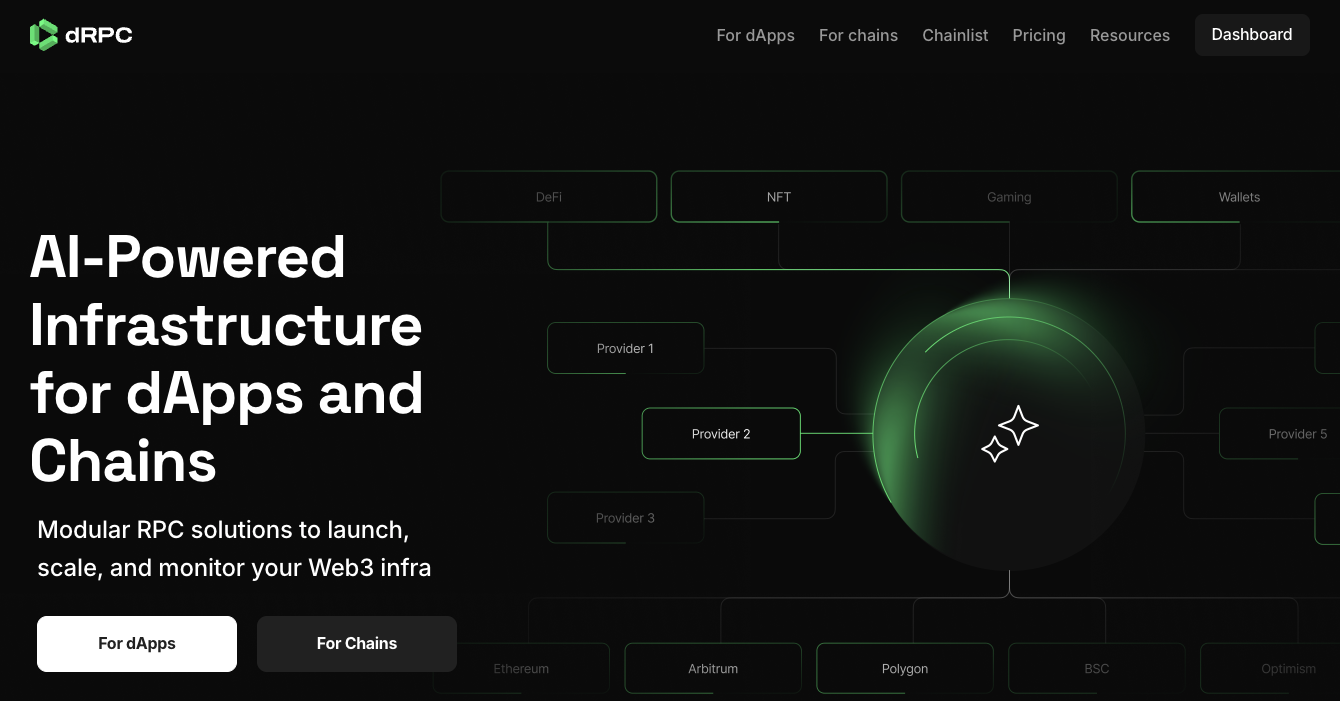
dRPC aggregates Berachain infrastructure from over 40 independent node operators across 7 geo-distributed clusters. Traffic routes automatically based on latency, availability, and region, with built-in failover between providers. Notably, dRPC is the only provider in this comparison offering MEV protection, making it particularly relevant for Berachain's DeFi-heavy ecosystem where front-running concerns apply.
Key Features
- Decentralized Routing: Traffic fails over automatically between vetted operators.
- MEV Protection: Built-in protection against front-running for DeFi transactions.
- Global Coverage: 7 geo-distributed clusters across US, EU, and APAC.
- High Throughput: Up to 5,000 RPS on paid plans.
- Debug and Trace APIs: Advanced debugging capabilities included.
Pricing Structure
| Plan | Price | Included Volume | Network Throughput | Notes |
|---|---|---|---|---|
| Free | $0 | 210M compute units/month | 40-250 RPS | Public nodes, prototyping |
| Growth | $6 per 1M requests | Metered | 5,000 RPS | High-performance nodes, 99.99% uptime |
| Enterprise | Custom | 300M+ requests/month | Unlimited RPS | Volume discounts, SLA included |
Billing per successful response avoids complex compute unit calculations, though latency can vary across operators.
Pros and Cons
Advantages:
- Decentralized operator pool reduces single-vendor risk.
- MEV protection included, critical for Berachain DeFi applications.
- Flat $6/M request pricing simplifies budgeting.
- Generous free tier (210M CUs monthly) for development.
- Unlimited API keys.
Considerations:
- Latency variance depends on underlying operator mix.
- Less centralized support than vertically integrated providers.
Best For
DeFi applications requiring MEV protection, teams prioritizing decentralization, or projects seeking a cost-effective secondary provider for redundancy.
6. Ankr - Decentralized Multi-Chain Hub
Ankr operates a decentralized network of globally distributed nodes supporting Berachain alongside 50+ other blockchain networks. The platform offers both free public endpoints for development and premium tiers with higher throughput and priority routing for production workloads.
Key Features
- Decentralized Architecture: Distributed network reduces single points of failure.
- Multi-Chain Hub: Single platform for 50+ blockchain networks.
- Public and Premium Endpoints: Free tier available with premium upgrades.
- Geographic Optimization: Regional node distribution for latency optimization.
- Simple Integration: Standard JSON-RPC interface.
Pricing Structure
| Plan | Price | Features | Notes |
|---|---|---|---|
| Public Endpoint | $0 | 30 RPS, community support | Development use |
| Premium | From $10/month | Up to 1,500 RPS, priority routing | Pay-as-you-go available |
| Enterprise | Custom | Dedicated resources, SLA | Custom solutions |
Pros and Cons
Advantages:
- Decentralization principles throughout architecture.
- Strong free tier for development and testing.
- Multi-chain support simplifies cross-chain infrastructure.
- Competitive pricing at scale.
Considerations:
- Premium pricing requires direct inquiry for exact rates.
- Advanced tooling less developed than enterprise-focused providers.
Best For
Developers building multi-chain applications who value decentralization and need reliable access across blockchain ecosystems beyond just Berachain.
7. GetBlock - Simple Deployment with Regional Optimization
GetBlock provides immediate Berachain node access through a straightforward platform emphasizing simplicity over feature depth. Regional data centers in Frankfurt, New York, and Singapore deliver consistent low-latency access, and both shared and dedicated node options accommodate different performance requirements.
Key Features
- Instant Node Access: No waiting for synchronization or setup.
- Regional Endpoints: Frankfurt, New York, Singapore data centers.
- Shared and Dedicated Options: Flexible infrastructure choices.
- JSON-RPC and WebSocket: Both connection methods supported.
- 99.9% Uptime SLA: Reliability guarantees for production use.
Pricing Structure
| Plan | Price | Included Volume | Throughput | Notes |
|---|---|---|---|---|
| Free | $0 | 40,000 requests/day | 60 RPS | Development use |
| Starter | $29/month | 100,000 requests/day | 100 RPS | Basic production |
| Pro | $199/month | 500,000 requests/day | 200 RPS | Team features |
| Unlimited | $499/month | Unlimited | 300 RPS | Full access |
Dedicated nodes available for isolated infrastructure requirements.
Pros and Cons
Advantages:
- Simple, straightforward pricing.
- Quick deployment without technical complexity.
- Multiple regional endpoints for latency optimization.
- Good free tier for development.
Considerations:
- Lower RPS limits than some competitors.
- No MEV protection.
- Limited enhanced API offerings.
Best For
Solo developers or small teams prioritizing quick deployment and simple pricing over advanced features.
Feature Comparison Table
| Feature | Dwellir | Alchemy | QuickNode | Chainstack | dRPC | Ankr | GetBlock |
|---|---|---|---|---|---|---|---|
| Pricing Model | 1:1 response-based | Compute units | API credits | Request buckets | Request-based | Pay-as-you-go | Request-based |
| Entry Price | Free | Free (30M CUs) | $49 Build | Free (3M req) | Free (210M CUs) | Free public | Free (40K/day) |
| Mid-Tier Price | $299 (150M, 500 RPS) | PAYG $0.45/M CU | $249 (450M credits) | $199 Pro (80M) | $6 per 1M requests | Premium tier | $199 (500K/day) |
| Max RPS | 5,000+ | 300 (PAYG) | 500 (Business) | 600 (Business) | 5,000 | 1,500 | 300 |
| MEV Protection | No | No | No | No | Yes | No | No |
| WebSocket | Yes | Yes | Yes | Yes | Yes | Yes | Yes |
| Debug/Trace APIs | Yes | Yes (CU heavy) | Yes | Yes | Yes | Limited | Limited |
Recommendations by Use Case
For DeFi Protocols and Yield Applications: Dwellir's 1:1 pricing eliminates surprise costs from varied method calls typical in DeFi workloads. For applications where MEV protection matters, pair with dRPC.
For Trading and Arbitrage: QuickNode's global edge network minimizes latency. Add dRPC as a secondary provider for MEV protection on sensitive transactions.
For Institutional DeFi: Chainstack provides SOC 2 Type II compliance documentation that regulated teams require.
For Rapid Prototyping: dRPC's free tier (210M compute units monthly) offers the most generous allowance for development.
Conclusion
For most Berachain development, Dwellir offers the best balance of transparent pricing, multi-chain coverage, and production-ready infrastructure. The 1:1 credit model eliminates compute unit complexity while trace/debug APIs come included at no premium.
For specialized requirements: dRPC stands out for MEV protection critical to DeFi applications, QuickNode excels at latency-sensitive trading workloads, and Chainstack serves institutional teams requiring SOC 2 compliance.
Frequently Asked Questions
What is the best Berachain RPC provider?
Dwellir offers the best balance of transparent 1:1 pricing, archive node access, and multi-chain coverage for Berachain. For MEV protection critical to DeFi, dRPC is the standout choice. QuickNode excels at latency-sensitive trading workloads.
How does Berachain's Proof of Liquidity affect RPC infrastructure?
Berachain's Proof of Liquidity consensus means validators stake active liquidity rather than idle tokens. This creates high-frequency DeFi activity with 2-3 second block times. RPC providers need low latency, burst capacity for market volatility, and predictable pricing for the varied method calls typical in DeFi workloads.
Are there free Berachain RPC endpoints?
Yes. dRPC offers the most generous free tier at 210M compute units monthly. Alchemy provides 30M free compute units, Dwellir offers 100K free requests per day, Chainstack includes 3M free request units, and Ankr has a free public endpoint. GetBlock provides 40,000 free requests per day.
Is Berachain EVM compatible for RPC purposes?
Yes. Berachain is built on the Cosmos SDK with full EVM compatibility, meaning it supports standard Ethereum JSON-RPC methods. Existing Ethereum tooling, wallets, and SDKs work with Berachain RPC endpoints without modification. The tri-token model (BERA, BGT, HONEY) operates through standard EVM contract interfaces.
Related Resources
- Best Ethereum RPC Providers — Compare providers for Ethereum, the EVM standard Berachain is compatible with
- RPC Providers Without Compute Units — Why transparent pricing matters for Berachain's DeFi-heavy ecosystem
Ready to build on Berachain? Start with Dwellir's Free plan to test your integration, or contact the Dwellir team for architectural guidance on your infrastructure setup.