At 04:46 UTC on 20 November 2026, the account that deployed XMR1 on Hyperliquid sent 100,000 tokens to an address that had existed for about an hour. Three minutes later that address started selling. By 05:20 UTC XMR1, which had traded near $500 all week, was worth $1.
By 08:00 UTC the seller had taken $13.5 million from 388 buyers. PerpetualCow, the founder of Wagyu.xyz, the swap service that issues XMR1, posted on X that he is still working out what happened, that the damage fell mainly on market makers who kept buying the XMR1 being dumped, that regular Wagyu swappers were fine, and that he is open to negotiating with whoever did it.
This post covers what the public data shows as of 12:30 UTC on 20 November, why the loss landed on market makers, and what to watch if you trade or quote bridged spot tokens on HyperCore. The story is still moving; figures below are from the Hyperliquid Info API and Bitquery's trace of the same morning.
What XMR1 is
Monero runs on its own chain with hidden senders and receivers, so it cannot trade on Hyperliquid directly. Wagyu wraps it. You send native XMR to the bridge and receive XMR1, a spot token on the HyperCore order book (pair @260, XMR1/USDC). Send XMR1 back and the bridge pays out XMR. Wagyu also uses that order book to route cross-chain swaps, so a user swapping ETH for XMR may pass through XMR1 for a few seconds without ever holding it.
tokenDetails for XMR1 shows how the supply was set up:
| Field | Value |
|---|---|
| Token index | 404, full name "XMR - Wagyu.xyz" |
| Deployed | 17 December 2025 |
| Max supply | 20,000,000 |
| Genesis | all 20,000,000 credited to 0x2077...e06a |
That is how HIP-1 tokens work: the deployer chooses the genesis balances, and here the whole supply went to one account. Tokens left that account as the bridge received Monero. For scale, fewer than 19 million XMR exist, so the minted supply was not backed at mint. Backing exists only for the tokens the bridge has paid out against real deposits, and only Wagyu can see the Monero side.
Timeline, 20 November (UTC)
| Time | Event |
|---|---|
| 03:30 | New address 0x1464...20bf receives 0.098 ETH from Tornado Cash |
| 03:38 | Same address appears on Hyperliquid |
| 04:46 | Deployer sends it 100,000 XMR1 |
| 04:49 | First large sale |
| 05:14 | Deployer sends another 100,000 XMR1 |
| 05:16 | Deployer sends 5,000,000 XMR1 |
| 05:00 | 76% of the proceeds already in |
| about 05:18 | Price reaches $1 |
| from 04:54 | Proceeds bridged to Arbitrum, swapped to ETH on CoW, bridged to Ethereum |
| 06:00 to 10:28 | Further selling at about $1 |
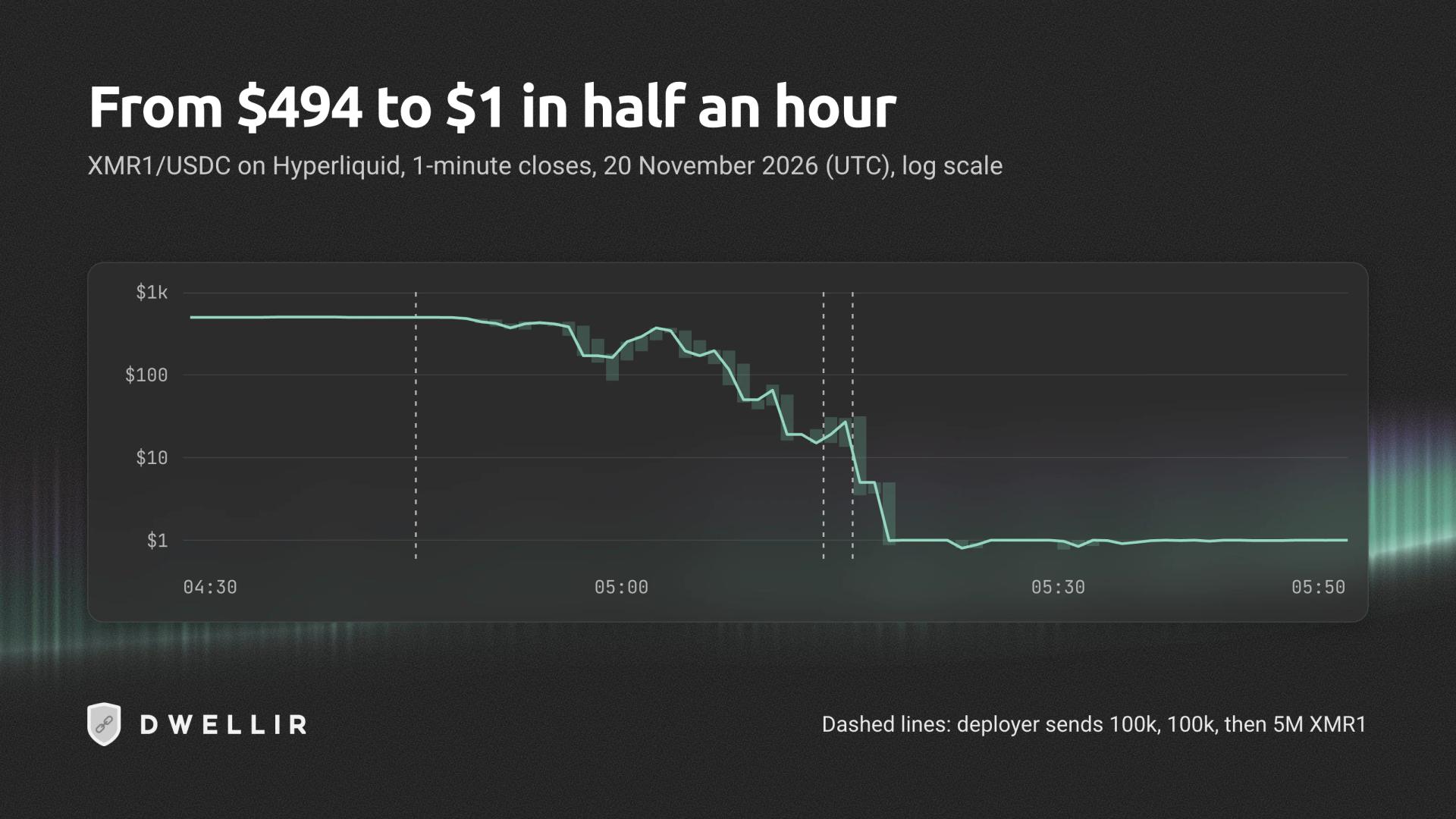
Hourly candles for @260 show the shape. The 03:00 hour closed at $494.68 on 157 trades. The 04:00 hour traded 6,941 times with a low of $85. The 05:00 hour traded 244,510 XMR1 with a low of $0.77 and closed at $1.00. Since then the pair has sat between $0.53 and $1.00.
The transfers matter more than the sales. On HyperCore a spotSend is a user-signed action: the account's main key signs it, and an API wallet cannot. The deployer has one named API wallet, called "wagyu", which can only trade. So whoever moved the 5.2 million tokens most likely held the deployer's main key. A stolen key and misuse by someone with access leave the same trail, and nothing on-chain separates them.
Where things stand at 12:30 UTC
Balances from spotClearinghouseState:
| Account | XMR1 | Other |
|---|---|---|
Deployer 0x2077...e06a | 13,398,781 | 20,993,997 ZEC1, 396.8M MAX |
Seller 0x1464...20bf | 4,824,377 (309,129 in open asks) | $219,008 USDC |
| Everyone else | about 1,777,000 |
By its own fills, the seller sold 369,623 tokens for $13.51 million, about 7% of what it received, at an average of roughly $37. Its last sale was at 10:28 UTC. The rest has nowhere to go: nobody bids the old price any more, and 309,129 tokens sit in asks between $1 and $170, most of them at $1. Bitquery counts 7,348 ETH, about $12.8 million, across three wallets on Ethereum and Arbitrum, the largest of which (0xf32d...dc59, 4,836 ETH) has never sent a transaction. That is what any negotiation would be about.
Bitquery also found the seller sent 6,000 XMR1 to seven other accounts just before the big sales. Four of them passed the tokens within half a minute to one busy address that behaves like a swap service's deposit sweeper. If that was Wagyu's own bridge, the seller tried to redeem some XMR1 for native Monero while the price was still near $500. Whether any Monero went out is visible only to Wagyu.
Native Monero was barely touched. The Hyperliquid XMR perp traded between $456 and $489 during the crash and sat at $462 at 12:30 UTC, down about 7% on the day with the wider market.
Why market makers took the loss
Every dollar the seller raised came from someone on the other side of a trade. Bitquery matched all 388 buyers; 27 of them paid 77% of the $13.5 million. The largest, 0x4c6d...5ee9, had bids resting near the old price and paid $3.56 million for the seller's tokens. That account now holds 29,894 XMR1 with an entry notional of $15.26 million.
The likely setup for most of those buyers is a standard one. A market maker quotes XMR1/USDC around a fair value taken from the XMR perp or from centralised exchange XMR prices, and hedges fills by shorting the perp. While the peg holds, the position is close to flat. When the peg breaks, every bid that fills adds a long in a token heading to zero, and the perp short barely moves. A quoter that keeps reading fair value from the perp keeps re-posting bids well above where XMR1 is trading, which helps explain how the seller raised 76% of its money in the first eleven minutes. The 04:00 hour shows 6,941 fills against 120 to 340 trades in each hour before it.
Wagyu's swappers sat on the other side of that risk. A swap through Wagyu buys or sells XMR1 and settles to the destination coin within seconds, so a swap user is exposed to the token only for the length of the trade. Holders who kept XMR1 in their accounts that morning are a different case. Roughly 1.4 million XMR1 sat outside the deployer before the transfers, some of it in Wagyu's own working accounts. Whether those tokens can still be redeemed for Monero depends on what the bridge holds and on Wagyu's decision.
The same key holds ZEC1
The deployer also created ZEC1 ("ZEC - Wagyu.xyz", token 1021), MAX and other tokens. At 12:30 UTC it still held 20,993,997 ZEC1, and the ZEC1 pair @867 traded at $824.16 against a ZEC perp at $814.33. ZEC1 has kept its peg so far, and the account that signed the XMR1 transfers controls almost all of its supply. ZEC1 trades far less than XMR1 did, so there is less to drain, but anyone quoting it is exposed to the same key.
What to watch on bridged spot tokens
Three checks would have flagged this before most of the damage.
Issuer balance. For any HIP-1 token where one account holds the unissued supply, a large transfer out of that account to a fresh address is the event to alert on. Here the first transfer came three minutes before the first sale and 30 minutes before the 5 million token transfer.
Basis to the underlying. A wrapped token that trades more than a few percent away from its perp is a broken peg until proven otherwise. Pull quotes, do not widen them.
Fill rate against normal volume. Bitquery puts a normal day of XMR1 trading at about $6.9 million. The seller matched that in about three minutes.
A minimal watcher against the public Info API in TypeScript (Bun or Node 24, no dependencies):
const INFO = "https://api.hyperliquid.xyz/info";
const DEPLOYER = "0x207700bd207df757825f9193ef9c648c1c65e06a";
const TOKEN = "XMR1", PAIR = "@260", PERP = "XMR";

type Balance = { coin: string; total: string };

async function info<T>(body: object): Promise<T> {
  const res = await fetch(INFO, {
    method: "POST",
    headers: { "Content-Type": "application/json" },
    body: JSON.stringify(body),
    signal: AbortSignal.timeout(5_000),
  });
  if (!res.ok) throw new Error(`info ${res.status}`);
  return res.json() as Promise<T>;
}

async function deployerBalance(): Promise<number> {
  const { balances } = await info<{ balances: Balance[] }>({
    type: "spotClearinghouseState",
    user: DEPLOYER,
  });
  return Number(balances.find((b) => b.coin === TOKEN)?.total ?? 0);
}

let last = await deployerBalance();
console.log(`watching ${TOKEN}, deployer holds ${last.toLocaleString()}`);

setInterval(async () => {
  try {
    const [bal, mids] = await Promise.all([
      deployerBalance(),
      info<Record<string, string>>({ type: "allMids" }),
    ]);
    const basis = Number(mids[PAIR]) / Number(mids[PERP]) - 1;
    if (last - bal > 10_000)
      console.log(`ALERT ${TOKEN}: deployer sent ${(last - bal).toLocaleString()} tokens`);
    if (Math.abs(basis) > 0.03)
      console.log(`ALERT ${TOKEN}: spot ${(basis * 100).toFixed(1)}% from perp`);
    last = bal;
  } catch (err) {
    console.error(`poll failed: ${err}`);
  }
}, 10_000);
Polling has limits. The Info API is rate limited, and a 10 second loop over many tokens and issuer accounts adds up fast. Periodic state snapshots, which land about every 12 minutes, are far too slow for an event that took 30 minutes end to end. For production you want the transfers themselves as they happen: HyperCore node data carries every signed action, including each spotSend from an issuer account, block by block. Dwellir's Hyperliquid gRPC streams deliver that from Tokyo with cursor replay, and the historical archive holds the full action history if you want to backtest a circuit breaker against this morning.
Open questions
Wagyu has not said whether the deployer key was stolen or misused, how much Monero the bridge holds against the roughly 1.8 million XMR1 outside the deployer and seller accounts, or whether redemptions are open. Whether the 7,348 ETH comes back depends on a negotiation that, by the founder's own account, he is willing to have. We will update this post as Wagyu publishes more.
Earlier this month Bitquery traced money from four separate hacks (Across, Kava, Lighter and Safe) buying about $6.6 million of XMR1 on its way to Monero. Nothing links those thieves to this drain. It does show how much stolen money passed through this one token.