You swap 10 ETH for a stablecoin on a decentralized exchange. The quote looks fine, slippage tolerance set to 1 percent. The transaction confirms, but you receive noticeably less than the screen promised. Nothing broke. A bot watched your pending transaction, bought ahead of you to push the price up, let your trade execute at the worse price, then sold immediately after. The difference went into someone else's wallet. That difference is MEV.
This post explains what MEV is, why it exists, how it gets extracted, who profits at each step, and what you can do to stop paying it. If you want to build the infrastructure to capture or compete on MEV, the MEV bot infrastructure guide covers RPC, latency, and cost. This piece is the layer underneath it: the concept itself.
What Does MEV Mean?
MEV stands for Maximal Extractable Value. It is the maximum value that can be added or removed from a block by including, excluding, or reordering transactions within it, beyond the standard block reward and gas fees.
The term originally meant Miner Extractable Value, coined in the 2019 paper "Flash Boys 2.0." Back then, Ethereum ran on proof of work, and miners controlled transaction ordering. After Ethereum moved to proof of stake in September 2022, miners disappeared, but the ability to order transactions did not. The community renamed it Maximal Extractable Value to keep the acronym while reflecting that validators, builders, and searchers now share that power.
The core idea is simple. Whoever decides the order of transactions in a block holds a profitable position, because order determines price, and price determines who wins. MEV is the dollar value of that ordering power.
Why MEV Exists
MEV is not a bug in a specific protocol. It is a structural property of public, ordered blockchains. Three conditions create it.
- Transactions are public before they confirm. When you submit a transaction, it usually sits in the mempool, a public waiting area, where anyone can read it before a validator includes it in a block. If you have never looked at how this works, the mempool explainer is a useful companion to this section.
- Order inside a block is not fixed by time. A validator (or the builder constructing the block) can place transactions in any order, and they usually order by what pays them most, not by who arrived first.
- On-chain prices move with each trade. A large swap shifts the price on an automated market maker. That predictable movement is something a bot can position around.
Put those together and you get an open auction for transaction ordering. Anyone who spots a profitable reordering can bid for it. The profit they capture is MEV.
How MEV Is Extracted
MEV is not one technique. It is a family of strategies, some benign, some predatory. Here are the main ones.
| MEV type | What the bot does | Who pays | Harm to users |
|---|---|---|---|
| DEX arbitrage | Buys an asset cheap on one exchange and sells it dearer on another in the same block | Nobody directly; corrects price gaps | Mostly neutral, even useful |
| Liquidations | Repays an undercollateralized loan to claim the liquidation bonus | The borrower being liquidated | Neutral to positive for protocol health |
| Backrunning | Places a transaction immediately after a known one to capture the resulting price move | Nobody directly | Low; often the basis of fair MEV |
| Frontrunning | Sees your profitable transaction and copies it ahead of you | You | High; steals your opportunity |
| Sandwich attack | Buys before your swap, lets it execute at a worse price, sells after | You | High; direct value loss on every swap |
| JIT liquidity | Adds liquidity right before a large swap and removes it right after to capture the fees | Passive liquidity providers | Medium; siphons fees from honest LPs |
The distinction that matters for you is toxic versus benign MEV. Arbitrage and liquidations keep markets efficient and protocols solvent; they are part of how DeFi is supposed to work. Sandwich attacks and frontrunning are extractive. They take value directly out of your trade and give nothing back.
A sandwich attack is the clearest example of the harm. The ordering looks like this:
1. [searcher buy]   pushes the token price up
2. [your swap]      executes at the inflated price (you get less)
3. [searcher sell]  dumps the token, pocketing the spread
All three land in the same block, in that exact order, because the searcher paid the builder to arrange it.
The MEV Supply Chain
On post-merge Ethereum, extraction is not done by one actor. It runs through a pipeline created by proposer-builder separation (PBS), the design that splits the job of choosing what goes in a block from the job of proposing it. Four roles make up the chain.
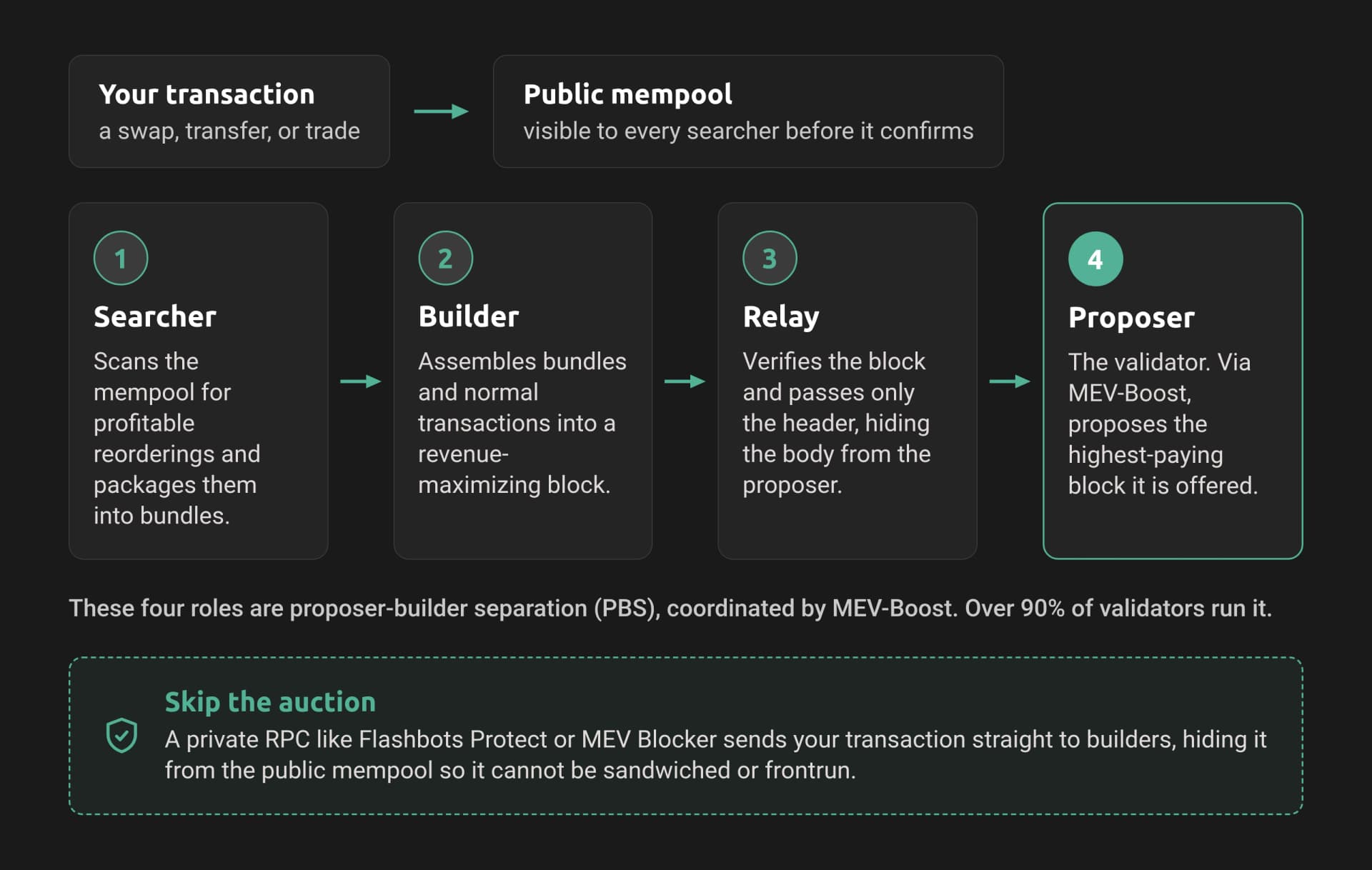
- Searchers scan the mempool and on-chain state for profitable opportunities. They package the required transactions into bundles and simulate them to make sure they land cleanly without reverting.
- Builders collect bundles from searchers plus ordinary transactions and assemble a complete, valid block engineered to maximize total revenue.
- Relays sit between builders and validators. They receive built blocks, verify them, and pass only the block header to the proposer, which prevents the proposer from stealing the builder's work.
- Proposers are the validators. Through MEV-Boost, the off-chain software that implements PBS, they receive bids from relays and propose the most profitable block, effectively renting out their blockspace to the highest bidder.
This is why MEV-Boost matters. Over 90 percent of Ethereum validators run it, because outsourcing block construction to specialized builders increases their rewards by a meaningful margin compared to building blocks themselves. The tradeoff is concentration. A handful of relay operators now route the large majority of MEV-Boost blocks, which is why the Ethereum Foundation lists enshrined PBS, moving the auction into the protocol itself, as a 2026 priority. Treat the exact validator and relay percentages as moving targets; the direction (high adoption, concentrated relays) is the stable fact.
How Much MEV Is Out There
MEV is real money, not a theoretical edge. Flashbots' MEV-Explore tracked over 675,000 ETH of extracted MEV on Ethereum across the years it ran, and industry trackers reported cumulative MEV crossing the 1 billion dollar mark across chains by 2025. More recent reporting puts annual extraction on Ethereum in the hundreds of millions of dollars, with comparable activity on BNB Chain, Solana, and Arbitrum. The precise totals vary by methodology and source, so treat any single figure as an estimate; the order of magnitude is what holds. (Sources: Flashbots MEV-Explore, EigenPhi.)
Encouragingly, the harm is shrinking where protection has taken hold. EigenPhi data shows monthly value extracted from sandwich attacks on Ethereum fell from roughly 10 million dollars in late 2024 to around 2.5 million by late 2025, as more transactions moved through private, MEV-aware routes.
MEV Beyond Ethereum
MEV exists on every chain with public ordering, but the mechanics differ, and the way MEV shows up changes the protection you need.
| Chain | Ordering model | How MEV manifests | User exposure |
|---|---|---|---|
| Ethereum | PBS via MEV-Boost | Full searcher/builder/relay supply chain | High in public mempool; strong protection tools exist |
| Arbitrum, Optimism, Base | Centralized sequencer, mostly first-come-first-served | No public mempool to snipe; sequencer controls order | Lower sandwich risk today, but sequencer is a trusted party |
| Polygon PoS | Validator-ordered, public mempool | EVM-style arbitrage and sandwiching | Similar to Ethereum, lower fees |
| BNB Chain | Adopting PBS-style block building | Heavy arbitrage and sandwich activity | High; historically one of the most extracted chains |
| Solana | No global mempool; leader schedule + Jito | Bundles via Jito; multi-slot "wide" sandwiches | Significant; sandwich losses measured in the hundreds of millions |
Two points deserve emphasis. On L2s like Arbitrum, Optimism, and Base, a single centralized sequencer orders transactions first-come-first-served, so there is no public mempool for bots to frontrun. That reduces sandwich risk today, but it concentrates ordering power in one operator, and decentralized sequencing will reintroduce MEV dynamics as it rolls out.
On Solana, there is no global public mempool, so the Ethereum-style sandwich does not work the same way. Instead, MEV flows through Jito, whose client runs under the large majority of stake and lets searchers submit bundles with tips. Researchers have measured large sums extracted through Jito bundles, including "wide" sandwiches that span multiple leader slots.
How You Protect Yourself From MEV
The common thread in every toxic MEV strategy is visibility. A bot can only sandwich or frontrun a transaction it can see before it confirms. Remove that visibility and most extraction disappears. MEV protection is mostly about how you submit transactions, not the trade itself.
- Use a private RPC endpoint. Instead of broadcasting to the public mempool, you send transactions directly to builders. Flashbots Protect is a permissionless RPC that does exactly this, hides your transaction from the public mempool, and can return MEV refunds. Switching is a one-line RPC URL change in your wallet.
- Route through MEV Blocker. Built by CoW Protocol, MEV Blocker is another private RPC that protects transactions and shares a portion of recovered MEV back to users as rebates. It has protected tens of billions of dollars in DEX volume.
- Trade on MEV-aware venues. CoW Swap settles trades through batch auctions with a uniform clearing price, so everyone in a batch gets the same rate regardless of order. That structurally removes the frontrunning advantage. DEX aggregators with built-in protection, like UniswapX, work on a similar principle.
- Set tight slippage and split large orders. Lower slippage tolerance caps how much a sandwich can move your price before the transaction reverts. Splitting a large swap into smaller ones reduces the price impact a bot can exploit.
For most users, switching your wallet's RPC to a private endpoint and trading on a batch-auction venue eliminates the bulk of extractive MEV. You will not capture MEV yourself, but you stop funding it.
Where Dwellir Fits
MEV protection and MEV extraction both run on RPC infrastructure. A searcher competing for opportunities needs low-latency reads of chain state across multiple networks. A user routing through a private RPC needs that endpoint to be fast and reliable, or protection costs them in missed inclusion. Either way, the quality of your node access shapes the outcome.
Dwellir provides RPC endpoints across Ethereum, Arbitrum, Optimism, Polygon, Base, BNB Chain, and 50+ more networks from one platform, so you can read state and submit transactions without running your own nodes per chain. The free tier includes 100,000 requests per day, which is enough to test private transaction routing or prototype an arbitrage strategy before committing to production capacity.
The Short Version
MEV is the value created by controlling transaction order on a public blockchain. It exists because transactions are visible before they confirm and because order, not arrival time, sets the price you get. Some of it (arbitrage, liquidations) keeps DeFi healthy. Some of it (sandwich attacks, frontrunning) comes straight out of your trades. On Ethereum it flows through a supply chain of searchers, builders, relays, and proposers; on L2s and Solana the plumbing differs but the incentive is identical. You do not have to accept the extractive kind. Route transactions privately, trade on batch-auction venues, and keep slippage tight.
If you want to go deeper on the economics of transaction inclusion, the gas fees explainer covers the fee market that MEV sits on top of. If you want to build on this, start with the MEV bot infrastructure guide.
Ready to test private transaction routing or a multi-chain strategy? Create a free Dwellir account or talk to our team about production RPC for MEV-sensitive workloads.