In November 2024, more than $3.3 billion changed hands on a single Polymarket question: who would win the US presidential election. While poll aggregates hovered near 50-50, the market priced one candidate well ahead. That gap is the whole pitch of a prediction market: a price that aggregates what thousands of financially motivated participants actually believe, updated in real time.
Prediction markets have since moved from a crypto curiosity to something Wall Street takes seriously. Combined monthly volume across the two largest venues rose from under $5 billion in September 2025 to roughly $24 billion by April 2026, and Intercontinental Exchange, the owner of the NYSE, committed up to $2 billion to Polymarket at a valuation around $9 billion. This explainer covers what a prediction market is, how the prices work, and how Polymarket runs one on top of Polygon.
What Is a Prediction Market?
A prediction market is a marketplace where people trade contracts tied to the outcome of a future, verifiable event: "Will X happen by date Y?" Each contract pays a fixed amount, almost always $1, if the event happens, and $0 if it does not.
Because the payout is fixed, the price of a contract is a direct estimate of the probability of that outcome:
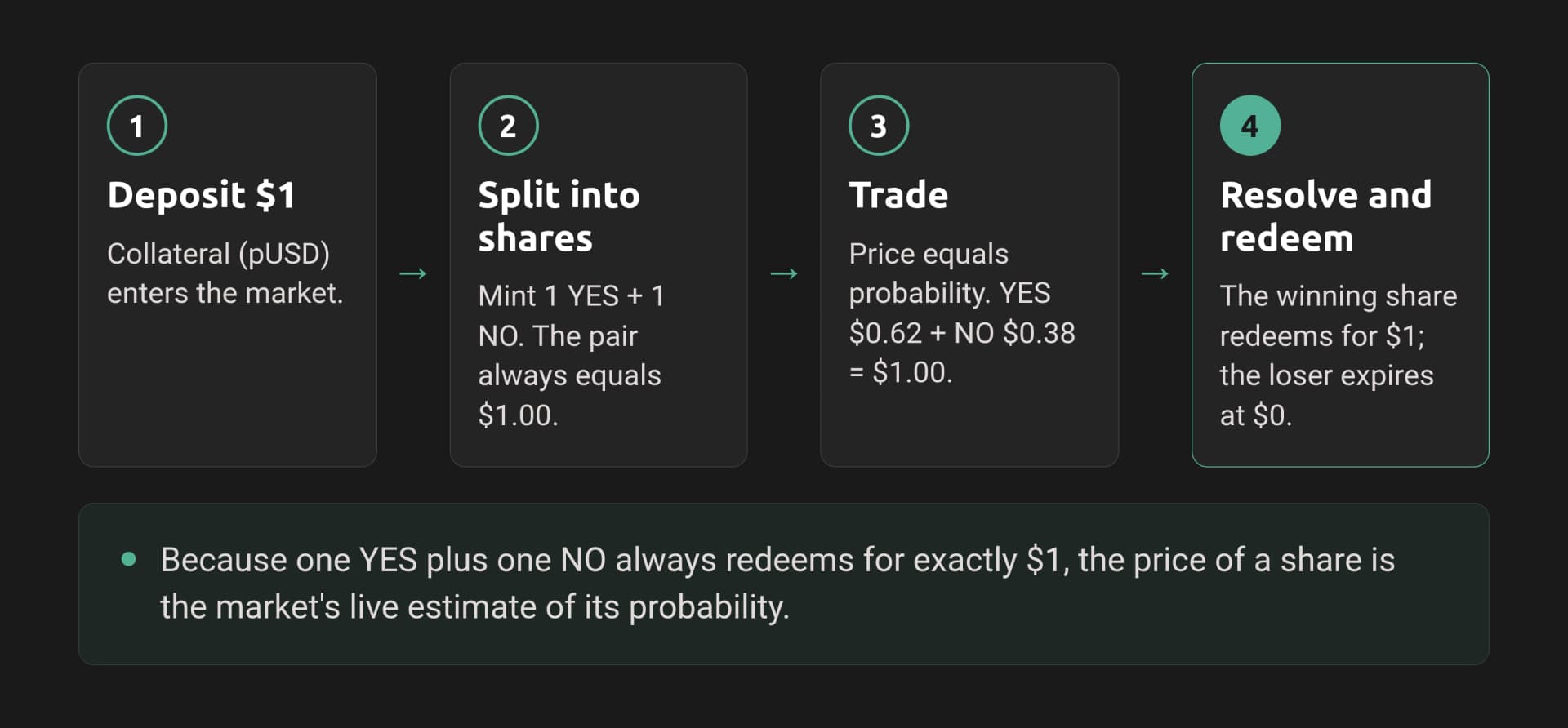
- A YES share trading at $0.62 implies the market thinks the event is about 62% likely. Buy it for $0.62; if it resolves YES, it pays $1.
- A NO share is the mirror image: it pays $1 if the event does not happen.
- 1 YES + 1 NO always equals $1.00. Exactly one of the two outcomes will be true and pay $1, so a complete pair is always worth a dollar.
That last rule is the structural anchor that keeps prices behaving like probabilities, and it is also what makes minting and redeeming shares work on-chain.
How Prediction Markets Work
Two designs dominate how trades get matched.
Order book (CLOB). Buyers and sellers post bids and asks, and the exchange matches compatible orders, exactly like a stock exchange. This gives tight spreads and transparent pricing in liquid markets. Polymarket and Kalshi both use a central limit order book.
Automated market maker (AMM). A smart-contract liquidity pool prices shares algorithmically, so there is always a counterparty even when liquidity is thin. Early Polymarket used an AMM before moving to its order book, and AMMs remain common in smaller on-chain markets.
Every market follows the same lifecycle:
- Creation. A question with a clear resolution criterion and end date is defined.
- Trading. Participants buy and sell YES and NO shares; prices move with supply and demand.
- Resolution. Once the real-world outcome is known, an oracle or authority reports the result.
- Payout. Winning shares redeem for $1 each; losing shares expire worthless.
Why Prediction Markets Matter
The case for prediction markets is information aggregation. Prices pull together dispersed knowledge from many participants who are financially accountable: being wrong costs money, which punishes wishful thinking and rewards genuine information. The idea traces back to the Iowa Electronic Markets, launched in 1988 as a research tool, which repeatedly forecast elections as well as or better than polls.
The caveat matters as much as the claim. Accuracy is strong in liquid markets and degrades in thin ones. Down-ballot races in 2024 showed larger errors than the headline presidential market, where billions in volume sharpened the price. A prediction market is only as good as its liquidity and the clarity of its resolution question. It is a strong signal, not a crystal ball.
How Polymarket Works
Polymarket is the largest prediction market by volume, with roughly $21.5 billion traded in 2025. Under the hood it is a hybrid of off-chain speed and on-chain settlement.
Off-chain matching, on-chain settlement. A central operator matches compatible signed orders quickly, typically in under 200 milliseconds, checking signatures, balances, and tick rules. Each matched trade then settles on Polygon through the CTF Exchange contract, which verifies the signatures and performs an atomic swap: collateral moves one way, outcome tokens the other. The operator never takes custody of funds, so the system stays non-custodial.
Outcome tokens and the Conditional Tokens Framework. YES and NO are distinct ERC-1155 tokens from Gnosis's Conditional Tokens Framework, both backed by the same collateral and tied to one parent condition. Three operations implement the "1 YES + 1 NO = $1" rule in code:
- Split (mint): deposit $1 of collateral, receive 1 YES + 1 NO.
- Merge: combine 1 YES + 1 NO, redeem $1 of collateral.
- Redeem: after resolution, the winning outcome token redeems for $1.
Collateral: pUSD. Trades historically settled in bridged USDC.e. In an April 2026 overhaul, Polymarket introduced pUSD, a Polygon ERC-20 backed 1:1 by Circle-issued USDC and enforced on-chain, alongside a rebuilt CTF Exchange V2. The simple mental model is unchanged: shares are priced in dollars backed by USDC.
Resolution: UMA's optimistic oracle. Outcomes are reported through UMA's optimistic oracle. A proposed answer is treated as correct unless someone disputes it within a challenge window, and disputes escalate to UMA token holders who vote to arbitrate. "Optimistic" means it is cheap and fast in the common case, with an economic dispute mechanism as the backstop.
Multi-outcome (neg-risk) markets. For events with several mutually exclusive outcomes, such as "which candidate wins," Polymarket's neg-risk contracts unify a set of binary markets where exactly one resolves YES. This keeps multi-candidate prices coherent and improves capital efficiency.
Why Polygon, and the gasless experience. Low fees and roughly 2-second blocks make frequent, cent-priced trades economical. A relayer sponsors gas for end users, paying for wallet deployment, approvals, and settlement, and each user gets an auto-deployed proxy wallet. The result is a Web2-style experience on a non-custodial base: traders only need a stablecoin and never touch the gas token.
The Infrastructure Behind Polymarket
Because settlement, outcome tokens, and resolution all live on Polygon, anything that interacts with Polymarket programmatically depends on Polygon RPC. Analytics tools read market state, outcome-token balances, and resolution events. Trading bots monitor on-chain settlement and submit redemptions. Dashboards watch for large trades and resolutions through log subscriptions.
If you are building on top of Polymarket, that read-and-write layer is where latency and reliability show up. We cover it in depth in the best Polygon RPC for Polymarket bots, and in our hands-on guides to the Polymarket API and building a Polymarket copy-trading bot.
The Takeaway
A prediction market turns a question about the future into a price you can read as a probability, kept honest by traders with money at stake. Polymarket implements that idea with off-chain matching for speed and Polygon for non-custodial settlement, using conditional tokens for shares and an optimistic oracle for truth. The mechanics are clever, but the user-facing idea is simple: a market price is a forecast you can trade.
Building something that reads or trades on Polymarket? It runs on Polygon RPC. Create a free Dwellir account to get a Polygon endpoint, or talk to the team about infrastructure for your prediction-market app.
Related Guides
- Polymarket API: The Complete Developer Guide - Discover markets, read the order book, place orders, and stream fills.
- How to Build a Polymarket Copy-Trading Bot - Detect a target wallet's trades and replicate them through the CLOB API on Polygon.