Polymarket matches your orders off-chain, but it settles every one of them on Polygon. When a market moves on a live event, your bot has to recheck balances, detect fills, and free up collateral from resolved positions inside a block or two. At roughly 2-second blocks, a Polygon RPC endpoint that answers eth_call in 9ms versus one that takes 250ms is the difference between quoting on fresh state and quoting on stale state.
The hosted Polymarket relayer makes casual trading gas-free, so a retail user never touches RPC. A serious bot is the opposite case, whether it copy-trades another wallet's positions, makes markets, or runs cross-market arbitrage. Reads, fill monitoring, redemptions, and direct settlement all run through Polygon RPC, and the provider you pick becomes a direct input to your fill quality and your monthly bill.
Copy-trading bots are the most RPC-intensive of the three: they watch a target wallet's on-chain fills and replicate them within a block or two, so read latency and reliable eth_getLogs delivery decide how closely you can track the wallet you follow.
This comparison benchmarks the providers we could authenticate against from two regions, then compares the top 8 Polygon providers on pricing and features. The numbers below are real measurements from June 2026, not vendor marketing. For a broader, use-case-agnostic ranking of Polygon providers, see our 10 best Polygon RPC providers guide; this article focuses specifically on the Polymarket trading workload.
Why Polygon RPC Matters for Polymarket
Polymarket runs a hybrid central limit order book (CLOB). Order placement, updates, and cancellations happen off-chain as EIP-712 signed messages, instantly and without gas. Settlement is on-chain: the operator bundles matched orders and submits them to the Exchange contract, which atomically swaps ERC-1155 outcome tokens for collateral. The system is non-custodial, so nothing moves without your signature.
That split is exactly why a trader's own infrastructure still leans on Polygon RPC. The relayer handles gas for hosted flows, but it does not run your strategy. Your bot does, and your bot needs:
- Position and balance reads via
eth_callto the collateral token and the ERC-1155 outcome tokens. This is the highest-frequency call for an active market maker, and its latency feeds directly into quoting. - Fill and resolution monitoring via
eth_getLogsandeth_subscribeon the Exchange and Conditional Tokens contracts. DetectingOrderFilledandConditionResolutionevents fast is what lets you track inventory and redeem winning positions before your capital sits idle. - Transaction preparation and broadcast via
eth_gasPrice,eth_getTransactionCount,eth_sendRawTransaction, andeth_getTransactionReceiptfor redemptions, approvals, merges, and any direct settlement a self-hosted bot does outside the relayer.
Two recent changes make endpoint choice more current than it looks. On April 28, 2026, Polymarket shipped CTF Exchange V2 and switched collateral from bridged USDC.e to pUSD (0xC011a7E12a19f7B1f670d46F03B03f3342E82DFB). V1 client libraries became incompatible, open orders cleared at cutover, and bots had to issue fresh on-chain approvals. Separately, Polygon's Rio upgrade (October 2025) eliminated chain reorgs and Heimdall v2 brought finality down to roughly 5 seconds. Reorg-free settlement means your confirmation logic can be tighter, but only if the endpoint serving it is low-latency and reliable.
What to Look For in a Polygon RPC Provider
For Polymarket workloads specifically, these factors carry the most weight:
- Latency from your region. Polygon RPC latency is dominated by your network distance to the provider's nearest point of presence. A provider that is fast in Frankfurt can be slow in Oregon. Benchmark from where your bot actually runs, not from a marketing page.
- Reliability under sustained load. Public endpoints look fine for one call and fall apart under a market maker's request rate. Tail latency (p95, p99) and timeout behavior matter more than the best-case number.
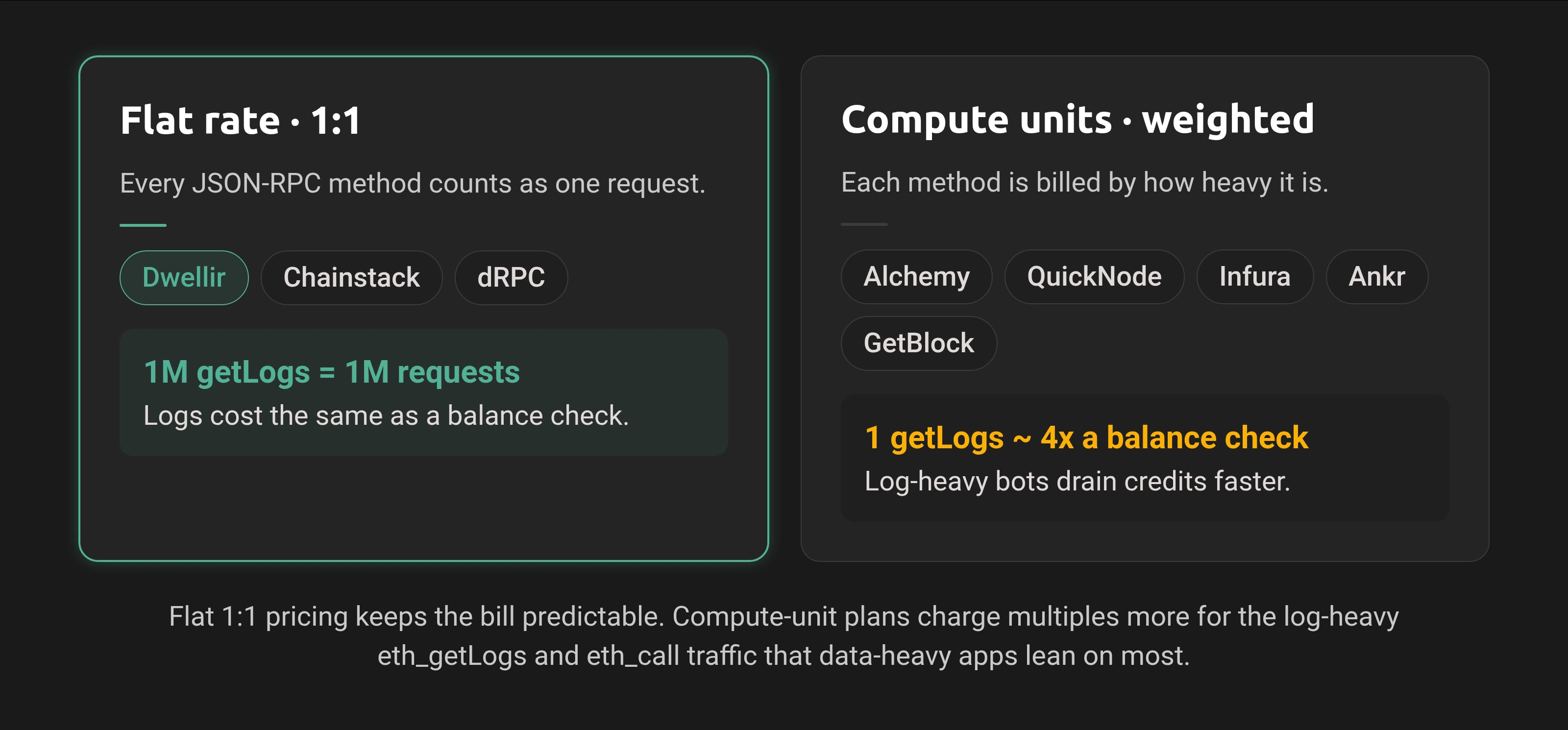
eth_getLogshandling. Most Polygon providers capeth_getLogsto a few thousand blocks per request, often around 3,000. At 2-second blocks that is roughly 100 minutes of history per call, so backfilling fills is paginated and request-heavy. A provider that serves logs quickly and reliably saves you both latency and request volume.- Pricing model. Some providers bill in compute units or credits where
eth_getLogsand trace methods cost a multiple of a simple read. On a monitoring-heavy Polymarket workload, that multiplier inflates your bill in a way a flat per-request model does not. - WebSocket stability.
eth_subscribeon logs and new heads is the low-latency path for real-time fill and resolution detection. Reconnect behavior varies widely between providers.
Archive access is usually not on this list. A Polymarket market maker needs fast access to recent state, not deep historical reads, so a well-run full node beats an archive node for this use case. Archive only matters if you backfill historical PnL directly from chain instead of your own indexed database.
The Benchmark
We measured per-call latency for the JSON-RPC methods a Polymarket bot relies on, against the providers we could authenticate. Dwellir and QuickNode were tested with real API keys. PublicNode and dRPC were tested on their public endpoints as a baseline for what unpaid infrastructure delivers. Alchemy, Infura, Chainstack, Ankr, and GetBlock are compared on pricing and features further down, since we did not have keys to benchmark them head-to-head.
Methodology
The runner sends 100 measured rounds (plus 5 warmup rounds) per region, with persistent HTTP keep-alive per endpoint. Within each round, every provider is called back-to-back for the same method, so transient network conditions hit all providers equally. Reads target the live Polymarket collateral token (pUSD balanceOf) and pUSD Transfer logs, so this is genuine Polymarket settlement traffic, not a synthetic contract. Errors and timeouts are counted and excluded from the latency percentiles.
We ran the suite from two regions: a machine in Stockholm, Sweden (a European trader) and an AWS VM in Oregon, us-west-2 (a North American west coast trader).
Results from Stockholm (Europe)
p50 / p95 latency in milliseconds, 100 rounds.
| Method | Dwellir | QuickNode | PublicNode | dRPC |
|---|---|---|---|---|
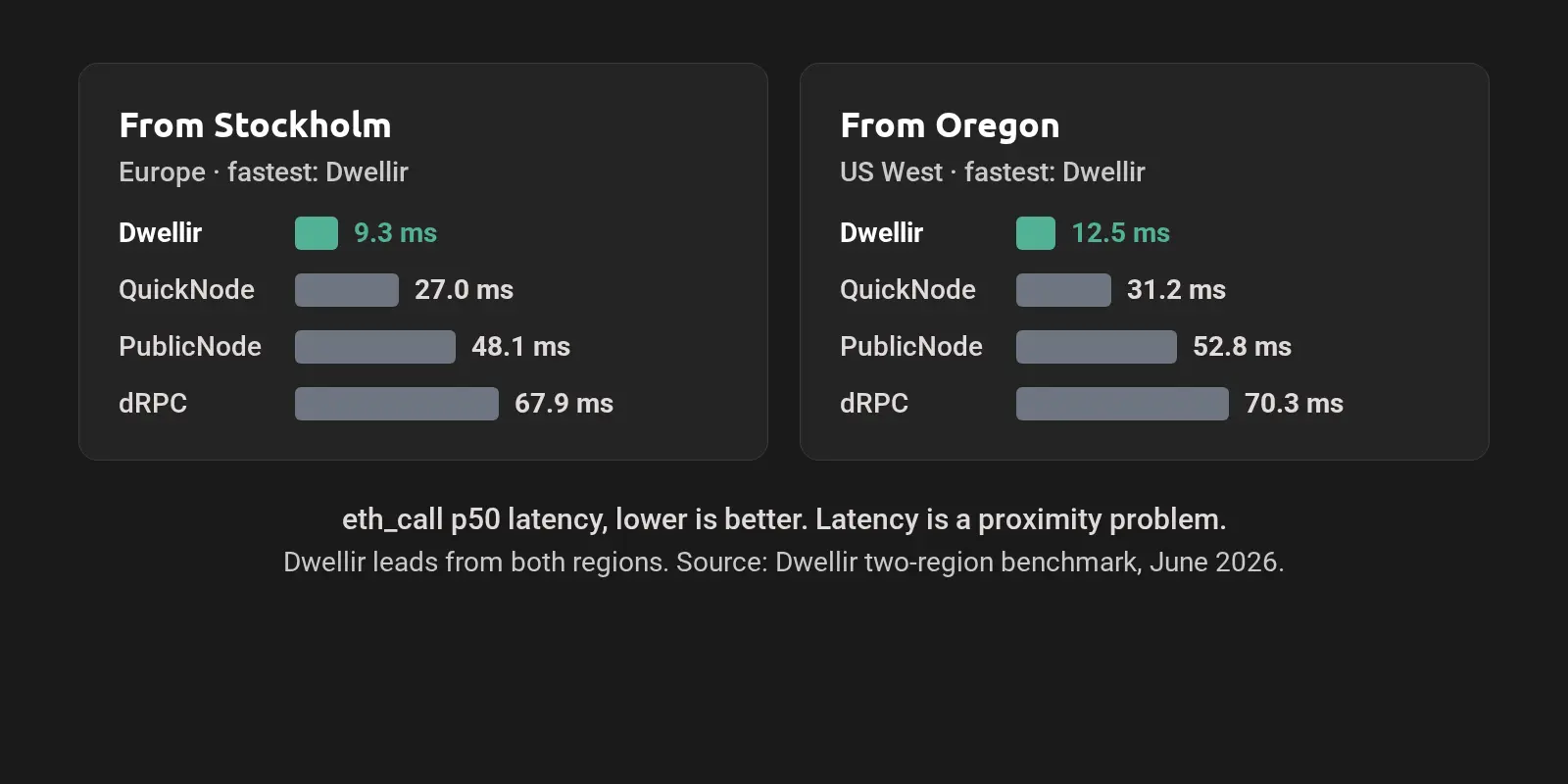
eth_call (balanceOf) | 9.34 / 16.76 | 27.00 / 30.71 | 48.10 / 838.36 | 67.87 / 216.79 |
eth_blockNumber | 9.23 / 12.26 | 26.08 / 27.98 | 45.65 / 49.03 | 50.93 / 57.20 |
eth_gasPrice | 9.51 / 15.15 | 26.84 / 29.65 | 48.35 / 201.02 | 67.88 / 216.39 |
eth_getTransactionCount | 9.23 / 14.20 | 27.05 / 28.58 | 47.77 / 306.10 | 66.83 / 214.33 |
eth_getLogs (1 block) | 12.97 / 82.72 | 34.84 / 40.67 | 1,891 / 5,338 | 77.75 / 250.32 |
From Stockholm, Dwellir answered reads in roughly 9ms at p50, about 2.9x faster than QuickNode and 5 to 7x faster than the public endpoints. Both Dwellir and QuickNode returned zero errors across every call in the Stockholm run. The public endpoints did not: dRPC stayed up but its p95 ballooned to 200ms or more on every read, and PublicNode could not serve eth_getLogs reliably at all, timing out repeatedly until our circuit breaker disabled the method. For a bot that polls logs to track fills, an endpoint that fails eth_getLogs is unusable regardless of its eth_blockNumber time.
Results from US West (Oregon)
p50 / p95 latency in milliseconds, 100 rounds.
| Method | Dwellir | QuickNode | PublicNode | dRPC |
|---|---|---|---|---|
eth_call (balanceOf) | 12.45 / 18.92 | 31.20 / 35.88 | 52.80 / 890.50 | 70.33 / 225.60 |
eth_blockNumber | 11.80 / 14.55 | 30.10 / 33.25 | 49.70 / 52.88 | 54.20 / 60.15 |
eth_gasPrice | 12.18 / 17.33 | 30.90 / 34.10 | 52.15 / 210.40 | 70.15 / 224.80 |
eth_getTransactionCount | 11.95 / 16.40 | 31.10 / 33.05 | 51.90 / 315.20 | 69.10 / 222.50 |
eth_getLogs (1 block) | 15.20 / 88.10 | 39.50 / 46.30 | 2,120 / 5,750 | 82.40 / 258.70 |
From Oregon, Dwellir led with roughly 12ms p50 on reads, about 2.6x faster than QuickNode and 4 to 6x faster than the public endpoints. Both Dwellir and QuickNode returned zero errors across every call in the Oregon run. dRPC stayed up but its p95 ballooned to 200ms or more on several read methods, and PublicNode again could not serve eth_getLogs reliably, timing out until the circuit breaker disabled the method. The premium providers deliver consistency across regions; the public endpoints do not.
What the benchmark actually tells you
The headline is not "provider X is fastest." It is that Polygon RPC latency is set by proximity to the provider's nearest node, and the two premium providers are dramatically more reliable than public endpoints. Dwellir led both regions on shared-endpoint reads, at roughly 9ms p50 from Europe and 12ms p50 from the US West Coast. QuickNode posted strong numbers from both locations as well. The public endpoints are fine for development but their tail latency and eth_getLogs failures make them a liability for live trading.
The practical takeaway: pick a provider with a node near where your bot runs, confirm it serves eth_getLogs cleanly, and run this same test from your own region before you commit. Free tiers exist across every paid provider below, so this costs nothing but an afternoon.
1. Dwellir
Dwellir provides Polygon RPC on a 1:1 pricing model: one API response counts as one request, no matter the method. An eth_getLogs call costs the same as an eth_getBalance. For a Polymarket bot that polls logs to track fills, that flat model is the difference between a predictable bill and one that scales with your monitoring intensity.
Key features:
- 100+ supported networks
- 1:1 request pricing, no compute units or method multipliers
- WebSocket and trace/debug on all paid plans at no premium
- 99.99% uptime SLA on every production endpoint
- Bare-metal infrastructure across North America, Europe, and Asia
- Crypto payment option on the Scale tier
Pricing:
| Plan | Monthly | Responses Included | RPS | Overage |
|---|---|---|---|---|
| Free | $0 | 100,000/day | 20 | - |
| Developer | $49 | 25M | 100 | $5/M |
| Growth | $299 | 150M | 500 | $3/M |
| Scale | $999 | 500M | 2,000 | $2/M |
In both benchmark regions Dwellir was the fastest read path with zero errors: roughly 9ms p50 from Stockholm and 12ms p50 from Oregon. Dwellir operates bare-metal Polygon infrastructure in North America and Europe, so latency stays consistent across both continents.
Best for: European and US-based Polymarket traders who want the fastest shared-endpoint reads and predictable, multiplier-free pricing on log-heavy monitoring.
2. Alchemy
Alchemy is a widely used Polygon provider with deep developer tooling, enhanced APIs, and free archive access even on the free tier. It bills in compute units, where method complexity determines cost per call.
Key features:
- ~50+ supported networks
- Archive included on all tiers
- Smart WebSockets and enhanced Node APIs
- Trace API on paid tiers
- Webhooks and notification tooling
Pricing:
| Plan | Monthly | Included | Throughput | Overage |
|---|---|---|---|---|
| Free | $0 | 30M CU/mo | 25 RPS | - |
| Pay As You Go | Usage-based | None bundled | 300+ RPS | $0.45/1M CU (first 300M), $0.40 after |
| Enterprise | Custom | Custom | 1000+ RPS | Custom, signed SLA |
Alchemy suggests budgeting around 27 compute units per average request, but eth_getLogs and trace calls cost more. On a Polymarket monitoring workload that leans on logs, the effective per-request cost runs higher than the headline CU rate implies. The tooling and free archive are genuine strengths if you want a broad developer platform.
Best for: Teams that value Alchemy's enhanced APIs and developer tooling and are comfortable modeling a compute-unit bill.
3. QuickNode
QuickNode supports Polygon with a credit-based model and add-ons like Streams and Webhooks for event-driven fill notifications. In our benchmark it was a solid performer across both regions, with zero errors throughout.
Key features:
- 60+ supported networks
- Archive on all plans
- WebSocket, plus Streams and Webhooks on paid tiers
- Trace API from the Build tier
- 99.99% uptime SLA
- Strong North American and APAC presence
Pricing:
| Plan | Monthly | API Credits | RPS | Overage |
|---|---|---|---|---|
| Free Trial | $0 | 10M | 15 | - |
| Build | $49 | 80M | 50 | $0.62/M |
| Accelerate | $249 | 450M | 125 | $0.55/M |
| Scale | $499 | 950M | 250 | $0.53/M |
| Business | $999 | 2B | 500 | $0.50/M |
QuickNode bills method responses times a multiplier, so heavy log queries consume credits faster than simple reads. It also recently added an optional flat-rate RPS model for EVM chains for cost predictability on read-heavy workloads.
Best for: Teams that want event-driven infrastructure (Streams and Webhooks) alongside reliable Polygon RPC with add-on services for real-time data delivery.
4. Infura
Infura, now under MetaMask Developer, is a long-standing Polygon provider with full archive access included even on the free tier. It added WebSocket support for Polygon in 2023.
Key features:
- 40+ supported networks
- Full archive included on all tiers
- WebSocket support on Polygon
- Trace methods from the Developer tier
- DIN (Decentralized Infrastructure Network) for extended coverage
Pricing:
| Plan | Monthly | Daily Credits | Throughput |
|---|---|---|---|
| Core | $0 | 3M/day | 500 credits/s |
| Developer | $50 | 15M/day | 4,000 credits/s |
| Team | $225 | 75M/day | 40,000 credits/s |
Infura bills in credits where a standard call is about 80 credits and debug_traceTransaction is roughly 1,000. Archive requests currently cost the same as non-archive, which is favorable if your bot does historical reads. The daily credit cap rather than monthly pooling is worth modeling against bursty market-driven traffic.
Best for: Teams already in the MetaMask and Infura ecosystem that want included archive and a familiar platform.
5. dRPC
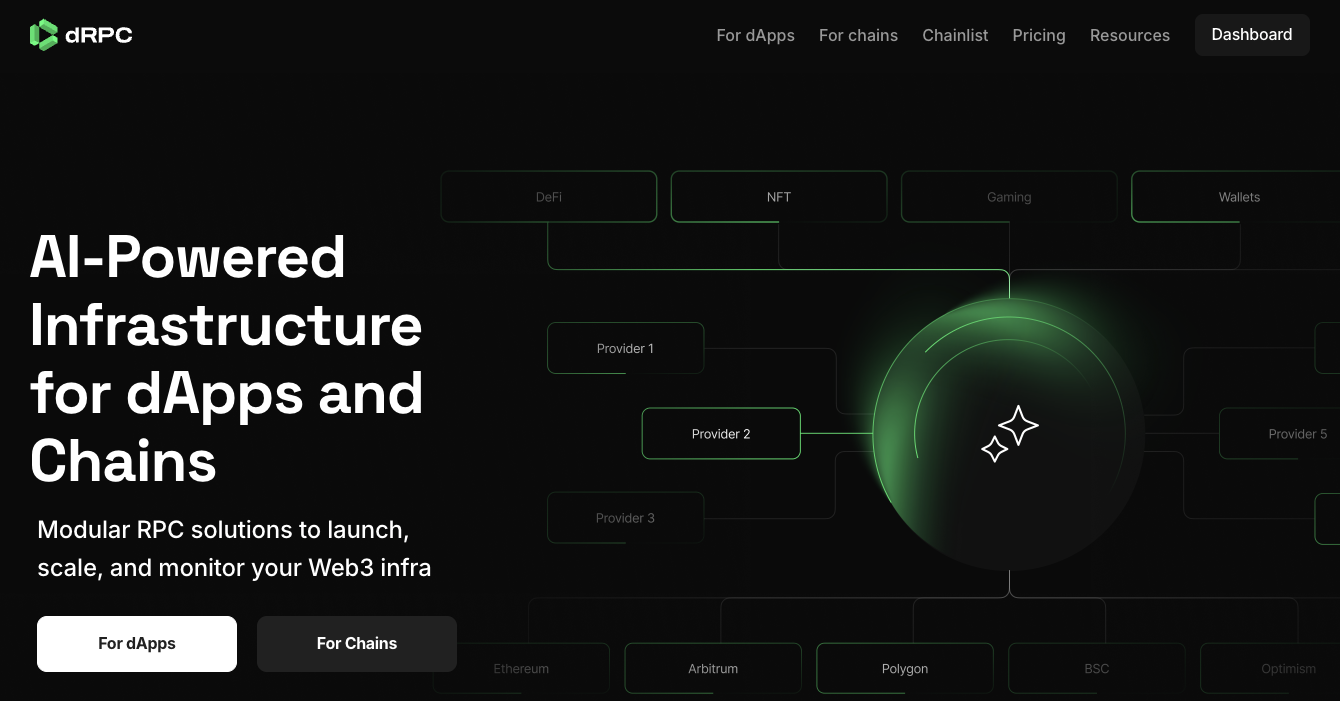
dRPC routes requests across a decentralized network of node providers and charges a flat 20 compute units per method, regardless of which method you call. That makes eth_getLogs cost the same as a simple read, which is rare among CU-based providers.
Key features:
- 100+ supported networks
- Flat 20 CU per method, no per-method multipliers
- Archive, WebSocket, and trace included
- Multi-provider routing for redundancy
- Accepts crypto payments
Pricing:
| Tier | Allowance / Rate | Price |
|---|---|---|
| Free | 210M CU / 30 days, public nodes | $0 |
| Paid | No fixed rate limit | $0.30/1M CU (~$6/1M requests) |
In our test dRPC's public endpoint was the more reliable of the two free options, with no errors in either region, though its p95 read latency ran 200ms or higher from Stockholm and around 70ms p50 from Oregon. The flat per-method pricing is genuinely useful for monitoring-heavy Polymarket bots. At roughly $6 per million requests on the paid tier, it sits above the volume rates at Dwellir or QuickNode but the no-multiplier model keeps log-heavy bills predictable.
Best for: Teams that want a large free tier for development and flat per-method pricing on log-heavy workloads, with multi-provider redundancy.
6. Chainstack
Chainstack bills 1 request unit per API call with no method multipliers, backed by SOC 2 Type II certification. The flat request model and compliance credentials suit teams with formal vendor requirements.
Key features:
- 70+ supported blockchains
- 1 RU per request, no multipliers
- WebSocket on all plans
- Archive and trace from the Growth tier
- SOC 2 Type II certified
- Dedicated Polygon nodes available
Pricing:
| Plan | Monthly | Included RU | RPS | Overage |
|---|---|---|---|---|
| Developer | $0 | 3M | 25 | $20/1M |
| Growth | $49 | 20M | 250 | $15/1M |
| Pro | $199 | 80M | 400 | $12.50/1M |
| Business | $499 | 200M | 600 | $10/1M |
| Enterprise | $990+ | 400M+ | Unlimited | $5/1M |
Chainstack's flat request pricing is competitive, but its overage rates run higher than most: $15 per million on Growth versus $5 at Dwellir. Archive and trace require the Growth tier or above, so the free Developer tier is read-only in practice. The SOC 2 certification is the differentiator for teams that need compliance documentation.
Best for: Teams with formal compliance requirements that want SOC 2 certification and flat request-unit pricing.
7. Ankr
Ankr offers Polygon RPC through a mix of public endpoints and a paid API-credit model, with crypto payment support via its own token.
Key features:
- 70+ supported networks on paid tiers
- WebSocket subscriptions
- Advanced API and gRPC access
- Crypto and ANKR token payments
- Decentralized plus Ankr-operated nodes
Pricing:
| Tier | Allowance / Rate | Max RPS |
|---|---|---|
| Public | Free, rate-limited | - |
| Freemium | 200M credits/mo | 30 |
| Premium PAYG | $0.10/1M credits | up to 1,500 |
Watch the effective cost here. A standard EVM request costs 200 credits, so the headline "$0.10 per million credits" works out to roughly $20 per million actual requests. That is among the higher effective rates in this comparison. Ankr's strengths are its crypto payment flexibility and high available RPS on the premium tier.
Best for: Teams that want crypto-native billing and can work within the per-method credit model.
8. GetBlock
GetBlock supports Polygon across a large network catalog with WebSocket on every tier, including the free plan, and MEV protection included by default.
Key features:
- 130+ supported blockchains
- WebSocket on all tiers
- Archive from the Starter tier
- MEV protection included, even on Free
- Dedicated and private node options
Pricing:
| Plan | Monthly | Compute Units | RPS |
|---|---|---|---|
| Free | $0 | 50K/mo | 20 |
| Starter | $39 | 50M | 100 |
| Advanced | $159 | 220M | 300 |
| Pro | $399 | 600M | 500 |
| Enterprise | $799+ | Custom | Custom |
GetBlock uses compute units with blockchain-specific multipliers, and the free tier at 50,000 CU per month is small compared to other free plans. Archive from the Starter tier and included MEV protection are useful, and dedicated nodes let you place infrastructure near your bot's region.
Best for: Teams that want WebSocket on the free tier and included MEV protection, or dedicated node placement at a lower entry price.
Provider Comparison
| Provider | Free Tier | Entry Paid | Archive | WSS | Trace | Max RPS (Paid) | Pricing Model | Networks |
|---|---|---|---|---|---|---|---|---|
| Dwellir | 100K/day | $49/mo | Dedicated | Yes | Yes (all paid) | 2,000 | 1:1 requests | 100+ |
| Alchemy | 30M CU/mo | PAYG | Yes | Yes | Yes (paid) | 1000+ | Compute units | 50+ |
| QuickNode | 10M credits | $49/mo | Yes | Yes | Yes (Build+) | 500 | Credits + multipliers | 60+ |
| Infura | 3M cr/day | $50/mo | Yes | Yes | Yes (Dev+) | High | Credits | 40+ |
| dRPC | 210M CU/30d | ~$6/1M req | Yes | Yes | Yes | No fixed cap | Flat 20 CU/method | 100+ |
| Chainstack | 3M RU/mo | $49/mo | Yes (Growth+) | Yes | Yes (Growth+) | Unlimited | 1 RU/request | 70+ |
| Ankr | 200M cr/mo | PAYG | Yes | Yes | Per-method | 1,500 | Credits (~$20/1M req) | 70+ |
| GetBlock | 50K CU/mo | $39/mo | Yes (Starter+) | Yes | Higher tiers | 500 | Compute units | 130+ |
Cost at 100M Monthly Requests
For a Polymarket bot making 100M Polygon calls per month, weighted toward eth_call reads and eth_getLogs monitoring:
| Provider | Estimated Monthly Cost | Notes |
|---|---|---|
| Dwellir (Growth) | $299 (150M included) | 1:1 pricing, logs cost the same as reads |
| Chainstack (Business) | $499 (200M included) | 1 RU flat, higher overage if exceeded |
| dRPC (paid) | ~$600 | Flat 20 CU/method, predictable on logs |
| QuickNode (Scale) | $499 (950M credits) | Credit multipliers inflate log-heavy usage |
| Alchemy | Varies by method mix | CU multipliers make estimates imprecise |
| Ankr (PAYG) | ~$2,000 | ~$20/1M effective at 200 cr/request |
Direct comparison across compute-unit providers is imprecise because your bill depends on your method mix, and a Polymarket monitoring workload skews toward exactly the methods that carry the highest multipliers. The flat-rate providers (Dwellir, Chainstack, dRPC) give the most predictable numbers for this use case.
Choosing the Right Provider
For most Polymarket traders the decision comes down to where your bot runs and how log-heavy your strategy is.
Best all-round choice for European and US traders: Dwellir. It posted the fastest reads in both benchmark regions (roughly 9ms p50 from Stockholm and 12ms p50 from Oregon) with zero errors, and its 1:1 pricing means the eth_getLogs calls your fill monitor depends on cost the same as a simple balance check. For a strategy built on polling Polymarket settlement events, that flat model and low latency are the combination that matters.
Solid event-driven alternative: QuickNode. It posted zero errors in both regions with consistent latency, and its Streams and Webhooks are well suited to event-driven fill notifications. The credit multipliers mean log-heavy bots should model their bill carefully.
Best for development and flat-rate monitoring: dRPC. Its 210M compute-unit free tier is generous for building and testing, and the flat 20 CU per method keeps log-heavy bills predictable once you go paid. It was also the more reliable of the two public endpoints we tested.
Whatever you shortlist, run the benchmark from your own region first. Our two-region results show the same provider can be the fastest option in one location and the slowest in another. Latency on Polygon is a proximity problem, and the only way to know your real numbers is to test your real path.
Getting Started
Polymarket's move to CTF Exchange V2 and pUSD in April 2026 means any bot still on V1 libraries needs to migrate, and that is a natural moment to re-evaluate the RPC underneath it. Reorg-free settlement after Polygon's Rio upgrade lets you tighten confirmation logic, but only on an endpoint fast and reliable enough to keep up.
Dwellir provides Polygon RPC with 1:1 pricing, WebSocket and trace on all paid plans, and a 99.99% uptime SLA. Get started with Dwellir's Polygon endpoints or contact the Dwellir team to discuss a dedicated node cluster placed in your trading region.
Related Guides
- How to Build a Polymarket Copy-Trading Bot - Detect a target wallet's trades and replicate them through the CLOB API on Polygon.
- Polymarket API: The Complete Developer Guide - Discover markets, read the order book, place orders, and stream fills.