On July 1, 2026, Robinhood turned tokenized equities into a live, permissionless market. Tokens that track stocks like NVDA and AAPL now trade 24/7 on-chain as Stock Tokens, settle in seconds, and plug directly into DeFi. The infrastructure underneath that shift is Robinhood Chain, the company's own Ethereum Layer 2. If you build trading tools, indexers, or DeFi protocols, this is a new chain with real order flow and a distribution channel of tens of millions of Robinhood users. Here is how it works and how to connect to it.
Quick answer: Robinhood Chain is a public, EVM-compatible Ethereum Layer 2 built on Arbitrum Orbit (the Nitro stack). It settles to Ethereum using blob data availability, uses ETH for gas, and runs on chain ID 4663. It is purpose-built for tokenized real-world assets, led by Robinhood's Stock Tokens, with a growing DEX ecosystem including Arcus (from the dYdX team), Uniswap, and Lighter. Dwellir provides archive RPC and WebSocket access to Robinhood Chain so you can index and trade without running your own node.
What Is Robinhood Chain?
Robinhood Chain is a general-purpose blockchain that Robinhood commissioned and operates. It launched a public testnet on February 10, 2026, and went live on mainnet on July 1, 2026. Contract deployment is permissionless, so any developer can ship to it without Robinhood's approval, and the network is fully EVM-compatible.
The chain has one clear design goal: bring tokenized real-world assets on-chain at scale. The flagship product is Stock Tokens, on-chain tokens that track equities like NVIDIA and Apple. They give holders economic exposure to the underlying stock rather than legal ownership of shares, trade around the clock where eligible, and behave like any other ERC-20 inside DeFi. This is the difference that matters for builders. Instead of another general L2 fighting for generic liquidity, Robinhood Chain arrives with a specific asset class, a specific user base, and specific order flow.
Early numbers reflect that focus. In its first two weeks, Robinhood Chain became a top-five chain by DEX volume, with roughly $3.1 billion in seven-day DEX volume, 65,000+ active users, and around 4 million transactions in week one. Treat these as launch-window figures that are still moving, but the direction is clear: this is not a ghost chain.
Why Robinhood Built Its Own Chain
Robinhood already sold tokenized stocks in Europe in 2025, running on Arbitrum One. Building a dedicated chain gives Robinhood control over throughput, fees, block times, and the compliance and custody integrations that regulated RWAs require. It also lets Robinhood offer partners day-one liquidity venues and a native settlement layer rather than renting space on a shared L2.
The positioning has shifted quickly. At launch, the pitch was institutional: tokenized stocks, RWA settlement, and on-chain finance for serious capital. Within a week, after a token called CASHCAT ran up on the chain, Robinhood's messaging widened to acknowledge memecoin and general DeFi activity too. For developers, the takeaway is simple. The chain is permissionless and general-purpose, even though its anchor product is tokenized equities.
How Robinhood Chain Works: The Architecture
Robinhood Chain runs on Arbitrum Orbit, the chains-as-a-service framework built on the Arbitrum Nitro stack. Orbit supplies the rollup machinery, fraud proofs, data posting, and Ethereum settlement. Robinhood configures the network and operates its infrastructure. A live node reports its client as nitro/v3.11.2, which confirms the Nitro lineage.
One detail is worth stating plainly, because it is a common point of confusion. Robinhood Chain is an Ethereum Layer 2, not an Arbitrum Layer 3. Per Robinhood's own documentation, it settles directly to Ethereum and uses Ethereum blobs for data availability. It is built with Arbitrum's technology, but its parent chain is Ethereum. If you query a block and see an l1BlockNumber field, that number tracks Ethereum, not Arbitrum One.
Here is the network at a glance:
| Property | Value |
|---|---|
| Type | Ethereum Layer 2 (Arbitrum Orbit / Nitro stack) |
| Settlement and DA | Ethereum, via blob data availability |
| Chain ID | 4663 mainnet (46630 testnet) |
| Gas token | ETH (no separate chain token) |
| EVM compatibility | Full |
| Block latency | Configurable block times with roughly 100ms preconfirmations |
| Sequencer | Centralized, operated by Robinhood |
| Contract deployment | Permissionless |
| Explorer | robinhoodchain.blockscout.com |
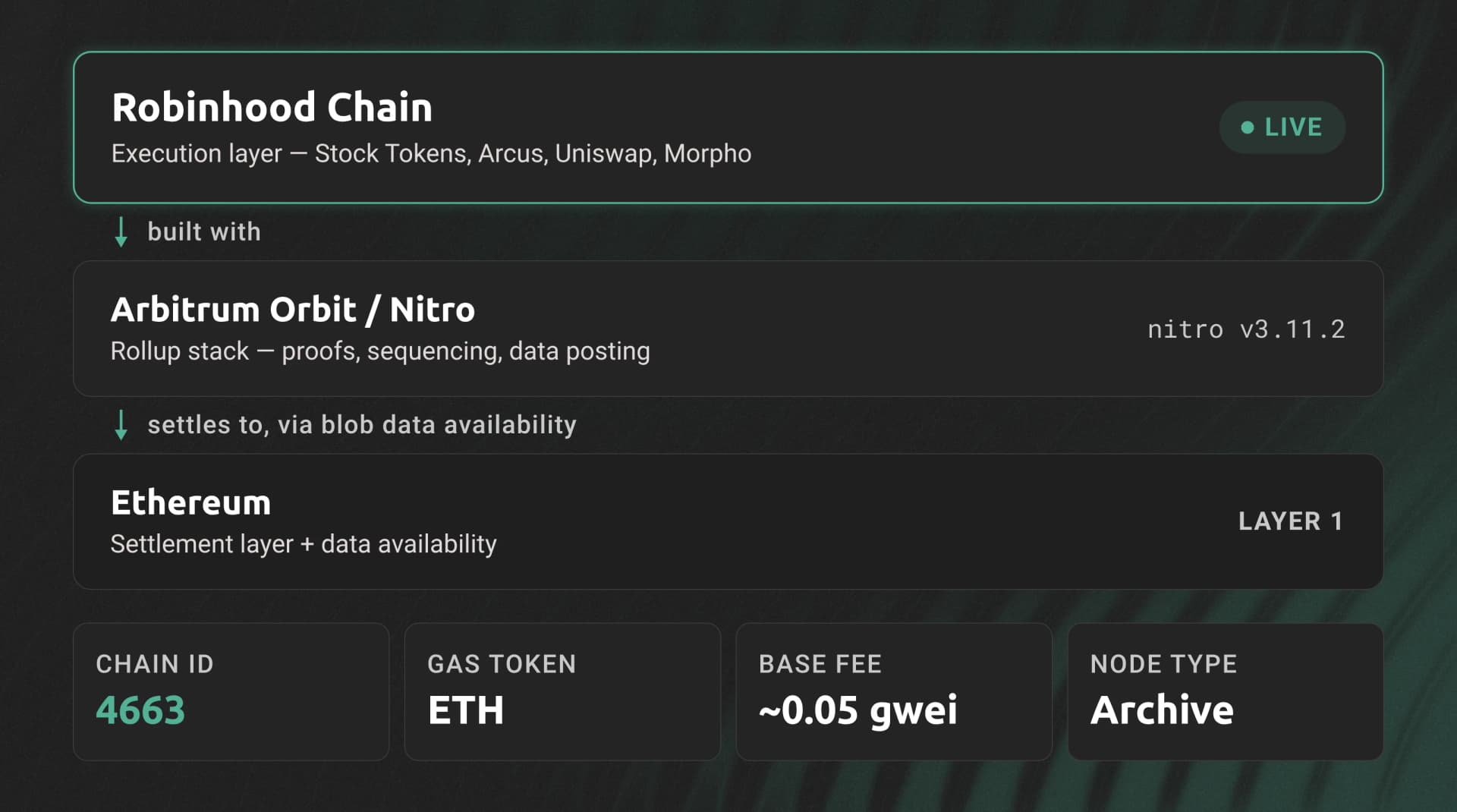
A few implications for builders:
- ETH is the gas token. There is no new asset to acquire before you can transact, and no custom-gas-token surprises in your tooling.
- Blob DA keeps fees low. Base fees observed on mainnet sit near 0.05 gwei, so high-frequency workloads stay cheap.
- The sequencer is centralized. Like most young Orbit and rollup chains, ordering is operated by the chain owner today. Validation and deployment remain permissionless.
Stock Tokens and Real-World Assets
Stock Tokens are the reason this chain exists. Each one is an on-chain token that tracks an equity and gives economic exposure to it rather than legal ownership of the underlying shares, and it trades 24/7 outside the constraints of traditional market hours. Availability is jurisdiction-dependent, so check Robinhood's Stock Token documentation for eligibility. Because they are standard tokens on an EVM chain, they compose with the rest of DeFi: you can trade them on an AMM, use them as collateral in protocols that accept them, or build structured products around them.
Chainlink provides the official price oracle, BitGo handles custody, and USDG (a dollar-backed stablecoin) serves as the primary quote and settlement asset. Robinhood also layered on adjacent products at launch, including RWA perpetuals in the EU (commodities, ETFs, and FX, up to 10x) and on-chain lending through Morpho that powers Robinhood Earn. That lending product drove a large share of early total value locked, so read headline TVL figures carefully: much of the first-week TVL came from Morpho rather than from organic trading depth.
The Ecosystem: Arcus, Uniswap, and DeFi on Robinhood Chain
Robinhood Chain launched with real venues rather than empty promises of future partners.
- Arcus is the headline DEX, built jointly by dYdX Labs and Robinhood Crypto. Spot trading of 95 Stock Tokens is live, and 35 RWA perpetuals are in a waitlist phase. Arcus represents a strategic pivot for the dYdX team toward a fast EVM L2, while dYdX Chain v4 continues to operate.
- Uniswap deployed a dedicated AMM as a primary public liquidity layer on day one.
- Lighter brings a decentralized perpetuals venue for crypto perps.
- Morpho powers on-chain lending, and USDG anchors stablecoin liquidity, with network stablecoin balances reaching roughly $300 million in the first weeks.
- LayerZero handles cross-chain bridging, including routes from other ecosystems into Robinhood Chain.
For builders, this mix matters. Multiple DEXes on one chain means cross-venue price differences, liquidations, and large trades worth tracking, which is exactly the raw material for indexers, whale trackers, arbitrage bots, and copy-trading tools.
What Robinhood Chain Means for Developers
If you have shipped anything on Ethereum or Arbitrum, you already know how to build here. Everything ports over directly: wallets, Solidity contracts, Hardhat, Foundry, ethers, viem, and standard JSON-RPC. There is no new SDK to learn and no bespoke consensus to reason about.
Connecting is a standard EVM setup:
# Read the current chain ID (returns 0x1237 = 4663)
curl -s -X POST "$ROBINHOOD_RPC_URL" \
  -H 'Content-Type: application/json' \
  --data '{"jsonrpc":"2.0","id":1,"method":"eth_chainId","params":[]}'

# Read the latest block number
curl -s -X POST "$ROBINHOOD_RPC_URL" \
  -H 'Content-Type: application/json' \
  --data '{"jsonrpc":"2.0","id":1,"method":"eth_blockNumber","params":[]}'
Robinhood publishes a public RPC endpoint, but it is rate-limited and not built for production read loads. That is why the docs also list multiple third-party providers. Any serious indexing job, whale tracker, or trading bot will exhaust a shared public endpoint quickly, especially when it needs historical state or a stable WebSocket subscription.
Accessing Robinhood Chain with Dwellir
Dwellir runs an archive node for Robinhood Chain, available over HTTPS and WebSocket. Archive access means you can read state at any historical block, which is what indexers, backtests, and analytics pipelines need. The node reports chain ID 4663 and returns state from the genesis block, and it is fully synced.
Two things make this useful in practice:
- Archive depth for indexing. Reconstructing balances, positions, or DEX trades over time requires historical state. A pruned or rate-limited endpoint cannot serve that reliably. Dwellir's archive node can.
- WebSocket subscriptions for real-time apps. Streaming new blocks and logs over
eth_subscribeis how you power live dashboards, liquidation monitors, and copy-trading bots. Dwellir exposes a WSS endpoint alongside HTTPS.
Dwellir's pricing is a flat request model with no compute units, so a busy indexer or bot does not get penalized for calling heavier methods like eth_getLogs. For high-frequency or latency-sensitive strategies, dedicated node clusters and colocated execution are available on request.
FAQ
Is Robinhood Chain a Layer 2 or a Layer 3? It is an Ethereum Layer 2. It is built with Arbitrum Orbit technology, but per Robinhood's documentation it settles to Ethereum and uses Ethereum blobs for data availability. It is not an L3 settling to Arbitrum One.
What is the Robinhood Chain chain ID?
Mainnet is 4663 (0x1237). The public testnet is 46630.
Does Robinhood Chain have its own token? No. Gas is paid in ETH, and there is no native chain token. Incentives are paid in dollars and partner assets. Arcus has hinted at a future token, but none is live.
Is it EVM-compatible? Yes, fully. Standard Ethereum and Arbitrum tooling works without modification.
How do I get production RPC access? The public endpoint is rate-limited. For archive reads and WebSocket streaming, sign up for a Dwellir account or contact the Dwellir team to discuss dedicated infrastructure.
Robinhood Chain gives developers something rare: a new EVM L2 that arrives with genuine order flow, tokenized equities as native primitives, and a direct line to millions of retail users. The build experience is standard Ethereum, so the real question is infrastructure. For archive reads, historical indexing, and real-time WebSocket feeds on Robinhood Chain, get started with Dwellir or talk to the team about dedicated node clusters.