Tempo is an EVM-compatible Layer 1 blockchain built for stablecoin payments, incubated by Stripe and Paradigm and run as its own company. It has no native gas token, so fees are paid in whichever USD stablecoin the payer holds. Blocks commit about every half second under Simplex BFT consensus and are final on commit, with payments guaranteed their own share of every block.
Tempo mainnet has been live since 18 March 2026 with chain ID 4217. This post covers who is behind the chain, how consensus and the fee model work, where Tempo departs from the EVM you know, what has shipped and when, how it compares with Arc, Plasma and Stable, and how to connect. Every chain reading below was taken from Tempo mainnet on 9 November 2026.
Tempo at a glance
| Tempo | |
|---|---|
| Built by | Tempo, an independent company incubated by Stripe and Paradigm; CEO Matt Huang |
| Mainnet chain ID | 4217 (0x1079) |
| Testnet (Moderato) chain ID | 42431 (0xa5bf) |
| Gas token | None. Fees in any USD TIP-20 stablecoin with Fee AMM liquidity; pathUSD is the fallback |
| Fee for a 50,000-gas transfer | About $0.00003 on 9 Nov 2026; protocol cap about $0.0006 |
| Block time | 0.54 s measured over 10,000 blocks on 9 Nov 2026 (docs: about 600 ms) |
| Finality | Deterministic, on commit, no reorgs |
| Consensus | Simplex BFT (Commonware), VRF leader election, permissioned validators |
| Execution client | Tempo node, built on the Reth SDK, Osaka EVM target, Apache 2.0 |
| Public testnet | 9 December 2025 |
| Public mainnet | 18 March 2026 |
| Active hardfork | T13, activated on mainnet 3 November 2026 |
| Public RPC | https://rpc.tempo.xyz, wss://rpc.tempo.xyz |
| Explorer | explore.tempo.xyz |
What is Tempo?
Tempo describes itself as "a purpose-built blockchain for stablecoin financial products". Stripe and Paradigm announced it on 4 September 2025 with design partners including Anthropic, Deutsche Bank, DoorDash, OpenAI, Revolut, Shopify, Standard Chartered and Visa. The pitch: most chains are tuned for trading, and a payments rail needs predictable fees, guaranteed throughput and settlement in the unit the money moves in.
For a developer, Tempo is a standard EVM target with four payment rules written into the protocol. Fees are priced in dollars and paid from a stablecoin balance. Payment transactions get blockspace that other traffic cannot consume. A block is final the moment it commits. And the token standard, TIP-20, carries a 32-byte memo and a compliance policy on every transfer, so an invoice number travels with the payment.
The chain is also where Stripe puts its own stablecoin traffic. Stripe's money management products settle payouts on Tempo in over 100 countries at a fixed $0.001 per transaction (21 April 2026), its streaming payments for AI usage bill in stablecoin micropayments on Tempo (29 April 2026), and OUSD on Tempo became Stripe's default stablecoin configuration on 30 September 2026. Tempo's homepage quotes Patrick Collison: "Tempo is now Stripe's default blockchain for new features."
Who builds Tempo?
Tempo is a company, not a Stripe product. Matt Huang, co-founder of Paradigm and a Stripe board member, is founder and CEO while continuing to run Paradigm. Fortune reported on 17 October 2025 that Tempo raised a $500 million Series A at a $5 billion valuation led by Thrive Capital and Greenoaks; Tempo has not published the terms.
The validator set is permissioned and made of payment companies. Stripe, Visa and Zodia Custody by Standard Chartered joined on 14 April 2026, MoneyGram became the "anchor remittance validator" on 20 May 2026, and zerohash joined on 6 October 2026. Tempo says it is on "a path towards permissionless validation" with no date, and it does not publish the full validator list or count, so treat the five named institutions as a floor.
How does Tempo work?
Tempo splits the job the way most modern chains do: a consensus layer orders and finalizes blocks, and an execution layer built on Reth runs the transactions. Three design choices set it apart.
Simplex BFT. Consensus is the Simplex protocol implemented by Commonware, which Tempo adopted in November 2025 while leading a $25 million round in the company. A VRF picks each block's proposer. The protocol prefers safety to liveness: if more than a third of validators go offline the chain halts rather than fork, and a finalized block can never be reverted. Finalization certificates are BLS threshold signatures, which is how a following RPC node verifies blocks without joining consensus.
Payment lanes. Every block header carries a second gas limit, general_gas_limit, that caps how much gas non-payment transactions can use. A transaction counts as a payment when every call in it is an allow-listed TIP-20 transfer, mint, burn or approval, decided from the payload alone. The finalized block we read on 9 November 2026 carried mainBlockGeneralGasLimit: 0x1c9c380, or 30,000,000 gas. Payments can always use the remainder, so a payroll run does not queue behind a token launch.
No native asset. There is nothing to stake, burn or speculate on. Validators are paid in stablecoins.
The measured block time on 9 November 2026 was 0.538 seconds across 10,000 blocks, about 160,000 blocks a day. The finalized tag returned a block adjacent to latest, which is what deterministic finality looks like from the client side.
How do fees work without a gas token?
Fees are quoted in attodollars per gas, 10^-18 of a dollar, and paid in a USD TIP-20 stablecoin. eth_gasPrice returned 0x23c34600, or 600,000,000 attodollars, on 9 November 2026:
50,000 gas × 600,000,000 attodollars = 3 × 10^13 attodollars = $0.00003That is the quiet-period floor. Since the T7 hardfork the base fee is dynamic but bounded, and Tempo puts the cap for a 50,000-gas transfer at about $0.0006. Every fee goes to the validator that proposed the block.
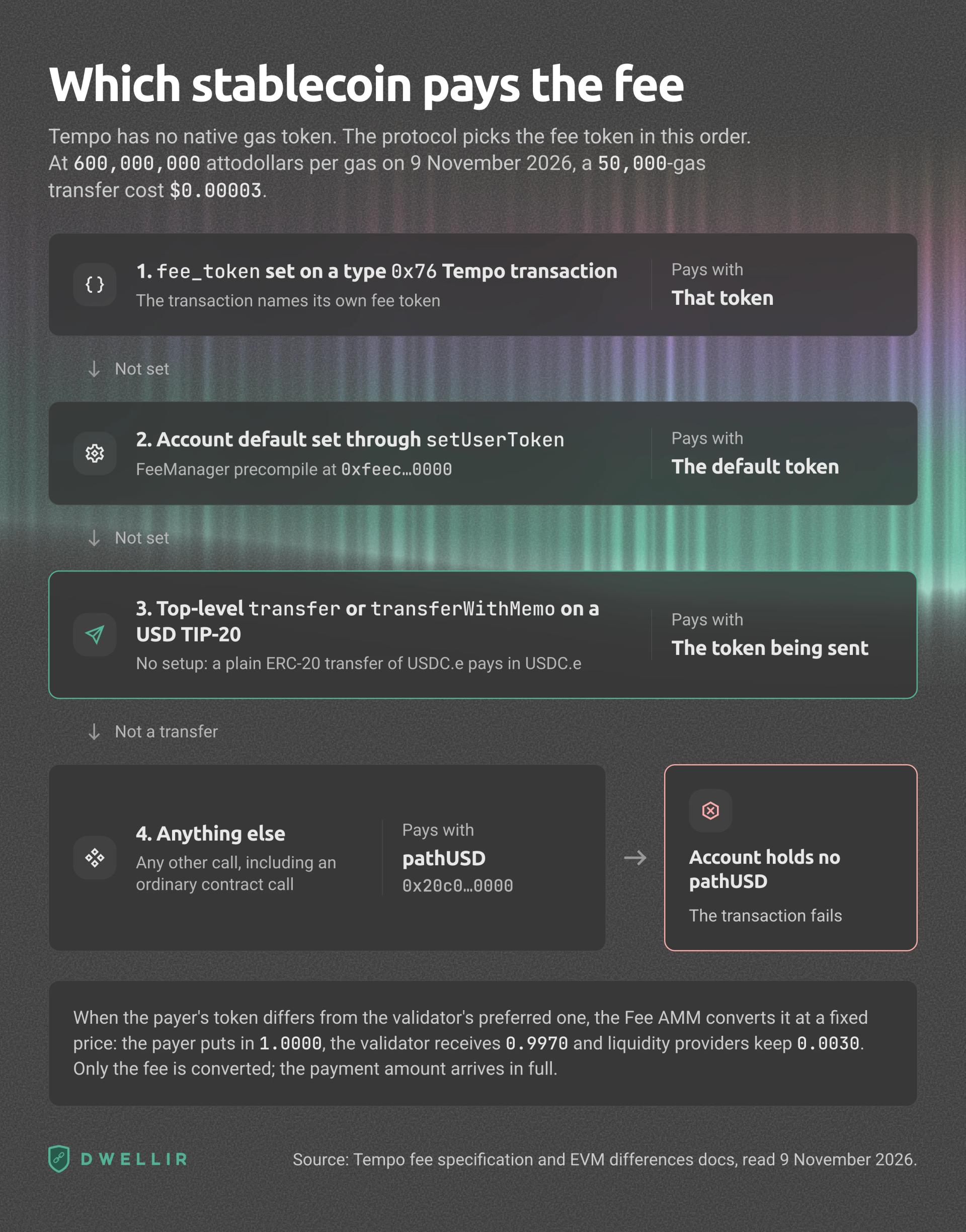
Which stablecoin pays is decided by a cascade. A type 0x76 Tempo transaction can name a fee_token directly. Failing that, the protocol uses the account default set through setUserToken on the FeeManager precompile at 0xfeec000000000000000000000000000000000000. Failing that, a top-level transfer or transferWithMemo on a USD TIP-20 pays from the token being sent, so a plain ERC-20 transfer of USDC.e works with no setup. Everything else falls back to pathUSD at 0x20c0000000000000000000000000000000000000, and a call to an ordinary contract from an account holding no pathUSD fails.
When the payer's token differs from the validator's preferred one, the enshrined Fee AMM converts it at a fixed price: the payer puts in 1.0000, the validator receives 0.9970 and liquidity providers keep 0.3%. Only the fee is converted; the payment amount arrives in full.
One cost is higher than Ethereum's, by design. A new storage slot or account costs 250,000 gas instead of 20,000 and 0, so the first transfer to a fresh address runs about 300,000 gas, roughly $0.00018 at today's price, and contract deployments cost 5 to 10 times what they do on Ethereum.
Is Tempo EVM compatible?
Yes. Solidity contracts deploy with Foundry (forge init -n tempo), Hardhat and viem work, and the node exposes the standard eth_, net_, web3_, txpool_, trace_ and debug_ namespaces. The execution environment targets the Osaka hard fork. Four differences will break code ported from Ethereum.
eth_getBalance returns the same constant for every account, 0x9612084f0316e0ebd5182f398e5195a51b5ca47667d4c9b26c9b26c9b26c9b2, about 4.2 × 10^75; we confirmed it against two unrelated addresses on 9 November 2026. Any native-balance check must go; read balanceOf on the TIP-20 instead. In Solidity, BALANCE, SELFBALANCE and CALLVALUE all return zero.
eth_estimateGas sizes the allowance from the fee payer's stablecoin balance. Estimating a USDT0 transfer from an empty account on 9 November 2026 reverted with InsufficientBalance { available: 0, required: 1000000 } instead of returning a number.
TIP-20 tokens have six decimals and extend ERC-20 with transferWithMemo, role-based issuance, supply caps, pause and a TIP-403 policy that decides who may send or receive. Since T6 a receiver can set a receive policy; a blocked delivery still succeeds but is parked in ReceivePolicyGuard, so a receipt alone does not prove the recipient's balance moved.
Tempo transactions, type 0x76, add what EIP-4337 and EIP-7702 bolt on elsewhere: a separate fee payer, atomic batches, access keys with spending limits, parallel nonce streams and validity windows. Legacy and EIP-1559 transactions still work; Tempo's docs recommend 0x76 for payment flows.
Is Tempo mainnet live?
Yes, since 18 March 2026. The dates that matter:
| Date | Event |
|---|---|
| 4 Sep 2025 | Stripe and Paradigm announce Tempo |
| 8 Nov 2025 | Tempo adopts Commonware's Simplex consensus |
| 9 Dec 2025 | Public testnet (Moderato, chain ID 42431), four Tempo-run validators |
| 12 Feb 2026 | T1 hardfork activates on mainnet, five weeks before public launch |
| 18 Mar 2026 | Mainnet live, chain ID 4217; Machine Payments Protocol released |
| 14 Apr 2026 | Stripe, Visa and Zodia Custody join as validators |
| 20 May 2026 | MoneyGram joins as anchor remittance validator |
| 30 Sep 2026 | OUSD live on Tempo; Stripe makes it the default stablecoin |
| 6 Oct 2026 | zerohash joins as validator |
| 14 Oct 2026 | Tempo Zones (private balances) generally available; Deel in production |
| 3 Nov 2026 | T13 hardfork activates on mainnet |
| 5 Nov 2026 | Credit on Tempo announced |
The T1 date comes from tempo_forkSchedule, so the mainnet chain ran privately before its public launch. Tempo has shipped T1 through T13 in under nine months, each activating on Moderato first; pin your node version and watch the upgrade schedule if you run your own infrastructure. Tempo's homepage showed $60 billion in annualized stablecoin payment volume and more than $700 million in stablecoins and tokenized assets on 9 November 2026. Those are Tempo's figures, not ours.
What Tempo means for a payments developer
A receipt is settlement. Credit the ledger on one receipt and persist the block hash for audit; there is no reorg path to code against. Subscribe to newHeads over WebSocket rather than polling, because 160,000 blocks a day outruns a per-block eth_getBlockByNumber loop.
Reconciliation moves onchain. Put the invoice ID or payout reference in the 32-byte memo and read it back from the TransferWithMemo event.
Your users never hold a gas token. A contractor paid in USDC.e pays the fee in USDC.e, or you sponsor it with a fee payer, and treasury can quote the network cost in dollars.
The stablecoins are live. pathUSD (Bridge), USDT0 at 0x20c00000000000000000000014f22ca97301eb73 and bridged USDC.e at 0x20c000000000000000000000b9537d11c60e8b50 all answered symbol() on 9 November 2026, and OUSD, Ondo's USDY, AllUnity's CHFAU and Canada's CADD have launched since May. Native Circle USDC is not on Tempo. If you are weighing tokenized deposits against stablecoins for the same flow, the tokenized deposits comparison covers the differences.
Privacy is opt-in through Zones, generally available since 14 October 2026. Inside a Zone the public chain shows the token and amount deposited but not who received it or what they hold, while the Zone operator keeps full visibility for compliance.
Tempo vs Arc, Plasma and Stable
Tempo is one of four stablecoin-first Layer 1s with a live mainnet, and the only one without a native asset. Chain IDs were checked against each public RPC on 3 November 2026 for the Arc explainer. The stablechain RPC guide has the full comparison and a working transfer on each chain.
| Tempo | Arc | Plasma | Stable | |
|---|---|---|---|---|
| Backed by | Stripe, Paradigm | Circle | Bitfinex, Framework, Founders Fund | Bitfinex, Hack VC, Tether |
| Chain ID | 4217 | 5042 | 9745 | 988 |
| Gas paid in | Any USD TIP-20 stablecoin | USDC (native) | XPL | USDT0 (native) |
eth_getBalance returns | A constant placeholder | USDC, 18 decimals | XPL | USDT0, 18 decimals |
| Block time | ~0.5 s | ~0.5 s | ~1 s | ~0.7 s |
| Finality | On commit, sub-second | On commit, under 1 s | 2 to 3 blocks | On inclusion, ~0.7 s |
| Consensus | Simplex BFT, permissioned | Malachite BFT, PoA | PlasmaBFT, trusted validators | StableBFT (CometBFT), dPoS |
| Public mainnet | 18 Mar 2026 | 16 Sep 2026 | 25 Sep 2025 (Beta) | 8 Dec 2025 |
The practical difference is the issuer. Arc is built around USDC and Circle's tooling, Plasma and Stable around USDT, and Tempo lets the payer pick among several dollar stablecoins and pay the fee in the same one.
How do I connect to Tempo?
Point any EVM library at a Tempo RPC endpoint with chain ID 4217. Tempo runs a public endpoint at https://rpc.tempo.xyz and wss://rpc.tempo.xyz, and its docs list Blockdaemon, Chainstack, Conduit, dRPC, Dwellir, Luganodes, SenseiNode and Validation Cloud among its providers. For production traffic, Dwellir serves Tempo mainnet over HTTPS and WSS:
https://api-tempo-mainnet.n.dwellir.com/YOUR_API_KEY
wss://api-tempo-mainnet.n.dwellir.com/YOUR_API_KEY
Three calls that show how Tempo differs from other EVM chains, run against the Dwellir endpoint on 9 November 2026:
# Chain ID
curl -s https://api-tempo-mainnet.n.dwellir.com/YOUR_API_KEY \
  -H 'content-type: application/json' \
  -d '{"jsonrpc":"2.0","id":1,"method":"eth_chainId","params":[]}'
# {"jsonrpc":"2.0","id":1,"result":"0x1079"}

# Native balance: the same constant for every address
curl -s https://api-tempo-mainnet.n.dwellir.com/YOUR_API_KEY \
  -H 'content-type: application/json' \
  -d '{"jsonrpc":"2.0","id":1,"method":"eth_getBalance","params":["0x1111111111111111111111111111111111111111","latest"]}'
# {"jsonrpc":"2.0","id":1,"result":"0x9612084f0316e0ebd5182f398e5195a51b5ca47667d4c9b26c9b26c9b26c9b2"}

# USDT0 decimals, read from the TIP-20 contract
curl -s https://api-tempo-mainnet.n.dwellir.com/YOUR_API_KEY \
  -H 'content-type: application/json' \
  -d '{"jsonrpc":"2.0","id":1,"method":"eth_call","params":[{"to":"0x20c00000000000000000000014f22ca97301eb73","data":"0x313ce567"},"latest"]}'
# {"jsonrpc":"2.0","id":1,"result":"0x...0006"}
On the Dwellir endpoint, rpc_modules returns eth, net, web3, rpc, debug, trace and txpool. trace_block and debug_traceBlockByNumber both returned traces for block 1,048,576, and an eth_call against block 1,000,000 executed against historical state, because the nodes keep an archive. Billing is one credit per response for every method including trace and debug. The free plan includes 100,000 responses a day at 20 per second, paid plans start at $49 a month, and a dedicated Tempo cluster lists at $4,300 a month. The Tempo documentation lists every supported method, the Tempo network page has plans and endpoints, and the Tempo RPC provider comparison prices eight providers side by side.
Getting started
Tempo behaves like any EVM chain until money moves, and then the missing native balance, the fee-token cascade and one-block finality change your code. Start with chain ID 4217, delete every native-balance check, decide which stablecoin pays fees for each flow, and put your reconciliation key in the memo.
To try it on Dwellir, create a free API key and run the three calls above. For dedicated Tempo nodes or higher limits, contact the Dwellir team.
Frequently asked questions
What is Tempo blockchain?
Tempo is an EVM-compatible Layer 1 built for stablecoin payments, incubated by Stripe and Paradigm and run as an independent company led by Matt Huang. It has no native gas token: fees are paid in any supported USD stablecoin, blocks are final when they commit in about half a second, and payments get reserved blockspace through a dedicated payment lane. Validators are a permissioned set that includes Stripe, Visa, Zodia Custody, MoneyGram and zerohash.
Is Tempo mainnet live, and what is its chain ID?
Yes. Tempo mainnet launched on 18 March 2026 with chain ID 4217 (0x1079). The public testnet, Moderato, launched on 9 December 2025 and uses chain ID 42431. The public RPC is https://rpc.tempo.xyz over HTTPS and WebSocket, and the explorer is explore.tempo.xyz. The network was on the T13 hardfork as of 9 November 2026.
How are gas fees paid on Tempo without a native token?
Fees are quoted in attodollars per gas and paid in a USD TIP-20 stablecoin that has liquidity on the protocol's Fee AMM. The fee token is chosen in order: the fee_token field on a type 0x76 Tempo transaction, then the account's default set on the FeeManager precompile, then the token being transferred if the call is a top-level transfer, then pathUSD. On 9 November 2026 the gas price was 600,000,000 attodollars, so a 50,000-gas transfer cost about $0.00003.
Is Tempo EVM compatible?
Yes, with documented differences. Solidity, Foundry, Hardhat and viem work, and the execution client is built on the Reth SDK targeting the Osaka hard fork. Because there is no native token, eth_getBalance returns the same constant for every account, the BALANCE and CALLVALUE opcodes return zero, and a new storage slot or account costs 250,000 gas instead of 20,000. Tempo also adds a transaction type (0x76) with fee sponsorship, atomic batches and access keys.
Which RPC providers support Tempo?
Tempo's own docs list Blockdaemon, Chainstack, Conduit, dRPC, Dwellir, Luganodes, SenseiNode and Validation Cloud among its providers, plus the public endpoint at rpc.tempo.xyz. Dwellir serves Tempo mainnet over HTTPS and WebSocket from archive nodes with the trace, debug and txpool namespaces, billed at one credit per response. The Tempo RPC provider comparison covers pricing for eight of them.
Sources
Chain readings (eth_chainId, eth_getBalance, eth_gasPrice, eth_estimateGas, eth_call, block tags, rpc_modules, trace_block, debug_traceBlockByNumber, txpool_status, tempo_forkSchedule and the 10,000-block timing) were taken from Dwellir's Tempo endpoint and rpc.tempo.xyz on 9 November 2026. Third-party pages were read the same day.
- Tempo: Introducing Tempo (4 Sep 2025), infrastructure partners (23 Sep 2025), Tempo × Commonware (8 Nov 2025), testnet live (9 Dec 2025), mainnet live (18 Mar 2026), Stripe, Visa and Zodia Custody validators (14 Apr 2026), Stripe and Tempo (21 Apr 2026), zerohash validator (6 Oct 2026), Privacy is live (14 Oct 2026), Credit on Tempo (5 Nov 2026), FAQ, homepage
- Tempo docs: network details, EVM differences, consensus and finality, payment lane specification, fees, Fee AMM, Tempo transactions, TIP-20, RPC reference, specifications and upgrade status, RPC and node providers, run a node
- Paradigm: Tempo: The Blockchain Designed for Payments (4 Sep 2025)
- Stripe: 2025 annual letter release (24 Feb 2026), Sessions 2026 (29 Apr 2026), OUSD on Stripe (30 Sep 2026)
- Press: Fortune on the Series A (17 Oct 2025), The Block on MoneyGram (20 May 2026)