Moving an Ethereum app to Robinhood Chain can leave you showing users the wrong transaction cost. Nitro's gas estimate includes both execution and data posting. Add a separate posting fee, and your quote counts that cost twice.
To quote fees correctly, estimate the actual transaction and use that result to set its gas limit and fee cap. The examples below show how to calculate the total fee and choose those limits.
For architecture background, read What is Robinhood Chain?.
Separate ordering from fee estimation
Robinhood Chain uses first-come, first-served ordering, or FCFS. On Ethereum, priority fees can influence which transactions a block builder includes. On Robinhood Chain, raising maxPriorityFeePerGas does not move your transaction forward in the queue.
Nitro ignores priority tips. A nonzero tip field does not mean the user pays that tip. Remove fee tiers that promise faster inclusion, and set the priority fee to zero.
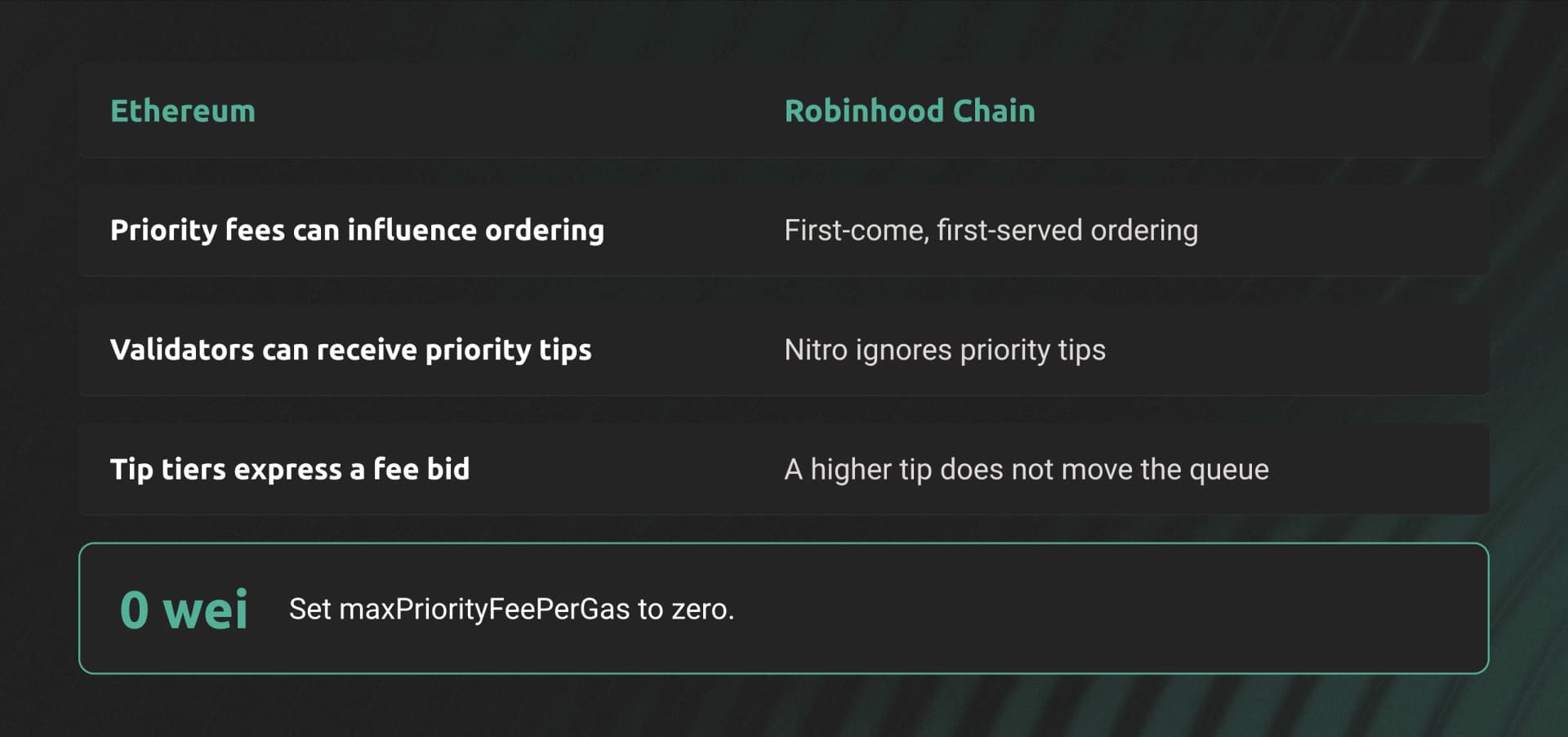
The mainnet endpoint returned zero priority fees and zero sampled reward percentiles during a read-only check on September 14, 2026. Treat those observations as a check, not a substitute for chain-specific fee policy.
Understand the two fee components
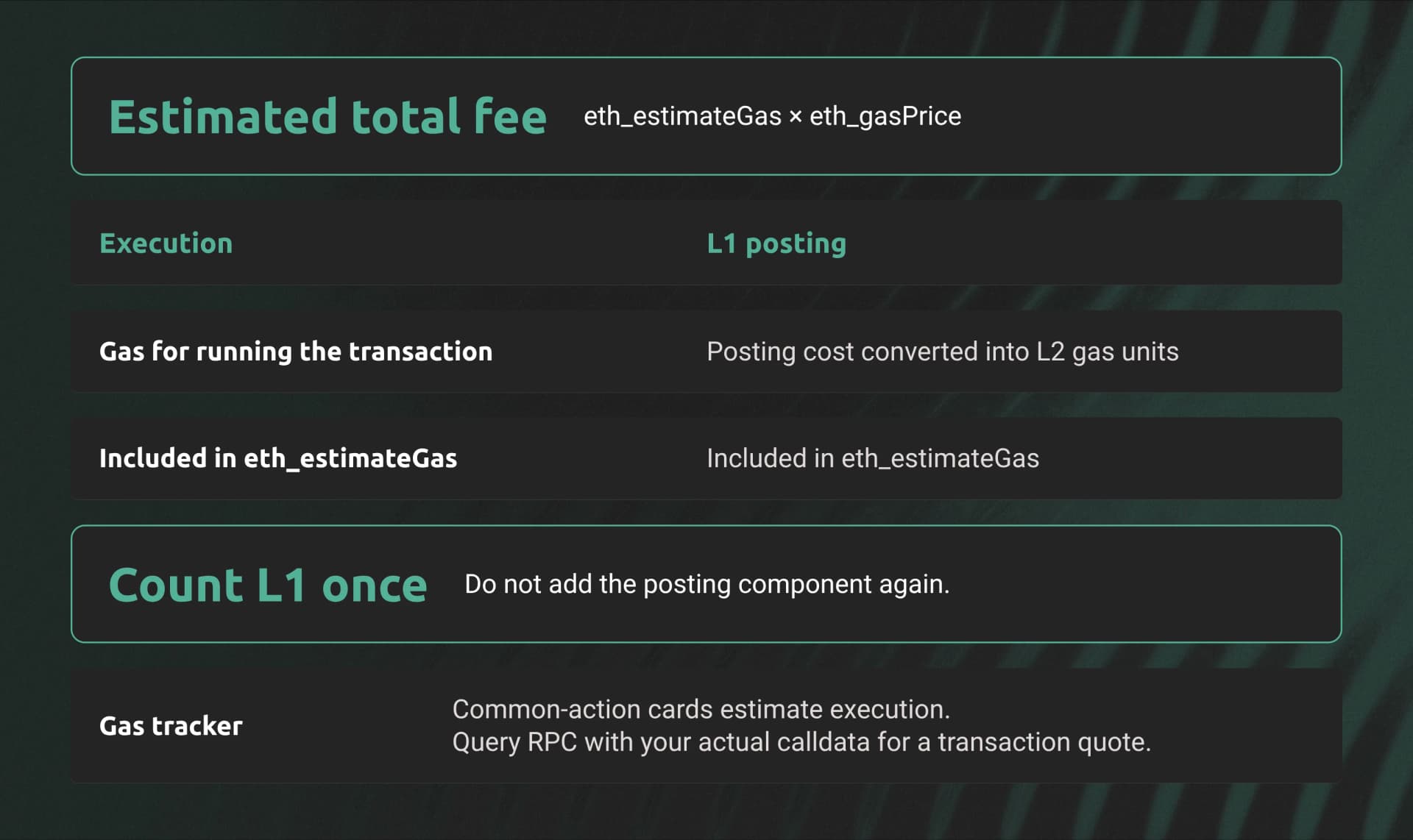
Nitro charges for execution on the child chain and for publishing transaction data to the parent chain. Its estimator converts the posting component into child-chain gas units.
estimated total fee = eth_estimateGas(transaction) × eth_gasPrice
That product estimates both components at the current price. Adding a separate L1 posting fee to it would count posting twice. The final charge can change before inclusion.
For a component breakdown, use NodeInterface.gasEstimateComponents(). The Arbitrum estimation guide explains the total estimate, its L1 component, and the relevant prices.
The Robinhood gas tracker uses fixed execution-gas assumptions for common-action cards. Those cards help compare execution fee levels. They are not a transaction-specific quote.
Read prices and estimate your transaction
The following read-only example uses Node.js and ethers v6. Install ethers, set DWELLIR_API_KEY, and provide valid FROM_ADDRESS and TO_ADDRESS values. The sender must have enough funds for the estimate.
import { JsonRpcProvider, formatEther, formatUnits } from 'ethers';

const provider = new JsonRpcProvider(
  `https://api-robinhood-mainnet-archive.n.dwellir.com/${process.env.DWELLIR_API_KEY}`,
);

const network = await provider.getNetwork();
if (network.chainId !== 4663n) throw new Error('Expected Robinhood mainnet');

const transaction = {
  from: process.env.FROM_ADDRESS,
  to: process.env.TO_ADDRESS,
  value: 0n,
  data: '0x',
};

const gasPrice = BigInt(await provider.send('eth_gasPrice', []));
const estimatedGas = await provider.estimateGas(transaction);
const estimatedFee = estimatedGas * gasPrice;

console.log('Gas price:', formatUnits(gasPrice, 'gwei'), 'gwei');
console.log('Estimated gas:', estimatedGas.toString());
console.log('Estimated total fee:', formatEther(estimatedFee), 'ETH');
Replace the transaction fields with your application's actual calldata and value. An estimate for an empty transfer cannot price a contract deployment or swap.
Use fee history for the base fee
eth_feeHistory returns base fees, gas-use ratios, and optional reward percentiles. On Robinhood, use the base-fee series to assess changes before inclusion.
const history = await provider.send('eth_feeHistory', [
  '0x14',
  'latest',
  [10, 50, 90],
]);

const nextBaseFee = BigInt(history.baseFeePerGas.at(-1));
console.log('Next base fee:', formatUnits(nextBaseFee, 'gwei'), 'gwei');
0x14 requests 20 blocks. Reward percentiles do not provide a basis for "slow," "standard," and "fast" ordering tiers on an FCFS chain.
Choose buffers explicitly
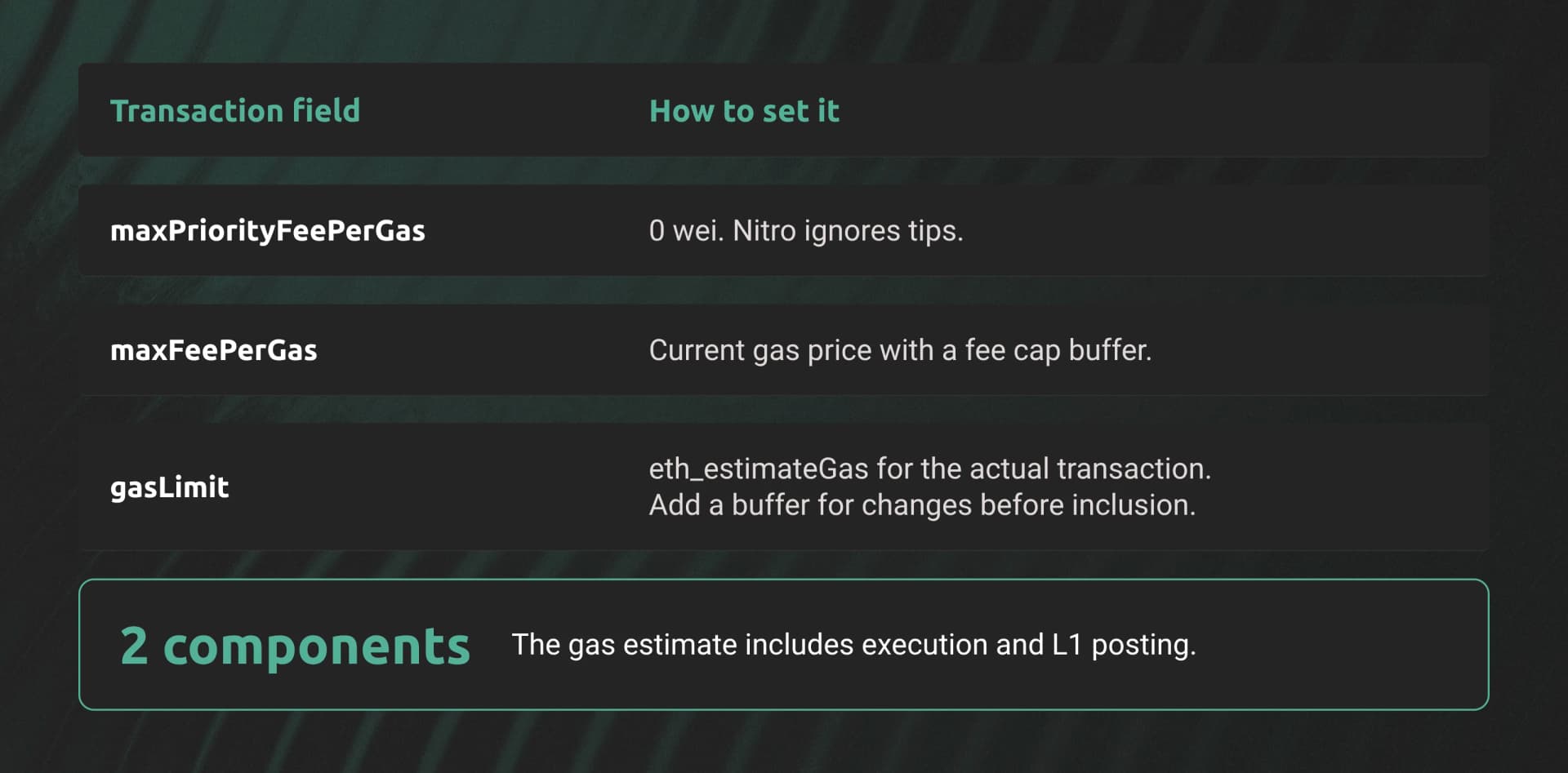
A fee cap limits the gas price you permit. A gas limit bounds the units your transaction may consume. They protect against different changes.
// Illustrative 20% buffers. Choose values for your transaction type.
const gasLimit = (estimatedGas * 120n + 99n) / 100n;
const maxFeePerGas = (gasPrice * 120n + 99n) / 100n;
const maxPriorityFeePerGas = 0n;

console.log({ gasLimit, maxFeePerGas, maxPriorityFeePerGas });
These are example buffers, not chain requirements. Estimate near submission, handle estimation errors, and compare receipts with quotes. Do not silently substitute a fixed gas limit after an estimate fails.
Choose the right source for each number
| Need | Source | Limit |
|---|---|---|
| Current execution gas price | eth_gasPrice | The price can change before inclusion |
| Recent base-fee changes | eth_feeHistory | History does not guarantee the next price |
| Gas for actual calldata | eth_estimateGas | Includes the converted posting component |
| Execution and posting breakdown | NodeInterface.gasEstimateComponents() | Requires Nitro-aware decoding |
| Common-action comparison | Gas tracker | Uses fixed execution-gas assumptions |
| Final amount charged | Transaction receipt and chain fee fields | Available after execution |
Check the transaction builder before release
- Select fee policy by chain ID. Keep Robinhood's policy separate from Ethereum's tip tiers.
- Query with the actual sender, recipient, calldata, and value.
- Label estimates as estimates. Distinguish tracker execution examples from complete transaction quotes.
- Test estimation failures, fee-cap changes, and receipt reconciliation.
- Record the quoted gas units and price so you can investigate differences after inclusion.
The Robinhood network page lists endpoint options. Use the gas tracker to monitor execution fees. For keyed RPC access, create a Dwellir account.