Monad launched its mainnet on November 24, 2025 and has rapidly accumulated $400.9 million TVL (DeFiLlama, April 2026). Processing 10,000 transactions per second with ~400ms finality using optimistic parallel execution, your RPC provider choice directly impacts whether your application can fully leverage this parallel EVM performance. Archive queries and trace methods can cost 20-50x more with compute unit-based providers—a pricing trap that becomes especially painful at Monad's transaction volumes. This comprehensive analysis compares production-grade Monad RPC providers to help you select infrastructure that matches the network's speed.
Understanding Monad's Architecture
Monad represents a fundamental rethinking of EVM execution. Since its mainnet launch on November 24, 2025, the network has demonstrated Solana-level performance while maintaining complete Ethereum compatibility:
- Parallel Execution: Processes multiple transactions simultaneously using optimistic parallelism, re-executing only when conflicts occur
- MonadBFT Consensus: Custom Byzantine Fault Tolerance protocol achieving single-slot finality in ~400ms
- Pipelined Architecture: Decouples consensus from execution, allowing block ordering and transaction processing to overlap
- MonadDB: Purpose-built database optimized for Merkle Patricia Trie storage, reducing hardware requirements
Key Performance Metrics:
| Metric | Monad | Ethereum | Improvement |
|---|---|---|---|
| TPS | 10,000 | 15-30 | ~500x |
| Block Time | 400ms | 12s | 30x faster |
| Finality | ~400ms | 12-18 min | ~1,800x faster |
| Gas Per Second | 300M | ~1.25M | 240x |
Why This Matters for RPC Selection:
Monad's unprecedented throughput creates unique infrastructure requirements. A provider delivering 100ms latency on Ethereum may become your bottleneck on Monad, where blocks arrive every 400ms. DeFi protocols, trading bots, and real-time applications need RPC infrastructure specifically optimized for Monad's speed.
When evaluating providers, prioritize:
- Sub-50ms P95 latency to avoid becoming the performance bottleneck
- WebSocket stability for real-time block and event subscriptions at 2.5x Ethereum's frequency
- Archive node depth for historical queries on rapidly growing state
- Cost transparency—high throughput means high request volumes
Critical Selection Criteria for Monad Infrastructure
Performance Requirements
Monad's 400ms block times demand RPC infrastructure that won't become your limiting factor. Key benchmarks:
- Latency targets: P95 under 50ms optimal, under 100ms acceptable
- Throughput capacity: Minimum 500 RPS for development, 5,000+ for production DeFi
- WebSocket reliability: Must handle 2.5 blocks per second without drops
- Archive depth: Full historical access for analytics—Monad's high TPS creates massive state growth
Pricing Model Analysis
The provider landscape splits between two pricing approaches that significantly impact costs at Monad's transaction volumes:
Request-Based Pricing (Simple):
- Every API call = 1 unit regardless of method
- Predictable costs even with high-frequency queries
- Example: eth_call = debug_traceTransaction = 1 credit
Compute Unit-Based (Complex):
- Each method assigned variable cost (10-500 CU)
- Archive and trace queries often 20-50x standard calls
- Costs scale unpredictably with method distribution
Real Cost Example (100M monthly requests, 25% archive):
- Simple pricing: $200 (100M × $2/million)
- Compute units: $680-1,200 (archive multipliers + trace premiums)
At Monad's throughput, these differences compound dramatically. A trading bot making 1,000 RPS accumulates 2.6 billion monthly requests—pricing model choice determines whether you're paying $5,200 or $17,000+.
Essential Monad Capabilities
Evaluate providers on:
- Full archive node access: Critical as Monad's high TPS generates massive historical data
- Trace/debug API support: Essential for transaction analysis on a parallel execution chain
- WebSocket endpoints: Real-time subscriptions at 2.5 blocks/second
- Geographic distribution: Low-latency nodes near your users and trading infrastructure
- EVM compatibility: Full JSON-RPC support including Monad-specific optimizations
Why Pricing Transparency Matters for Monad
Before diving into provider comparisons, consider how Monad's throughput amplifies pricing model differences:
On Ethereum (15 TPS), a moderately active dApp might generate 5 million monthly requests. The same application on Monad could easily generate 50-500 million requests—a 10-100x increase. At these volumes, compute unit multipliers that seemed negligible become major cost drivers.
The Case for 1:1 Pricing:
Providers using true request-based pricing (1 RPC response = 1 credit, regardless of method) deliver predictable costs at any scale. When your archive query costs the same as eth_blockNumber, budgeting becomes straightforward:
- 100M requests × $2/million = $200 (predictable)
- 100M requests with variable CU = $200-$2,000 (depends on method mix)
Dwellir's Transparent Approach:
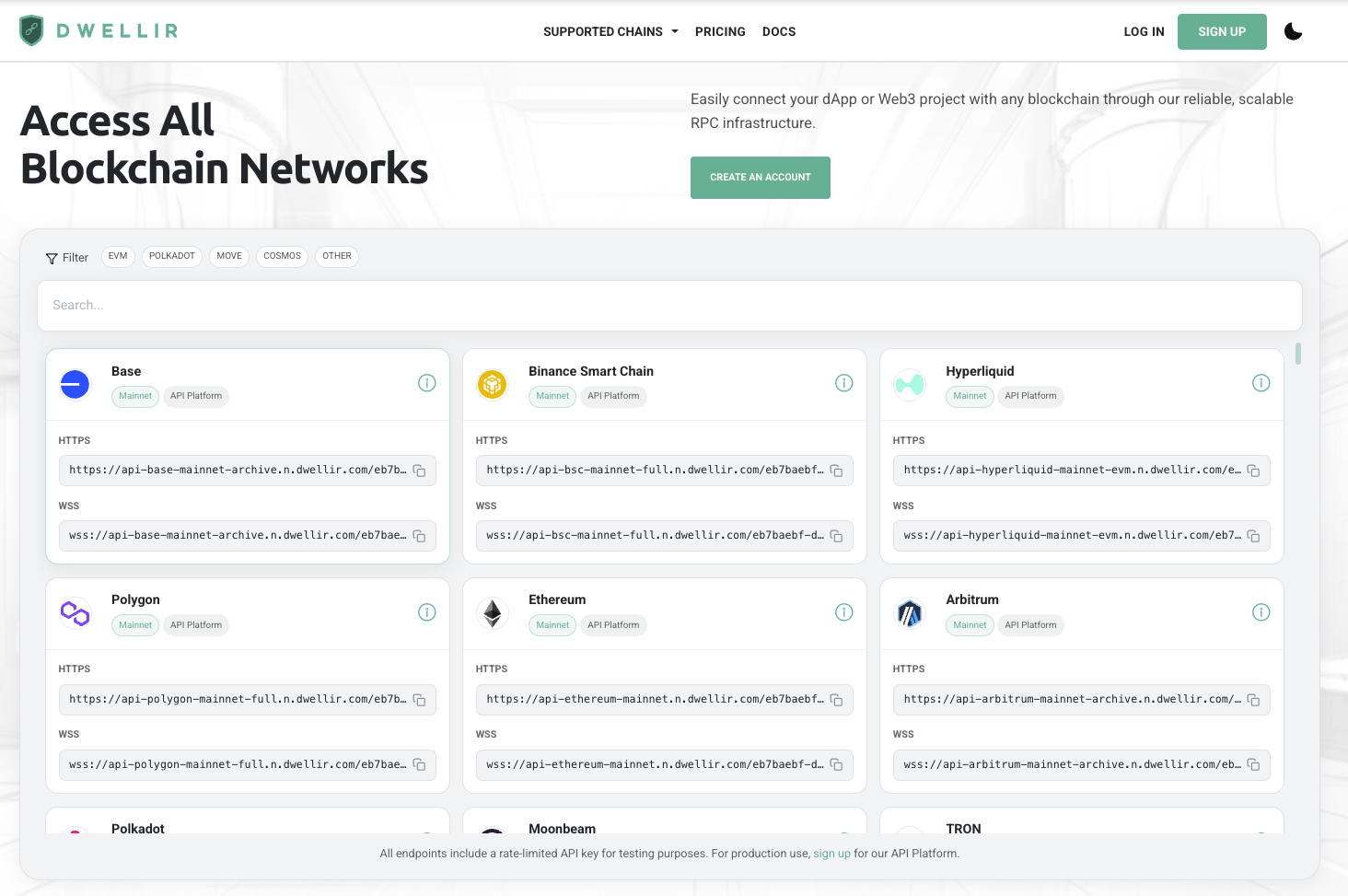
Dwellir has pioneered this transparent pricing model across their 150+ supported blockchain networks, proving that enterprise-grade infrastructure doesn't require enterprise-level pricing complexity. Their approach delivers:
- True 1:1 pricing: Every RPC response costs exactly one credit—eth_blockNumber, eth_call, debug_traceTransaction, archive queries—all identical
- No archive surcharges: Historical data access at the same rate as current state reads
- No trace/debug premiums: Complex debugging methods priced identically to simple queries
- Global infrastructure: Geo-distributed bare-metal nodes with 99.99% uptime SLA, continuously expanding to improve latency for global clients
- 150+ networks: Unified authentication and billing across the entire multi-chain ecosystem
- Archive nodes coming soon: Full historical data access expanding across supported networks
While Monad support is not yet available on Dwellir's platform, their pricing model demonstrates the standard that high-throughput chains demand. Since Monad's mainnet launch in November 2025, the network has grown to $400.9 million TVL, and developers should prioritize providers offering cost transparency—the compute unit complexity that works acceptably on 15 TPS chains becomes genuinely painful at 10,000 TPS.
Cost Comparison at Monad Scale:
| Scenario | Dwellir Model | Compute Unit Model | Savings |
|---|---|---|---|
| 100M requests (mixed) | $200 | $400-800 | 50-75% |
| 100M requests (30% archive) | $200 | $800-1,500 | 75-87% |
| 100M requests (20% trace) | $200 | $1,200-2,500 | 83-92% |
For production applications on Monad, this pricing difference compounds monthly. A DeFi protocol spending $2,000/month with compute unit providers would pay approximately $200-400/month with transparent 1:1 pricing—savings that fund additional development, marketing, or runway extension.
Top 8 Monad RPC Providers: Detailed Analysis
Comprehensive Comparison Matrix
| Provider | Pricing Model | Archive Support | Free Tier | Starting Price | Monad Status |
|---|---|---|---|---|---|
| Dwellir | 1:1 per request | Coming soon | 100K/day | $49/mo | Coming Soon |
| Chainstack | Request units (1 RU, 2 for archive/trace) | Archive (recent state only) | 3M RU | $49/mo | ✅ Mainnet |
| dRPC | Flat rate (20 CU) | Full | 210M CU | $49/mo | ✅ Mainnet |
| Ankr | Compute units | Full | Public tier | $99/mo | ✅ Mainnet |
| Validation Cloud | Compute units | Full | 50M CU | Pay-as-you-go | ✅ Mainnet |
| Tatum | Request-based | Full | Free tier | $29/mo | ✅ Mainnet |
| QuickNode | API credits | Full | 50M credits | $49/mo | ✅ Mainnet |
| Alchemy | Compute units | Full | 30M CU | $49/mo | ✅ Mainnet |
1. Dwellir – Transparent Pricing for High-Throughput Chains
Best For: Production applications requiring predictable costs and straightforward pricing at scale
Pricing: $49 to $999/month | Model: 1 response = 1 credit (no method multipliers)
Dwellir eliminates compute unit complexity by charging one credit per request regardless of method type. This becomes especially valuable for high-throughput chains like Monad, where archive queries and trace methods with competitors can cost 20-50x standard rates. With Monad support coming soon, Dwellir is positioning itself as the cost-efficient choice for the parallel EVM ecosystem.
Key Strengths:
- True 1:1 pricing—every method costs the same, from eth_blockNumber to debug_traceTransaction
- No archive surcharges or trace method premiums
- 150+ blockchain networks supported with unified authentication
- Globally distributed bare-metal infrastructure with 99.99% uptime SLA
- Continuous expansion of node locations to improve latency for global clients
- Archive nodes coming soon to complete the infrastructure offering
Pricing Structure:
- Free: Free (100K requests/day, 20 RPS)
- Developer: $49/mo (unlimited requests, 100 RPS)
- Growth: $299/mo (unlimited, 500 RPS)
- Scale: $999/mo (unlimited, 5,000 RPS)
- Overages: $1.96-2.00 per million requests
Technical Features:
- 99.99% uptime SLA with response credits
- HTTPS, WebSocket (WSS), and gRPC protocol support
- Geographic node distribution across North America, Europe, and Asia
- Dedicated Slack channels for Scale tier customers
- Burst capacity up to 10,000 RPS for traffic spikes
Cost Efficiency Example: For a DeFi aggregator making 100M monthly requests (30% archive, 10% trace methods):
- Dwellir: $200 (100M × $2/million, no multipliers)
- Alchemy: $1,500+ (archive 25 CU + trace 200 CU weighted average)
- QuickNode: $800-1,200 (credit multipliers vary)
- Savings: 75-87% lower operational cost
Monad Status: Monad support is coming soon. Teams building on Monad should monitor Dwellir's network additions as the ecosystem matures—their transparent pricing model is particularly well-suited for Monad's 10,000 TPS throughput.
2. Chainstack – Request Units With Archive and Trace on Global Nodes
Best For: Teams that want shared Monad endpoints with debug and trace access and per-request billing without method weights
Pricing: Free to $990/month | Model: Request units (1 RU per request, 2 RU for archive reads and debug/trace)
Chainstack serves Monad mainnet on its shared Global Nodes in full and archive mode, plus a Monad testnet. It bills request units with no per-method weights: a request under 127 blocks behind the tip costs 1 RU, while archive reads and every debug_ and trace_ call cost 2 RU.
Monad Strengths:
- Monad mainnet on Global Nodes (full and archive) and Dedicated Nodes
- Debug and trace APIs, including
callTracerthroughdebug_traceTransactionanddebug_traceBlockByNumber - WebSocket on all plans
- Unlimited Node add-on from $149/month at 25 RPS for flat-fee billing
- SOC 2 Type II and ISO 27001; 70+ chains
Pricing Structure:
- Developer: Free (3M request units/month, 25 RPS)
- Growth: $49/mo (20M RU, 250 RPS)
- Pro: $199/mo (80M RU, 400 RPS)
- Business: $499/mo (200M RU, 600 RPS)
- Enterprise: From $990/mo (400M RU)
- Overages: $5.00-20.00 per million RU depending on plan
Archive Depth on Monad:
Chainstack's Monad archive serves the full history of blocks, transactions, receipts and logs, plus callTracer traces. State reads (eth_call, eth_getBalance, eth_getStorageAt, eth_getCode, eth_estimateGas, debug_traceCall and prestateTracer) are only served for a rolling window of recent blocks, several days long. An older state read returns Block requested not found.
Cost Efficiency: At 1 RU per request, plan pricing works out to about $2.45-2.50 per million calls:
- 50M requests/month = $199 (Pro)
- 100M requests/month = $449 (Pro plus 20M RU overage at $12.50/million)
- Archive reads and debug/trace calls count double
Limitations:
- Historical state reads on Monad are limited to the recent window
- Archive, debug and trace access starts on the paid Growth plan
- Overage of $10-20 per million below Enterprise
3. dRPC – Decentralized Infrastructure with Flat Pricing
Best For: Cost-conscious teams and applications requiring decentralized infrastructure
Pricing: Free to custom | Model: Flat 20 CU per request (as of June 2025)
dRPC operates a decentralized network of node providers, offering redundancy and censorship resistance. Their recent pricing simplification—20 CU per request regardless of method—provides welcome predictability for Monad applications.
Monad Strengths:
- Decentralized node network for redundancy
- Same price for every method ($4.80 per million on the $49 Pro plan, $6 on pay as you go)
- Low-latency infrastructure optimized for high-throughput chains
- MEV protection options for transaction privacy
Pricing Structure:
- Free: 210M compute units/month on public nodes (about 10M requests)
- Pro: $49/month (about 10M requests, 300 RPS)
- Scale: $199/month (about 47M requests, 600 RPS)
- Enterprise: From $990/month
- All methods: 20 CU = $6 per million requests on pay as you go and overage
Technical Features:
- Multi-provider failover for reliability
- Geographic distribution across node operators
- WebSocket support for real-time subscriptions
- Archive data access through node network
Cost Efficiency: The flat 20 CU per request model eliminates archive and trace multipliers:
- 100M requests/month = ~$517 on Scale plus overage (vs $1,200+ with variable CU)
- Predictable scaling regardless of method mix
Limitations:
- Decentralized architecture may introduce slight latency variance
- Less extensive developer tooling compared to Alchemy
- Support primarily through Discord community
4. Ankr – Global Node Network
Best For: Multi-chain applications and projects needing decentralized infrastructure
Pricing: Free public endpoints to $399/month | Model: Compute units
Ankr operates a globally distributed network of independent node providers, offering both public (rate-limited) and premium endpoints for Monad. Their infrastructure emphasizes decentralization while maintaining performance.
Key Capabilities:
- Global node distribution across independent operators
- Public and premium endpoint tiers
- Multi-chain support for applications spanning networks
- WebSocket connections for real-time data
Pricing Structure:
- Public: Free, rate-limited
- Premium: From $99/month
- Enterprise: Custom pricing with dedicated resources
Technical Features:
- Geographic load balancing
- Automatic failover between nodes
- Standard Ethereum JSON-RPC compatibility
- Archive data access on premium tiers
Considerations: Ankr's decentralized model provides resilience but may introduce latency variance compared to dedicated infrastructure. Best suited for applications prioritizing decentralization over raw speed.
5. Validation Cloud – Performance Leader
Best For: Latency-critical applications and high-frequency trading
Pricing: Free to scale | Model: Compute units with generous free tier
Validation Cloud positions itself as the fastest node provider, with Compare Nodes benchmarks supporting this claim. Their generous free tier (50M CU without credit card) makes them attractive for evaluation.
Key Capabilities:
- Industry-leading latency benchmarks
- 50M compute units free (no credit card required)
- Scale tier with no rate limits
- Full archive and trace support
Pricing Structure:
- Free: 50M CU/month
- Scale: Custom pricing, no rate limits
- Enterprise: Dedicated infrastructure
Performance Focus: For applications where microseconds matter—MEV extraction, arbitrage, liquidation bots—Validation Cloud's optimized infrastructure provides measurable advantages.
6. Tatum – Unified Blockchain API
Best For: Applications needing high-level APIs beyond raw RPC
Pricing: Free to $99/month | Model: Request-based
Tatum provides RPC nodes alongside higher-level APIs for common blockchain operations. Their unified API approach simplifies development for teams building across multiple chains.
Key Capabilities:
- RPC access plus high-level APIs
- Real-time notifications
- Multi-chain unification
- NFT and token APIs
Pricing Structure:
- Free: Development tier
- Start: $29/mo
- Basic: $99/mo
- Enterprise: Custom
7. QuickNode – Performance-Focused Infrastructure
Best For: High-frequency trading applications and latency-sensitive DeFi protocols
Pricing: Free to $999/month | Model: API credits with method multipliers
QuickNode has emerged as a leading Monad infrastructure provider, offering dedicated endpoints and strong support for the ecosystem. Their global edge network with 30+ regions delivers consistent low-latency performance critical for Monad's high-speed environment.
Monad Strengths:
- Dedicated Monad endpoints optimized for parallel EVM
- Global edge network minimizing latency across regions
- Extensive documentation and Monad-specific guides
- Discounts available for Monad ecosystem projects
Pricing Structure:
- Free: 50M API credits/month
- Build: $49/mo (80M credits)
- Accelerate: $249/mo (450M credits)
- Scale: $499/mo (950M credits)
- Business: $999/mo (2B credits)
Technical Features:
- HTTP and WebSocket endpoints with high throughput
- Archive data access for historical queries
- Stream API for real-time blockchain events
- Built-in retry logic and connection handling
Cost Considerations: QuickNode's API credit system uses method multipliers. Archive and trace methods consume more credits, making cost prediction challenging for analytics-heavy applications. At 100M monthly requests with 25% archive queries, expect $400-600 depending on method distribution.
Limitations:
- Variable credit consumption complicates budgeting
- Archive method multipliers increase costs for historical analysis
- Premium pricing compared to flat-rate alternatives
8. Alchemy – Comprehensive Developer Platform
Best For: Teams needing full-stack Web3 tooling alongside RPC access
Pricing: Free to custom | Model: Compute units (10-500 CU per method)
Alchemy provides the most extensive developer platform in Web3, with enhanced APIs, webhooks, and monitoring tools. Their Monad support includes access to their Core API alongside platform features like real-time notifications and transaction simulation.
Key Capabilities:
- Full JSON-RPC API support for Monad
- Enhanced APIs for NFTs, tokens, and transactions
- Real-time webhook notifications
- Transaction simulation and debugging tools
- Comprehensive developer dashboard
Pricing Structure:
- Free: 30M compute units/month (300 CU/s, about 15 requests per second)
- Growth: $49/mo (400M CU)
- Scale: Custom pricing
- Enterprise: Volume discounts
Compute Unit Examples:
- eth_blockNumber: 10 CU
- eth_call: 26 CU
- eth_getLogs: 75 CU
- Archive queries: 25x multiplier
- Trace methods: 200-500 CU
Cost Analysis: For a DeFi aggregator making 50M monthly requests (30% archive, 10% trace):
- Base calls: 35M × 26 CU = 910M CU
- Archive: 15M × 26 CU × 25 = 9.75B CU
- Trace: 5M × 300 CU = 1.5B CU
- Total: ~12B CU = Enterprise pricing required
Limitations:
- Complex compute unit calculations obscure true costs
- Archive multipliers dramatically increase analytics costs
- Free tier depletes quickly with Monad's high request volumes
Choosing the Right Provider for Monad
Matching Infrastructure to Monad's Speed
Monad's 400ms block times create a unique situation: your RPC provider may be slower than the blockchain itself. For latency-sensitive applications, you need infrastructure that delivers both speed and cost efficiency:
- Trading bots: Require low P95 latency with predictable costs. Dwellir's globally distributed infrastructure continues to expand with new node locations to reduce latency for clients worldwide—all with 1:1 pricing that eliminates cost surprises as trading volume scales.
- DeFi protocols: Need consistent sub-100ms responses with transparent archive access. Providers using compute unit multipliers can balloon costs 10x for archive-heavy DeFi analytics.
- Analytics: Historical queries stress archive infrastructure. Only flat-rate providers like Dwellir's 1:1 model make trace-heavy analytics economically viable at Monad scale.
The Archive Node Question
Monad's 10,000 TPS generates approximately 864 million transactions daily at full capacity. This creates massive historical datasets that grow faster than any other EVM chain:
- After 1 month: ~26 billion transactions
- After 1 year: ~315 billion transactions
Providers offering "full archive access" may throttle heavy queries or charge 25-50x through compute unit multipliers. The cost difference at scale:
| Archive Query Volume | 1:1 Pricing (Dwellir model) | Compute Units (25x multiplier) |
|---|---|---|
| 10M archive calls | $20 | $500 |
| 50M archive calls | $100 | $2,500 |
| 100M archive calls | $200 | $5,000 |
Dwellir's approach—identical pricing for archive queries and current state reads—eliminates this cost trap entirely.
Financial Modeling for Monad Scale
Monad's throughput enables applications that weren't viable on slower chains—but infrastructure costs scale accordingly. Here's how different pricing models compare:
Moderate Usage (50M requests/month):
- Dwellir 1:1 model: ~$100 (predictable, all methods equal)
- Chainstack Pro: $199 (80M request units)
- dRPC: ~$217 (Scale plus overage)
- QuickNode Build: $49-150 (credit consumption varies)
- Alchemy Growth: $49-400 (CU dependent)
High Usage (500M requests/month):
- Dwellir 1:1 model: ~$1,000 (predictable, scales linearly)
- Chainstack Enterprise: ~$1,490 (400M RU plus 100M overage at $5/million)
- dRPC: ~$2,917 (predictable)
- QuickNode Scale: $499-2,000 (credit consumption varies)
- Alchemy Scale: Custom pricing required
Heavy Analytics (500M requests, 40% archive/trace):
- Dwellir 1:1 model: ~$1,000 (same as standard—no multipliers)
- Chainstack Enterprise: ~$2,490 (archive and trace calls at 2 RU = 700M RU)
- dRPC: ~$2,917 (same rate)
- Compute unit providers: $8,000-15,000+ (multipliers compound)
The Dwellir model delivers 85-93% cost savings for archive/trace-heavy workloads compared to compute unit providers.
Multi-Chain and Migration Considerations
If your application spans Monad and other EVM chains, provider selection becomes even more critical:
- Provider consistency: Using the same provider across chains simplifies operations and billing
- Authentication model: Unified API keys reduce credential management complexity
- Pricing parity: Some providers charge differently per chain; Dwellir maintains consistent 1:1 pricing across all 150+ supported networks
Dwellir's multi-chain approach means teams can use identical infrastructure patterns across Ethereum, Arbitrum, Polygon, Avalanche, and (when available) Monad—with predictable, transparent pricing regardless of chain.
For teams currently on Ethereum or other EVMs, Monad's full compatibility means existing code works without modification. When selecting infrastructure, prioritize providers whose pricing model scales sustainably with Monad's throughput.
Final Recommendations by Use Case
DeFi Protocols (DEXs, Lending, Yield): For production DeFi on Monad, transparent pricing prevents budget surprises as your protocol scales. Providers with 1:1 request-based pricing—like Dwellir's model across their 150+ supported networks—deliver predictable costs regardless of archive query volume. When Monad support becomes available, Dwellir's combination of globally distributed nodes and flat-rate pricing makes it ideal for DeFi applications. With archive nodes coming soon to their lineup, Dwellir will offer complete historical data access at the same transparent rates. In the meantime, dRPC offers similar cost predictability.
High-Frequency Trading & MEV: Latency-sensitive applications need both speed and cost efficiency. While Validation Cloud and QuickNode offer strong performance, their compute unit models can result in unpredictable costs at trading volumes. Dwellir's globally distributed infrastructure—with ongoing expansion to new regions—delivers competitive latency with completely predictable pricing. This combination is critical when your trading bot generates millions of daily requests.
Analytics and Block Explorers:
Archive and trace-heavy workloads suffer most from compute unit multipliers. A block explorer making 10M monthly trace calls pays $49-200 with flat-rate providers versus $2,000-5,000+ with CU-based pricing. Dwellir's 1:1 model treats debug_traceTransaction identically to eth_blockNumber—no archive surcharges, no trace premiums. With archive nodes coming soon to Dwellir's lineup, this 90%+ cost reduction will make analytics economically viable on high-throughput chains like Monad.
Gaming and Consumer Apps: Consumer applications on Monad need reliable WebSocket connections and predictable unit economics. Dwellir's infrastructure supports real-time subscriptions with 99.99% uptime SLA, and their transparent pricing lets you accurately model per-user infrastructure costs—essential for consumer business models.
Multi-Chain Applications: Teams building across Monad and other EVM chains benefit from unified infrastructure. Dwellir's 150+ network support with consistent 1:1 pricing across all chains eliminates the complexity of managing multiple providers with different pricing models. One API key, one billing relationship, one support channel.
Early-Stage Projects: Start with available free tiers to establish usage patterns. As you scale toward production, prioritize providers offering transparent pricing to avoid cost surprises. Dwellir's straightforward model scales linearly with your growth—no cliff edges where archive usage suddenly multiplies your bill.
Enterprise Requirements: Enterprise deployments need both performance guarantees and cost predictability. Dwellir offers 99.99% uptime SLAs, dedicated Slack support channels, and enterprise-grade infrastructure without the opaque pricing of traditional enterprise providers. Their bare-metal infrastructure outside public clouds provides additional resilience and data sovereignty.
The Bottom Line: Monad's 10,000 TPS throughput amplifies every pricing decision. A 25x archive multiplier that costs an extra $50/month on Ethereum becomes $5,000/month on Monad. Providers offering true 1:1 pricing—where every request costs the same regardless of method—deliver the cost predictability that high-throughput chains demand. Dwellir's transparent approach across 150+ networks represents the pricing model best suited for Monad's scale.
Frequently Asked Questions
What is the best Monad RPC provider?
Dwellir offers the best balance of transparent 1:1 pricing and multi-chain coverage for Monad. For teams needing immediate mainnet access, QuickNode, Chainstack and dRPC provide confirmed Monad support.
How does Monad's parallel execution affect RPC provider requirements?
Monad processes 10,000 TPS with 400ms block times using optimistic parallelism. This demands RPC providers with sub-50ms P95 latency, stable WebSocket connections handling 2.5 blocks per second, and infrastructure that won't become a bottleneck for the chain's speed.
Are there free Monad RPC endpoints available?
Yes. Dwellir offers 100K free requests per day, QuickNode provides 50M free API credits monthly, Alchemy includes 30M free compute units, Chainstack includes 3M free request units monthly, and dRPC offers a free tier for testing. These free tiers are suitable for development but not production workloads.
What are the key differences between Monad and Ethereum RPC?
Monad is fully EVM-compatible, so the JSON-RPC interface is identical to Ethereum. The key difference is scale: Monad's 10,000 TPS and 400ms block times generate far higher request volumes, making pricing model choice critical. Compute unit multipliers that cost an extra $50/month on Ethereum can become $5,000/month on Monad.
Related Resources
- Best Ethereum RPC Providers — Compare infrastructure options for the network Monad is designed to scale
- RPC Providers Without Compute Units — Why transparent pricing matters for high-throughput chains like Monad
Get Started
Ready to Build on Monad?
Monad's parallel EVM opens possibilities that weren't viable on slower chains. Select your RPC provider based on your specific requirements:
- Performance + Cost Efficiency: Dwellir (when Monad available) for unmatched price-performance ratio
- Current Monad Support: QuickNode, Chainstack, dRPC for immediate deployment
- Enterprise: Blockdaemon for compliance requirements
Why Dwellir for High-Throughput Chains?
Monad's 10,000 TPS demands infrastructure pricing that scales sustainably. Dwellir's transparent 1:1 model delivers:
- Predictable costs: Every request costs the same—no archive multipliers, no trace premiums
- Global performance: Geo-distributed nodes with 99.99% uptime SLA, continuously expanding to serve clients worldwide
- Archive nodes coming soon: Full historical data access expanding across supported networks
- Multi-chain simplicity: 150+ networks with unified authentication and billing
- Real support: Dedicated Slack channels, not just Discord communities
For teams building on Monad who need infrastructure that won't become a cost bottleneck:
- Contact: Get in touch
- Documentation: Dwellir Docs
- Supported Networks: View all chains
- Pricing: Transparent pricing
References
This content is for informational purposes only and does not constitute financial or investment advice. Always conduct your own research when selecting infrastructure providers.