An indexer backfilling six months of ERC-20 transfers sends the same method over and over: eth_getLogs, wide block ranges, thousands of calls per minute. On a compute-unit plan, one of those calls can be worth anywhere from 10 CU for a single block to 2,000 CU or more for a range near a thousand blocks. The same number of requests can consume wildly different amounts, depending on how wide the ranges are and how busy those blocks were. Compute unit values are not standardized across providers either, so a weight table from one vendor does not carry over to the next.
That is why "what will the indexer cost next month" has no good answer on a metered plan. You can forecast request volume from your own code. You cannot forecast compute units without also forecasting chain activity, method mix and range width, then redoing the work for every vendor. The operational failure mode is the mirror image: providers cap eth_getLogs block ranges to protect node time, and a reported Ponder backfill that should have taken seconds ran for hours because the provider only allowed about 30 blocks per call, forcing thousands of extra round-trips. Range caps are near-universal, Dwellir's included: our metered plans allow 500 blocks per query on Developer and 10,000 on Growth, Scale, and Enterprise. The difference is what a split scan costs you, since each extra request is one more response at one credit rather than an unpredictable pile of compute units. The spread is wide enough to matter: The True Cost of eth_call found effective rates from $1.96 to $20 per million for the same single method.
Four providers have now shipped essentially the same answer to this within about a year: turn the request meter off, sell throughput instead of volume, charge a flat monthly price. Chainstack calls it Unlimited Node, QuickNode calls it Flat Rate RPS, GetBlock calls it Limitless Node, Dwellir calls it an Unlimited Node. This post explains how the model works, compares every published offer on one number nobody else publishes (dollars per RPS per month), and says plainly who should not buy one.
What Is an Unlimited RPC Node?
An unlimited RPC node is an endpoint with per-request billing switched off, priced at a flat monthly fee for a fixed requests-per-second ceiling. You are not buying a request quota, you are buying a rate. Beneath the ceiling you send as many requests as you want, and above it the gateway returns HTTP 429 rather than adding an overage line to your invoice.
The RPS number is a ceiling, not a floor. It caps the rate the gateway will admit. It does not guarantee the backend will always serve that rate, and under the cap you get whatever the cluster behind the endpoint can serve. Dwellir states this on its Unlimited Nodes page rather than burying it, and it is the framing to apply to every vendor in this category.
If you need throughput as a guarantee rather than a permission, that is a dedicated node cluster conversation at a different price point. The cap also binds both ways: an endpoint rated at 100 RPS stays at 100 RPS even when your account plan allows more.
"Unlimited Node" Means Three Different Things
Most of the confusion here comes from comparing products that are not the same thing. Before you compare prices, work out which of these three you are looking at.
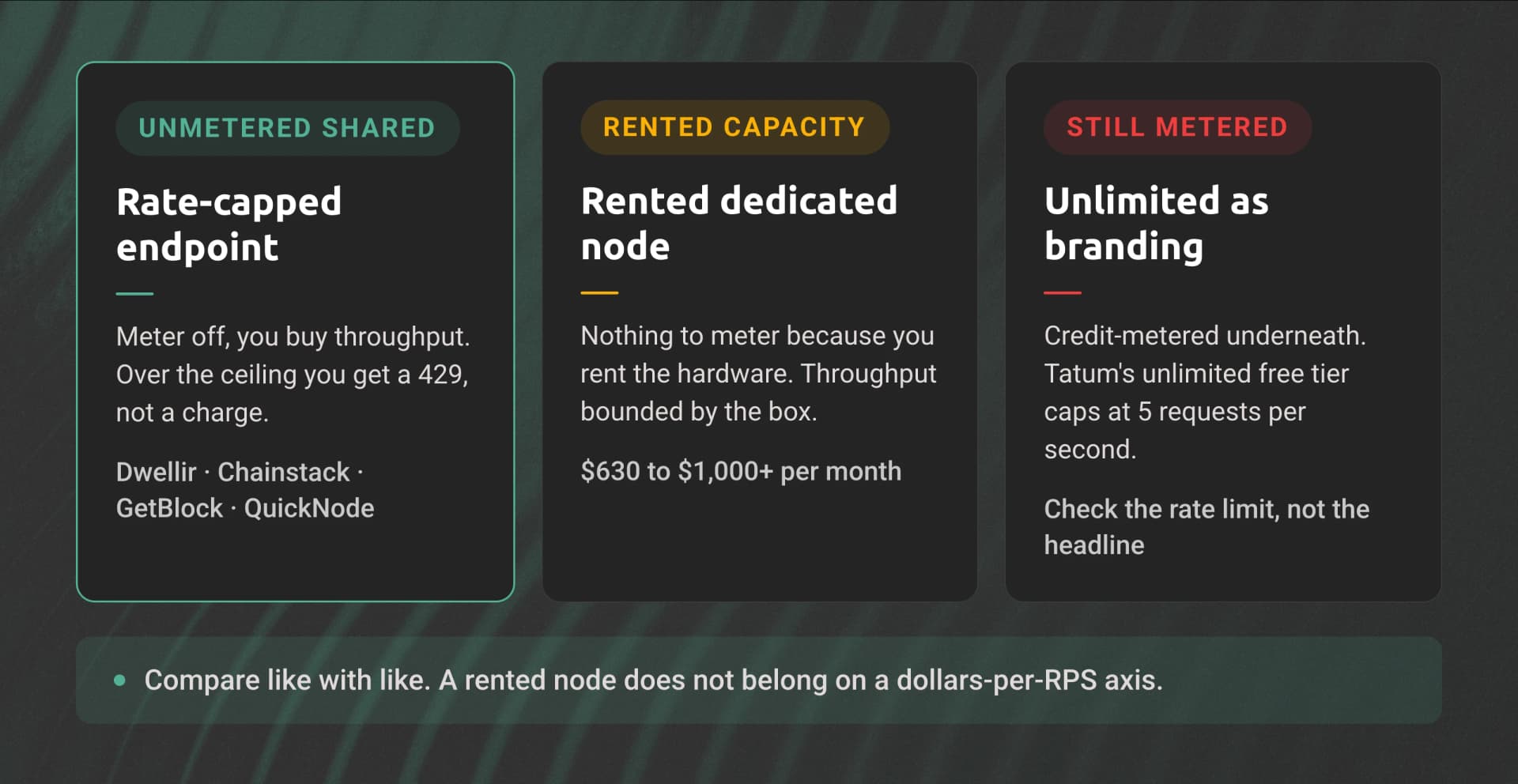
1. An unmetered shared endpoint gated by an RPS ceiling. The request meter is off and you buy throughput instead of volume. Dwellir's Unlimited Node, Chainstack's Unlimited Node, GetBlock's Limitless Node and QuickNode's Flat Rate RPS all sit here. The endpoint runs on the provider's shared node pool, and crossing the ceiling returns 429 rather than a charge. These are directly comparable to each other, and dollars per RPS per month is the right axis.
2. A rented dedicated or private node at a flat monthly price. "Unlimited" here means there is nothing to meter, because you are renting capacity rather than buying calls. GetBlock's Dedicated Nodes start at $1,000/month, BlockPI prices dedicated BNB at $630/month and Base at $720/month, and Allnodes, Blockdaemon, OnFinality and Dwellir's Dedicated Node Clusters occupy the same class. Throughput is bounded by hardware, not by a configured cap. Do not compare these on dollars per RPS, because there is no published RPS to divide by.
3. "Unlimited" as branding on something still metered. Tatum markets unlimited RPC nodes, but the unlimited credit pool applies to the free tier, and that tier is capped at 5 requests per second. The paid Starter plan is 4 million credits per month at 200 RPS, credit-metered like any other quota plan. Nothing dishonest is happening there, but "unlimited" in the headline does not mean unmetered production request volume, and that is the distinction to check.
Categories 1 and 3 are shared infrastructure with a rate limit. Category 2 is capacity you rent. A 250 RPS unmetered endpoint at $1,199/month and a dedicated node at $1,000/month look similar on an invoice and behave nothing alike under load.
Provider Comparison: Dollars per RPS per Month
Every provider publishes a monthly price and an RPS ceiling. None of them publish what that works out to per RPS, which is the only way to compare offers built on different rungs. All prices below were checked against each provider's own pricing page in September 2026.
| Provider | Product | Entry tier | Top published tier | $/RPS/month |
|---|---|---|---|---|
| Dwellir | Unlimited Node | 25 RPS, $119 | 1,000 RPS, $4,799 | $4.80 at every rung |
| Chainstack | Unlimited Node add-on | 25 RPS, $149 | 500 RPS, $3,199 | $5.96 to $6.60 |
| GetBlock | Limitless Node | 25 RPS, $150 | 300 RPS, not published | $6.00 |
| QuickNode | Flat Rate RPS | 75 RPS, $799 | 250 RPS, $1,949 | $7.80 to $10.65 |
Tier by tier, where the rungs line up:
| Ceiling | Dwellir | Chainstack | GetBlock | QuickNode |
|---|---|---|---|---|
| 25 RPS | $119 | $149 | $150 | not offered |
| 50 RPS | no rung | not offered | $300 | not offered |
| 75 RPS | no rung | not offered | not offered | $799 |
| 100 RPS | $479 | $649 | not offered | not offered |
| 150 RPS | no rung | not offered | not published | $1,499 |
| 250 RPS | $1,199 | $1,649 | not offered | $1,949 |
| 500 RPS | $2,399 | $3,199 | not offered | contact sales |
| 1,000 RPS | $4,799 | contact sales | not offered | contact sales |
Per RPS, Chainstack costs 24% to 38% more than Dwellir depending on the rung, GetBlock 25% more at both of its confirmed tiers, and QuickNode 63% to 122% more. At 250 RPS that is $450 a month more on Chainstack and $750 more on QuickNode. Dwellir is also the only one of the four whose per-RPS rate stays flat all the way up the ladder.
Price is not the whole comparison, and three competitor details are worth knowing before you decide.
Chainstack has one advantage a per-endpoint product cannot match. A single subscription gives you one RPS pool shared across all 70+ chains Chainstack supports. If you run 12 chains at modest rates each, that pool can beat 12 separate endpoint subscriptions outright, whatever the per-RPS gap. The catch is that the add-on needs a Growth plan or above underneath it, so the headline price is not your whole bill. Full, archive, debug and trace are included within the tier at no surcharge.
GetBlock includes the expensive methods explicitly and discounts annual billing. eth_getLogs, debug_trace and basic reads all cost the same within a tier, with no CU limits, and there is a 20% discount for paying annually. The Limitless Node covers a single chain with multi-region geo-routing and is available on 11 chains. The 150 and 300 RPS prices render client-side on their pricing page and were not retrievable, so treat those rungs as unquoted.
QuickNode documents the mechanic clearly but sells it without an SLA. Their docs state it directly: "Requests that exceed your configured RPS or concurrent connection limits will be rejected with HTTP 429 (rate limit) responses. There are no overage charges." That confirms 429-instead-of-overage is how the whole category works, not one vendor's quirk. The same docs say Flat Rate RPS runs on shared Pro infrastructure with no SLA, and that trace and debug methods "can hit concurrency limits quickly due to long processing times." Each subscription covers one chain in one region, so running several chains multiplies the bill.
Dwellir's Unlimited Nodes run on the shared node pool with the standard SLA and automatic region routing, cover any of the 150+ networks Dwellir serves, and count every method as one request including trace and debug. One Unlimited Node is one endpoint route, so two hot paths means two nodes. For a wider comparison of metered plans across the market, see Best RPC Node Providers of 2026.
Three providers deserve a mention for what they do not sell. Alchemy and Infura have no unmetered product at all; both remain credit or compute-unit metered with contact-sales enterprise tiers. dRPC moved off pure CU billing in June 2025 to flat per-request pricing at $6 per million with every method normalized to the same weight, which makes per-call cost predictable but is still metered by volume rather than by rate. Their announcement contained the cleanest statement of the underlying problem anyone in this market has made: "Devs shouldn't need a spreadsheet to calculate RPC costs." For the wider set of providers that have dropped compute units, see RPC Providers Without Compute Units.
What to Check Before Buying Anything Sold as Unlimited
None of these four is sold as unconditionally unlimited, and all four are open about the rate cap. The differences are in the details around that cap, and those details are where two offers at the same headline price stop being equal. Ask every vendor the same six questions.
- Is the ceiling on requests per second, on concurrent requests, or on both? A 250 RPS cap with a separate concurrency limit behaves differently for long-running trace calls than for fast reads.
- Are trace, debug and archive methods included at the same rate? Dwellir counts every method as one request. GetBlock and Chainstack both include them within the tier. QuickNode makes them usable but concurrency-constrained. Get this in writing if your workload leans on them.
- Does the price cover one endpoint, one chain, or all chains? This is the biggest swing factor for multi-chain teams, and it is where Chainstack's pooled model can beat a cheaper per-RPS rate.
- Is a base subscription required underneath the flat-rate add-on? Chainstack requires Growth or above. Dwellir sells the node directly.
- What SLA applies? Flat-rate products sometimes sit on a different infrastructure tier than the vendor's headline plans, with a correspondingly different SLA. Ask explicitly rather than assuming the plan SLA carries over.
- What happens above the ceiling: 429, silent throttle, or overage billing? All four here return 429. Confirm it anyway, because "unlimited with fair use" and "unlimited up to a hard 429" are different products.
Who Should Buy One, and Who Should Stay Metered
Buy an unmetered node if your traffic is flat by construction:
- Indexers and analytics backends. Continuous sync and backfills run at a steady rate you set in code, which is the ideal case. Heavy
eth_getLogsand trace usage is also where compute-unit weighting hurts most. - Trading and MEV systems. Polling loops and simulation calls are constant-rate by design, and a fixed monthly line item is easier to reason about than a variable one on a workload that runs 24 hours a day.
- Agents and bots. The hard ceiling is the safety net. A retry storm costs you latency instead of money.
- A single hot path inside a larger app. Put the one endpoint that dominates your volume on an unmetered node and leave everything else on the metered plan. You do not have to move the whole application.
Stay metered if any of these describe you:
- Bursty traffic with 5x to 10x spikes. Overflow above the ceiling returns 429 rather than being served. Metered billing with real headroom, or a dedicated node cluster, serves that traffic. Flat rate does not.
- Low or sporadic volume. A few thousand calls a day is always cheaper on a free or entry metered tier. An endpoint that sits idle most of the month is an expensive way to buy a small number of requests.
- Many chains at low per-chain rates. A per-endpoint product multiplies by the number of chains. Chainstack's pooled model or an ordinary metered plan will usually cost less.
- You need throughput as a guarantee. A ceiling is permission to send, not a promise to serve. If your SLA depends on sustained throughput, price a dedicated node cluster instead.
Above 1,000 RPS the maths changes again. That is the highest rung published anywhere in this category. Past it, a dedicated node cluster costs less per unit of throughput and adds isolated hardware, region selection and a custom SLA up to 99.99%.
Self-hosting is the other alternative, and it is worth a sanity check. Cherry Servers priced a production Ethereum full node at $240 to $320 per month and an archive node at $700 to $1,300 per month in June 2026, hardware only, before redundancy, bandwidth, monitoring or anyone's time. The low end of archive hardware alone costs more than a 100 RPS Unlimited Node at $479/month.
The Bottom Line
For most teams buying in this category, Dwellir's Unlimited Node is the best all-round choice, for three reasons you can check. It is the cheapest published rate at $4.80 per RPS per month, with comparable rungs from Chainstack, GetBlock and QuickNode running 24% to 122% higher. It is the only offer whose per-RPS rate stays flat from 25 RPS to 1,000 RPS. And it counts every method as one request, trace and debug included, on an endpoint with the standard SLA rather than a lower tier.
Three situations point elsewhere. If you run many chains at modest rates each, Chainstack's single RPS pool across 70+ chains can beat a cheaper per-endpoint rate outright, and that advantage is real rather than promotional. If you want annual billing and your workload sits on one of the 11 chains GetBlock covers, their 20% annual discount narrows the gap. And if your traffic spikes far above its average, none of these four is the right purchase. You would be paying for a ceiling you touch for a few minutes a day. Stay on a metered plan with headroom.
Before you buy, measure two things. Your peak request rate sets the rung you need. Your real cost per million is last month's RPC bill divided by the millions of requests it covered. If your traffic is steady and your current rate is high, an unmetered node will cost less and remove the overage line. If your traffic is spiky, or you are already paying close to $2 per million, you now have a defensible reason not to buy one, which is worth just as much.
Ready to run the numbers on your own workload? Dwellir's Unlimited Nodes page lists every rung and its price, the pricing calculator models the metered alternative side by side, and the Dwellir team can scope a dedicated node cluster if your peak sits above 1,000 RPS.