Starknet does not use eth_ methods. It does not run the EVM. Every account is a smart contract. If you are building on Starknet, your RPC provider needs to speak an entirely different language than what most Ethereum infrastructure was designed to handle. That distinction matters more than you might expect when evaluating providers.
As a ZK-rollup built on STARK proofs, Starknet executes transactions in the Cairo VM and settles validity proofs on Ethereum L1. The network processes roughly 245,000 daily transactions with 2-second soft confirmations (since the v0.13.2 "Bolt" upgrade) and full L2 finality in about 3 seconds. Native account abstraction makes every wallet a smart contract by default, enabling session keys and social recovery without additional infrastructure. With over $300M in TVL and a growing ecosystem spanning DeFi protocols like Ekubo, Nostra, and zkLend, Starknet has established itself as a leading validity rollup for developers who want zero-knowledge security without EVM constraints.
Choosing the right Starknet RPC provider determines whether your application can reliably query Cairo-specific state, handle the starknet_ JSON-RPC namespace, and scale without unpredictable costs. This comparison breaks down 6 providers across pricing, features, and Starknet-specific support to help you make an informed decision.
What to Look for in a Starknet RPC Provider
Starknet's non-EVM architecture creates infrastructure requirements that differ significantly from standard Ethereum L2s.
Starknet RPC Spec Compatibility: Starknet uses its own starknet_ JSON-RPC namespace with methods like starknet_call, starknet_getBlockWithTxHashes, and starknet_estimateFee. Your provider must support the full Starknet RPC specification, not just a subset of methods mapped from eth_ equivalents. Incomplete method coverage creates gaps that surface at the worst possible time: in production.
Cairo VM Awareness: Starknet runs Cairo, not Solidity. Providers need infrastructure built around Starknet-native node clients like Juno, Pathfinder, or Papyrus rather than adapted Ethereum execution clients. This affects everything from state query behavior to how trace data is structured.
Archive Data Access: Historical state queries are essential for analytics dashboards, DeFi position tracking, and block explorers. Starknet's architecture means archive data covers both L2 execution state and L1 proof settlement. Confirm your provider offers full archive access without punitive pricing multipliers.
Pricing Predictability: Some providers weight starknet_ methods differently in their compute unit systems, making it difficult to forecast monthly costs for applications with varied call patterns. Flat-rate or 1:1 pricing models eliminate this complexity.
1. Dwellir - Transparent 1:1 Pricing for Starknet
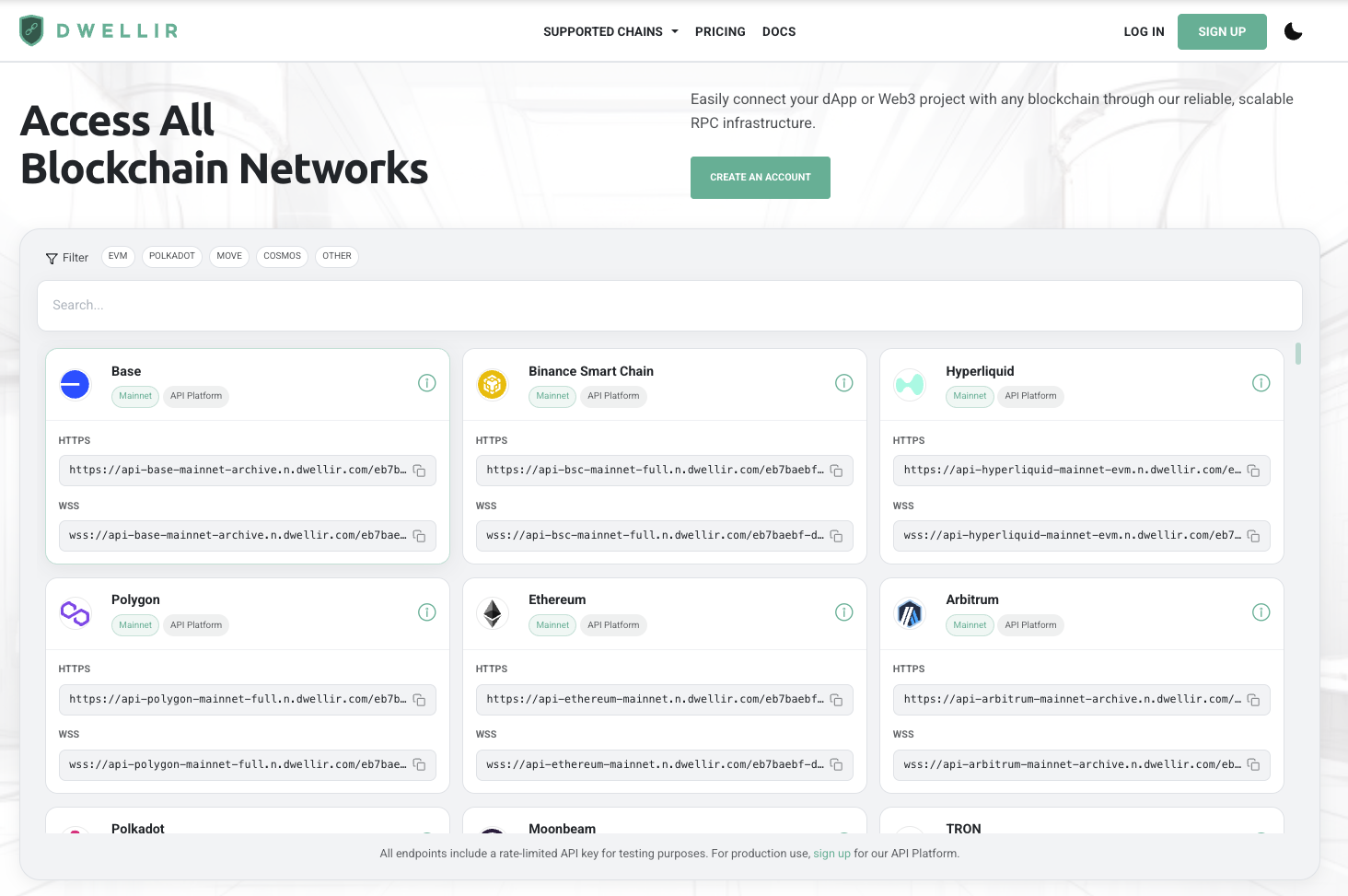
Dwellir provides Starknet mainnet and Sepolia testnet access with full support for the starknet_ JSON-RPC namespace. The platform supports 26+ Starknet RPC methods with detailed request/response examples, covering everything from starknet_blockNumber to starknet_simulateTransactions. Every RPC response costs exactly 1 API credit regardless of method complexity. A starknet_chainId call costs the same as a resource-intensive trace operation.
This 1:1 credit model extends across Dwellir's 150+ supported blockchains, making it straightforward for teams running multi-chain applications that include Starknet alongside EVM networks. Archive node access, WebSocket connections, and trace/debug APIs are included in all paid plans at no extra cost.
Key Features
- 1:1 Credit System: Every Starknet method costs 1 credit. No compute unit multipliers, no variable pricing by method complexity.
- Full starknet_ Namespace: 26+ documented RPC methods with request/response examples.
- Archive Node Access: Complete historical Starknet data through mainnet archive endpoints.
- WebSocket Support: WSS endpoints for both mainnet and Sepolia testnet.
- 150+ Network Coverage: Single API key works across Starknet and other blockchains.
- Trace and Debug APIs: Advanced debugging included in all paid plans without premium charges.
- Crypto Payments: Pay in crypto on every paid plan, from Developer to Enterprise.
Pricing Structure
| Plan | Price | Included Responses | Sustained RPS | Overage |
|---|---|---|---|---|
| Free | Free | 100K responses per day | 20 RPS | N/A |
| Developer | $49/month | 25M responses per month | 100 RPS | $5 per 1M |
| Growth | $299/month | 150M responses per month | 500 RPS | $3 per 1M |
| Scale | $999/month | 500M responses per month | 5,000 RPS | $2 per 1M |
Dedicated node clusters for Starknet are available for teams requiring unlimited RPS and responses with guaranteed resources.
Pros and Cons
Advantages:
- Predictable costs with no compute unit complexity across all Starknet methods.
- Comprehensive Starknet method documentation with working examples.
- Trace and debug endpoints included at no premium.
- Multi-chain infrastructure under a single API key for teams building beyond Starknet.
Considerations:
- Starknet-specific enhanced APIs (NFT indexing, token metadata) less extensive than larger platforms.
Best For
Teams building DeFi protocols, analytics dashboards, or multi-chain applications on Starknet that need cost predictability and full starknet_ method coverage. The free plan supports prototyping before committing to a paid tier.
2. Alchemy - Enhanced APIs and Developer Tooling
Alchemy extends its developer platform to Starknet with mainnet support, enhanced APIs, and integration with the broader Alchemy SDK ecosystem. Beyond standard RPC access, the platform provides NFT and Token APIs tailored for Starknet's Cairo-based contracts, webhook notifications, and analytics dashboards that track request volumes and compute unit consumption per method.
Alchemy uses a compute unit (CU) model where different starknet_ methods consume varying amounts of CUs. Simple calls like starknet_chainId cost around 10 CUs, while complex queries can reach 26 CUs or more. This variable weighting requires careful monitoring for applications with diverse call patterns.
Key Features
- Enhanced APIs: NFT and Token APIs for Starknet reduce custom indexing work.
- Compute Unit Tracking: Analytics dashboard breaks down CU consumption by method.
- SDK Coverage: TypeScript and Python SDKs for faster Starknet integration.
- Webhook Notifications: Event-driven alerts for on-chain activity.
- Comprehensive Documentation: Extensive Starknet guides and code examples.
Pricing Structure
| Plan | Price | Included Volume | Throughput | Notes |
|---|---|---|---|---|
| Free | $0 | 30M compute units/month | 25 req/s | Community support |
| Pay As You Go | $5 base + $0.45/1M CUs | Metered | 300 req/s | Priority support |
| Enterprise | Custom | Custom pools | Custom | VIP engineering, volume discounts |
Compute unit weights vary by method. Budget accordingly for workloads with heavy starknet_getBlockWithTxs or starknet_estimateFee calls.
Pros and Cons
Advantages:
- Mature developer platform with strong documentation.
- Enhanced APIs for NFTs and tokens reduce custom indexing work.
- Broad SDK support simplifies integration.
- Enterprise SLAs available for production workloads.
Considerations:
- Compute unit pricing requires monitoring for accurate cost forecasting.
- Variable CU weights per method add budgeting complexity for diverse call patterns.
- Platform depth may exceed needs for straightforward RPC access.
Best For
Teams building Starknet applications that benefit from enhanced APIs, SDK tooling, and analytics where developer productivity justifies the compute unit pricing model.
3. Infura - Established Infrastructure with MetaMask Integration
Infura provides Starknet API access as part of its multi-chain infrastructure platform. Backed by Consensys, Infura offers HTTP and WebSocket endpoints for Starknet mainnet with archive data access. The platform uses a daily credit system where computational complexity determines credit consumption per call.
Infura supports a subset of the Starknet API methods, covering the most common operations but not necessarily every method in the full starknet_ specification. The MetaMask integration makes Infura a natural choice for teams already embedded in the Consensys ecosystem.
Key Features
- Daily Credit System: Credits refresh daily rather than accumulating monthly.
- Archive Data: Historical Starknet state available on all plans.
- WebSocket Support: Real-time event streaming for Starknet.
- Trace APIs: Available on Developer plans and above.
- MetaMask Integration: Seamless connection for Consensys ecosystem tools.
Pricing Structure
| Plan | Price | Daily Credits | Credits/sec | Notes |
|---|---|---|---|---|
| Core (Free) | $0 | 3M daily credits | 500 credits/sec | Community support |
| Developer | $50/month | 15M daily credits | 4,000 credits/sec | Trace API access |
| Team | $225/month | 75M daily credits | 40,000 credits/sec | Team collaboration features |
| Enterprise | Custom | Custom | Custom | Dedicated support |
Credits are weighted by computational complexity. Daily credit refresh means unused capacity does not roll over.
Pros and Cons
Advantages:
- Long track record in blockchain infrastructure.
- Strong integration with MetaMask and Consensys ecosystem.
- Daily credit refresh provides consistent daily capacity.
- Trace APIs available on paid plans.
Considerations:
- Supports a subset of Starknet API methods rather than the full specification.
- Unused daily credits expire, with no rollover to the next day.
- Complexity-weighted pricing complicates cost prediction for varied workloads.
Best For
Teams already invested in the Consensys ecosystem who need reliable Starknet access alongside Ethereum mainnet infrastructure and value MetaMask integration.
4. Chainstack - Managed Infrastructure with Compliance
For teams with regulatory requirements, Chainstack offers managed Starknet node infrastructure with shared endpoints, dedicated nodes, and an Unlimited Node option that removes per-request billing entirely. The platform holds SOC 2 Type II certification, making it suitable for institutional applications on Starknet. Deployment spans AWS, GCP, and Azure with geo-balanced routing.
Chainstack uses a request unit (RU) model where 1 RU equals 1 RPC call, keeping pricing straightforward. The Unlimited Node option provides flat-fee access with configurable RPS tiers from 25 to 500 RPS, eliminating per-request billing for bursty workloads.
Key Features
- Request Unit Model: 1 RU = 1 RPC call, simple and predictable.
- Unlimited Node Option: Flat monthly fee for unlimited requests within chosen RPS tier.
- SOC 2 Type II Compliance: Audit documentation for regulated environments.
- Multi-Cloud Deployment: AWS, GCP, and Azure with geo-balanced routing.
- Team Collaboration: Role-based access, unlimited API keys, per-project configuration.
Pricing Structure
| Plan | Price | Monthly Request Units | Included RPS | Notes |
|---|---|---|---|---|
| Developer (Free) | $0 | 3M request units | 25 RPS | Shared nodes |
| Growth | $49/month | 20M RU | 250 RPS | Up to 10 project nodes |
| Pro | $199/month | 80M RU | 400 RPS | Priority support |
| Business | $349/month | 140M RU | 600 RPS | SSO, 50 project nodes |
| Unlimited Node | $149+/month | Unlimited | 25-500 RPS tiers | Flat-fee endpoint |
Pros and Cons
Advantages:
- Simple 1 RU = 1 call pricing model.
- Unlimited Node option eliminates per-request billing for high-volume workloads.
- SOC 2 Type II compliance for institutional requirements.
- Multiple cloud providers and deployment regions.
Considerations:
- Unlimited Node requires a Growth or higher subscription as a prerequisite.
- Higher effective cost per million requests compared to dedicated flat-rate providers at scale.
Best For
Institutional teams and enterprises that need SOC 2 compliance documentation and managed Starknet infrastructure without building internal DevOps capacity.
5. dRPC - Decentralized Network with MEV Protection
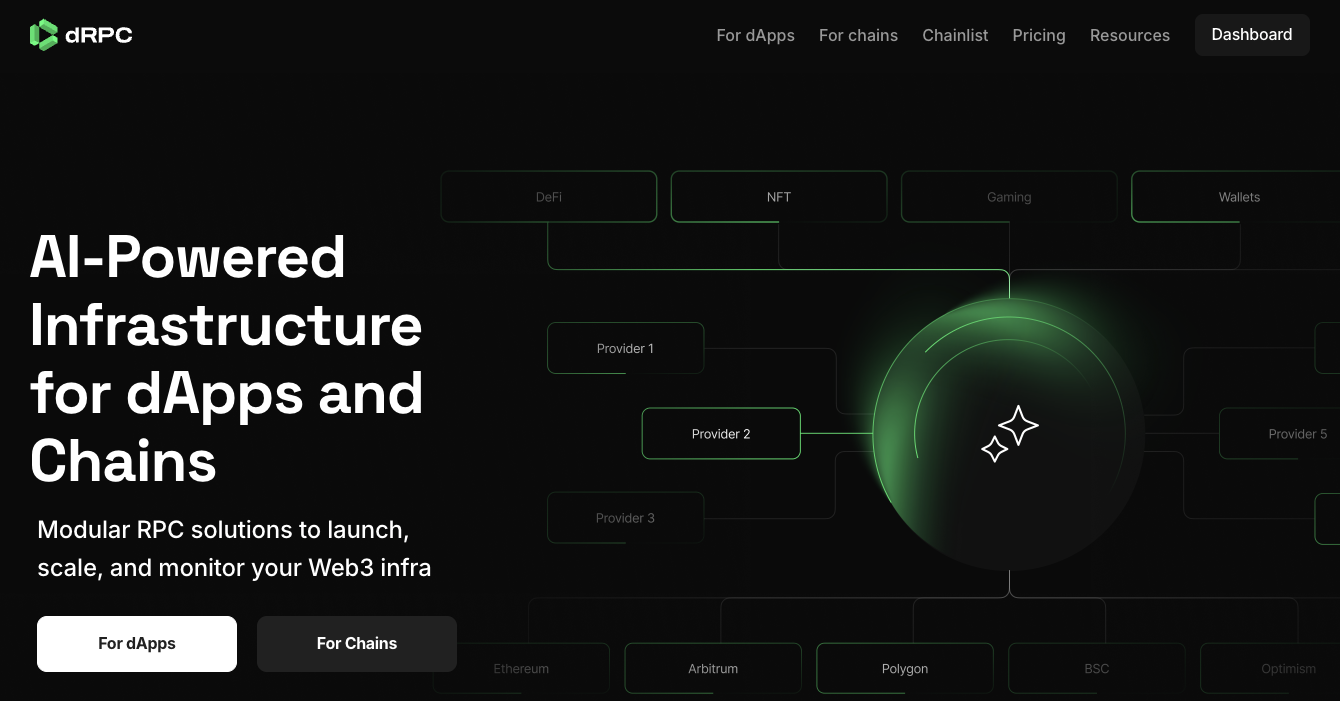
dRPC routes Starknet RPC traffic across 40+ independent node operators with automatic failover based on latency, availability, and geographic proximity. The decentralized architecture reduces single-vendor risk and provides built-in MEV protection against front-running, which is relevant for DeFi applications on Starknet where transaction ordering matters.
dRPC lists Starknet as a "Premium" network. Every method consumes 20 compute units (no variable rates per method), and the free tier offers 210M CUs monthly. Paid plans scale to 5,000 RPS with debug and trace API support.
Key Features
- Decentralized Routing: Traffic distributed across 40+ independent operators with automatic failover.
- MEV Protection: Built-in front-running protection for DeFi transactions.
- Flat CU Per Method: Every
starknet_method costs 20 CU, no variable weighting. - High Throughput: Up to 5,000 RPS on Growth plans.
- Debug and Trace APIs: Advanced debugging on paid plans.
Pricing Structure
| Plan | Price | Included Volume | Throughput | Notes |
|---|---|---|---|---|
| Free | $0 | 210M compute units/month | 100 RPS | Prototyping and development |
| Growth | $6 per 1M requests | Metered | 5,000 RPS | 99.99% uptime SLA |
| Enterprise | Custom | 300M+ requests/month | Unlimited RPS | Volume discounts, dedicated SLA |
Archive data access costs the same as full node queries, with no archive premium.
Pros and Cons
Advantages:
- Decentralized operator pool reduces single-vendor dependency.
- MEV protection included for DeFi-sensitive transactions.
- Generous free tier (210M CUs monthly) for development and testing.
- No archive data surcharge.
- Flat 20 CU per method keeps pricing predictable.
Considerations:
- Latency variance depends on the underlying operator mix.
- Less centralized support compared to vertically integrated providers.
- Starknet classified as a Premium network, which may affect future pricing.
Best For
DeFi applications on Starknet requiring MEV protection, or teams seeking a decentralized secondary provider for redundancy alongside a primary endpoint.
6. BlockPI - Distributed RPC Network
BlockPI operates a distributed RPC network for Starknet with geographic node distribution, archive data access, and a 99.99% uptime SLA. The platform includes MEV protection, debug and trace capabilities, and a bundler service for applications leveraging Starknet's native account abstraction.
BlockPI uses a request unit (RU) model with a free tier offering 50M RUs monthly. The distributed architecture routes requests to the nearest available node with automatic failover between geographic regions.
Key Features
- Distributed RPC Network: Geographic node distribution with automatic failover.
- MEV Protection: Front-running protection for DeFi transactions.
- 99.99% Uptime SLA: High availability guarantee for production workloads.
- Debug and Trace APIs:
debug_tracecapabilities for troubleshooting. - Bundler Service: Account abstraction bundler for advanced transaction patterns.
Pricing Structure
| Plan | Price | Included Volume | Notes |
|---|---|---|---|
| Free | $0 | 50M RU/month | Development and testing |
| Paid | Variable | Higher limits | Contact for details |
Detailed paid tier pricing requires direct inquiry.
Pros and Cons
Advantages:
- Strong uptime SLA at 99.99%.
- MEV protection included.
- Bundler service supports Starknet's native account abstraction.
- Generous free tier for prototyping.
Considerations:
- Paid tier pricing lacks public transparency.
- Smaller community and documentation compared to established providers.
- Limited enhanced API offerings beyond core RPC.
Best For
Teams building account abstraction-heavy applications on Starknet that need MEV protection and a bundler service, or developers seeking a reliable secondary endpoint with strong uptime guarantees.
Feature Comparison Table
| Feature | Dwellir | Alchemy | Infura | Chainstack | dRPC | BlockPI |
|---|---|---|---|---|---|---|
| Pricing Model | 1:1 response-based | Compute units (variable) | Daily credits (weighted) | Request units (1:1) | CU-based (flat per method) | Request units |
| Free Tier | 100K/day | 30M CU/month | 3M credits/day | 3M RU/month | 210M CU/month | 50M RU/month |
| Archive Data | Yes | Yes | Yes | Yes | Yes (no surcharge) | Yes |
| WebSocket | Yes | Yes | Yes | Yes | Yes | Yes |
| Debug/Trace APIs | Yes (all paid plans) | Yes (CU weighted) | Yes (Developer+) | Yes | Yes (paid plans) | Yes |
| Multi-Chain | 150+ | 40+ | 40+ | 70+ | 110+ | 30+ |
Recommendations by Use Case
For DeFi Protocols and Production Applications: Dwellir's 1:1 credit model eliminates cost surprises from the varied starknet_ method calls typical in DeFi workloads. If MEV protection is critical, consider pairing with dRPC as a secondary provider for transaction-sensitive operations.
For Enterprise and Institutional Teams: Chainstack offers the Unlimited Node option for predictable flat-fee billing at scale, along with multi-cloud deployment and team collaboration features.
For High Availability and Redundancy: BlockPI provides a distributed RPC network with a 99.99% uptime SLA, making it a strong secondary endpoint for teams that need geographic failover.
Frequently Asked Questions
What is the best Starknet RPC provider?
Dwellir offers the strongest combination of transparent 1:1 pricing, comprehensive starknet_ method coverage with 26+ documented RPC methods, and multi-chain flexibility across 150+ networks. For teams needing MEV protection, dRPC is a strong complementary option.
How does Starknet RPC differ from Ethereum RPC?
Starknet uses its own starknet_ JSON-RPC namespace with methods like starknet_call, starknet_getBlockWithTxHashes, and starknet_estimateFee instead of standard eth_ methods. Providers must support the full Starknet RPC specification built around Cairo VM execution rather than the EVM.
Are there free Starknet RPC endpoints?
Yes. Dwellir provides 100,000 free requests per day, dRPC offers 210 million compute units per month, Alchemy includes 30 million compute units per month, Chainstack provides 3 million free monthly requests, and BlockPI offers 50 million request units per month.
What are the starknet_ namespace methods?
The starknet_ namespace includes methods specific to Starknet's Cairo VM architecture, such as starknet_call, starknet_getBlockWithTxHashes, starknet_estimateFee, starknet_chainId, and starknet_simulateTransactions. These replace the standard eth_ methods used on EVM chains.
Related Resources
- Best Ethereum RPC Providers 2026 — Compare pricing and features across top Ethereum L1 infrastructure providers
- RPC Providers Without Compute Units — Find providers with simple per-request pricing
Conclusion
For most teams building on Starknet, Dwellir provides the strongest combination of transparent pricing, comprehensive starknet_ method coverage, and multi-chain flexibility. The 1:1 credit model means you never need to calculate compute unit weights for different Starknet methods, and trace/debug APIs come included on all paid plans. With 26+ documented Starknet RPC methods and archive node access, the platform covers the full spectrum from prototyping to production.
For specialized requirements, dRPC stands out for MEV protection in DeFi-sensitive transactions, Chainstack serves teams needing managed infrastructure with multi-cloud deployment, and BlockPI provides a distributed network with strong uptime guarantees.
Ready to build on Starknet? Start with Dwellir's free plan to test your integration, or contact the Dwellir team to discuss your Starknet infrastructure needs.