Celo has carved out a unique position in the blockchain ecosystem as a mobile-first, EVM-compatible network focused on financial inclusion. Following its migration to an Optimism OP Stack Layer 2 in 2024, Celo now delivers 1-second block times, sub-cent transaction fees, and strong finality guarantees while maintaining its mission to bring cryptocurrency payments to smartphone users worldwide. With 420 million transactions processed via MiniPay, 14 million accounts across 66 nations, 1.3 million monthly active users, and $6.2 billion monthly stablecoin volume, Celo offers developers a compelling platform for building payment and DeFi applications across Africa and emerging markets through stablecoin ecosystems like cUSD, cEUR, and regional currencies.
For developers building on Celo, selecting the right RPC provider directly impacts application performance, user experience, and operational costs. This comparison examines seven leading Celo RPC providers to help you make an informed decision based on your specific requirements, budget, and scaling needs.
Understanding Celo RPC Provider Selection Criteria
Before diving into specific providers, consider these key evaluation factors:
Performance and Latency: Celo's 1-second block times demand responsive infrastructure. Look for providers with global distribution and sub-100ms response times to maintain real-time user experiences.
Reliability and Uptime: Downtime disrupts payment flows and erodes user trust. Prioritize providers offering 99.9%+ uptime SLAs with robust failover mechanisms.
Pricing Transparency: Some providers use compute unit (CU) models where different methods cost varying amounts, while others offer straightforward per-request pricing. Dwellir's RPC providers without compute units guide explains how billing models affect total cost of ownership.
Archive Node Access: Historical data queries require archive nodes. Verify whether archive access is included or carries premium charges.
Scalability: Your infrastructure should handle traffic spikes from successful campaigns or viral adoption without requiring emergency migrations.
1. Dwellir - Transparent Pricing Without Compute Units
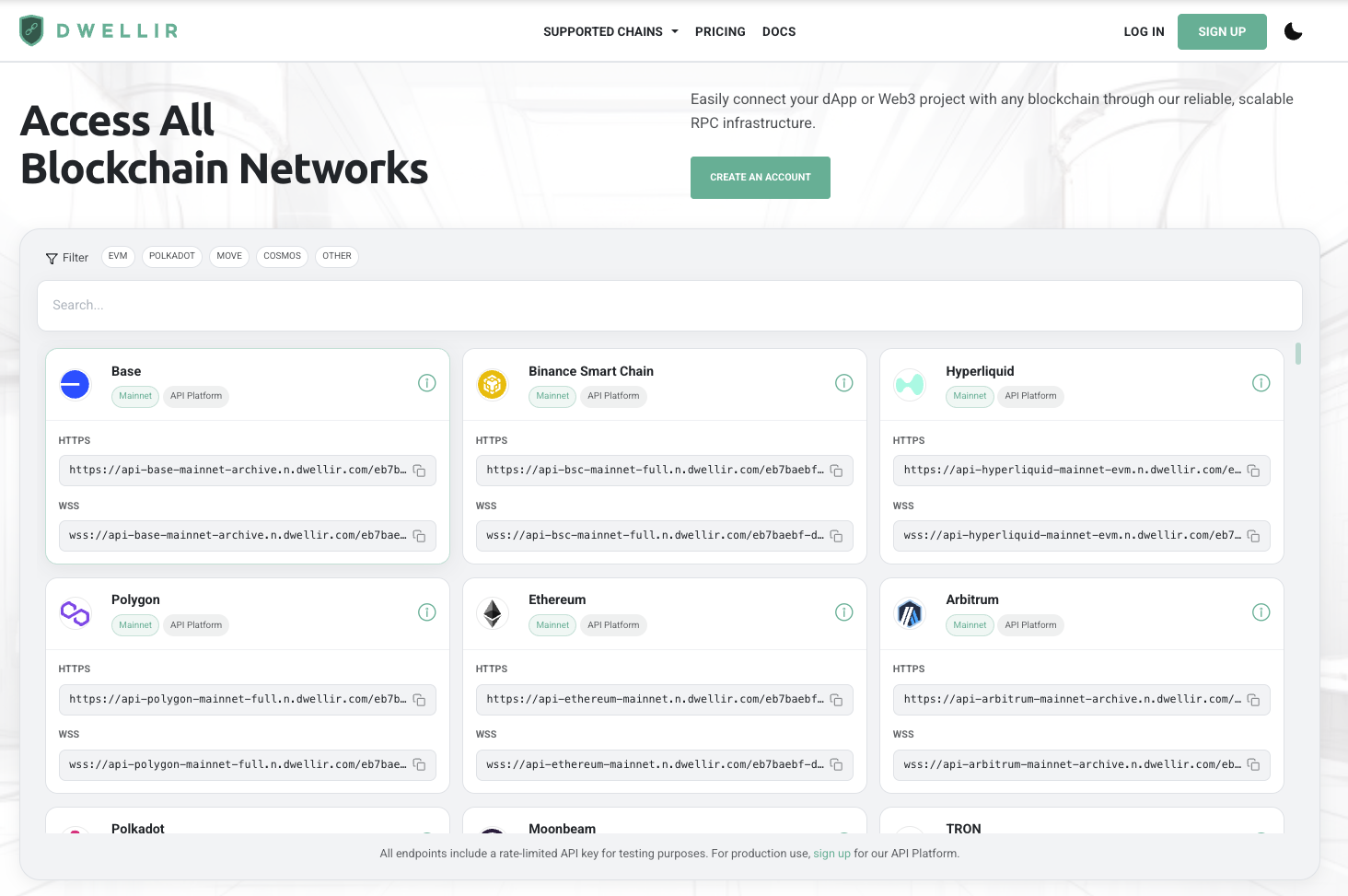
Dwellir provides Celo archive node access with a transparent 1:1 credit model where one RPC response equals one API credit, regardless of method complexity. Trace calls, debug operations, WebSocket streaming, and standard methods all cost the same across Dwellir's 140+ supported blockchains.
Key Features
- Simple Credit System: Trace, debug, archive, and standard methods all cost the same, eliminating compute unit guesswork.
- Archive Node Access: Full historical Celo data through mainnet archive endpoints.
- Protocol Support: HTTPS and WebSocket (WSS) endpoints for real-time event monitoring.
- Extensive Network Coverage: 140+ blockchains through a single API key, ideal for multi-chain applications.
- Performance Tiers: 20 to 5,000 sustained RPS with burst capacity up to 10,000 RPS and autoscaling.
- Dedicated Support: Growth plans and above include direct account management and migration assistance.
Pricing Structure
| Plan | Price | Included Responses | Sustained RPS | Overage |
|---|---|---|---|---|
| Free | Free | 100K responses per day | 20 RPS | N/A |
| Developer | $49/month | 25M responses per month | 100 RPS | $5 per 1M |
| Growth | $299/month | 150M responses per month | 500 RPS | $3 per 1M |
| Scale | $999/month | 500M responses per month | 5,000 RPS | $2 per 1M |
Dedicated node clusters for Celo are available at $875/month with unlimited RPS and responses for teams requiring guaranteed resources.
Pros and Cons
Advantages:
- Transparent, predictable pricing without compute unit complexity.
- Archive node access included at no premium.
- Multi-chain footprint for unified infrastructure across 140+ networks.
- Direct support from the engineering team.
Considerations:
- Ecosystem-specific tooling (prebuilt monitors, enhanced APIs) is leaner than larger platforms.
Best For
Teams building payment applications, DeFi protocols, or multi-chain dashboards that need predictable costs and archive data access. Startups benefit from the Free plan, while scaling applications avoid compute unit surprises.
2. Alchemy - Comprehensive Developer Platform
Alchemy extends its comprehensive development platform to Celo, pairing RPC endpoints with enhanced APIs for NFTs and tokens, webhook notifications, and detailed analytics dashboards. Both HTTP and WebSocket connections are supported on mainnet.
Key Features
- Enhanced APIs: NFT, Token, and Notify APIs reduce custom indexing work.
- Analytics Dashboard: Request volumes, latency, error breakdowns, and per-method CU consumption.
- SDK Coverage: TypeScript, Python, and other language SDKs accelerate integration.
- Transaction Simulation: Pre-send validation for payment applications.
- Comprehensive Documentation: Extensive guides and code examples for Celo development.
Pricing Structure
| Plan | Price | Included Volume | Throughput | Notes |
|---|---|---|---|---|
| Free Tier | $0 | 30M compute units/month | 25 req/s | Community support, 5 apps |
| Pay As You Go | $5 base + $0.45 per 1M CUs | Metered | 300 req/s | Priority support, 30 apps |
| Enterprise | Custom | Custom pools | Custom | VIP engineering, volume discounts |
Compute unit weights vary by method: lightweight calls like eth_chainId consume fewer CUs while eth_getLogs and archive queries consume more, requiring workload monitoring for accurate budgeting.
Pros and Cons
Advantages:
- Mature platform with best-in-class documentation.
- Enhanced APIs minimize custom development.
- Strong developer experience tooling.
- Reliable infrastructure backed by enterprise-grade SLAs.
Considerations:
- Compute unit pricing requires monitoring to avoid overruns.
- Platform depth may feel excessive for simple RPC-only use cases.
Best For
Teams building sophisticated Celo applications that will leverage enhanced APIs, webhooks, and analytics. Ideal when developer productivity outweighs raw infrastructure cost.
3. QuickNode - High-Performance Infrastructure
QuickNode operates a global edge network that routes Celo requests to the nearest region, minimizing latency for geographically distributed users. The platform bundles RPC access with Streams for real-time data pipelines and webhooks for event-driven architectures.
Key Features
- Global Edge Network: Automatic routing to nearest regions minimizes latency worldwide.
- Streams & Webhooks: Real-time event streaming for analytics and monitoring.
- Dedicated Nodes: Isolation option for workloads requiring guaranteed resources.
- Observability Dashboard: Response times, errors, and credit consumption tracking.
- 24/7 Support: Round-the-clock assistance from infrastructure experts.
Pricing Structure
| Plan | Price | Included Credits | Requests per Second | Overage |
|---|---|---|---|---|
| Discover (Free) | $0 | 10M API credits | 15 RPS | N/A |
| Build | $49/month | 80M API credits | 50 RPS | $0.62 per 1M credits |
| Accelerate | $249/month | 450M API credits | 125 RPS | $0.55 per 1M credits |
| Scale | $499/month | 950M API credits | 250 RPS | $0.53 per 1M credits |
| Business | $999/month | 2B API credits | 500 RPS | $0.50 per 1M credits |
Add-ons like Streams, Functions, and dedicated node clusters are billed separately.
Pros and Cons
Advantages:
- Consistently low latency backed by global routing.
- Streams/webhook stack simplifies event-driven architectures.
- Dedicated node option ensures deterministic performance.
- Strong documentation and support.
Considerations:
- Credit accounting requires workload modeling.
- Add-ons increase total spend for complex use cases.
Best For
Performance-critical applications like trading platforms or gaming projects where latency is paramount and teams can manage credit-based billing.
4. Chainstack - Managed Infrastructure with Flexible Options
Chainstack offers managed Celo infrastructure spanning shared endpoints, dedicated nodes, and an Unlimited Node add-on that removes per-request billing entirely. SOC 2 Type II compliance and multi-cloud deployment (AWS, GCP, Azure) suit teams with regulatory or geographic requirements.
Key Features
- Managed Shared + Dedicated Nodes: Deploy shared RPC or dedicated nodes with SOC 2 controls.
- Unlimited Node Add-on: Flat monthly fee unlocks unlimited requests within chosen RPS tiers (25-500 RPS).
- Multi-Cloud Footprint: AWS, GCP, Azure deployment options with geo-balanced routing.
- Team Collaboration: Role-based access and per-project API keys.
- Archive Data Access: Cost-effective historical blockchain queries.
Pricing Structure
| Plan | Price | Monthly Request Units | Included RPS | Notes |
|---|---|---|---|---|
| Developer | $0 | 3M request units | 25 RPS | Shared nodes, community support |
| Growth | $49/month | 20M request units | 250 RPS | Up to 10 project nodes |
| Pro | $199/month | 80M request units | 400 RPS | Priority support |
| Business | $349/month | 140M request units | 600 RPS | SSO, 50 project nodes |
| Unlimited Node | $149+/month | Unlimited (per RPS tier) | 25-500 RPS | Flat-fee shared endpoint |
Archive queries count as two request units.
Pros and Cons
Advantages:
- Managed infrastructure without handling cloud operations.
- Unlimited Node add-on removes per-request billing for bursty workloads.
- SOC 2 Type II compliance for regulated teams.
- Multiple deployment regions available.
Considerations:
- Higher effective cost per million than 1:1 pricing models.
- Unlimited Node requires Growth+ plans.
Best For
Teams wanting managed infrastructure with compliance documentation, especially those needing dedicated nodes without hiring protocol DevOps specialists.
5. dRPC - Decentralized Aggregated RPC Network
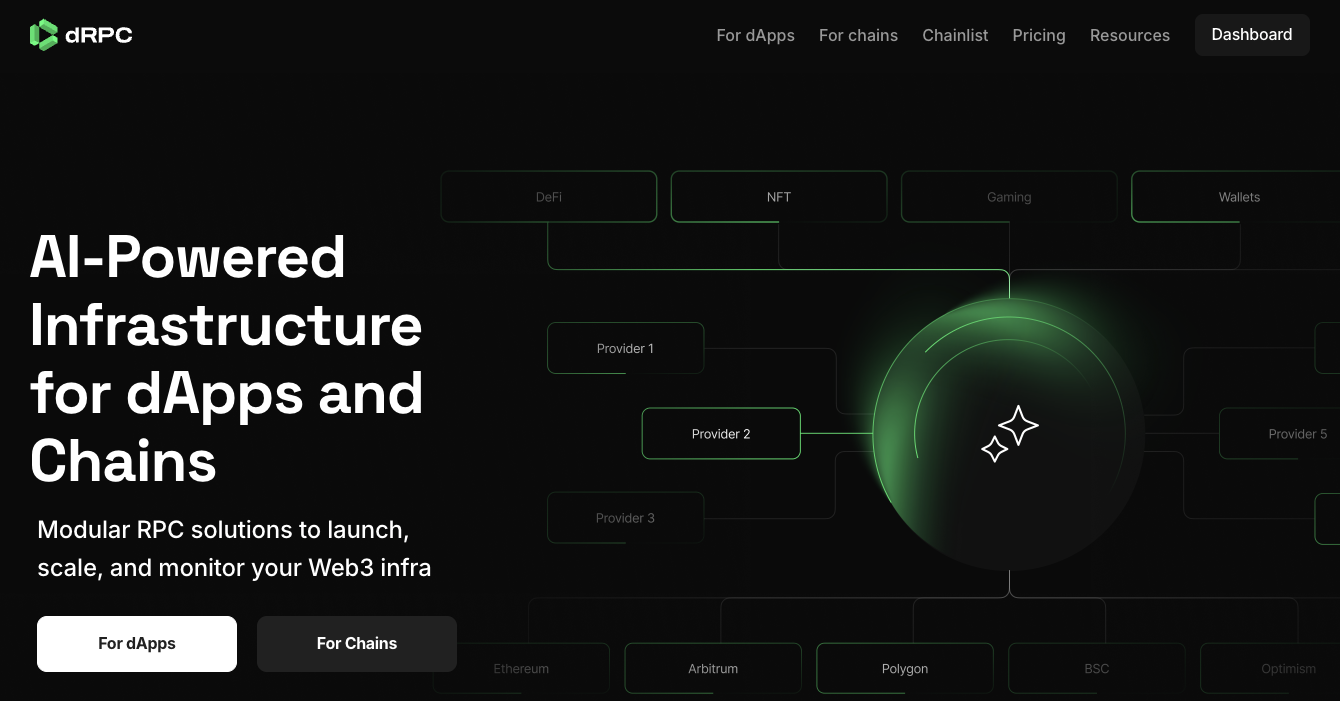
dRPC aggregates Celo traffic across a decentralized marketplace of independent node operators, automatically failing over between providers when issues occur. The platform supports mainnet plus Alfajores and Sepolia testnets via both HTTP and WebSocket.
Key Features
- Decentralized Routing: Traffic automatically fails over between vetted providers for resilience.
- Global Coverage: Operators across US, EU, and APAC with automatic load balancing.
- AI-Driven Load Balancer: Smart routing optimizes for latency and availability.
- Testnet Support: Celo Sepolia and Alfajores endpoints for development.
- Startup Program: Discounted credits for early-stage teams.
Pricing Structure
| Plan | Price | Included Volume | Network Throughput | Notes |
|---|---|---|---|---|
| Free | $0 | 210M compute units/month | 100 RPS | Public nodes, great for prototyping |
| Growth | $6 per 1M requests | Metered | 5,000 RPS | High-performance nodes, 99.99% uptime |
| Enterprise | Custom | 300M+ requests/month | Unlimited RPS | Volume discounts, SLA included |
dRPC bills per successful response, avoiding complex CU math, though latency can fluctuate across operators.
Pros and Cons
Advantages:
- Decentralized operator pool reduces single-vendor risk.
- Flat $6/M request pricing keeps costs predictable.
- Generous free tier for development.
- Built-in failover across multiple providers.
Considerations:
- Latency variance depends on underlying operator mix.
- Less centralized support compared to vertically integrated providers.
Best For
Teams prioritizing decentralization or seeking a cost-effective backup provider to complement primary infrastructure.
6. Ankr - Decentralized Multi-Chain Access
Ankr runs a decentralized network of globally distributed nodes, offering both a free public Celo endpoint and premium tiers with higher rate limits. Independent latency tests consistently rank Ankr among the fastest options in the Americas.
Key Features
- Decentralized Architecture: Distributed network reduces single points of failure.
- Multi-Chain Hub: Single platform for accessing 50+ blockchain networks.
- Public and Premium Endpoints: Free tier with options to upgrade for higher performance.
- Geographic Optimization: Strong performance in specific regions based on node distribution.
- Simple Integration: Standard JSON-RPC interface for easy adoption.
Pricing Structure
| Plan | Price | Features | Notes |
|---|---|---|---|
| Public Endpoint | $0 | Rate-limited, community support | Best for development |
| Premium | Pay-as-you-go | Higher limits, priority routing | Contact for pricing |
| Enterprise | Custom | Dedicated resources, SLA | Custom solutions |
Ankr's public endpoint (https://rpc.ankr.com/celo) provides a reliable free option for development with affordable premium tiers for production.
Pros and Cons
Advantages:
- Decentralization principles built into architecture.
- Strong free tier for testing and development.
- Multi-chain support simplifies infrastructure for cross-chain teams.
- Good regional performance in Americas.
Considerations:
- Premium pricing details require direct inquiry.
- Advanced tooling less developed than enterprise-focused providers.
Best For
Developers building multi-chain applications who value decentralization and need reliable access across different blockchain ecosystems.
7. OnFinality - High Availability with Archive Access
OnFinality emphasizes high availability with a 99.99% uptime SLA and includes archive node access at no extra cost. Servers in Hong Kong, France, and Northern Virginia provide low-latency coverage across three continents.
Key Features
- 99.99% Uptime SLA: High availability guarantee backed by global infrastructure.
- Archive Node Access: Full historical data included without premium charges.
- Global Distribution: Servers in Hong Kong, France, and N. Virginia for low latency.
- Protocol Support: Both HTTPS and WebSocket connections.
- API Analytics: Powerful monitoring and usage tracking tools.
Pricing Structure
| Plan | Price | Daily API Limit | Notes |
|---|---|---|---|
| Free Tier | $0 | 400,000 requests/day | Rate-limited public endpoint |
| Growth | $49/month | 20M API responses | $6/million additional responses |
| Scale | Custom | Custom limits | Dedicated node options |
Pros and Cons
Advantages:
- Archive access included at no extra cost.
- Strong uptime guarantees.
- Global server distribution for low latency.
- Straightforward pricing structure.
Considerations:
- Smaller ecosystem compared to major providers.
- Limited enhanced API offerings.
Best For
Teams requiring archive data access without premium charges, especially those building analytics or historical data applications on Celo.
Feature Comparison Table
| Feature | Dwellir | Alchemy | QuickNode | Chainstack | dRPC | Ankr | OnFinality |
|---|---|---|---|---|---|---|---|
| Pricing Model | 1:1 response-based | Compute units | API credits | Request buckets | Request-based | Pay-as-you-go | Response units |
| Entry Price | Free | Free (30M CUs) | $49 Build | Free (3M req) | Free (210M CUs) | Free public | Free (400K/day) |
| Mid-Tier Price | $299 (150M, 500 RPS) | PAYG $0.45/M CU | $249 (450M credits) | $199 Pro (80M) | $6 per 1M requests | Premium tier | $49 (20M) |
| Archive Access | Included | Available (CU heavy) | Add-on | Double units | Included (paid) | Available | Included |
| Testnet Support | Mainnet only | Sepolia | Mainnet | Mainnet | Sepolia, Alfajores | Mainnet | Mainnet |
| WebSocket | Yes | Yes | Yes | Yes | Yes | Yes | Yes |
| Max RPS | 5,000+ | 300 (PAYG) | 500 (Business) | 600 (Business) | 5,000 | Varies | Custom |
Performance Considerations for Celo
When evaluating Celo RPC providers, consider these factors:
Block Time Compatibility: Celo's 1-second blocks require providers that can deliver fresh data without significant lag. Verify that your provider's infrastructure keeps pace with Celo's block production.
Regional Distribution: Celo's adoption in Africa and emerging markets means your users may be geographically distributed. Map provider PoP locations to your user base.
Archive Depth: If your application queries historical state (token balances, contract storage at past blocks), confirm archive node availability and associated costs.
Rate Limiting Behavior: Understand how providers enforce caps during traffic spikes. Burst protection prevents failed requests during campaign launches or viral moments.
Making Your Decision: Recommendations by Use Case
For Payment and Mobile Applications
Recommended: Dwellir Growth or Scale
Celo's mobile-first design targets payment use cases where cost predictability matters. Dwellir's 1:1 pricing eliminates surprise costs from varied method calls typical in payment flows.
For DeFi and Advanced Applications
Recommended: Alchemy Pay As You Go or QuickNode Accelerate
Complex DeFi applications benefit from enhanced APIs, simulation tools, and comprehensive analytics that Alchemy and QuickNode provide.
For Multi-Chain Projects
Recommended: Dwellir or Ankr
Teams building across multiple networks benefit from unified infrastructure. Dwellir covers 140+ chains with consistent billing, while Ankr's decentralized approach spans 50+ networks.
For Analytics and Historical Data
Recommended: OnFinality or Dwellir
Archive-heavy workloads need included archive access. OnFinality includes archive at no premium, and Dwellir's archive endpoints maintain 1:1 pricing regardless of query complexity.
For Decentralized Redundancy
Recommended: dRPC Growth + Primary Provider
Pairing dRPC's decentralized routing with a primary provider creates resilient infrastructure with automatic failover across multiple node operators.
Key Takeaways and Next Steps
For most Celo projects, Dwellir offers the best balance of transparent pricing, archive access, and multi-chain coverage without compute unit complexity. Teams needing enhanced APIs and developer tooling should consider Alchemy, while those prioritizing decentralized redundancy can pair their primary provider with dRPC as a failover layer.
Ready to build on Celo? Start with Dwellir to test your integration in minutes, or talk to the team for architectural guidance on optimizing your Celo RPC infrastructure.
As Celo's ecosystem continues evolving post-L2 migration, revisit your provider mix regularly and benchmark performance as new features roll out. Many successful teams use multiple providers - one for primary traffic and another for redundancy - to balance reliability, performance, and cost control.
Frequently Asked Questions
What is the best Celo RPC provider?
Dwellir offers the best balance of transparent 1:1 pricing, archive node access, and multi-chain coverage for Celo. For teams needing enhanced APIs and developer tooling, Alchemy provides the most comprehensive platform. OnFinality includes archive access at no extra cost with a 99.99% uptime SLA.
How did Celo's L2 migration impact RPC infrastructure?
Celo migrated from an independent L1 to an Optimism OP Stack Layer 2 in 2024. This brought 1-second block times, sub-cent transaction fees, and stronger finality guarantees. RPC providers now need to handle OP Stack-specific features while maintaining low latency to keep pace with faster block production.
Are there free Celo RPC options?
Yes. dRPC offers 210M free compute units monthly, Alchemy provides 30M free compute units, OnFinality includes 400,000 free requests per day, Dwellir offers 100K free requests per day, Chainstack includes 3M free request units, and Ankr has a free public endpoint.
Does Celo have stablecoin-specific RPC methods?
Celo's stablecoin ecosystem (cUSD, cEUR, and regional currencies) uses standard ERC-20 contract interfaces accessible through normal Ethereum JSON-RPC methods. Applications querying stablecoin balances, transfers, and allowances use standard methods like eth_call and eth_getLogs. Providers with transparent pricing help control costs for frequent stablecoin balance queries.
Related Resources
- Best Ethereum RPC Providers — Compare providers for Ethereum L1, the settlement layer for Celo's L2
- Top Optimism RPC Providers — Infrastructure options for the OP Stack ecosystem Celo now belongs to
- RPC Providers Without Compute Units — Understanding transparent pricing for cost-effective mobile payment infrastructure