Your RPC provider determines how fast your dApp responds, how much you pay per transaction, and whether your infrastructure holds up during the next network congestion spike. Pick the wrong one and you hit rate limits during peak traffic, get surprise bills from opaque compute unit multipliers, or end up managing multiple vendor relationships because no single provider covers all your chains.
The RPC provider market in 2026 looks nothing like the Infura-dominated landscape of a few years ago. Dozens of providers now compete across pricing models, chain coverage, and developer tooling. Some charge per compute unit with 40x multipliers on debug methods. Others offer flat-rate pricing where every call costs the same. A few are decentralizing the infrastructure layer entirely.
This comparison covers 9 providers with verified pricing and features. The goal is straightforward: give you enough data to match your workload to the right provider without needing to visit 9 different pricing pages and normalize the numbers yourself.
What to Look for in an RPC Provider
Not every criterion carries equal weight. Your priorities depend on whether you are building a DeFi protocol, running an indexer, or shipping a consumer dApp. These are the factors that matter most across workloads.
Pricing model and transparency. The biggest source of friction in RPC procurement. Providers using compute units (CU) assign different costs to different methods - a simple eth_getBalance might cost 10 CU while a debug_traceTransaction costs 400 CU. Your headline "requests included" number becomes meaningless without knowing your method mix. Flat-rate providers charge one credit per response regardless of complexity. For workloads that include trace, debug, or compute-heavy calls, the pricing model determines whether your monthly bill is $300 or $3,000.
Latency and uptime SLA. A 99.9% SLA allows 8.7 hours of downtime per year. A 99.99% SLA brings that to 52 minutes. For trading bots and DeFi protocols, the difference between these two tiers matters. Latency benchmarks (p50, p95, p99) vary by provider and region - test with your actual workload before committing.
Chain and network coverage. If you operate across multiple chains, consolidating under one provider reduces operational overhead. Coverage ranges from 25 chains (Infura) to 150+ (Dwellir). Breadth matters less if you only build on Ethereum, but multi-chain teams burn engineering hours managing separate provider relationships, API keys, and billing dashboards per chain.
Archive node access. Archive nodes store the complete historical state of a blockchain at every block height. You need them for historical balance queries, transaction replay, compliance audits, and analytics. Some providers restrict archive access to paid tiers or charge a multiplier. Others include it on every plan.
Developer experience. Enhanced APIs (token APIs, NFT APIs, transaction simulation), SDKs, webhook support, and documentation quality vary significantly across providers. If your team relies on indexed data alongside raw RPC, this becomes a major differentiator.
Compliance certifications. SOC 2 Type II and ISO 27001 are increasingly expected for enterprise procurement. Not all providers have them, and the absence can block a deal if your customers require vendor compliance documentation.
1. Dwellir
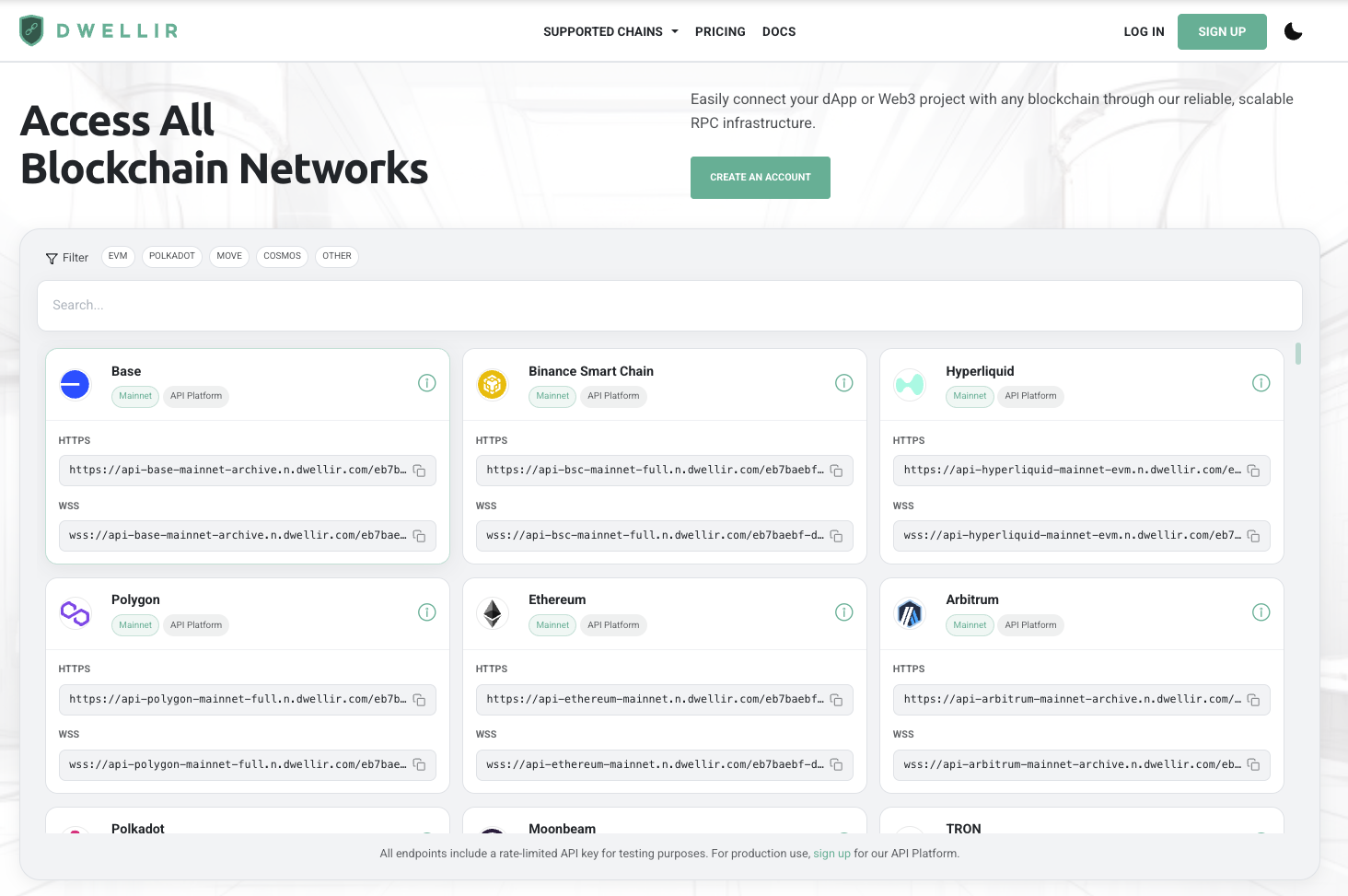
Dwellir uses a 1:1 pricing model where every API response counts as one request, regardless of method complexity. A debug_traceTransaction costs the same as an eth_getBalance. No compute units, no multipliers.
The platform runs on bare-metal infrastructure across data centers in North America, Europe, Asia, and Africa. Dwellir supports 150+ networks - the broadest coverage in this comparison - with particular depth in the Polkadot and Substrate ecosystem, where the Dwellir team operates validators and serves as a treasury-funded infrastructure partner for Moonbeam and Moonriver.
Key features:
- 150+ supported networks
- Archive nodes included on all paid plans
- WebSocket (WSS) and gRPC support
- Trace and debug APIs on all paid plans at no extra charge
- European bare-metal infrastructure
- Autoscaling with capped overage rates
- 99.99% uptime SLA
Pricing:
| Plan | Monthly Cost | Responses Included | RPS (Burst) | Overage |
|---|---|---|---|---|
| Free | $0 | 100,000/day | 20 | - |
| Developer | $49 | 25M | 100 (500) | $5/M |
| Growth | $299 | 150M | 500 (2,500) | $3/M |
| Scale | $999 | 500M | 2,000 (10,000) | $2/M |
At the Scale tier, the $2 per million overage rate is the lowest in this comparison. The burst capacity of 10,000 RPS handles traffic spikes without throttling, which is 20x the RPS ceiling on QuickNode's equivalent $999 tier.
The 1:1 pricing model saves the most on workloads that include trace, debug, or compute-heavy methods. On providers using compute unit multipliers, a workload mixing 70% reads with 30% trace calls can cost 3-5x more than the same workload on a flat-rate provider.
Considerations: Dwellir's enhanced API offering is less extensive than Alchemy's. If you need indexed NFT or token APIs alongside RPC, you will need a separate data provider. The free tier (100,000 requests/day) is smaller than dRPC's or Alchemy's free allocations.
Best for: Teams running high-volume, method-diverse workloads where cost predictability matters - particularly those needing trace and debug access without premium pricing. Multi-chain teams benefit from the 150+ network coverage under a single API key.
2. Alchemy
Alchemy offers the most comprehensive developer platform in the RPC space, combining node infrastructure with enhanced APIs for tokens, NFTs, transactions, and webhooks. The platform uses compute units (CU) for billing, where each RPC method has a different cost weight.
Alchemy operates a proprietary Supernode architecture rather than standard node software behind a load balancer. The system uses a coordinator service to ensure data accuracy and real-time sync across its distributed infrastructure.
Key features:
- 50+ supported networks
- Archive nodes and Smart WebSockets included
- Trace API available
- Enhanced APIs: Transfers API, Token API, NFT API, Webhooks (Notify)
- Alchemy Build debugging suite
- 99.9% SLA (signed SLAs on Enterprise)
Pricing:
| Plan | Monthly Cost | Compute Units | Throughput | Overage |
|---|---|---|---|---|
| Free | $0 | 30M CU/month | 500 CU/s (~25 RPS) | - |
| Pay-as-you-go | Variable | First 300M CU | 10,000 CU/s | $0.45/1M CU |
| Pay-as-you-go (300M+) | Variable | 300M+ CU | 10,000 CU/s | $0.40/1M CU |
| Enterprise | Custom | Custom | 1,000+ RPS | Custom |
No fixed-price subscription exists between the free plan and Enterprise. The pay-as-you-go model scales linearly with usage, which works well for variable workloads but makes budgeting harder for steady-state traffic.
A standard eth_call costs 26 CU. An eth_getLogs costs 60 CU. At an average of ~27 CU per request, 100M monthly requests translates to roughly 2.7 billion CU, costing approximately $1,095/month on the PAYG tier. That same workload costs $299 on Dwellir's Growth plan.
Considerations: Alchemy's enhanced APIs (Token API, NFT API, Transfers API) are a real differentiator. If your application relies on indexed blockchain data alongside raw RPC, the all-in-one platform reduces integration complexity. The compute unit model becomes expensive for trace-heavy workloads.
Best for: EVM-focused teams that want the richest developer tooling ecosystem. If you need indexed token and NFT data, webhook notifications, and transaction debugging alongside standard RPC, Alchemy offers the most integrated experience.
3. QuickNode
QuickNode combines standard RPC infrastructure with a marketplace of add-ons for specialized data, MEV protection, DeFi analytics, and gas optimization. The platform uses an API credit model with method-based multipliers, where debug and trace calls consume 2x the standard rate.
QuickNode holds SOC 1 Type II, SOC 2 Type II, and ISO 27001 certifications - the most comprehensive compliance portfolio in this comparison.
Key features:
- 80+ blockchains, 130+ networks (including testnets)
- Archive nodes and WebSocket included
- Trace API (2x credit cost)
- Streams: real-time and historical blockchain data streaming to webhooks, S3, PostgreSQL
- Marketplace with 50+ add-ons
- 99.99% uptime SLA
- SOC 1/2 Type II, ISO 27001
Pricing:
| Plan | Monthly Cost | API Credits | RPS | Overage |
|---|---|---|---|---|
| Free | $0 (trial) | 10M | 15 | - |
| Build | $49 | 80M | 50 | $0.62/M |
| Accelerate | $249 | 450M | 125 | $0.55/M |
| Scale | $499 | 950M | 250 | $0.53/M |
| Business | $999 | 2B | 500 | $0.50/M |
QuickNode also offers a Flat Rate RPS option (launched March 2026) for EVM and Solana. EVM starts at $799/month for 75 sustained RPS with no per-request metering - useful for bots and indexers with predictable, sustained throughput.
At the Business tier ($999/month), QuickNode includes 2B credits but caps RPS at 500. Compare that to Dwellir's Scale tier at the same price: 500M responses at 2,000 RPS (10,000 burst). The credit model means QuickNode's 2B headline number sounds larger, but effective request counts depend on your method mix.
Considerations: The Streams product stands out for event-driven architectures. Streaming historical and real-time blockchain data directly to S3 or PostgreSQL eliminates the need to build your own indexing pipeline. The free tier is a trial, not a permanent free plan.
Best for: Teams that need data streaming (Streams), MEV protection, or specialized add-ons from the Marketplace alongside standard RPC. Also the strongest choice for enterprise procurement due to SOC 1/2 and ISO 27001 certifications.
4. Chainstack
Chainstack uses a request unit (RU) model where most API calls equal one RU - similar to Dwellir's approach, with one significant exception: archive methods (queries against historical state beyond recent blocks) are billed at 2x the standard rate. The platform achieved SOC 2 Type II certification in December 2025 and backs its infrastructure with a 99.99% uptime SLA.
Chainstack also offers gRPC/Yellowstone streaming for Solana at $49/month via a Geyser plugin integration, making it one of the more cost-effective options for Solana data streaming.
Key features:
- 70+ supported chains
- Archive nodes available
- WebSocket and Trace API included
- SOC 2 Type II certified
- 99.99% uptime SLA
- Unlimited Node add-on (flat-rate RPS billing, unlimited requests)
- Self-hosted node deployment option
- gRPC/Yellowstone Solana streaming
Pricing:
| Plan | Monthly Cost | Request Units | RPS | Overage |
|---|---|---|---|---|
| Developer (Free) | $0 | 3M/month | 25 | $20/M |
| Growth | $49 | 20M | 250 | $15/M |
| Pro | $199 | 80M | 400 | $12.50/M |
| Business | $499 | 200M | 600 | $10/M |
| Enterprise | From $990 | 400M | Unlimited | ~$5/M |
The base request unit model makes costs predictable for standard workloads, but the 2x archive multiplier and high overage rates change the picture. Overage runs $15 per million on the Growth tier versus $5 at Dwellir or $0.62 per million API credits at QuickNode. At enterprise scale, the $5/M overage narrows the gap.
The Unlimited Node add-on is worth evaluating separately. It provides flat-fee, RPS-tiered access with no per-request billing or overage risk - a different cost model entirely from the standard plans.
Considerations: Overage pricing on lower tiers is the highest in this comparison. The 1:1 base pricing is a strength, but the 2x charge for archive methods means workloads heavy on historical state queries effectively pay double the headline rate. Combined with overage costs that exceed plan limits, this can erode the savings versus compute-unit providers. Plan capacity carefully.
Best for: Enterprise teams that need SOC 2 Type II documentation for vendor qualification. Also strong for Solana streaming workloads via the gRPC/Yellowstone integration.
5. Infura
Infura is the default RPC provider embedded in MetaMask, the largest crypto wallet with over 100 million users. The platform bills on daily credit quotas rather than monthly allocations, which is unique among the providers in this comparison.
Infura launched its Decentralized Infrastructure Network (DIN) in partnership with Microsoft, Chainstack, and 16+ other node operators, addressing the single-point-of-failure criticism that followed Infura outages affecting MetaMask users.
Key features:
- 25 supported chains
- Archive nodes and WebSocket (WSS) included
- Trace API on Developer plan and above
- MetaMask SDK integration
- Gas API (powers MetaMask's gas estimator)
- Decentralized Infrastructure Network (DIN) with 18+ node operator partners
- 99.9% SLA
Pricing:
| Plan | Monthly Cost | Daily Credits | Throughput | API Keys |
|---|---|---|---|---|
| Core (Free) | $0 | 3M/day | 500 credits/sec | 1 |
| Developer | $50 | 15M/day | 4,000 credits/sec | 5 |
| Team | $225 | 75M/day | 40,000 credits/sec | Unlimited |
| Enterprise | Custom | Custom | Custom | Unlimited |
The daily quota model prevents cost spikes from traffic bursts but also means unused capacity does not roll over. A Developer plan at 15M credits/day translates to roughly 450M credits/month for consistent workloads.
Infura's chain coverage is the narrowest in this comparison at 25 networks. The platform prioritizes depth on Ethereum and selected L2s (Arbitrum, Optimism, Base, Polygon, Linea) over breadth. Solana access remains limited to select customers as of April 2026.
Considerations: If you are building on Ethereum and want tight MetaMask SDK integration plus access to the Gas API, Infura is the natural fit. For multi-chain teams, the 25-chain limit means supplementing with a second provider. WebSocket support on non-Ethereum chains (Arbitrum, Avalanche, BNB, Optimism) is still in beta.
Best for: Ethereum-focused projects that need MetaMask SDK compatibility, ConsenSys ecosystem integration (Linea, Hardhat), and the most battle-tested Ethereum infrastructure. Also strong for teams that want the decentralization guarantees of the DIN network.
6. dRPC
dRPC is an aggregator that routes requests through a network of 50+ independent node providers via an AI-driven load balancer. Rather than running its own infrastructure exclusively, dRPC combines multiple upstream providers to optimize for latency and reliability.
The free tier offers 210 million compute units per month at 100 RPS - the most generous free allocation in this comparison by a wide margin.
Key features:
- 115 chains, 201 networks
- Archive nodes included (even on free tier)
- WebSocket support
- Trace API on paid tier
- MEV protection on paid tier
- AI-powered load balancing across 50+ node providers
- 99.99% uptime on paid tiers
- Accepts crypto payments
Pricing:
| Plan | Monthly Cost | Included | RPS | Notes |
|---|---|---|---|---|
| Free | $0 | 210M CU/month | 100 | No trace/debug, public nodes only |
| Growth | Pay-as-you-go | - | 5,000 | $6/1M requests |
| Enterprise | Custom | 300M+ requests | Unlimited | Volume discounts |
The Growth plan charges a flat $6 per million requests with no monthly subscription - the lowest entry cost for paid RPC in this comparison. The 5,000 RPS ceiling is also the highest available without an enterprise contract.
At 100M monthly requests on the Growth plan, your bill comes to $600/month. That is more than Dwellir's Growth tier ($299 for 150M included) but less than Alchemy's PAYG (~$1,095) for the same workload.
Considerations: The free tier restricts access to public nodes only and disables trace, debug, and filter methods. The aggregator model means your requests route through third-party node operators, which may raise data privacy concerns for sensitive workloads. dRPC does not publish compliance certifications.
Best for: Teams that need a large free tier for development and testing, or cost-conscious production workloads that prioritize broad chain coverage (115 chains) and high RPS without enterprise contracts.
7. Ankr
Ankr positions itself as a decentralized physical infrastructure network (DePIN) with third-party node operators running bare-metal infrastructure across 30+ global regions. Beyond standard RPC, Ankr provides an Advanced API for multi-chain indexed queries across NFTs, tokens, and DeFi data - closer to The Graph than a traditional RPC provider.
Key features:
- 80+ supported chains (Premium)
- Archive nodes on Premium plan
- WebSocket on Premium plan
- Trace API on Premium plan
- Advanced API: multi-chain indexed queries across 19 mainnets
- gRPC support
- DePIN architecture with bare-metal node operators
Pricing:
| Tier | Monthly Cost | Included | Rate Limit | Notes |
|---|---|---|---|---|
| Public | Free | Shared endpoints | ~1,800 req/min | 40+ chains, no trace/debug |
| Freemium | Free | 200M API credits/mo | ~1,800 req/min | 65+ chains, Advanced API |
| Premium (PAYG) | Min $10 deposit | Pay-per-use | 1,500 RPS (EVM) | 80+ chains, all features |
| Deal | $500-$3,000/mo | +20% bonus credits | Same as PAYG | Volume commitment |
The pricing model requires careful attention. The headline rate is $0.10 per million API credits, but each EVM request consumes 200 credits. That puts the effective cost at approximately $20 per million EVM requests - 200x higher than the headline rate suggests.
For Solana requests at 500 credits each, the effective cost is ~$50 per million. The Deal subscription adds 20% bonus credits for committed spend, which helps at volume but does not change the underlying economics.
Considerations: Ankr's Advanced API for multi-chain indexed data is useful if you need NFT, token, and DeFi data alongside RPC. The credit multiplier structure makes Ankr one of the more expensive options for pure RPC workloads. No public uptime SLA is documented.
Best for: Multi-chain applications that need indexed data APIs (NFTs, tokens, DeFi positions) alongside standard RPC, and teams that want a DePIN-aligned infrastructure provider.
8. Tenderly
Tenderly is primarily a smart contract development platform that also provides RPC infrastructure. The platform's core value is its simulation and debugging layer: Virtual TestNets that fork mainnet state, transaction simulation, execution traces, and real-time alerting. RPC access is one component of a broader developer toolkit.
Tenderly uses Tenderly Units (TU) for billing, with high multipliers on complex operations.
Key features:
- 80+ EVM networks (EVM only)
- Archive nodes with full execution traces
- Transaction simulation and debugging
- Virtual TestNets (fork mainnet state for testing)
- Real-time alerting
- 99.99% uptime SLA
Pricing:
TU consumption varies by method type:
| Method Type | TU Cost | Example |
|---|---|---|
| Read | 1 TU | eth_getBalance |
| Compute | 4 TU | eth_call |
| Write | 20 TU | eth_sendRawTransaction |
| Debug/Trace | 40 TU | debug_traceBlock |
| Simulation | 400 TU | tenderly_simulateTransaction |
| Plan | Monthly Cost | Tenderly Units | Rate Limit | Overage |
|---|---|---|---|---|
| Free | $0 | 25M TU/month | 10 TU/s | - |
| Starter | $50 | 35M TU | 20 TU/s | $10/1M TU |
| Pro | $500 | 350M TU | 300 TU/s | $10/1M TU |
The multipliers are steep for production RPC workloads. A simulation call at 400 TU means your 25M free TU translates to just 62,500 simulations. For pure reads, the same budget covers 25M calls. Tenderly's economics make sense for development and testing workflows, not as a primary production RPC provider.
Considerations: EVM only - no Solana, Cosmos, or other non-EVM chains. The platform is not designed to compete on RPC price. Its value is the simulation and debugging layer that no other provider in this comparison offers. Use Tenderly for dev/staging and a different provider for production RPC.
Best for: Smart contract developers and protocol teams that need to simulate transactions, debug execution traces, and test against forked mainnet state. Security auditors analyzing contract behavior will find the Virtual TestNet and simulation tools essential.
9. Lava Network
Lava Network is not a traditional RPC provider. Rather than operating infrastructure directly, Lava is a decentralized routing protocol that coordinates independent node providers through on-chain incentives. Any node operator can join the network and serve traffic, with payments distributed in proportion to relay volume.
The network has processed 186 billion+ requests since inception, with 2 billion+ daily relays across 50+ blockchains as of March 2026.
Key features:
- 50+ blockchains and rollups
- Archive and trace API access (as add-ons)
- Permissionless node operator network
- On-chain quality-of-service scoring
- Censorship resistance by design
- Free public RPC pools available
Pricing:
Lava uses on-chain compute unit subscriptions rather than traditional SaaS pricing. The website does not publish specific dollar costs. Developers purchase CU allocations on-chain, and payments flow to node providers based on relays served.
Free public RPC pools at pools.lavanet.xyz provide access to select chains without any payment.
Considerations: The lack of transparent, published pricing is a practical barrier for teams that need procurement approval or budget planning. No formal SLA exists - quality of service depends on the node operator network. The on-chain payment model adds complexity compared to a standard API key signup. Lava solves a real problem (censorship resistance, single-provider dependency) but the tradeoffs in pricing transparency and operational simplicity are significant.
Best for: Teams that prioritize censorship resistance and want to avoid single-provider dependency without running their own nodes. Also relevant for projects philosophically aligned with decentralized infrastructure.
Provider Comparison
| Provider | Chains | Pricing Model | Free Tier | Archive | WSS | Trace API | Max Throughput (Paid) | Uptime SLA | SOC 2 |
|---|---|---|---|---|---|---|---|---|---|
| Dwellir | 150+ | 1:1 requests | 100K/day | Yes | Yes | Yes (paid) | 2,000 RPS (10K burst) | 99.99% | - |
| Alchemy | 50+ | Compute units | 30M CU/mo | Yes | Yes | Yes | 10,000 CU/s (~300 RPS) | 99.9% | - |
| QuickNode | 80+ | API credits | 10M (trial) | Yes | Yes | Yes (2x) | 500 RPS | 99.99% | Yes |
| Chainstack | 70+ | 1:1 RU (2x archive) | 3M RU/mo | Yes | Yes | Yes | Unlimited (Enterprise) | 99.99% | Yes |
| Infura | 25 | Daily credits | 3M/day | Yes | Yes | Yes (paid) | 40,000 credits/s (~1,000 RPS) | 99.9% | - |
| dRPC | 115 | Flat PAYG | 210M CU/mo | Yes | Yes | Yes (paid) | 5,000 RPS | 99.99% | - |
| Ankr | 80+ | API credits | 200M credits/mo | Yes (paid) | Yes (paid) | Yes (paid) | 1,500 RPS (EVM) | - | - |
| Tenderly | 80+ (EVM) | Tenderly Units | 25M TU/mo | Yes | - | Yes | 300 TU/s (~75 RPS) | 99.99% | - |
| Lava | 50+ | On-chain CU | Free pools | Yes | - | Yes | - | - | - |
Cost at 100 Million Monthly Requests
The real test of pricing transparency. Headline credit allocations rarely match what you actually pay - providers using compute units assign different multipliers to each method, with a single eth_call costing anywhere from 1 to 200 units. This table normalizes pricing to a single benchmark: the average cost per million eth_call requests across each provider's plans, and the projected monthly bill at 100M calls.
| Provider | Avg Cost per Million eth_calls | Cost for 100M eth_calls |
|---|---|---|
| Dwellir | $1.98 | $198 |
| Chainstack | $2.48 | $248 |
| Tenderly | $5.71 | $571 |
| dRPC | $5.99 | $599 |
| Infura | $8.45 | $845 |
| Alchemy | $10.68 | $1,068 |
| QuickNode | $10.96 | $1,096 |
| Ankr | $20.00 | $2,000 |
Dwellir comes out cheapest because its 1:1 pricing model charges one credit per response regardless of method - no multipliers, no compute-unit translation, and archive calls cost the same as standard reads. Chainstack uses a similar 1:1 base rate but doubles the cost for archive methods, so workloads heavy in historical state queries can run closer to $5/M than the $2.48/M shown above. Ankr sits at the opposite end: its headline rate of $0.10 per million units looks competitive until you account for the 200 credits consumed per eth_call, putting the effective cost at $20 per million calls - a 200x gap between advertised and effective pricing.
Methodology: for each plan published on the provider's pricing page, we calculated cost per million units (monthly cost ÷ included units), multiplied by units consumed per eth_call per provider documentation, and averaged across all available plans. Lava is excluded because it does not publish fiat pricing. Tenderly's figure reflects eth_call only (4 TU per call) - workloads heavy in simulation or trace methods will exceed this rate due to higher TU multipliers on those methods.
Direct cost comparison across compute-unit providers is inherently imprecise because your actual bill depends on your method mix. Dwellir's flat 1:1 model gives the most predictable costs - the headline price is the price you pay regardless of method. Chainstack uses the same 1:1 base rate for standard methods but applies a 2x multiplier on archive calls, so historical-state-heavy workloads bill higher than the headline suggests. On compute-unit plans, a 30% trace mix can double or triple your bill because methods like debug_traceTransaction carry their own multipliers on top of the rates shown above.
For a deeper analysis of how compute unit multipliers affect real costs, see RPC Providers Without Compute Units.
Choosing the Right Provider
For most teams, the decision comes down to three scenarios.
Best all-round choice: Dwellir. The 1:1 pricing model eliminates the guesswork of compute unit billing, and the impact grows with workload complexity. At the Scale tier, 2,000 RPS with 10,000 burst capacity, $2/M overage, and 150+ network coverage under a single API key gives the broadest combination of price, performance, and chain support. Archive nodes and trace APIs on all paid plans mean no hidden costs for data-heavy workloads. The main tradeoff is a smaller enhanced API offering compared to Alchemy - if you need indexed token or NFT data, you will need to supplement with a separate data provider.
Best for developer tooling: Alchemy or Tenderly. Alchemy provides the most integrated developer platform with enhanced APIs, webhooks, and debugging tools alongside RPC. If your team builds primarily on EVM chains and wants indexed blockchain data in the same platform, Alchemy reduces integration overhead. Tenderly serves a different niche: simulation, mainnet forking, and execution tracing for smart contract development. Use Tenderly for dev and staging, pair it with a production RPC provider.
Best for enterprise compliance: QuickNode or Chainstack. QuickNode's SOC 1/2 Type II and ISO 27001 certifications are the most comprehensive in the market, backed by a mature Streams product for data pipelines. Chainstack offers SOC 2 Type II with 1:1 base request pricing (archive methods at 2x) and unlimited RPS on the Enterprise tier. Both meet the vendor qualification requirements that institutional customers increasingly demand.
Looking for Chain-Specific Comparisons?
This roundup covers providers across all chains. For detailed comparisons focused on specific networks, including chain-specific pricing and feature analysis:
- Best Ethereum RPC Providers 2026
- Top 6 Base RPC Providers 2026
- Best Arbitrum RPC Providers 2026
- 10 Best Polygon RPC Providers 2026
For a primer on what RPC is and how it works in blockchain, start there before diving into provider comparisons.
Getting Started
Pricing, chain support, and feature sets across these 9 providers change quarterly. Before committing to a long-term plan, test 2-3 providers with your actual workload. Every provider in this comparison offers a free tier or trial - use them to benchmark latency, check archive data availability for your chains, and verify that the APIs you need are actually supported, not just listed.
If cost predictability is your primary concern, start with a provider that uses 1:1 request billing and save yourself the spreadsheet exercise of modeling compute unit costs across your method mix.
Ready to test? Sign up for Dwellir's free tier or contact the Dwellir team to discuss infrastructure requirements for your production workload.