Your high-frequency trading bot just missed fifteen arbitrage opportunities. Not because your strategy failed, but because your RPC provider added 150ms latency to each query. On MegaETH, where blocks arrive every 10 milliseconds, infrastructure that worked fine on Ethereum becomes a performance bottleneck. With MegaETH's mainnet launched on February 9, 2026, selecting the right RPC provider determines whether your application exploits real-time blockchain capabilities or fights against them.
The problem extends beyond latency. A trading bot making 1,000 requests per second accumulates 2.6 billion monthly requests. Under traditional compute unit pricing, archive queries and trace methods cost 20-50x standard calls. This pricing structure, designed for Ethereum's 15 TPS, becomes expensive at MegaETH's 100,000 TPS scale. Your infrastructure costs could increase 10-25x based solely on which methods your application calls.
This guide examines four RPC providers with confirmed MegaETH support, comparing pricing models, performance benchmarks, and architectural approaches. The analysis focuses on the infrastructure decisions that determine whether your application can operate sustainably at real-time blockchain speeds.
What is MegaETH?
Since its mainnet launch, MegaETH has accumulated $110.8 million TVL (DeFiLlama, April 2026). MegaETH achieves real-time blockchain performance through specialized node architecture and aggressive optimization of the execution stack, fundamentally departing from traditional Layer 2 designs.
Core Architecture:
- Single Sequencer Model: One high-performance sequencer handles ordering with 10,000+ cores and terabytes of RAM, eliminating consensus overhead during execution
- In-Memory State Execution: Full state maintained in RAM rather than disk, removing I/O bottlenecks
- Parallel Transaction Processing: EVM-equivalent execution with optimistic parallelism across transaction batches
- EigenDA Integration: Data availability through EigenLayer's decentralized network, separating data storage from execution
- Specialized Node Types: Four distinct node roles (sequencer, full, replica, prover) optimized for specific workloads
Performance Metrics:
| Metric | MegaETH | Ethereum L1 | Arbitrum | Base | Improvement vs L1 |
|---|---|---|---|---|---|
| TPS | 100,000+ (35,000 sustained in pre-launch stress test, 10.7B txns processed) | 15-30 | 40-100 | 50-120 | ~5,000x |
| Block Time | 10ms | 12s | 250ms | 2s | 1,200x faster |
| Finality | 1s | 12-18 min | 5-15 min | 1-2 min | 720-1,080x faster |
| Computational Throughput | 1,700 MGas/s | 1 MGas/s | 50 MGas/s | 60 MGas/s | 1,700x |
Target Applications:
MegaETH's real-time performance enables entirely new blockchain application categories:
- High-Frequency DeFi Trading: Order book DEXs with sub-second execution competitive with centralized exchanges
- Fully On-Chain Games: Real-time multiplayer games with blockchain state updates at 100 Hz
- Derivatives and Prediction Markets: Margin trading and perpetuals with rapid liquidation processing
- AI-Powered Applications: Machine learning models operating on live blockchain data with millisecond inference
- Institutional Trading Infrastructure: Professional trading platforms requiring CEX-equivalent performance
RPC Requirements for Real-Time Performance:
MegaETH produces 100 blocks per second. RPC infrastructure optimized for 12-second Ethereum blocks creates bottlenecks. Your provider must deliver:
- Sub-50ms P95 latency: Responses faster than 5 block intervals
- High-throughput WebSockets: Reliable subscriptions handling 100 blocks per second
- Cost-efficient pricing: Request volumes 100-1,000x higher than L1 applications demand transparent pricing
- Archive node depth: Rapid block production creates massive historical datasets
Physical distance between your application and RPC node becomes critical on MegaETH. A 200ms round-trip latency - acceptable on Ethereum - represents 20 missed blocks.
What to Look for in a MegaETH RPC Provider
Performance Requirements for Real-Time Blockchain
MegaETH's 10ms block production creates unique infrastructure demands:
Latency Benchmarks:
- P95 under 50ms: Optimal for maintaining pace with block production
- P99 under 100ms: Acceptable for non-critical paths
- WebSocket stability: Must handle 100 block notifications per second without dropped connections
- Geographic distribution: Physical distance becomes performance-critical at 10ms block times
Throughput Capacity:
- Minimum 1,000 RPS for development: Testing real-time applications generates significant request volume
- 5,000+ RPS for production: High-frequency applications easily exceed traditional RPC load assumptions
- Burst protection: MegaETH applications experience extreme traffic variability
API Compatibility: MegaETH implements standard Ethereum JSON-RPC with important limitations:
- Full support for
eth_*methods - Limited
debug_*andtrace_*support (varies by provider) - No
eth_subscribefilter support - Archive node access critical for analytics applications
Why Pricing Transparency Matters for MegaETH
Traditional compute unit-based pricing creates expensive economics at MegaETH's throughput:
The Compute Unit Problem:
Most RPC providers assign variable costs to API methods:
- Simple calls: 10-26 compute units
eth_getLogs: 75-150 CU- Archive queries: 25x multiplier (650 CU+)
- Trace methods: 200-500 CU
This complexity works at Ethereum's 15 TPS. At MegaETH's 100,000 TPS, it becomes expensive.
Real Cost Example (100M monthly requests, 20% archive, 10% trace):
| Provider Model | Calculation | Monthly Cost |
|---|---|---|
| Dwellir (1:1 Pricing) | 100M × $2/million | $200 |
| Compute Units | 70M std (26 CU) + 20M archive (650 CU) + 10M trace (300 CU) | $2,400-4,200 |
| Savings | Dwellir 1:1 advantage | 92-95% |
Request-Based Pricing Advantage:
True 1:1 pricing - where every RPC response costs one credit regardless of method - eliminates this cost trap:
- Predictable budgeting: 100M requests always costs $200, not $200-4,000
- No archive penalties: Historical queries cost the same as current state reads
- Trace method parity:
debug_traceTransaction=eth_blockNumber= 1 credit - Linear scaling: Costs scale predictably with application growth
For high-frequency trading bots making 2.6 billion monthly requests, this pricing difference represents $40,000-100,000 in annual infrastructure savings.
Archive Node Considerations
MegaETH's throughput creates unique archive requirements:
At 100,000 TPS sustained capacity:
- Daily transactions: 8.64 billion
- Monthly transactions: ~260 billion
- Annual transactions: ~3.15 trillion
This rapid state growth makes archive node access expensive. Providers offering "full archive access" often throttle heavy archive queries, charge 25-50x through compute unit multipliers, or limit historical depth to recent months.
Cost comparison for analytics applications:
| Archive Query Volume | Dwellir (1:1 Pricing) | Compute Units (25x) | Difference |
|---|---|---|---|
| 10M archive calls | $20 | $500 | 25x more |
| 50M archive calls | $100 | $2,500 | 25x more |
| 100M archive calls | $200 | $5,000 | 25x more |
For block explorers, analytics platforms, and compliance systems requiring historical data access, pricing model determines economic viability.
Essential MegaETH Capabilities
When evaluating providers, prioritize:
- WebSocket reliability: Real-time subscriptions must handle 100 blocks/second without drops
- Geographic distribution: Sub-50ms latency requires nodes near your users
- Rate limiting transparency: Understand both provider limits and MegaETH network-level restrictions
- Archive depth: Confirm historical data access extent and pricing
- Protocol support: HTTPS, WebSocket (WSS), and potentially gRPC for high-performance applications
- EVM compatibility: Full JSON-RPC standard support with clear documentation of MegaETH-specific limitations
With these requirements in mind, here's how the current MegaETH RPC provider landscape measures up.
Top MegaETH RPC Providers: Detailed Analysis
Comprehensive Comparison Matrix
| Provider | Pricing Model | MegaETH Status | Free Tier | Starting Price | Archive Support | Max RPS |
|---|---|---|---|---|---|---|
| Dwellir | 1:1 per request | Mainnet | 100K/day | $49/mo | Yes | 5,000+ |
| Tatum | Credit-based (2-50 per method) | Mainnet | Free tier | $29/mo | Yes | 500+ |
| Alchemy | Compute units | Mainnet | 300M CU | $49/mo | Yes | 300+ |
| dRPC | Flat rate | Mainnet | 210M CU | $6/M requests | Yes | 5,000 |
MegaETH support status as of February 2026. Contact providers directly for latest availability.
1. Dwellir - Transparent 1:1 Pricing
Best For: Production applications requiring cost predictability at MegaETH's extreme throughput
Pricing: $49 to $999/month | Model: 1 response = 1 credit (no method multipliers)
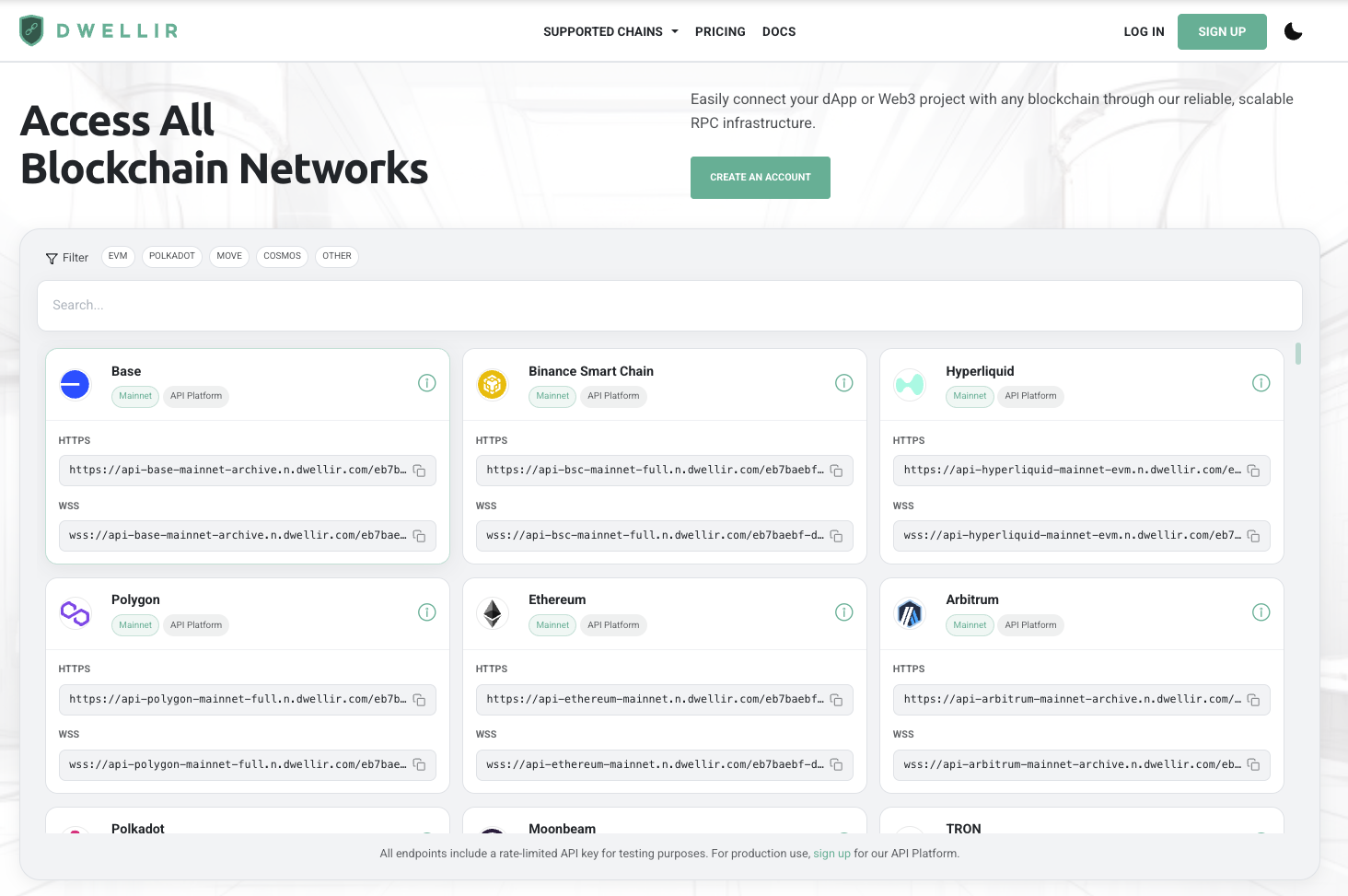
Dwellir operates infrastructure across 150+ blockchain networks using a 1:1 pricing model where every API method costs the same. MegaETH support is now live, bringing transparent pricing to the highest-throughput EVM chain.
Key Advantages for MegaETH:
- True 1:1 pricing: Every method costs the same -
eth_blockNumber,eth_call,debug_traceTransaction, archive queries - all identical - No archive surcharges: Historical data access at the same rate as current state reads
- No trace/debug premiums: Complex debugging methods priced identically to simple queries
- Globally distributed infrastructure: Geo-distributed bare-metal nodes designed for low-latency access
- 99.99% uptime SLA: Enterprise-grade reliability with response credits for downtime
- 150+ networks: Unified authentication and billing across entire multi-chain ecosystem
Pricing Structure:
- Free: Free (100K requests/day, 20 RPS)
- Developer: $49/mo (25M requests/month, 100 RPS)
- Growth: $299/mo (150M requests/month, 500 RPS)
- Scale: $999/mo (500M requests/month, 5,000 RPS)
- Overages: $1.96-2.00 per million requests
Technical Features:
- HTTPS, WebSocket (WSS), and gRPC protocol support
- Geographic node distribution across North America, Europe, and Asia
- Dedicated Slack channels for Scale tier customers
- Burst capacity up to 10,000 RPS for traffic spikes
- Archive nodes expanding across supported networks
Cost Efficiency Example:
For a high-frequency DeFi application making 500M monthly requests (30% archive, 15% trace methods):
- Dwellir 1:1 model: $1,000 (500M × $2/million)
- Compute unit providers: $8,000-15,000+ (archive 25x + trace multipliers)
- Savings: 87-93%
MegaETH Status:
MegaETH support is now live on Dwellir's platform. The 1:1 pricing model eliminates the cost multipliers that create budget uncertainty for high-volume applications on MegaETH, providing transparent and predictable infrastructure costs from day one.
Get started with MegaETH on Dwellir: Sign up now or contact the team for enterprise requirements.
2. Tatum - Multi-Chain RPC with Credit-Based Pricing
Best For: Multi-chain applications needing unified API access across blockchains including MegaETH
Pricing: Free to $999/month | Model: Credit-based (2-50 credits per method)
Tatum supports MegaETH mainnet as part of their multi-chain RPC platform covering 100+ blockchains. Beyond raw RPC access, Tatum offers higher-level APIs for common blockchain operations, simplifying development for teams building across multiple networks.
MegaETH Capabilities:
- Mainnet RPC access confirmed
- Multi-chain unified authentication
- Higher-level APIs beyond raw JSON-RPC
- WebSocket support for real-time subscriptions
- Archive node access available
Pricing Structure:
- Free: Development tier with limited requests
- Start: $29/mo (300K credits)
- Basic: $99/mo (5M credits)
- Pro: $499/mo (50M credits)
- Enterprise: Custom pricing
Credit Consumption: Different methods consume 2-50 credits per call. MegaETH's high request volumes require careful monitoring to avoid cost surprises.
Key Features:
- Unified API across 100+ blockchain networks
- Real-time notifications and webhooks
- NFT and token APIs for simplified development
- Developer dashboard with usage analytics
- Multiple programming language SDKs
Pros:
- Confirmed MegaETH mainnet support
- Multi-chain consistency for cross-chain applications
- Higher-level APIs reduce custom development
- Reasonable entry pricing
Cons:
- Credit-based model requires method mix monitoring
- Higher effective cost per million than 1:1 pricing
- Archive query costs not publicly documented
- Less performance-focused than specialized providers
Cost Analysis:
For 100M monthly requests:
- Simple calls (2 credits): 200M credits = $500+ at Pro tier
- Mixed workload: Costs vary based on method distribution
Best For: Multi-chain applications needing unified infrastructure across MegaETH and other networks, where API abstraction justifies premium pricing.
3. Alchemy - Comprehensive Developer Platform
Best For: Teams needing extensive developer tooling alongside RPC access
Pricing: Free to custom | Model: Compute units (10-500 CU per method)
Alchemy supports MegaETH mainnet, providing comprehensive infrastructure with enhanced APIs, webhooks, transaction simulation, and analytics dashboards.
MegaETH Status:
- Mainnet support confirmed
- Full JSON-RPC API support
- Enhanced APIs and platform features available
Key Capabilities:
- Full JSON-RPC API support
- Enhanced APIs for NFTs, tokens, and transactions
- Real-time webhook notifications
- Transaction simulation and debugging tools
- Comprehensive developer dashboard
- Multi-language SDK support
Pricing Structure:
- Free: 300M compute units/month
- Growth: $49/mo (400M CU)
- Scale: Custom pricing
- Enterprise: Volume discounts
Compute Unit Model:
eth_blockNumber: 10 CUeth_call: 26 CUeth_getLogs: 75 CU- Archive queries: 25x multiplier (650+ CU)
- Trace methods: 200-500 CU
Cost Implications for MegaETH:
MegaETH's throughput amplifies compute unit complexity:
For 100M monthly requests (20% archive, 10% trace):
- Base calls: 70M × 26 CU = 1.82B CU
- Archive: 20M × 26 CU × 25 = 13B CU
- Trace: 10M × 300 CU = 3B CU
- Total: ~18B CU = Enterprise tier required
Pros:
- Comprehensive documentation with interactive examples and detailed guides
- Enhanced APIs minimize custom development
- Robust platform features beyond RPC
- Strong enterprise support
Cons:
- Compute unit pricing creates budget uncertainty at MegaETH scale
- Archive multipliers dramatically increase analytics costs
- Free tier depletes quickly with high-throughput applications
Best For: Applications leveraging Alchemy's enhanced APIs and platform features, where developer productivity justifies premium infrastructure costs.
4. dRPC - Decentralized Infrastructure with Flat Pricing
Best For: Applications requiring decentralized infrastructure with predictable costs
Pricing: Free to custom | Model: Flat rate per request
dRPC operates a decentralized network of node providers offering redundancy and censorship resistance. Their flat-rate pricing model ($6 per million requests) provides cost predictability valuable for MegaETH's high request volumes.
MegaETH Status:
- Mainnet support confirmed
- Decentralized node network for redundancy
- Archive access available through node providers
Key Capabilities:
- Decentralized node network across independent operators
- Flat $6 per million requests (all methods equal)
- MEV protection options for transaction privacy
- Geographic distribution across provider network
- WebSocket support for real-time subscriptions
- Up to 5,000 RPS on paid plans
Pricing Structure:
- Free: 210M compute units/month for testing
- Growth: $6 per 1M requests (metered)
- Enterprise: Custom pricing for 300M+ monthly requests
Technical Features:
- Multi-provider failover for reliability
- Geographic load balancing
- Debug and trace API support
- 99.99% uptime target through redundancy
Cost Efficiency:
The flat $6 per million request model eliminates archive and trace multipliers:
| Request Volume | dRPC Cost | Compute Units (25x archive) | Savings |
|---|---|---|---|
| 100M requests | $600 | $2,400-4,200 | 75-85% |
| 500M requests | $3,000 | $12,000-21,000 | 75-85% |
| 1B requests | $6,000 | $24,000-42,000 | 75-85% |
Pros:
- Decentralized architecture reduces single-vendor risk
- Flat pricing eliminates method-based cost variance
- Generous free tier (210M CU monthly)
- MEV protection available
- High throughput capacity (5,000 RPS)
Cons:
- Decentralized architecture may introduce latency variance
- Support primarily through Discord community
- Less extensive developer tooling than vertically integrated providers
Best For: Applications prioritizing decentralization and pricing predictability, especially for archive and trace-heavy workloads.
Each provider offers different strengths and trade-offs. The key is matching infrastructure to your specific application requirements and growth trajectory.
Choosing the Right Provider for MegaETH
MegaETH's 10ms block times create a scenario where your RPC provider becomes slower than the blockchain itself. Infrastructure selection requires matching both performance and economic models to real-time requirements.
Matching Infrastructure to Real-Time Performance
High-Frequency Trading Applications:
Trading bots making 1,000+ requests per second need sub-50ms latency and cost predictability. At 2.6 billion monthly requests, pricing model determines economic viability:
- 1:1 Pricing Model (Dwellir): $5,200/month ($2 per million × 2,600M)
- Compute Unit Model: $26,000-52,000/month (10-20x cost for archive/trace methods)
Geographic distribution becomes critical. A 150ms round-trip represents 15 missed blocks - 15 missed arbitrage opportunities or liquidations.
DeFi Protocols and DEXs:
Order book DEXs and derivatives platforms need consistent sub-100ms responses with transparent archive access for settlement verification and compliance monitoring. Compute unit multipliers increase costs 10-25x for archive-heavy DeFi analytics:
- Analytics queries (30% archive): Dwellir's 1:1 model delivers 75-87% cost savings
- Compliance monitoring (trace-heavy): Dwellir's 1:1 model delivers 90-93% savings
Real-Time Gaming:
Fully on-chain games with 100 Hz state updates generate massive request volumes. A game with 10,000 concurrent players updating state 100 times per second generates 259 billion monthly requests:
- Traditional compute unit cost: $2.6M-5.2M monthly
- Dwellir 1:1 pricing cost: $520K monthly
Analytics and Block Explorers:
MegaETH's throughput creates 8.64 billion daily transactions at capacity. Block explorers and analytics platforms face unique challenges:
- Archive nodes required for historical queries
- Trace methods essential for transaction analysis
- Request volumes 100-1,000x higher than Ethereum equivalents
Archive query cost comparison (100M calls):
| Pricing Model | Monthly Cost | Annual Cost |
|---|---|---|
| Dwellir (1:1, no multiplier) | $200 | $2,400 |
| Compute Units (25x archive) | $5,000 | $60,000 |
| Savings with Dwellir | $4,800/month | $57,600/year |
For analytics applications, pricing model determines economic sustainability.
Financial Modeling at MegaETH Scale
MegaETH's throughput enables applications that weren't economically viable on slower chains, but infrastructure costs scale accordingly. Realistic request volume estimates are essential:
Moderate Usage (100M requests/month):
Typical for mid-sized DeFi protocols, gaming applications, or NFT platforms:
| Provider Model | Estimated Cost | Notes |
|---|---|---|
| Dwellir (1:1 Pricing) | $200 | Predictable, all methods equal |
| dRPC Flat Rate | $600 | Predictable, decentralized |
| Tatum Credits | $500-800 | Varies by method mix |
| Compute Units | $400-2,000 | Highly dependent on archive/trace ratio |
High Usage (500M requests/month):
High-frequency DeFi, active gaming platforms, derivatives protocols:
| Provider Model | Estimated Cost | Notes |
|---|---|---|
| Dwellir (1:1 Pricing) | $1,000 | Scales linearly |
| dRPC Flat Rate | $3,000 | Predictable scaling |
| Credit/CU Models | $2,500-10,000+ | Method distribution critical |
Heavy Analytics (500M requests, 40% archive/trace):
Block explorers, compliance platforms, institutional analytics:
| Provider Model | Estimated Cost | Cost Driver |
|---|---|---|
| Dwellir (1:1 Pricing) | $1,000 | Same as standard - no multipliers |
| dRPC Flat Rate | $3,000 | No method differentiation |
| Compute Units | $15,000-30,000+ | Archive 25x + trace multipliers compound |
At MegaETH's scale, Dwellir's 1:1 pricing model delivers 85-95% cost savings for archive/trace-heavy workloads compared to compute unit providers.
Multi-Chain Considerations
If your application spans MegaETH and other EVM chains, provider selection requires additional considerations:
Provider Consistency: Using the same provider across chains simplifies operations, authentication, and billing. Providers offering 1:1 pricing across all networks maintain cost predictability regardless of chain.
Pricing Parity: Some providers charge differently per chain. Verify MegaETH pricing matches expectations based on other network experience.
Authentication Model: Unified API keys reduce credential management complexity. Teams managing infrastructure across 5-10 chains benefit from single-provider consistency.
Migration Path: MegaETH's full EVM compatibility means existing Ethereum applications work without modification. Prioritize providers whose pricing model scales sustainably from Ethereum L1 (15 TPS) to MegaETH (100,000 TPS).
Final Recommendations by Use Case
For High-Frequency Trading & MEV Applications:
Latency and cost efficiency both matter. Compute unit models create unpredictable costs at trading volumes. Dwellir's combination of distributed infrastructure and 1:1 pricing suits trading applications generating billions of monthly requests perfectly. Their MegaETH support eliminates the pricing uncertainty that makes HFT cost modeling difficult. dRPC also offers predictable flat-rate pricing ($6/M) with MEV protection.
For DeFi Protocols:
Production DeFi on MegaETH demands transparent pricing to prevent budget surprises. Dwellir's live 1:1 model eliminates the cost uncertainty that compute unit providers create. Every method costs the same - no archive multipliers, no trace premiums. Tatum also offers mainnet access with credit-based pricing (2-50 credits per method).
For Gaming Applications:
Real-time multiplayer games need reliable WebSocket connections handling 100 blocks per second and predictable per-user infrastructure costs. Dwellir's 1:1 model enables accurate per-user cost modeling - crucial for games with thousands of concurrent players. Their 99.99% uptime SLA and WebSocket support align perfectly with gaming requirements.
For Analytics and Block Explorers:
Archive and trace-heavy workloads suffer most from compute unit multipliers. A block explorer making 100M monthly trace calls pays $600-1,000 with flat-rate providers versus $15,000-30,000+ with compute unit pricing. Dwellir's 1:1 model treats debug_traceTransaction identically to eth_blockNumber, delivering 93-95% cost reduction for analytics applications.
For Multi-Chain Applications:
Teams building across MegaETH and other EVM chains benefit from unified infrastructure. Dwellir's 150+ network support with consistent 1:1 pricing across all chains simplifies operations - one API key, one billing relationship, one support channel. MegaETH joins their comprehensive network lineup with the same transparent pricing.
For Early-Stage Projects:
Start with available free tiers (Dwellir's 100K requests/day, Tatum, dRPC, Alchemy) to establish usage patterns. As you approach production, prioritize providers offering transparent pricing. Dwellir's 1:1 model scales linearly with growth without cliff edges where archive usage multiplies costs 25x.
Key Takeaway: MegaETH's 100,000 TPS amplifies every pricing decision. A 25x archive multiplier that costs $100/month on Ethereum becomes $25,000/month on MegaETH. Dwellir's true 1:1 pricing delivers the cost predictability that real-time blockchain applications require.
Frequently Asked Questions
What is the best MegaETH RPC provider?
Dwellir offers the best combination of transparent 1:1 pricing and production-ready infrastructure for MegaETH. Their pricing model eliminates the cost multipliers that create budget uncertainty at MegaETH's extreme throughput. dRPC provides a strong alternative with flat-rate pricing and decentralized infrastructure.
What are the RPC requirements for MegaETH's 100,000 TPS?
MegaETH produces blocks every 10 milliseconds, requiring sub-50ms P95 latency, WebSocket connections that handle 100 blocks per second, and minimum 5,000 RPS for production applications. Physical distance between your application and RPC node becomes critical since a 200ms round-trip represents 20 missed blocks.
Are there free MegaETH RPC endpoints?
Yes. Dwellir offers 100K free requests per day, dRPC provides 210M free compute units monthly, Alchemy includes 300M free compute units, and Tatum has a free development tier. These free tiers are suitable for testing but not production workloads at MegaETH's throughput.
How does MegaETH compare to other high-throughput chains for RPC costs?
MegaETH's 100,000 TPS is roughly 10x Monad's throughput and 5,000x Ethereum's. This amplifies every pricing decision. A 25x archive multiplier that costs $100/month on Ethereum becomes $25,000/month on MegaETH. Providers with 1:1 pricing like Dwellir deliver 85-95% cost savings compared to compute unit models at MegaETH scale.
Related Resources
- Best Monad RPC Providers — Compare providers for Monad, another high-throughput EVM chain with similar infrastructure demands
- RPC Providers Without Compute Units — Why transparent pricing is essential at MegaETH's 100,000 TPS scale
Get Started with MegaETH
MegaETH's performance enables applications that weren't viable on previous blockchain infrastructure - high-frequency trading, fully on-chain games, real-time derivatives, AI-powered applications. Select your RPC provider based on specific requirements:
- Cost Predictability + Performance: Dwellir for transparent 1:1 pricing with mainnet support
- Multi-Chain Applications: Dwellir for 150+ networks with unified 1:1 pricing
- Alternative Mainnet Access: Tatum for credit-based pricing or dRPC for flat-rate decentralized infrastructure
- Developer Platform: Alchemy for enhanced APIs and comprehensive tooling
Transparent Pricing for MegaETH Scale
MegaETH's 100,000 TPS demands infrastructure pricing that scales sustainably. Dwellir's 1:1 model now supports MegaETH alongside 150+ networks, addressing the pricing challenges of real-time blockchain applications:
- Predictable costs: Every request costs the same - no archive multipliers, no trace premiums
- Global performance: Geo-distributed nodes with 99.99% uptime SLA
- Multi-chain simplicity: Unified authentication and billing across networks including MegaETH
- Archive access: Full historical data with no premium pricing
- Real support: Dedicated Slack channels for Scale tier customers
Start building on MegaETH with Dwellir:
Understanding Compute Units vs 1:1 Pricing
For deeper analysis of how pricing models impact blockchain application economics:
- Compute Units Explained - comprehensive breakdown of CU complexity
- RPC Provider Cost Comparison - similar analysis for Monad's high-throughput EVM