With Linea processing over 6,200 transactions per second and gas fees 25-30x lower than Ethereum mainnet, your RPC provider choice directly impacts whether your application can fully leverage this zkEVM's performance. Archive queries and trace methods can cost 20-50x more with compute unit-based providers - a pricing trap that becomes especially painful as Linea's ecosystem reaches $92.8 million in TVL (DeFiLlama, April 2026). This comprehensive analysis compares production-grade Linea RPC providers to help you select infrastructure that matches the network's capabilities.
Understanding Linea's Architecture
Linea represents ConsenSys' vision for Ethereum scaling - a Type 2 zkEVM that delivers full EVM equivalence while leveraging zero-knowledge proofs for security and speed. Developed by the team behind MetaMask and Infura, Linea offers native integration with the most widely-used Web3 tools:
- Zero-Knowledge Proofs: Uses zk-SNARKs to validate batched transactions cryptographically, providing mathematical certainty rather than relying on challenge periods
- Type 2 zkEVM: Bytecode-level EVM compatibility means existing Solidity contracts deploy without modification
- Recursive Proof Stack: Vortex and Arcane inner proofs aggregate into a single PLONK proof verified on Ethereum L1
- Lattice-Based Cryptography: Post-quantum resistant proof system future-proofs the network against emerging cryptographic threats
Key Performance Metrics:
| Metric | Linea | Ethereum L1 | Improvement |
|---|---|---|---|
| TPS | 6,200 | 15-30 | ~300x |
| Block Time | ~2s | 12s | 6x faster |
| Finality | Minutes | 12-18 min | ~10x faster |
| Gas Costs | ~$0.01-0.05 | $1-50+ | 25-30x lower |
Why This Matters for RPC Selection:
Unlike optimistic rollups with week-long withdrawal delays, Linea's zk-proofs enable near-instant finality once proofs are verified on Ethereum. This creates unique infrastructure requirements. A provider delivering 200ms latency might be acceptable on Ethereum, but on Linea - where transactions finalize in minutes rather than days - your RPC infrastructure needs to match the network's responsiveness.
When evaluating providers, prioritize:
- Sub-100ms P95 latency to avoid becoming the performance bottleneck
- WebSocket stability for real-time block and event subscriptions
- Archive node access for historical queries on Linea's rapidly growing state
- Cost transparency - high throughput applications generate high request volumes
Critical Selection Criteria for Linea Infrastructure
Performance Requirements
Linea's 2-second block times and sub-minute proof finality demand RPC infrastructure that won't introduce artificial delays. Key benchmarks to evaluate:
- Latency targets: P95 under 100ms optimal, under 200ms acceptable
- Throughput capacity: Minimum 500 RPS for development, 5,000+ for production DeFi
- WebSocket reliability: Must handle real-time subscriptions without drops
- Archive depth: Full historical access for analytics - Linea's growing ecosystem generates substantial state
Pricing Model Analysis
The provider landscape splits between two fundamentally different pricing approaches that significantly impact costs at scale:
Request-Based Pricing (Simple):
- Every API call equals 1 unit regardless of method
- Predictable costs even with high-frequency queries
- Example:
eth_call=debug_traceTransaction= 1 credit
Compute Unit-Based (Complex):
- Each method assigned variable cost (10-500 CU)
- Archive and trace queries often 20-50x standard calls
- Costs scale unpredictably with method distribution
Real Cost Example (100M monthly requests, 25% archive):
- Simple pricing: $200 (100M x $2/million)
- Compute units: $600-1,400 (archive multipliers + trace premiums)
As Linea's ecosystem expands and your application scales, these differences compound dramatically. A DeFi protocol making 500M monthly requests could pay $1,000 with transparent pricing versus $5,000+ with compute unit models.
Essential Linea Capabilities
Evaluate providers on:
- Full archive node access: Critical as Linea's TVL and transaction history grow
- Trace/debug API support: Essential for transaction analysis and debugging
- WebSocket endpoints: Real-time subscriptions for DeFi applications
- Geographic distribution: Low-latency nodes near your users and infrastructure
- EVM compatibility: Full JSON-RPC support including Linea-specific methods
Why Pricing Transparency Matters for Linea
Linea's zkEVM design creates a unique cost dynamic that makes transparent pricing critical:
The zkRollup Data Pattern: Unlike optimistic rollups, Linea bundles transactions into batches that are verified via zero-knowledge proofs on Ethereum L1. Applications frequently need to:
- Query pre-proof and post-proof transaction states
- Verify batch submission status across Linea and Ethereum
- Access historical data to correlate Linea transactions with L1 proof events
These zkEVM-specific patterns result in higher archive query ratios than typical L2s. A DeFi protocol on Linea might see 30-40% archive queries versus 10-15% on optimistic rollups. With compute unit pricing, this architectural difference can triple your infrastructure costs.
The Case for 1:1 Pricing:
Providers using true request-based pricing (1 RPC response = 1 credit, regardless of method) deliver predictable costs at any scale. When your archive query costs the same as eth_blockNumber, budgeting becomes straightforward:
- 100M requests x $2/million = $200 (predictable)
- 100M requests with variable CU = $200-$2,000 (depends on method mix)
Dwellir's Transparent Approach:
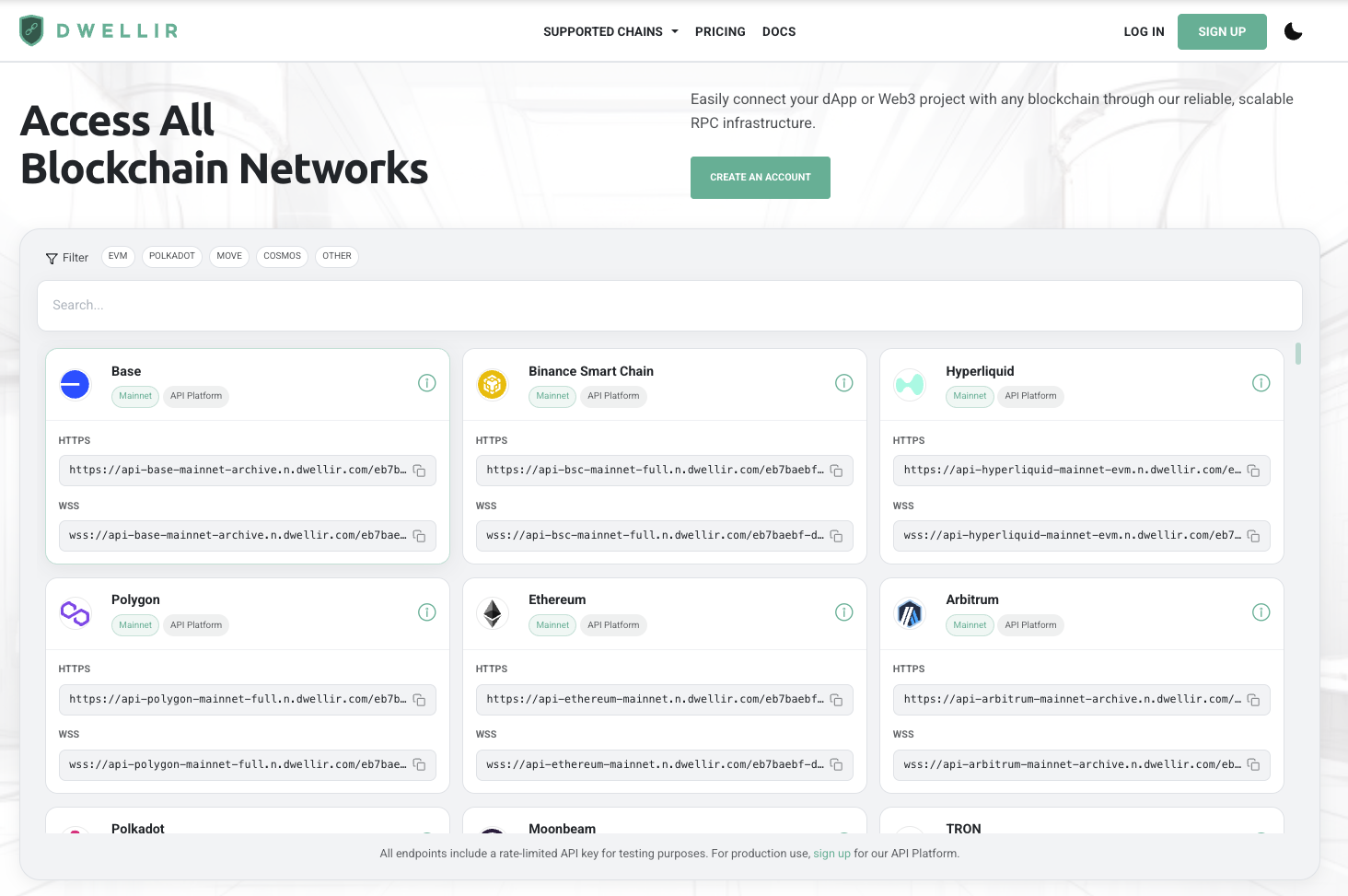
Dwellir has pioneered this transparent pricing model across their 140+ supported blockchain networks, including full Linea mainnet support. Their approach delivers:
- True 1:1 pricing: Every RPC response costs exactly one credit -
eth_blockNumber,eth_call,debug_traceTransaction, archive queries - all identical - No archive surcharges: Historical data access at the same rate as current state reads
- No trace/debug premiums: Complex debugging methods priced identically to simple queries
- Global infrastructure: Geo-distributed bare-metal nodes with 99.99% uptime SLA
- 140+ networks: Unified authentication and billing across the entire multi-chain ecosystem
zkEVM-Specific Cost Impact:
Linea applications commonly exhibit these query patterns:
| Application Type | Typical Query Mix | Dwellir (1:1) | Compute Units | Monthly Savings |
|---|---|---|---|---|
| DEX (50M req/mo) | 40% archive, 15% trace | $100 | $420-650 | $320-550 |
| NFT Marketplace | 25% archive, 5% trace | $100 | $280-380 | $180-280 |
| Yield Aggregator | 50% archive, 20% trace | $100 | $680-950 | $580-850 |
The zkRollup architecture means applications naturally query more historical data—every proof verification creates archive-worthy state transitions. With 1:1 pricing, these queries don't create cost penalties. With compute unit models, the architectural requirements of zkEVMs directly inflate your bill.
Top 7 Linea RPC Providers: Detailed Analysis
Comprehensive Comparison Matrix
| Provider | Pricing Model | Archive Support | Free Tier | Starting Price | Linea Status |
|---|---|---|---|---|---|
| Dwellir | 1:1 per request | Full | 100K/day | $49/mo | Mainnet + Testnet |
| Infura | Credits | Full | 3M credits/day | $50/mo | Mainnet + Testnet |
| Alchemy | Compute units | Full | 30M CU/mo | $49/mo | Mainnet |
| QuickNode | API credits | Full | 50M credits | $49/mo | Mainnet |
| Chainstack | Requests | Full | 3M requests/mo | $49/mo | Mainnet |
| Ankr | API credits | Full | Public tier | Pay-as-you-go | Mainnet |
| dRPC | Compute units | Full | Free tier | $6/1M requests | Mainnet |
1. Dwellir
Best For: zkEVM applications needing transparent costs without surprise bills from archive queries
Pricing: $49 to $999/month | Model: 1 response = 1 credit (no method multipliers)
For Linea's zkEVM environment—where zero-knowledge proof verification and state queries drive high archive usage—Dwellir's approach eliminates the pricing complexity that plagues most providers. While competitors multiply costs 20-50x for historical queries, Dwellir charges identically whether you're fetching the latest block or analyzing transaction traces from Linea's launch. This matters significantly for zkEVM applications that frequently query historical proof states and transaction data.
Key Strengths:
- True 1:1 pricing - every method costs the same, from
eth_blockNumbertodebug_traceTransaction - No archive surcharges or trace method premiums
- 140+ blockchain networks supported with unified authentication
- Globally distributed bare-metal infrastructure with 99.99% uptime SLA
- Full Linea archive node access included at standard rates
Pricing Structure:
- Free: Free (100K requests/day, 20 RPS)
- Developer: $49/mo (unlimited requests, 100 RPS)
- Growth: $299/mo (unlimited, 500 RPS)
- Scale: $999/mo (unlimited, 5,000 RPS)
- Overages: $1.96-2.00 per million requests
Technical Features:
- 99.99% uptime SLA with response credits
- HTTPS, WebSocket (WSS), and gRPC protocol support
- Geographic node distribution across North America, Europe, and Asia
- Dedicated Slack channels for Scale tier customers
- Burst capacity up to 10,000 RPS for traffic spikes
Real-World Linea Cost Example: A Linea DEX aggregator querying liquidity across 50+ pools with historical price data:
- 80M standard RPC calls (current state, blocks, transactions)
- 35M archive queries (historical pool states, price history)
- 15M trace calls (MEV analysis, failed transaction debugging)
Monthly costs:
- Dwellir: $260 (130M × $2/million—every method identical)
- Infura: $950+ (archive credits consume 3-5x base rate)
- Alchemy: $2,100+ (archive 25 CU multiplier + trace 200-300 CU)
- Dwellir savings: 72-88% vs compute unit models
Why This Matters for Linea zkEVM: Linea's zero-knowledge architecture generates unique data access patterns. Applications frequently need to:
- Verify historical proof submissions to L1 Ethereum
- Query transaction states before and after batch finalization
- Trace execution paths for zk-proof-related transaction failures
- Access archived data for compliance and audit trails
With compute unit providers, these zkEVM-specific query patterns can cost 10-30x more than simple balance checks. Dwellir's flat pricing treats all these operations identically, making comprehensive Linea integration economically sustainable.
2. Infura
Best For: Projects requiring deep ConsenSys ecosystem alignment and MetaMask-first experiences
Pricing: Free to $1,000/month | Model: Credits with method weighting
Being built by the same parent company, Infura and Linea share organizational DNA that manifests in infrastructure advantages other providers can't match. Infura's nodes receive Linea updates simultaneously with mainnet releases, their documentation reflects internal knowledge of zkEVM optimizations, and their support teams understand the nuances of zero-knowledge proof finality. For projects where ConsenSys ecosystem alignment is strategic—MetaMask Snaps, Linea-specific SDK integrations, or early access to experimental features—Infura provides insider advantages.
Key Capabilities:
- Native MetaMask and Linea ecosystem integration
- Direct access to ConsenSys developer resources
- Enterprise SLAs for production deployments
- IPFS APIs for decentralized storage needs
Pricing Structure:
- Core (Free): 3M credits/day, 500 credits/sec
- Developer: $50/mo, 15M requests/day
- Team: $225/mo, 75M requests/day
- Growth: $1,000/mo, 5M requests/day
- Enterprise: Custom pricing
Technical Features:
- HTTP and WebSocket endpoints
- Archive data access
- 24/7 support on Enterprise plans
- MetaMask SDK integration
Linea-Specific Value: Infura's ConsenSys connection translates to practical benefits on Linea:
- Zero-downtime upgrades coordinated with Linea network updates
- Advanced notice of zkEVM protocol changes
- MetaMask SDK optimizations specific to Linea's proof finality model
- Direct access to Linea core developer knowledge for complex debugging
Cost Reality: The credit system applies multipliers to archive and trace methods, though less aggressive than some competitors. A Linea application with 35% archive queries might consume 1.8-2.5x base credits. For zkEVM applications requiring frequent historical state verification, the ecosystem benefits may justify premium costs over pure-play budget providers.
3. Alchemy
Best For: Startups and teams prioritizing developer velocity over infrastructure costs
Pricing: Free to custom | Model: Compute units (10-500 CU per method)
Alchemy's platform extends far beyond basic RPC—they've built a complete development environment that can accelerate Linea application launches by weeks. Their enhanced APIs abstract zkEVM complexities, webhooks eliminate polling infrastructure, and simulation tools help debug proof-related transaction failures before mainnet submission. For teams where time-to-market matters more than marginal infrastructure costs, Alchemy's tooling delivers measurable velocity gains.
Key Capabilities:
- Full JSON-RPC API support for Linea
- Enhanced APIs for NFTs, tokens, and transactions
- Real-time webhook notifications
- Transaction simulation and debugging tools
- Comprehensive developer dashboard
Pricing Structure:
- Free: 30M compute units/month
- Growth: $49/mo (400M CU)
- Scale: Custom pricing
- Enterprise: Volume discounts
Compute Unit Examples:
eth_blockNumber: 10 CUeth_call: 26 CUeth_getLogs: 75 CU- Archive queries: 25x multiplier
- Trace methods: 200-500 CU
Cost Analysis: For a DeFi aggregator making 50M monthly requests (30% archive, 10% trace):
- Base calls: 35M x 26 CU = 910M CU
- Archive: 15M x 26 CU x 25 = 9.75B CU
- Trace: 5M x 300 CU = 1.5B CU
- Total: ~12B CU requiring Enterprise pricing
Linea Development Benefits:
- Proof-Aware Webhooks: Trigger notifications when batches finalize on L1, not just when transactions land on Linea
- zkEVM Gas Estimation: Enhanced
eth_estimateGasthat accounts for proof computation overhead - Batch Tracking: Monitor your transactions from Linea submission through L1 proof verification
- Simulation Suite: Test transactions against Linea's zkEVM before burning gas
Cost Trade-Off: The compute unit model significantly penalizes archive-heavy zkEVM workloads. Applications querying historical proof states or analyzing failed transactions across finality boundaries can see 5-10x cost increases versus simple balance checks. Early-stage projects benefit from the free tier and tooling velocity; scale-stage projects may find the CU economics unsustainable for Linea's natural query patterns.
4. QuickNode
Best For: MEV strategies and arbitrage requiring sub-100ms P95 latency on Linea
Pricing: Free to $999/month | Model: API credits with method multipliers
Speed defines QuickNode's value proposition—their globally distributed infrastructure consistently delivers the lowest latency to Linea's 2-second blocks. For MEV extraction and cross-DEX arbitrage on Linea, where milliseconds determine profitability, QuickNode's edge network provides competitive advantages that justify premium pricing. Their Linea endpoints are optimized specifically for the zkEVM's proof finality model, reducing the latency typically associated with L2 state queries.
Linea Performance Edge:
- zkEVM-Optimized Routing: Requests route intelligently based on Linea batch status—current state from L2, historical from L1-verified snapshots
- Proof-Finality Awareness: WebSocket subscriptions differentiate between Linea block confirmation and L1 proof verification
- Geographic Optimization: Edge nodes positioned near Linea validator infrastructure for minimal propagation delay
- Dedicated High-Frequency Endpoints: Premium tier offers isolated Linea nodes for latency-critical strategies
Pricing Structure:
- Free: 50M API credits/month
- Build: $49/mo (80M credits)
- Accelerate: $249/mo (450M credits)
- Scale: $499/mo (950M credits)
- Business: $999/mo (2B credits)
Technical Features:
- HTTP and WebSocket endpoints with high throughput
- Archive data access for historical queries
- Stream API for real-time blockchain events
- Built-in retry logic and connection handling
- 99.99% uptime SLA
Cost Considerations: QuickNode's API credit system uses method multipliers. Archive and trace methods consume more credits, making cost prediction challenging for analytics-heavy applications. At 100M monthly requests with 25% archive queries, expect $400-700 depending on method distribution.
Performance Focus: QuickNode's infrastructure optimization makes them well-suited for latency-sensitive Linea applications. Their edge network and focus on speed justify premium pricing for applications where milliseconds matter.
5. Chainstack
Best For: Enterprises needing compliance-ready infrastructure with predictable request-based costs
Pricing: Free to $549/month | Model: Request-based with RPS tiers
Chainstack positions itself between budget providers and premium platforms, offering request-based pricing that's simpler than compute units but with enterprise features like audit logs, compliance reports, and dedicated infrastructure options. For Linea projects requiring SOC 2 compliance or infrastructure isolation, Chainstack provides the governance layer that pure-play providers lack.
Enterprise-Grade Capabilities:
- Dedicated Linea Nodes: Isolated infrastructure preventing noisy neighbor issues
- Multi-Cloud Deployment: Choose AWS, GCP, or Azure for data residency compliance
- Audit Trails: Complete request logging for regulatory requirements
- Team Management: Role-based access control for organizational deployments
Pricing Structure:
- Developer (Free): 3M requests/month
- Growth: $49/mo (20M requests)
- Business: $349/mo (140M requests)
- Enterprise: $990+/mo (400M+ requests)
- Unlimited Node: Flat monthly rate for unmetered traffic
Technical Features:
- HTTP and WebSocket endpoints
- Archive data access
- Debug and trace APIs
- Geographic region selection
- 99.99% uptime guarantee
Cost vs Compliance Trade-Off: At $49-349/mo, Chainstack costs 25-40% more than pure-play budget providers for equivalent request volumes. However, their enterprise features—audit logs, dedicated nodes, compliance documentation—may be non-negotiable for regulated Linea applications (institutional DeFi, tokenized securities, payment systems). The premium buys governance and isolation that shared infrastructure can't provide.
Linea Use Case Fit: Best suited for institutional Linea integrations where compliance documentation matters more than marginal cost savings. Startups building consumer applications will find better economics elsewhere.
6. Ankr
Best For: Multi-chain DeFi protocols prioritizing censorship resistance over raw performance
Pricing: Free public endpoints to pay-as-you-go | Model: API credits with significant multipliers
Ankr's decentralized node network spans dozens of independent operators, creating infrastructure that's inherently resistant to single-point failures and jurisdictional pressures. For Linea applications concerned about provider-level censorship or geographic restrictions—privacy protocols, DEXs serving restricted regions, censorship-resistant applications—Ankr's distributed architecture provides resilience that centralized providers fundamentally cannot.
Key Capabilities:
- Global node distribution across independent operators
- Public and premium endpoint tiers
- Multi-chain support for applications spanning networks
- WebSocket connections for real-time data
Pricing Structure:
- Public: Free, rate-limited
- Premium: Pay-as-you-go at $0.10 per 1M API credits
- Custom: Volume discounts available
Technical Features:
- Geographic load balancing
- Automatic failover between nodes
- Standard Ethereum JSON-RPC compatibility
- Archive data access on premium tiers
Pricing Reality: Ankr's headline "$0.10 per million API credits" obscures aggressive multipliers. Real costs:
- Simple calls (eth_blockNumber): ~$0.10/million = competitive
- Standard calls (eth_call, eth_getLogs): ~$2-5/million = acceptable
- Archive queries: ~$50-100/million = expensive
- Trace methods: ~$150-250/million = prohibitive
For Linea applications with typical query patterns (30-40% archive), effective costs reach $30-60 per million requests—15-30x higher than advertised and 15-20x more than transparent 1:1 providers.
When Ankr Makes Sense: The decentralization premium is worth paying only when censorship resistance is a core requirement. For pure performance or cost optimization, centralized alternatives deliver better economics.
7. dRPC
Best For: Analytics-heavy Linea applications needing flat-rate pricing with decentralized resilience
Pricing: Free to custom | Model: Flat 20 CU per request (all methods equal)
dRPC has solved a problem that plagued earlier decentralized networks: predictable pricing. While Ankr and other distributed providers use aggressive method multipliers, dRPC charges a flat 20 CU per request whether you're querying current balances or tracing historical zkEVM transactions. For Linea applications needing both decentralization benefits (censorship resistance, multi-provider redundancy) and cost predictability, dRPC represents the middle ground.
Linea-Specific Advantages:
- zkRollup-Friendly Pricing: Archive and trace queries cost the same as standard calls—critical for Linea's proof-verification patterns
- Multi-Provider Redundancy: Requests automatically route across dozens of independent Linea nodes
- Geographic Distribution: Node operators span continents, reducing single-jurisdiction risk
- Linea Batch Awareness: Load balancing accounts for zkEVM batch submission timing to optimize data freshness
Pricing Structure:
- Free: Limited requests for testing
- Growth: From $10/month
- Scale: Custom pricing
- All methods: 20 CU = ~$6 per million requests
Technical Features:
- Multi-provider failover for reliability
- Geographic distribution across node operators
- WebSocket support for real-time subscriptions
- Archive data access through node network
Cost Analysis: dRPC's ~$6 per million requests (20 CU flat rate) positions them in the middle tier:
- vs Dwellir: 3x more expensive ($600 vs $200 at 100M requests/month)
- vs Variable CU (archive-heavy): 60-75% cheaper ($600 vs $1,500-2,500 at 100M with 35% archive)
- vs Ankr (effective): 80-90% cheaper ($600 vs $3,000-6,000 after multipliers)
Value Calculation: The 3x premium over Dwellir buys decentralization and censorship resistance. For Linea applications where those properties aren't requirements, Dwellir's centralized infrastructure delivers identical uptime at lower cost. For applications where those properties are essential, dRPC dramatically undercuts alternatives like Ankr while maintaining flat-rate predictability.
Choosing the Right Provider for Linea
Matching Infrastructure to zkEVM Performance
Linea's zero-knowledge proof architecture creates distinct infrastructure requirements compared to other L2s:
zkRollup-Specific Considerations:
- Applications frequently cross-reference Linea state with Ethereum L1 proof submissions
- Batch finality creates query patterns that span pre-proof and post-proof states
- Zero-knowledge verification failures generate complex debugging requirements
- Proof-aware applications query historical data more frequently than optimistic rollup equivalents
Infrastructure Implications by Application Type:
- zkEVM DEXs: Need sub-150ms latency to match Linea's 2s blocks + transparent pricing for heavy archive usage (liquidity history, proof-state correlation). Variable CU pricing can inflate costs 8-15x for typical zkEVM query patterns.
- Cross-chain bridges: Must query both Linea and Ethereum L1 simultaneously to verify proof submissions. Multi-chain support with unified authentication prevents credential sprawl.
- Linea-native DeFi: Yield protocols and lending platforms require extensive historical queries to calculate TVL across proof boundaries. Flat-rate pricing makes these calculations economically sustainable.
The Archive Node Question for zkEVM
Linea's zero-knowledge architecture makes archive access more critical than on other L2s. Unlike optimistic rollups where most applications only need recent state, zkEVM applications frequently query across proof boundaries:
Why Linea Apps Query More Archive Data:
- Proof Verification: Applications correlate Linea transactions with L1 proof submissions, requiring historical lookups
- Batch Awareness: Smart contracts need to understand which proof batch contains specific state changes
- zkEVM Debugging: Transaction failures related to proof generation require deep historical tracing
- Compliance & Auditing: Zero-knowledge proofs create immutable audit trails that applications must query historically
Linea's $92.8M TVL and a growing ecosystem of applications generate this archive data at increasing rates. Providers offering "full archive access" may throttle heavy queries or charge 25-50x through compute unit multipliers—particularly problematic for zkEVM's naturally high archive usage. The cost difference at scale:
| Archive Query Volume | 1:1 Pricing (Dwellir) | Compute Units (25x multiplier) |
|---|---|---|
| 10M archive calls | $20 | $500 |
| 50M archive calls | $100 | $2,500 |
| 100M archive calls | $200 | $5,000 |
Dwellir's approach - identical pricing for archive queries and current state reads - eliminates this cost trap entirely.
Financial Modeling for Linea Scale
Linea's low fees attract high-volume applications - but infrastructure costs scale accordingly. Here's how different pricing models compare:
Moderate Usage (50M requests/month):
- Dwellir 1:1 model: ~$100 (predictable, all methods equal)
- dRPC: ~$300 (flat rate)
- Chainstack: ~$150-200 (request-based)
- QuickNode Build: $49-200 (credit consumption varies)
- Alchemy Growth: $49-400 (CU dependent)
High Usage (300M requests/month):
- Dwellir 1:1 model: ~$600 (predictable, scales linearly)
- dRPC: ~$1,800 (predictable)
- Chainstack: ~$800-1,000
- QuickNode Scale: $499-1,500 (credit consumption varies)
- Alchemy Scale: Custom pricing required
Heavy Analytics (300M requests, 40% archive/trace):
- Dwellir 1:1 model: ~$600 (same as standard - no multipliers)
- dRPC: ~$1,800 (same rate)
- Compute unit providers: $4,000-10,000+ (multipliers compound)
The Dwellir model delivers 75-90% cost savings for archive/trace-heavy workloads compared to compute unit providers.
Multi-Chain and Migration Considerations
If your application spans Linea and other EVM chains, provider selection becomes even more critical:
- Provider consistency: Using the same provider across chains simplifies operations and billing
- Authentication model: Unified API keys reduce credential management complexity
- Pricing parity: Some providers charge differently per chain; Dwellir maintains consistent 1:1 pricing across all 140+ supported networks
Dwellir's multi-chain approach means teams can use identical infrastructure patterns across Ethereum, Arbitrum, Polygon, Base, and Linea - with predictable, transparent pricing regardless of chain.
For teams currently on Ethereum or other EVMs planning to expand to Linea, the full EVM equivalence means existing code works without modification. When selecting infrastructure, prioritize providers whose pricing model scales sustainably with Linea's growth potential.
Final Recommendations by Use Case
zkEVM-Native DeFi (DEXs, Lending, Yield Aggregators): Linea DeFi protocols face unique cost pressures due to zkRollup data patterns. A DEX querying liquidity across 50+ pools while correlating with historical proof states might see 40-50% archive queries—versus 15-20% on optimistic rollups. Dwellir's 1:1 pricing treats these zkEVM-specific patterns identically to simple queries, delivering 72-88% cost savings versus compute unit providers that penalize archive access. For production Linea DeFi requiring transparent budgeting across proof boundaries, Dwellir's architecture eliminates surprise bills from zkEVM-inherent query patterns.
Linea MEV and Cross-DEX Arbitrage: Linea's 2-second blocks and near-instant proof finality create MEV opportunities distinct from slower chains. Trading strategies need sub-100ms latency to exploit arbitrage windows between Linea DEXs—but also predictable costs as trade frequency scales. QuickNode delivers the lowest P95 latency for latency-critical strategies where microseconds matter. However, for strategies generating millions of daily requests (market-making, grid trading), Dwellir's 1:1 pricing eliminates the cost unpredictability that plagues variable CU models at high request volumes. Choose based on whether you optimize for last-millisecond speed (QuickNode) or cost predictability at scale (Dwellir).
Linea Block Explorers and Analytics Platforms: zkEVM transaction analysis requires extensive trace and debug queries—particularly for proof-related failures that don't occur on simpler chains. A Linea block explorer making 15M monthly trace calls (analyzing proof batch compositions, zkEVM-specific errors, cross-L1-L2 correlations) faces:
- Flat-rate (Dwellir): $30 (15M × $2/million—every method equal)
- Compute units: $3,000-4,500 (trace methods 200-300 CU each)
- Savings: 99%+ cost reduction with 1:1 pricing
For zkEVM analytics where trace queries constitute 30-50% of traffic (versus 5-10% on simpler chains), only flat-rate providers like Dwellir make comprehensive Linea analysis economically sustainable.
Consumer Web3 Apps and Gaming on Linea: Linea's low gas costs attract consumer applications—but infrastructure pricing must scale sustainably with user growth. Consumer apps generate high request volumes (wallet balance checks, transaction status polling, NFT metadata) but limited archive queries. For this profile:
- Early stage (< 10M requests/mo): Use free tiers (Infura, Alchemy) to validate product-market fit
- Growth stage (10-100M requests/mo): Migrate to transparent pricing (Dwellir $200-400/mo) to prevent infrastructure from consuming runway as you scale
- Scale stage (100M+ requests/mo): Negotiate with Dwellir or Chainstack for volume discounts
Consumer apps must model per-user infrastructure costs accurately—Linea's zkEVM architecture shouldn't create surprise bills. Dwellir's 99.99% uptime SLA plus flat-rate pricing provides the predictability consumer business models require.
Multi-Chain Applications: Teams building across Linea and other EVM chains benefit from unified infrastructure. Dwellir's 140+ network support with consistent 1:1 pricing across all chains eliminates the complexity of managing multiple providers with different pricing models. One API key, one billing relationship, one support channel.
MetaMask-Native Linea Applications: Projects building specifically for the MetaMask + Linea ecosystem—MetaMask Snaps leveraging Linea's zkEVM, MetaMask SDK integrations, or applications requiring day-zero support for new Linea features—should prioritize Infura. The shared ConsenSys organization means:
- Simultaneous updates: Infura nodes update with Linea protocol changes, not days later
- Insider documentation: Access to zkEVM optimization guidance from Linea core developers
- MetaMask optimizations: SDK features that understand Linea's proof finality model
- Early access: Beta features and testnet access before public availability
The ConsenSys ecosystem premium (20-40% higher costs for archive-heavy workloads) buys organizational alignment that external providers can't replicate. Worth paying when MetaMask integration is strategic; unnecessary for general Linea development.
Early-Stage Projects: Start with available free tiers to establish usage patterns. As you scale toward production, prioritize providers offering transparent pricing to avoid cost surprises. Dwellir's straightforward model scales linearly with your growth - no cliff edges where archive usage suddenly multiplies your bill.
Enterprise Requirements: Enterprise deployments need both performance guarantees and cost predictability. Dwellir offers 99.99% uptime SLAs, dedicated Slack support channels, and enterprise-grade infrastructure without the opaque pricing of traditional enterprise providers. Their bare-metal infrastructure provides additional resilience and performance consistency.
The Bottom Line: Linea's growing ecosystem - $92.8M TVL (DeFiLlama, April 2026), over 7 million wallets created with 283 million total transactions processed - amplifies every pricing decision. A 25x archive multiplier that costs an extra $50/month early on becomes $5,000/month as your application scales. Providers offering true 1:1 pricing - where every request costs the same regardless of method - deliver the cost predictability that successful Linea applications demand.
Frequently Asked Questions
What is the best Linea RPC provider?
Dwellir offers the best price-performance ratio for Linea with transparent 1:1 pricing at $1.96 per million requests, full archive node access without surcharges, and 99.99% uptime SLA. Infura is the best choice for teams requiring deep ConsenSys ecosystem integration.
How does Linea zkEVM RPC differ from standard Ethereum RPC?
Linea is a Type 2 zkEVM with full EVM equivalence, so it uses standard eth_ JSON-RPC methods. The key difference is that Linea applications generate higher archive query ratios due to zero-knowledge proof verification patterns, making pricing model selection more impactful than on standard EVM chains.
Are there free Linea RPC endpoints?
Yes. Dwellir provides 100,000 free requests per day, Infura offers 3 million daily credits, Alchemy includes 30 million compute units per month, and Chainstack provides 3 million free monthly requests. Public endpoints are also available with basic rate limits.
Do Linea RPC providers support archive nodes?
All major Linea RPC providers offer archive node access, but pricing varies significantly. Dwellir includes archive queries at standard 1:1 rates with no surcharges, while compute unit providers can charge 25x or more for historical data queries—a critical cost factor given Linea's zkEVM architecture generates high archive query volumes.
Related Resources
- Best Ethereum RPC Providers 2026 — Compare pricing and features across top Ethereum L1 infrastructure providers
- RPC Providers Without Compute Units — Find providers with simple per-request pricing
Get Started
Ready to Build on Linea?
Linea's zkEVM opens possibilities that combine Ethereum's security with zero-knowledge scaling. Select your RPC provider based on your specific requirements:
- Cost Efficiency + Performance: Dwellir for unmatched price-performance ratio
- ConsenSys Integration: Infura for native ecosystem alignment
- Developer Platform: Alchemy for comprehensive tooling alongside RPC
Why Dwellir for Linea?
Linea's growth demands infrastructure pricing that scales sustainably. Dwellir's transparent 1:1 model delivers:
- Predictable costs: Every request costs the same - no archive multipliers, no trace premiums
- Full Linea support: Mainnet and testnet with complete archive access
- Global performance: Geo-distributed nodes with 99.99% uptime SLA
- Multi-chain simplicity: 140+ networks with unified authentication and billing
- Real support: Dedicated Slack channels, not just Discord communities
For teams building on Linea who need infrastructure that won't become a cost bottleneck:
- Contact: Get in touch
- Documentation: Dwellir Linea Docs
- Supported Networks: View all chains
- Pricing: Transparent pricing
References
This content is for informational purposes only and does not constitute financial or investment advice. Always conduct your own research when selecting infrastructure providers.