Building a yield-focused DeFi application on Blast means your RPC provider must handle auto-rebasing token balances, frequent historical queries for yield calculations, and the specialized APIs that make Blast's native yield mechanics work. Choose the wrong provider and your infrastructure costs could scale unpredictably as balance queries multiply.
Blast launched in February 2024 with a compelling proposition: automatic yield on bridged ETH (via Lido staking) and stablecoins (via MakerDAO's T-Bill protocol). This native yield architecture, combined with full EVM compatibility and OP Stack performance, attracted significant developer interest. The network reached $2.7 billion TVL at its peak, though TVL has since settled to $34.8 million as of April 2026 as the ecosystem matures and competition among L2s intensifies.
For developers building on Blast today, the technical requirements remain clear: reliable archive access for yield tracking, stable WebSocket connections for real-time monitoring, and predictable pricing that does not penalize the frequent balance queries yield applications demand. This comparison examines eight leading Blast RPC providers to help you select infrastructure that matches both Blast's unique features and your application's requirements.
Understanding Blast's Architecture
Blast differentiates itself from other Ethereum L2s through its native yield mechanism:
Auto-Rebasing ETH: Unlike wrapped ETH on other L2s, ETH on Blast automatically rebases to reflect staking yield. EOA (externally owned account) balances update automatically, while smart contracts can opt into rebasing through Blast's YIELD mode configuration.
USDB Stablecoin: Bridged stablecoins (USDC, DAI, USDT) convert to USDB, Blast's native rebasing stablecoin backed by MakerDAO's T-Bill protocol. USDB balances also auto-rebase for EOAs and opted-in contracts.
Gas Revenue Sharing: Unlike other L2s that retain gas revenue, Blast programmatically returns net gas fees to DApp developers. This creates additional revenue streams or subsidizes user gas costs.
Technical Specifications:
| Metric | Blast | Notes |
|---|---|---|
| Chain ID | 81457 | Mainnet |
| Block Time | 2 seconds | OP Stack based |
| Gas Token | ETH | Auto-rebasing |
| Consensus | Optimistic Rollup | Uses Ethereum for DA |
| Native Yield (ETH) | 3.4% APY | Via Lido staking |
| Native Yield (USDB) | 7% APY | Via MakerDAO T-Bills |
What to Look for in a Blast RPC Provider
Blast's yield-generating architecture creates specific infrastructure considerations:
Yield API Support: Applications querying rebasing balances need providers that correctly handle Blast's auto-rebasing token mechanics. Some providers may cache balances in ways that create stale yield data.
Archive Node Access: Analyzing historical yield accrual, auditing rebasing events, or building analytics dashboards requires full archive node support. Blast's yield mechanics generate more historical data queries than typical L2s.
WebSocket Reliability: Real-time monitoring of yield distributions, rebasing events, and balance changes demands stable WebSocket connections. DeFi applications tracking yield in real-time cannot afford connection drops.
Cost Predictability: Blast applications often make frequent balance queries to track yield accrual. Variable compute unit pricing can make these queries expensive at scale.
1. Dwellir - Transparent Pricing for Yield Applications
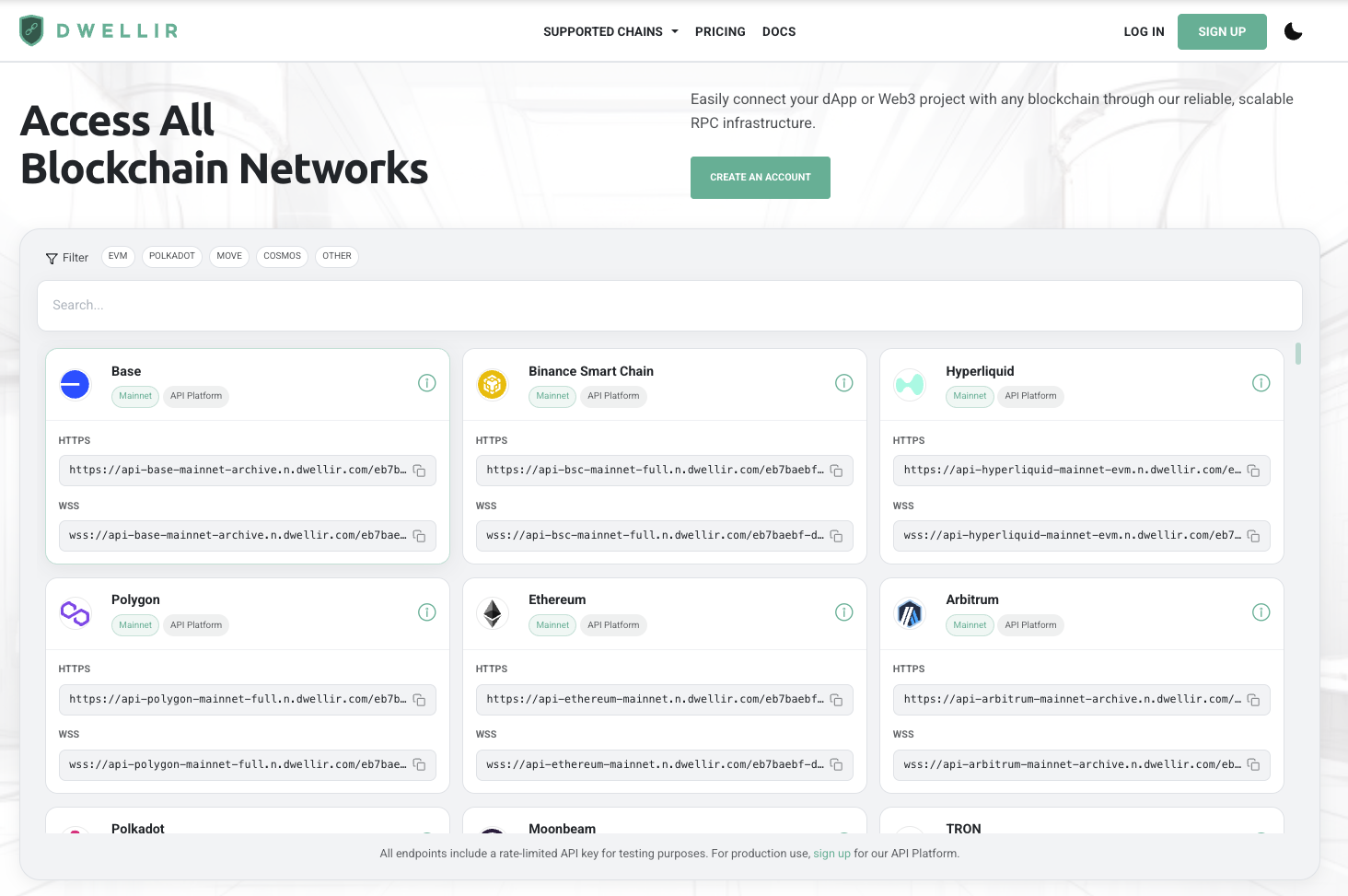
Dwellir provides Blast mainnet and Sepolia testnet access with a transparent 1:1 credit model. Every RPC response costs one API credit regardless of method complexity, whether querying current balances, historical yield data, or running trace operations. This pricing consistency extends across 140+ supported blockchains, making Dwellir well-suited for teams building multi-chain applications that span Blast alongside other networks.
Key Features
- 1:1 Credit System: All methods cost the same - standard calls, archive queries, and trace operations.
- Archive Node Access: Full historical Blast data for yield analysis and auditing.
- Protocol Support: HTTPS and WebSocket (WSS) endpoints for real-time yield monitoring.
- 140+ Network Coverage: Single API key works across Blast and other EVM chains.
- Performance Tiers: 20 to 5,000 sustained RPS with burst capacity up to 10,000 RPS.
- Trace and Debug APIs: Advanced debugging included in all paid plans.
Pricing Structure
| Plan | Price | Included Responses | Sustained RPS | Overage |
|---|---|---|---|---|
| Free | Free | 100K responses per day | 20 RPS | N/A |
| Developer | $49/month | 25M responses per month | 100 RPS | $5 per 1M |
| Growth | $299/month | 150M responses per month | 500 RPS | $3 per 1M |
| Scale | $999/month | 500M responses per month | 5,000 RPS | $2 per 1M |
Dedicated node clusters for Blast run $875/month with unlimited RPS and responses for teams requiring guaranteed resources and crypto payment options.
Pros and Cons
Advantages:
- Predictable pricing without compute unit complexity.
- Trace and debug endpoints included at no premium.
- Multi-chain footprint for unified infrastructure across 140+ networks.
- Direct engineering support on Growth plans and above.
Considerations:
- Ecosystem-specific tooling (enhanced yield APIs, Blast-specific monitors) less extensive than some platforms.
Best For
Teams building yield aggregators, DeFi protocols, or multi-chain applications that need cost predictability and comprehensive archive access. Particularly suited for applications with high query volumes for yield tracking.
2. Alchemy - Full-Featured Development Platform
Alchemy extends its comprehensive development platform to Blast with enhanced APIs, transaction simulation, and detailed analytics dashboards. The platform provides specialized tooling for Blast's EVM-compatible environment, including webhooks for monitoring yield events and transaction debugging tools.
Key Features
- Enhanced APIs: NFT, Token, and Notify APIs reduce custom indexing work.
- Transaction Simulation: Pre-send validation for catching errors before on-chain submission.
- Analytics Dashboard: Request volumes, latency breakdowns, and compute unit tracking.
- SDK Coverage: TypeScript, Python, and other language SDKs for faster integration.
- Blast-Specific Documentation: Guides for working with Blast's yield mechanics.
Pricing Structure
| Plan | Price | Included Volume | Throughput | Notes |
|---|---|---|---|---|
| Free Tier | $0 | 30M compute units/month | 25 req/s | Community support, 5 apps |
| Pay As You Go | $5 base + $0.45 per 1M CUs | Metered | 300 req/s | Priority support, 30 apps |
| Enterprise | Custom | Custom pools | Custom | VIP engineering, volume discounts |
Compute unit weights vary by method: lightweight calls consume fewer CUs while eth_getLogs and archive queries consume more.
Pros and Cons
Advantages:
- Mature platform with extensive documentation.
- Enhanced APIs minimize custom development work.
- Transaction simulation prevents costly failed transactions.
- Strong developer experience and tooling ecosystem.
Considerations:
- Compute unit pricing requires monitoring for budget accuracy.
- Archive and trace queries consume significantly more CUs.
- Platform depth may exceed needs for simple RPC-only use cases.
Best For
Teams building sophisticated Blast applications that leverage enhanced APIs, webhooks, and analytics where developer productivity justifies infrastructure costs.
3. QuickNode - High-Performance Global Infrastructure
QuickNode operates a global edge network providing Blast access through Endpoints, Streams for real-time data, and QuickAlerts for blockchain notifications. The platform emphasizes low latency through geographic distribution and offers add-ons for enhanced functionality.
Key Features
- Global Edge Network: Automatic routing to nearest regions for minimal latency.
- Streams: Real-time blockchain data streaming for monitoring yield events.
- QuickAlerts: Instant notifications for on-chain activity.
- Elastic API: Handles traffic spikes during high-activity periods.
- Observability Dashboard: Response times, errors, and credit consumption tracking.
Pricing Structure
| Plan | Price | Included Credits | Requests per Second | Overage |
|---|---|---|---|---|
| Discover (Free) | $0 | 10M API credits | 15 RPS | N/A |
| Build | $49/month | 80M API credits | 50 RPS | $0.62 per 1M credits |
| Accelerate | $249/month | 450M API credits | 125 RPS | $0.55 per 1M credits |
| Scale | $499/month | 950M API credits | 250 RPS | $0.53 per 1M credits |
| Business | $999/month | 2B API credits | 500 RPS | $0.50 per 1M credits |
Streams, Functions, and dedicated node clusters incur additional charges.
Pros and Cons
Advantages:
- Consistently low latency through global routing.
- Streams and QuickAlerts simplify event-driven architectures.
- Strong documentation and responsive support.
- Elastic API handles yield-related traffic spikes.
Considerations:
- Credit accounting requires workload modeling for budget accuracy.
- API keys capped at 50.
- Add-ons increase total spend for complex use cases.
Best For
Latency-sensitive DeFi applications, trading platforms, and yield aggregators where response time directly impacts performance.
4. Chainstack - Managed Infrastructure with Flexibility
Chainstack offers managed Blast infrastructure with both shared Global Nodes and dedicated options. The platform provides straightforward deployment through its dashboard with support for both mainnet and testnet environments.
Key Features
- Global Nodes: Geo-distributed shared infrastructure starting at $0/month.
- Dedicated Nodes: Isolated infrastructure for production workloads.
- Multi-Cloud Deployment: Options across major cloud providers.
- Team Collaboration: Role-based access and per-project API keys.
- Archive Data Access: Full historical Blast data available.
Pricing Structure
| Plan | Price | Monthly Request Units | Included RPS | Notes |
|---|---|---|---|---|
| Developer | $0 | 3M request units | 25 RPS | Shared nodes, community support |
| Growth | $49/month | 20M request units | 250 RPS | Up to 10 project nodes |
| Pro | $199/month | 80M request units | 400 RPS | Priority support |
| Business | $349/month | 140M request units | 600 RPS | SSO, 50 project nodes |
| Unlimited Node | $149+/month | Unlimited (per RPS tier) | 25-500 RPS | Flat-fee shared endpoint |
Archive queries count as two request units.
Pros and Cons
Advantages:
- Managed infrastructure without cloud operations overhead.
- Unlimited Node option removes per-request billing for bursty workloads.
- Quick deployment through web dashboard.
- Supports 70+ blockchain networks.
Considerations:
- Higher effective cost per million than 1:1 pricing models.
- Unlimited Node requires Growth+ subscription.
Best For
Teams wanting managed infrastructure with flexible deployment options and straightforward scaling paths.
5. Ankr - Decentralized Multi-Chain Access
Ankr operates a decentralized network of globally distributed nodes supporting Blast alongside 70+ other blockchain networks. The platform offers both free public endpoints for development and premium tiers with higher throughput for production workloads.
Key Features
- Decentralized Architecture: Distributed network reduces single points of failure.
- Multi-Chain Hub: Single platform for 70+ blockchain networks.
- Public and Premium Endpoints: Free tier available with premium upgrades.
- Geographic Distribution: Regional node distribution for latency optimization.
- Standard JSON-RPC Interface: Compatible with existing Ethereum tooling.
Pricing Structure
| Plan | Price | Features | Notes |
|---|---|---|---|
| Public Endpoint | $0 | Rate limited, community support | Development use |
| Premium | From $50/month | Up to 1,500 RPS, priority routing | Pay-as-you-go with CUs |
| Enterprise | Custom | Dedicated resources, SLA | Custom solutions |
Pros and Cons
Advantages:
- Decentralization principles throughout architecture.
- Strong free tier for development and testing.
- Multi-chain support simplifies cross-chain infrastructure.
Considerations:
- Compute unit multipliers apply to archive and trace methods.
- Premium pricing requires direct inquiry for exact rates.
- Some advanced methods restricted to Enterprise plans.
Best For
Developers building multi-chain applications who value decentralization and need reliable access across blockchain ecosystems.
6. dRPC - Decentralized Network with MEV Protection
dRPC aggregates Blast infrastructure from multiple independent node operators with automatic failover and load balancing. The platform stands out with built-in MEV protection, making it relevant for DeFi applications where front-running concerns apply.
Key Features
- Decentralized Routing: Traffic fails over automatically between vetted operators.
- MEV Protection: Built-in protection against front-running for DeFi transactions.
- Global Coverage: Geo-distributed nodes across US, EU, and APAC.
- High Throughput: Up to 5,000 RPS on premium plans.
- 95+ Networks: Broad multi-chain support.
Pricing Structure
| Plan | Price | Included Volume | Network Throughput | Notes |
|---|---|---|---|---|
| Free | $0 | Limited requests | 40-250 RPS | Public nodes, prototyping |
| Growth | From $10/month | Metered | 5,000 RPS | High-performance nodes |
| Enterprise | Custom | 300M+ requests/month | Unlimited RPS | Volume discounts, SLA |
Pros and Cons
Advantages:
- Decentralized operator pool reduces single-vendor risk.
- MEV protection included, important for Blast DeFi applications.
- Unlimited API keys.
- Competitive pricing for high-volume workloads.
Considerations:
- Latency variance depends on underlying operator mix.
- Less centralized support than vertically integrated providers.
Best For
DeFi applications requiring MEV protection, teams prioritizing decentralization, or projects seeking a secondary provider for redundancy.
7. GetBlock - Simple Deployment with Flexible Options
GetBlock provides immediate Blast node access through both shared and dedicated options. The platform emphasizes simplicity with straightforward deployment and supports over 100 blockchain networks.
Key Features
- Instant Node Access: No waiting for synchronization or setup.
- Shared and Dedicated Nodes: Flexible infrastructure choices based on needs.
- JSON-RPC and WebSocket: Both connection methods supported.
- 100+ Networks: Broad blockchain coverage.
- Compute Unit Model: Method-based pricing with clear documentation.
Pricing Structure
| Plan | Price | Included Volume | Throughput | Notes |
|---|---|---|---|---|
| Free | $0 | 40,000 requests/day | 60 RPS | Development use |
| Starter | $29/month | 50M CU | 100 RPS | Basic production |
| Pro | $199/month | 220M CU | 200 RPS | 24/7 support |
| Enterprise | $499+/month | 600M+ CU | Custom | Dedicated resources |
Dedicated nodes available for isolated infrastructure requirements.
Pros and Cons
Advantages:
- Simple deployment without technical complexity.
- Both shared and dedicated options available.
- Good free tier for development.
- Migration discounts available for BlastAPI users.
Considerations:
- Lower RPS limits than some competitors at entry tiers.
- Compute unit model requires understanding method costs.
Best For
Solo developers or small teams prioritizing quick deployment and flexible pricing over advanced features.
8. Infura - ConsenSys Ecosystem Integration
Infura provides Blast access through their DIN (Decentralized Infrastructure Network) partnership, routing requests to partner infrastructure providers. The integration provides MetaMask compatibility and ConsenSys ecosystem alignment.
Key Features
- DIN Integration: Requests routed through decentralized infrastructure network.
- MetaMask Native: Seamless integration with MetaMask wallet.
- HTTP and WebSocket: Both connection types supported.
- HTTPS and WSS Endpoints: Secure connections for mainnet access.
- ConsenSys Ecosystem: Benefits from broader ecosystem tooling.
Pricing Structure
| Plan | Price | Features | Notes |
|---|---|---|---|
| Core (Free) | $0 | 3M credits/day, 500 credits/sec | Development use |
| Developer | $50/month | 15M requests/day | Production workloads |
| Team | $225/month | 75M requests/day | Team features |
| Growth | $1,000/month | 5M requests/day | Enterprise features |
Pros and Cons
Advantages:
- MetaMask and ConsenSys ecosystem integration.
- Established infrastructure provider with track record.
- DIN partnership provides decentralized routing.
Considerations:
- Blast support in Open Beta with potential feature limitations.
- Partner-routed requests may have different performance characteristics.
- Higher tiers focused on enterprise features.
Best For
Projects building within the ConsenSys ecosystem or requiring MetaMask-native integration and established provider reliability.
Feature Comparison Table
| Feature | Dwellir | Alchemy | QuickNode | Chainstack | dRPC | Ankr | GetBlock | Infura |
|---|---|---|---|---|---|---|---|---|
| Pricing Model | 1:1 response | Compute units | API credits | Request units | Request-based | Compute units | Compute units | Credits |
| Entry Price | Free | Free (30M CUs) | $49 Build | Free (3M req) | Free | Free public | Free (40K/day) | Free (3M/day) |
| Mid-Tier Price | $299 (150M, 500 RPS) | PAYG $0.45/M CU | $249 (450M) | $199 Pro (80M) | From $10/mo | $50+/mo | $199 (220M CU) | $225/mo |
| Max RPS | 5,000+ | 300 (PAYG) | 500 (Business) | 600 (Business) | 5,000 | 1,500 | Custom | 500/sec |
| MEV Protection | No | No | No | No | Yes | No | No | No |
| WebSocket | Yes | Yes | Yes | Yes | Yes | Yes | Yes | Yes |
| Archive Access | Yes | Yes (CU heavy) | Yes | Yes (2x cost) | Yes | Yes | Yes | Yes |
| Networks | 140+ | 40+ | 50+ | 70+ | 95+ | 70+ | 100+ | 20+ |
Recommendations by Use Case
For Yield Aggregators and DeFi Protocols: Dwellir's 1:1 pricing eliminates surprise costs from frequent balance queries typical in yield-tracking applications. For MEV-sensitive transactions, pair with dRPC as a secondary provider.
For Trading and Arbitrage: QuickNode's global edge network minimizes latency. dRPC's MEV protection adds security for swap transactions.
For Multi-Chain Applications: Dwellir's 140+ network support with consistent 1:1 pricing simplifies cross-chain infrastructure management.
For MetaMask Integration: Infura provides native ConsenSys ecosystem compatibility and established MetaMask support.
For Development and Prototyping: dRPC's free tier or Alchemy's 30M monthly compute units offer generous allowances for building and testing.
Working with Blast's Native Yield
When building on Blast, applications need to handle auto-rebasing tokens properly. Key implementation considerations:
Balance Queries: ETH and USDB balances update automatically through rebasing. Applications tracking yield should query balances at consistent intervals and account for rebasing in their calculations.
Smart Contract Configuration: Contracts must opt into yield mode through Blast's YIELD configuration. Review Blast documentation for proper implementation of claimable yield patterns.
Historical Analysis: Tracking yield accrual over time requires archive node access. Providers with heavy compute unit multipliers for archive queries can make comprehensive yield analysis expensive.
Conclusion
For most Blast development, Dwellir offers the best balance of transparent pricing, multi-chain coverage, and production-ready infrastructure. The 1:1 credit model eliminates compute unit complexity while trace and debug APIs come included at no premium. This approach particularly suits Blast's yield-focused ecosystem where frequent balance queries are common.
For specialized requirements: dRPC stands out for MEV protection critical to DeFi applications, QuickNode excels at latency-sensitive trading workloads, and Alchemy provides the most comprehensive development platform with enhanced APIs and tooling.
Frequently Asked Questions
What is the best Blast RPC provider?
Dwellir offers the best balance of transparent pricing and production-ready infrastructure for Blast. The 1:1 credit model eliminates compute unit complexity, which is particularly valuable for yield-tracking applications that make frequent balance queries.
How does Blast's native yield affect RPC requirements?
Blast auto-rebases ETH and USDB balances to reflect staking yield. Applications tracking yield need providers that correctly handle rebasing token mechanics, offer stable WebSocket connections for real-time monitoring, and provide archive node access for historical yield analysis.
Are there free Blast RPC endpoints?
Yes. Dwellir offers 100K free requests per day, dRPC provides a free tier with archive access, Alchemy includes 30M free compute units monthly, and Chainstack offers 3M free request units. These are suitable for development and testing.
How do I configure Blast L2 RPC in my wallet or application?
Add Blast as a custom network using Chain ID 81457 and your provider's RPC URL. Blast uses ETH as the gas token and operates as an Optimistic Rollup with 2-second block times. Most providers offer both HTTPS and WebSocket endpoints for mainnet access.
Related Resources
- Best Ethereum RPC Providers — Compare providers for Ethereum L1, the settlement layer for Blast
- RPC Providers Without Compute Units — Why transparent pricing matters for yield-heavy applications on Blast
Ready to build on Blast? Start with Dwellir's Free plan to test your integration, or contact the Dwellir team for architectural guidance on your infrastructure setup.